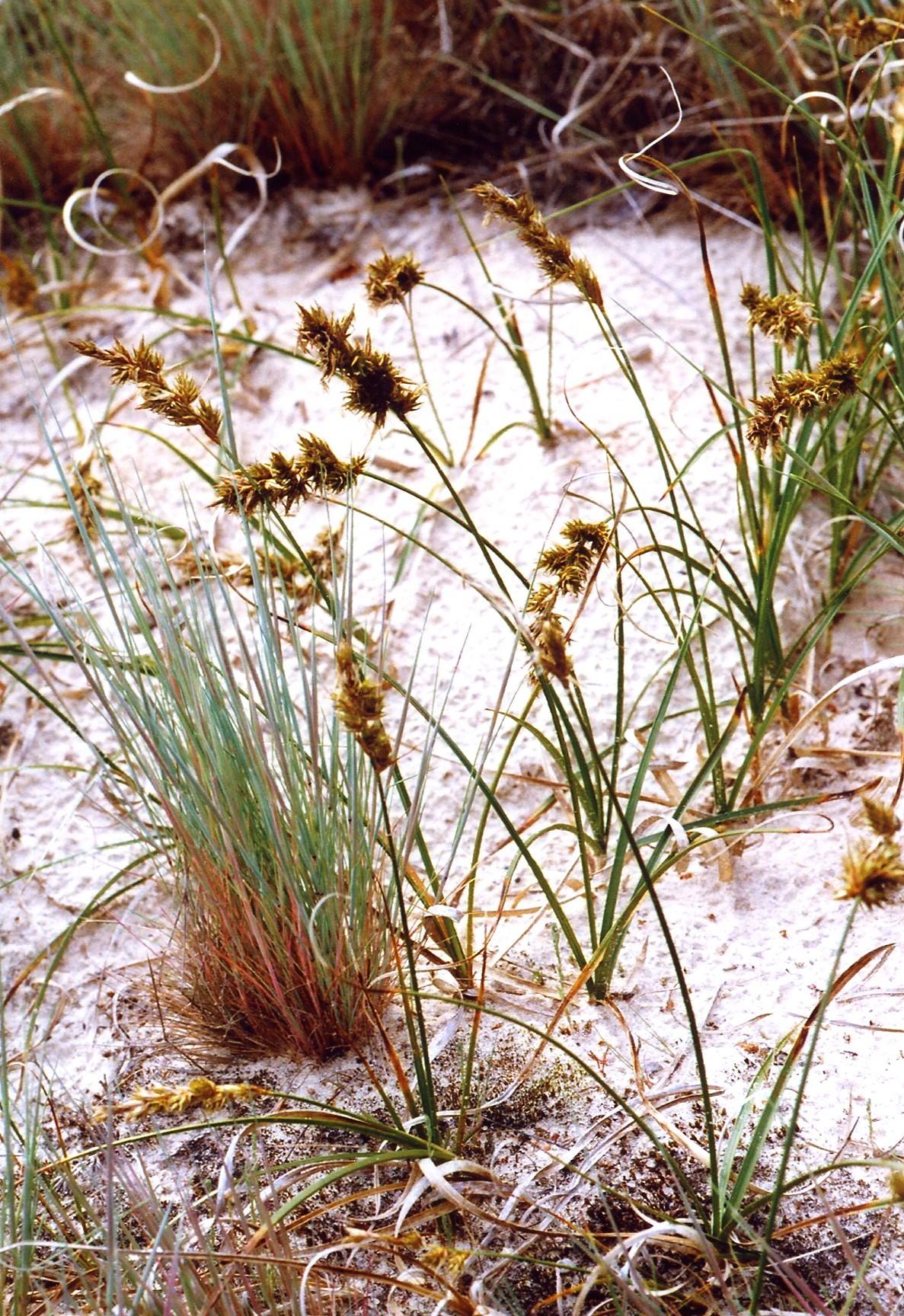
Creeping sedge (Carex chordorrhiza) is a perennial wetland plant native to boreal bogs across North America, northern Europe, and northern Asia. It grows along floating peat mats and acidic peat moss hummocks where groundwater remains saturated year-round.
Unlike standard clumping sedges, creeping sedge spreads using long trailing stems that root at old leaf nodes. It survives extreme winter temperatures down to -40 °C (-40 °F) in nutrient-poor peat soils.
Key Facts
- Plant Type: Wild wetland perennial sedge
- Height: 10–30 cm (4–12 in) tall
- Habitat: Acidic bogs, fens, and peatlands
- Native Range: Circumboreal (North America, Eurasia)
- Key Trait: Cord-like creeping stems up to 1 m (3.3 ft) long
Where Creeping Sedge Fits in Boreal Ecosystems
Creeping sedge acts as a specialized pioneer binder in wet peatlands and floating sphagnum mats across subarctic regions. Its primary role in nature is stabilizing saturated peat beds where few other vascular plants can survive.
This species thrives exclusively in nutrient-poor wetlands where standing water level remains within 5 cm (2 in) of the soil surface. It rarely succeeds outside specialized peat bog conditions.
What Does Creeping Sedge Look Like
Creeping sedge is recognizable by its long trailing stems that creep horizontally along damp moss, producing erect flowering shoots 10–30 cm (4–12 in) high. The prostrate stems reach lengths of 50–120 cm (20–47 in) and retain dry leaf sheaths from previous growing seasons.
Leaves are narrow, measuring 1–2.5 mm (0.04–0.1 in) wide, with a pale green to glaucous color. The inflorescence forms a compact brown head 8–15 mm (0.3–0.6 in) long consisting of 2 to 6 aggregated spikelets blooming between May and July.
- Stems: Cord-like prostrate stolons rooting at old nodes
- Leaves: Incurved blades 1–2.5 mm (0.04–0.1 in) wide
- Inflorescence: Ovoid dense brown spike clusters
- Roots: Fine fibrous roots emerging from decumbent stems
Creeping Sedge Habitat and Native Range
Creeping sedge is native to boreal zones across Eurasia and North America, extending south to latitudes of 43°N in cold peatlands. It grows primarily in nutrient-poor acidic bogs, quaking mats, transition fens, and subarctic tundra pool margins.
The plant requires acidic organic peat soils with a pH between 3.5 and 5.5. It relies on consistent cold moisture and dies back if substrate water levels drop significantly during summer months.
Ecological Role of Carex chordorrhiza
Carex chordorrhiza contributes directly to peat accumulation by weaving dense cord-like stem networks through floating Sphagnum moss layers. These horizontal stolons bind loose peat particles together, creating stable structure for other wetland vegetation.
The dense vegetative mats provide shelter and microhabitats for cold-adapted aquatic invertebrates, amphibians, and foraging waterfowl. Its tiny seeds are dispersed by water flow and aquatic birds across connected boreal bog complexes.
Conservation Status and Wetland Threats
Globally, creeping sedge is categorized as Least Concern on the IUCN Red List due to vast northern populations, but it is rare or endangered along its southern range limits. In several central European countries and US states, habitat fragmentation has reduced wild populations by over 30%.
Key threats to local populations include peat extraction, agricultural drainage, and climate warming that lowers water tables in peat bogs. Wetland restoration projects focus on re-wetting damaged peatlands to preserve native populations.
Human and Restoration Uses of String Sedge
String sedge has no commercial culinary or ornamental garden uses, but environmental scientists utilize it for boreal peatland restoration and erosion stabilization. Its trailing root structure allows it to recolonize degraded moss mats faster than non-stoloniferous sedge species.
Indigenous circumboreal communities historically used dried sedge fibers for insulation inside footwear. Today, its primary utility remains ecological bio-monitoring for high-integrity wetland habitats.
Distinguishing Creeping Sedge from Ornamental Sedges
Creeping sedge (Carex chordorrhiza) is often confused in search results with ornamental landscape sedges or unrelated groundcovers that share similar common names. Wild Carex chordorrhiza produces thin, cord-like stolons in peat bogs, whereas garden sedges form ornamental mounds in garden soils.
Key differences help distinguish Carex chordorrhiza from commercially grown plants:
- Creeping Broadleaf Sedge (Carex laxiculmis ‘Bunny Blue’): Broad blue-green foliage 8–12 mm wide, grown as a shade perennial.
- Banana Boat Sedge (Carex siderosticta ‘Banana Boat’): Bright yellow-striped leaves up to 20 mm wide for garden borders.
- Creeping Sedum (Sedum album or Sedum spurium): Succulent fleshy leaves and star-shaped flowers, completely unrelated to Cyperaceae sedges.
- True Creeping Sedge (Carex chordorrhiza): Fine thread-like foliage 1–2 mm wide, prostrate woody-based runners, restricted to wild acidic bogs.
Frequently Asked Questions
What is the difference between Carex chordorrhiza and Bunny Blue creeping sedge?
Wild creeping sedge (Carex chordorrhiza) is a narrow-leaved bog plant with cord-like runners, whereas 'Bunny Blue' is a cultivar of broadleaf sedge (Carex laxiculmis) grown in shady gardens with wide blue-green leaves.
Can you grow Carex chordorrhiza in a home garden?
No, Carex chordorrhiza requires specialized saturated acidic peat bog conditions and is not sold or grown as a home garden ornamental. Gardeners seeking creeping groundcovers usually grow ornamental sedges like Carex laxiculmis or low-growing succulents like creeping sedum.
Is creeping sedge a true grass?
Creeping sedge belongs to the sedge family (Cyperaceae), not the true grass family (Poaceae). Like other sedges, it has solid, triangular stems ('sedges have edges') rather than hollow round stems.
How fast does creeping sedum spread compared to creeping sedge?
Creeping sedum (Sedum species) is a fast-growing succulent that can spread 30–60 cm (12–24 in) per year in sunny, dry soil. Wild creeping sedge spreads at a moderate rate along floating moss in cold wetland bogs.
Where is Carex chordorrhiza found in the wild?
Carex chordorrhiza is found across northern North America, northern Europe, and northern Asia in acidic bogs, fens, and cold subarctic peatlands.
Sources & Verification
Taxonomy and distribution are checked against the databases below. Care guidance is written for cultivated species only and reviewed by our editor. How We Build Plant Profiles →