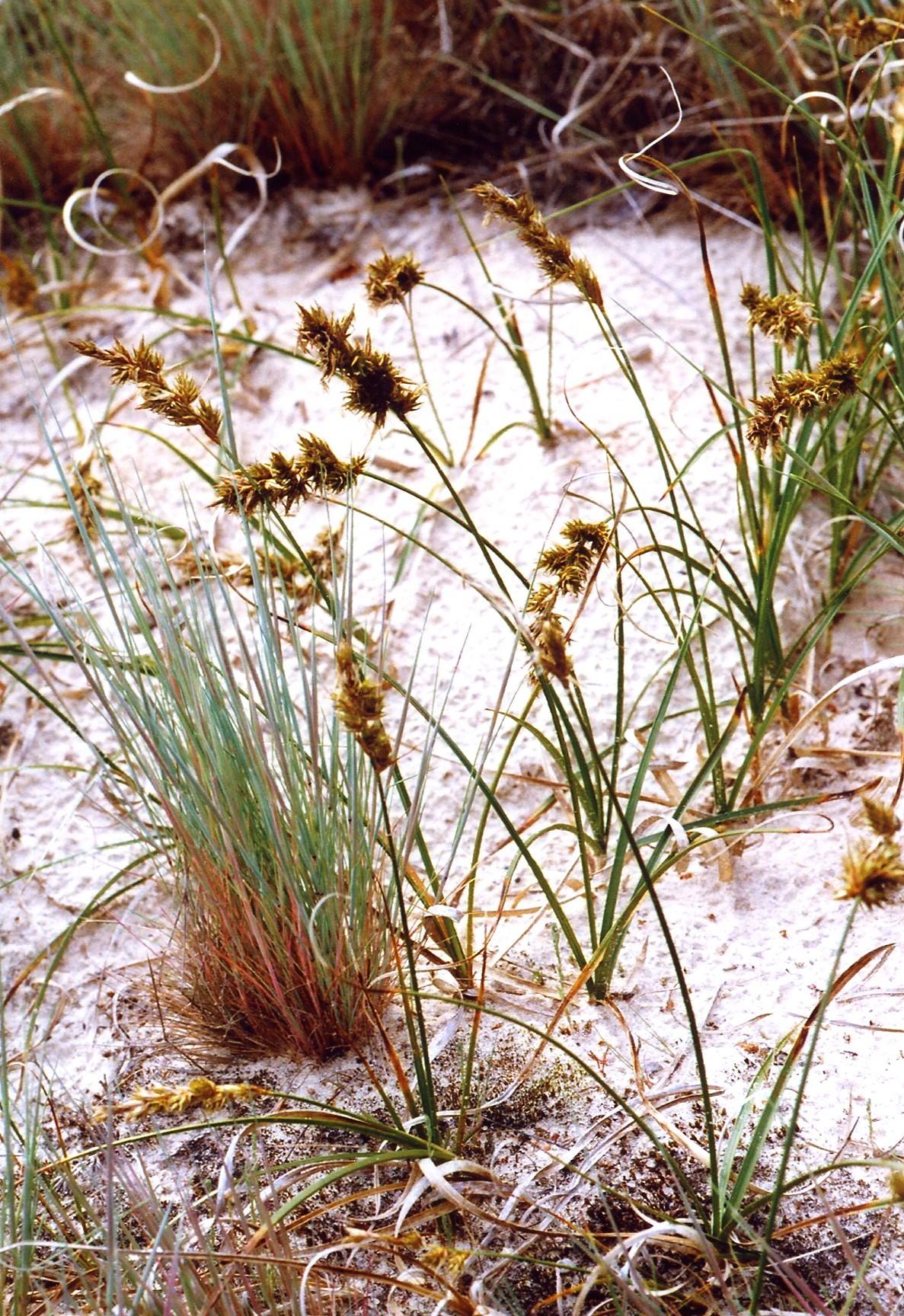
Hanging Sedge is a large evergreen perennial from Europe and North Africa, recognized by its arching, grass-like leaves and catkin-like flower spikes that hang up to 15 cm (6 in) long. Carex pendula is one of the largest sedges in its native range, often found in damp woodlands and along stream banks.
It thrives in heavy shade and waterlogged ground where other plants fail, but its prolific self-seeding often makes it a nuisance in smaller gardens. This species is frequently used to stabilize soil on wet slopes or to provide structure in bog gardens.
Key Facts
- Water: High; prefers permanently damp or wet soil
- Light: Full shade to partial sun
- Height: Reaches up to 1.5 m (5 ft)
- Spread: Clumps expand to 1.2 m (4 ft)
- Hardiness: USDA zones 5 to 9
- Soil: Heavy clay or loamy, moisture-retentive soil
Is Hanging Sedge Right for Your Garden
Hanging Sedge is best suited for large, damp gardens or wilder areas where its aggressive self-seeding can be managed. It is an ideal choice for stabilizing banks or filling dark, wet corners where most ornamental grasses struggle to survive. Because it grows in dense clumps, it provides excellent cover for amphibians and small mammals in a wildlife garden.
You should avoid planting it in small borders or near delicate perennials, as it can quickly dominate the space. Its ability to grow in heavy clay and deep shade makes it a functional solution for difficult north-facing sites. In some regions, it is considered invasive due to the sheer volume of seeds it produces annually.
How to Identify Hanging Sedge
Hanging Sedge is identified by its smooth, yellowish-green leaves that measure up to 2 cm (0.8 in) wide and have a prominent central midrib. The plant forms massive, dense tussocks that can reach 1.5 m (5 ft) in height when in flower. Unlike many other sedges, the stems are triangular in cross-section, a common trait of the Cyperaceae family.
The most distinctive feature is the flowering spikes, which appear from May to July. These consist of:
- One or two male spikes at the very top of the stem
- Four or five female spikes that hang downwards on long stalks
- Female spikes that reach 15 cm (6 in) in length and look like brown catkins
- Arching stems that bend under the weight of the developing seeds
Choosing the Best Site
The best site for this plant is a shady spot with heavy, moisture-retentive soil. It is one of the few ornamental plants that genuinely prefers heavy clay, though it will grow in any soil that does not dry out. While it can tolerate some sun if the ground is boggy, the leaves may scorch or turn yellow in dry, bright conditions.
Consider the proximity to water features or natural streams, as it will naturally migrate toward the water’s edge. If you are planting in a woodland setting, it performs well under the canopy of deciduous trees like common oak (Quercus robur). Ensure there is enough space for the 1.2 m (4 ft) spread, as the arching leaves can smother smaller neighbors.
Planting and Establishing
Plant Hanging Sedge in early spring or autumn when the soil is naturally moist. If you are planting multiple specimens for groundcover, space them at least 1 m (3.3 ft) apart to allow for their mature spread. Dig a hole twice the width of the root ball and incorporate leaf mold or well-rotted organic matter to improve moisture retention.
Once planted, water the area thoroughly to settle the soil around the roots. While established plants are tough, young sedges need consistent moisture during their first summer to develop a deep root system. If planting on a slope for erosion control, use a mulch of bark chips to prevent soil wash-off while the clumps establish.
Watering and Feeding Requirements
Hanging Sedge requires consistently moist to wet soil and should never be allowed to dry out completely. If the soil feels dry to the touch at a depth of 2 cm (0.8 in), provide a deep soaking. During hot summer spells, plants in partial sun may require watering twice a week to prevent the leaf tips from browning.
Feeding is rarely necessary for this species, as it is a vigorous grower that thrives in nutrient-poor soils. Adding a layer of organic mulch around the base in spring is usually sufficient to provide the slow-release nutrients it needs. Avoid high-nitrogen fertilizers, which can lead to excessive, floppy leaf growth and even more aggressive seeding.
Pruning and Controlling Spread
The most effective way to control this plant is to cut off the flower spikes before they turn brown and release their seeds. A single plant can produce thousands of seeds that germinate readily in damp soil. If you want to prevent it from spreading across your garden, deadhead the plant in late July or August.
To keep the foliage looking tidy, perform a hard prune in late winter:
- Remove dead or damaged leaves in February or March
- Cut back the entire clump to 15 cm (6 in) if it looks tatty
- Wear gloves, as the leaf edges can be sharp and cause minor cuts
- Clear away the debris to prevent slugs from nesting in the crown
How to Get Rid of Hanging Sedge Naturally
To remove Hanging Sedge naturally, you must dig out the entire root system using a sharp spade or mattock. The roots are deep and fibrous, and any remaining fragments of the crown can potentially regrow. This is best done in early spring when the soil is soft and the plant is just beginning to grow.
If the plant has already seeded, you will need to mulch the area with a thick layer of cardboard or black plastic for at least one full growing season to kill emerging seedlings. Regularly hoeing the area to disturb the soil will also prevent new plants from establishing. Persistence is required, as the seed bank in the soil can remain viable for several years.
Propagation Methods
The easiest way to propagate Hanging Sedge is by root division in spring. Use a spade to lift an established clump and slice it into smaller sections, ensuring each piece has a healthy portion of roots and several green shoots. Replant these immediately into moist soil and water them well until they show signs of new growth.
Propagation by seed is also possible but usually happens without any effort from the gardener. If you wish to grow them in a controlled way, sow seeds in a cold frame during autumn. They require a period of cold stratification to germinate successfully the following spring. Seedlings should be potted on once they are large enough to handle.
Common Problems and Pests
Hanging Sedge is largely pest and disease resistant, though it can occasionally suffer from rust or leaf spot in very humid conditions. Rust appears as small orange or brown pustules on the undersides of the leaves. If this occurs, prune away the affected foliage and improve air circulation around the plant.
Aphids may congregate on the young flower spikes in early summer, but they rarely cause significant damage and can usually be ignored. The primary ‘problem’ reported by gardeners is the plant’s invasive tendency in damp environments. In the UK and parts of North America, it can escape gardens and displace native wetland flora.
Year-Round Care for Hanging Sedge
| Spring | Divide large clumps in March or April. Apply a 5 cm (2 in) layer of leaf mold mulch to retain moisture. |
|---|---|
| Summer | Water frequently during dry spells. Cut off flower spikes in July before seeds ripen to prevent unwanted spreading. |
| Autumn | Clear away fallen tree leaves from the center of the clump to prevent crown rot. Do not prune the foliage yet. |
| Winter | Cut back old, tatty foliage to 15 cm (6 in) in late February. Check for and pull up any stray seedlings. |
Hanging Sedge Problems and Solutions
| What you see | Likely cause | What to do |
|---|---|---|
| Yellowing leaf tips | Soil is too dry | Increase watering frequency and apply a thick organic mulch. |
| Orange spots on leaves | Sedge rust fungus | Prune off infected leaves and dispose of them; do not compost. |
| Seedlings appearing everywhere | Prolific self-seeding | Deadhead flower spikes in mid-summer before they turn brown. |
| Floppy, weak growth | Excessive nitrogen or too much shade | Stop fertilizing and ensure the plant isn’t in total darkness. |
Hanging Sedge Varieties
- Carex pendula – The standard wild species with green leaves.
- ‘Moonlight’ – A cultivar with paler, lime-green to yellowish foliage.
Companion Plants for Damp Shade
Pair Hanging Sedge with broad-leaved plants to create a contrast with its fine, arching foliage. It looks effective alongside large-leaved hostas (Hosta species) or the architectural fronds of the ostrich fern (Matteuccia struthiopteris). These plants share similar requirements for shade and moisture.
For a splash of color in a bog garden, consider these companions:
- Yellow flag iris (Iris pseudacorus) for height and early summer bloom
- Candelabra primulas (Primula bulleyana) for tiered orange flowers
- Meadowsweet (Filipendula ulmaria) for frothy white summer plumes
- Marsh marigold (Caltha palustris) for bright yellow spring color
Frequently Asked Questions
Is hanging sedge invasive?
Yes, it is considered invasive in many regions because it produces thousands of seeds that germinate easily in damp soil. It can quickly take over a garden or escape into local woodlands if not deadheaded.
Is hanging sedge edible?
No, hanging sedge is not edible and has no culinary use. The leaves are tough and have sharp edges that can cause irritation if handled without gloves.
How do I prune Carex pendula?
Prune it in late winter by cutting the entire clump back to about 15 cm (6 in) from the ground. You should also cut off the flower spikes in summer before they release their seeds.
Can I grow hanging sedge in a pot?
You can, but it requires a very large container and must be watered daily to keep the soil saturated. It is generally better suited for planting directly in the ground near water.
How do I get rid of hanging sedge naturally?
The only reliable natural method is to dig out the entire root ball with a spade. You must be thorough, as any part of the crown left in the soil can regrow.
Can I use hanging sedge for hanging baskets?
No, despite the name 'Hanging Sedge', this is a large ground-dwelling plant. The name refers to the drooping flower spikes, not its suitability for hanging containers.
Sources & Verification
Taxonomy and distribution are checked against the databases below. Care guidance is written for cultivated species only and reviewed by our editor. How We Build Plant Profiles →