
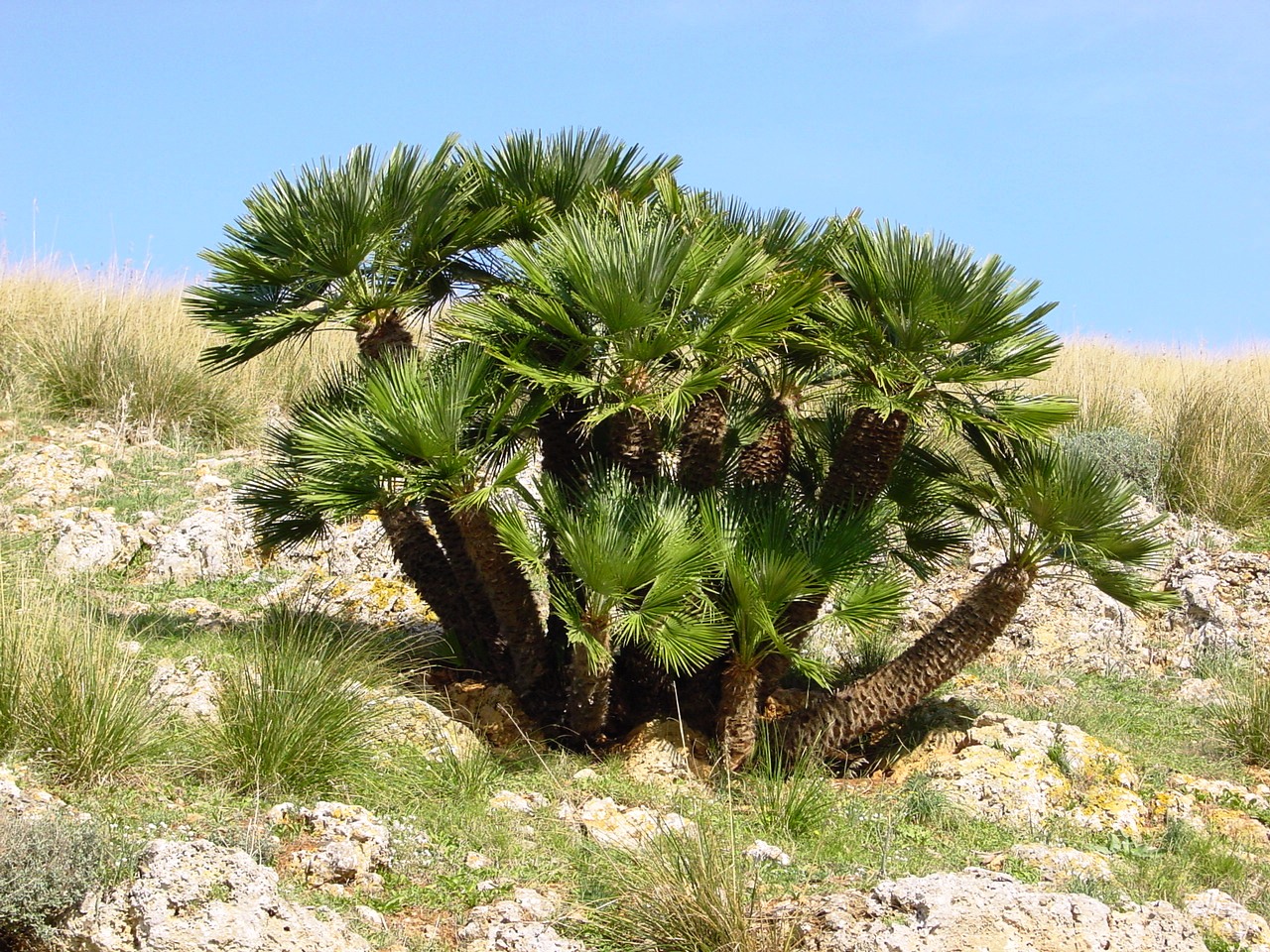
European fan palm (Chamaerops humilis) is a clumping, shrubby palm native to coastal rocky hillsides across the southwestern Mediterranean basin. It forms dense thickets of stiff, fan-shaped fronds atop fibrous trunks armed with sharp petiole spines.
Mature outdoor specimens tolerate sustained winter freezes down to -12 °C (10 °F) provided the root zone drains freely, making it one of the few reliable palms for temperate European and North American gardens.
Key Facts
- Cold hardiness: Survives sustained freezes down to -12 °C (10 °F)
- Growth rate: Slow, adding 10–15 cm (4–6 in) of trunk annually
- Mature height: Reaches 2–4 m (6.5–13 ft) across multi-stemmed clumps
- Sun exposure: Requires full sun to light afternoon shade
- Soil drainage: Demands gritty, fast-draining substrate to prevent rot
Is European Fan Palm Right for Your Garden?
European fan palm thrives in dry, sun-drenched landscapes where winter lows do not drop below -12 °C (10 °F). It is well-suited to Mediterranean-style schemes, gravel gardens, and large patio urns where its multi-stemmed architectural habit acts as a focal point.
Its lateral spread can exceed 2.5 m (8 ft) over time as basal suckers push outward. Because every leaf petiole bears rigid, hooked thorns, keep the plant at least 1.5 m (5 ft) away from swimming pools, walkways, and children’s play zones.
Identifying European Fan Palm Fronds, Stems, and Fruit
European fan palm is recognized by its rounded fan fronds measuring 50 to 80 cm (20 to 31 in) across, carried on stiff, spiny stalks. Each leaf divides into 10 to 20 rigid, narrow segments with pointed tips that do not droop.
Key botanical features to verify:
- Fronds: Blue-green to grey-green palmate leaves held upright on 30–60 cm (12–24 in) stalks
- Petiole margins: Lined with sharp, needle-like spines pointing toward the leaf blade
- Trunk: Cloaked in a dense, dark brown mat of persistent fibrous leaf sheaths
- Flowers: Small, bright yellow blooms clustered in dense 15–20 cm (6–8 in) panicles at leaf bases in spring
- Fruit: Globular or oblong drupes measuring 1–4 cm (0.4–1.6 in), turning dull yellow to reddish-brown in autumn
European Fan Palm Height and Growth Rate
Mature specimens grow to 2 to 4 m (6.5 to 13 ft) tall and 1.5 to 3 m (5 to 10 ft) wide under outdoor cultivation. In hot, continental microclimates, rare single-stem specimens can slowly reach 5 m (16 ft).
Growth is deliberate and slow, averaging 10 to 15 cm (4 to 6 in) of vertical trunk height per growing season. A 10-litre container purchase will take roughly a decade to form a defined, woody trunk structure in cool-temperate regions.
Where to Plant European Fan Palm
Select an open planting site that receives at least six hours of direct sun each day. Full sun keeps the leaf petioles short and rigid; plants in partial shade develop loose, elongated fronds that bend in high winds.
Soil drainage must be sharp. The species naturally colonises rocky limestone cliffs and coastal dunes, meaning waterlogged clays will kill the roots within a single winter. If your garden has heavy ground, construct a raised bed 30–45 cm (12–18 in) high incorporating crushed gravel and coarse grit.
How to Plant European Fan Palm
Dig a planting hole twice as wide as the container but no deeper than the existing root ball. Burying the stem base below the original soil line encourages crown rot and fungal invasion.
Follow these steps to establish the root system:
- Gently loosen circling outer roots with your fingers; avoid tearing the thick primary taproots
- Set the plant into the hole so the top of the root flare sits 2 cm (0.8 in) above surrounding grade
- Backfill with native soil mixed with 30% coarse grit or pumice, tamping firmly to eliminate air voids
- Build a low circular soil berm around the drip line to direct irrigation water over the roots
- Water thoroughly with 20 L (5 gal) of water to settle the ground
European Fan Palm Care Outdoors
Irrigate new plantings once every 7 to 10 days during the first two summers after planting. Once the deep root system establishes, the palm requires no supplementary watering except during severe, multi-week heatwaves.
Feed in late spring using a specialized, slow-release palm fertilizer with an NPK ratio close to 8-2-12. Ensure the formula contains 4% magnesium and trace elements like manganese; potassium and manganese deficiencies cause necrotic spotting and frizzled leaf tips on older growth.
How to Trim European Fan Palm
Prune only fully dead, brown fronds by slicing through the petiole base with sharp loppers, leaving a 5 cm (2 in) stub. Cutting green or partially yellowing fronds robs the palm of stored carbohydrates and attracts pests.
Wear thick leather safety gauntlets and eye protection when working near the trunk. If you prefer a distinct multi-trunk look rather than a solid shrub, snip off weak outer basal suckers at ground level in late spring, leaving three to five main leaders to develop.
Common Pests and Diseases
Fungal bud rot triggered by prolonged winter moisture is the primary threat to outdoor plantings in cool maritime regions. Good air circulation and free-draining soil prevent most fungal issues.
Common pests and symptoms include:
- Bud rot (Phytophthora palmivora): The central spear turns brown and pulls free easily with a rotten smell; treat with copper-based fungicide
- Palm borer moth (Paysandisia archon): Large caterpillars bore into the crown and produce sawdust piles; apply biological nematodes in summer
- Scale insects: Brown, waxy bumps along frond ribs; wipe away using horticultural summer oil
- Spider mites: Yellow speckling and webbing under leaf blades in hot, dry weather; rinse foliage with strong water jets
European Fan Palm Cold Hardiness and Winter Care
Mature in-ground specimens survive brief minimum temperatures of -12 °C (10 °F) with minimal foliage burn, while established plants on dry gravel can withstand short dips to -15 °C (5 °F). Cold tolerance drops sharply if the root zone stays saturated with winter rain.
In zones 7b and 8a, bundle the fronds upward using soft jute twine in late autumn to shield the growing bud from freezing rain and heavy snow. Wrap the gathered crown in two layers of breathable horticultural fleece. Remove wraps immediately once temperatures rise above freezing in early spring.
European Fan Palm Through the Seasons
| Spring | Remove any burlap or fleece winter wrapping as daytime temperatures rise above 10 °C (50 °F). Apply a slow-release palm fertilizer with added magnesium across the root zone in late spring. |
|---|---|
| Summer | Soak young palms every 10 days during extended dry spells; monitor leaf undersides for spider mites. Prune off completely dry, brown lower fronds using disinfected bypass loppers. |
| Autumn | Cease all fertilizer applications by late August to allow new tissues to harden before winter frosts. Clean fallen leaves and organic debris from between the stem clumps to reduce rot risks. |
| Winter | Gather and tie fronds with twine ahead of prolonged freezes below -8 °C (18 °F) to protect the apical bud. Move container-grown specimens into an unheated garage or greenhouse. |
European Fan Palm Leaf and Trunk Problems
| What you see | Likely cause | What to do |
|---|---|---|
| Central growth spear pulls free and smells rotten | Crown rot from freezing water trapped in the apex | Drench the central crown with copper fungicide, shelter the crown from rain, and cease overhead watering. |
| Older fronds show yellow-orange spotting and orange margins | Potassium deficiency in nutrient-poor or sandy soils | Apply a balanced palm fertilizer supplemented with coated slow-release potassium sulfate. |
| Chewed fronds with symmetrical holes and sawdust at the crown | Larvae of the palm borer moth (Paysandisia archon) | Drench the crown apex with Steinernema carpocapsae nematodes during warm summer months. |
| Foliage turns bronze and displays delicate webbing underneath | Red spider mite infestation in dry, sheltered locations | Spray frond undersides thoroughly with horticultural soap or insecticidal oil twice, 7 days apart. |
Distinct European Fan Palm Varieties
- ‘Cerifera’ – intense silver-blue waxy foliage, high cold tolerance
- ‘Vulcano’ – compact, slow growth with short spineless petioles
- ‘Arborescens’ – forms taller single or dual upright trunks
- ‘Argentea’ – bright silvery-grey sheen on leaf undersides
Landscape Uses and Companion Plants
European fan palm serves as an effective evergreen windbreak and barrier hedge due to its dense clumping habit and spiny petioles. It also tolerates salty onshore winds, making it practical for coastal garden borders.
Pair this palm with drought-adapted Mediterranean shrubs that share its soil and sunlight requirements. Excellent companion plants include olive (Olea europaea), rosemary (Salvia rosmarinus), rock rose (Cistus ladanifer), and blue fescue (Festuca glauca).
Frequently Asked Questions
How cold hardy is European fan palm in the UK?
European fan palm is reliably hardy down to -12 °C (10 °F) across most coastal and southern UK regions (RHS hardiness rating H5). In colder inland gardens, plant against a south-facing brick wall and wrap the crown during prolonged freezing spells.
What is the difference between European fan palm and Chinese fan palm?
Chinese fan palm (Livistona chinensis) forms a tall, single trunk with weeping leaf tips and tolerates freezes down to only -7 °C (20 °F). European fan palm produces multi-stemmed clumps with stiff, non-drooping fronds and survives significantly colder winter freezes.
Is European fan palm fruit edible?
European fan palm fruit is non-toxic but inedible to humans due to its bitter, intensely astringent pulp and dense fiber. While birds and native mammals consume the ripe drupes in autumn, they have no culinary value.
How do you grow European fan palm from seed?
Soak cleaned seeds in lukewarm water for 48 hours, then sow 1 cm (0.4 in) deep in gritty seed compost at 24–28 °C (75–82 °F). Germination typically takes between two and four months under consistent bottom heat.
How do you remove an established European fan palm?
Cut all stems down to ground level using a reciprocating saw or chainsaw, wearing thick protective leather gauntlets. Dig out the dense, fibrous root ball with a mattock, or sever the remaining stump collar 10 cm (4 in) below grade.
Sources & Verification
Taxonomy and distribution are checked against the databases below. Care guidance is written for cultivated species only and reviewed by our editor. How We Build Plant Profiles →