
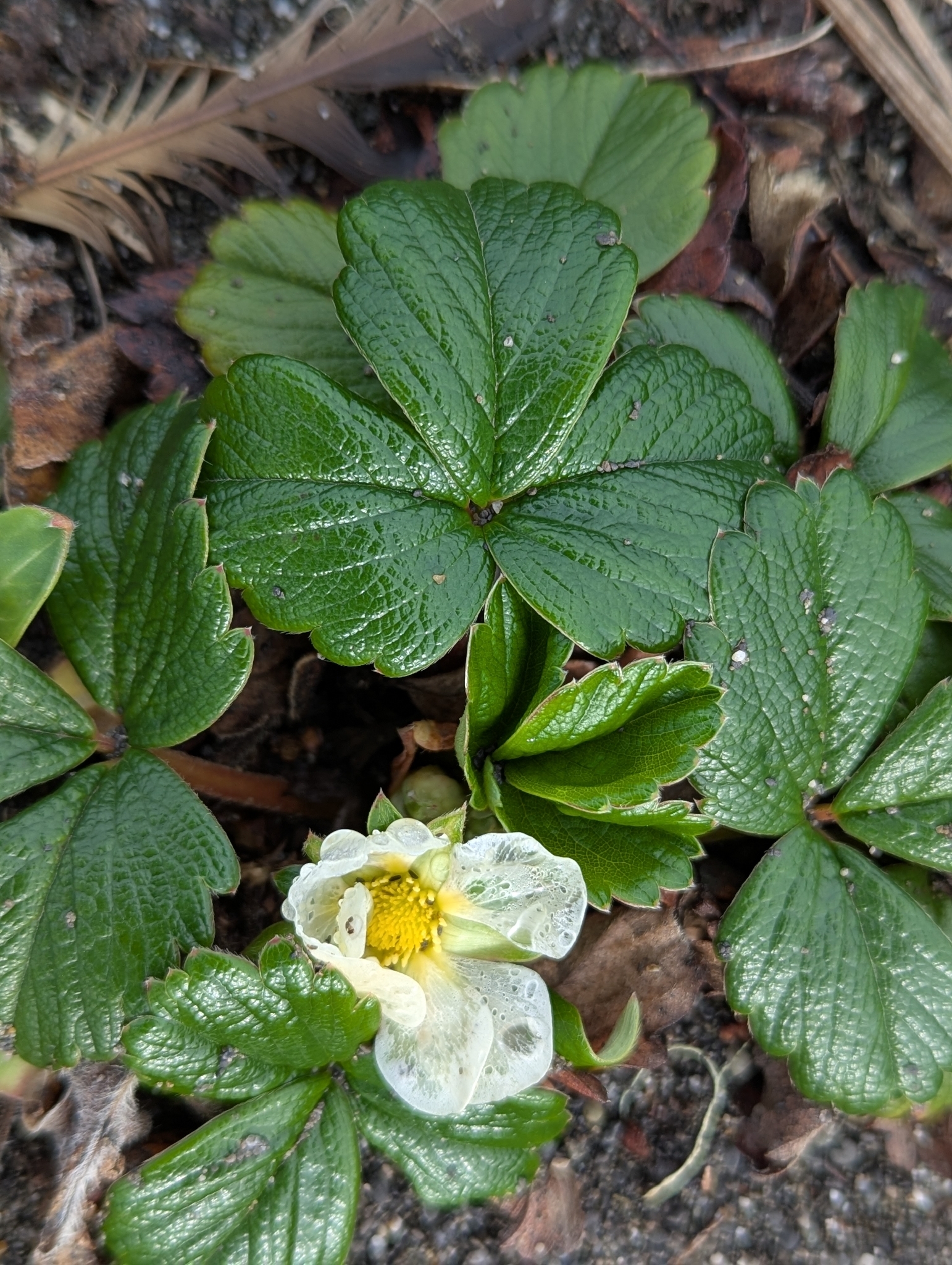
Beach Strawberry is a low-growing, evergreen perennial native to the Pacific coastlines of North and South America, scientifically known as Fragaria chiloensis. It is one of the two primary ancestors used to create the modern garden strawberry (Fragaria × ananassa), contributing its large fruit size and salt tolerance.
This species is frequently used as a drought-tolerant lawn alternative in coastal regions where grass fails to thrive. It spreads rapidly via reddish runners, forming a dense mat of leathery, glossy foliage that suppresses weeds.
Key Facts
- Light: Full sun to partial shade
- Water: Low to moderate once established
- Hardiness: USDA zones 4 to 9
- Size: 15 cm (6 in) tall, 1 m (3 ft) spread
- Fruit: Small, edible berries with pineapple flavor
Growing Beach Strawberry as a Groundcover
Beach Strawberry is an ideal choice for gardeners seeking a salt-tolerant, edible groundcover or a low-maintenance lawn alternative. Unlike traditional turf, this perennial maintains its green color in sandy soils and coastal environments where salt spray is common. It is particularly suited for stabilizing slopes or filling gaps between stepping stones, as it tolerates occasional foot traffic once its root system is established.
Because it spreads via runners, it can quickly cover large areas, making it a cost-effective solution for coastal landscaping. The dense foliage suppresses most weeds, though you may need to hand-weed during the first year of establishment. It is highly effective in the following scenarios:
- Erosion control on sandy coastal bluffs
- Alternative to grass in low-traffic areas
- Underplanting for taller coastal shrubs
- Filling crevices in rock gardens
- Container planting for trailing foliage
Identifying Beach Strawberry
Beach Strawberry forms a low mat reaching 5 to 15 cm (2 to 6 in) in height with thick, leathery leaves. The leaves are trifoliate, meaning they grow in groups of three leaflets, each measuring 2 to 5 cm (0.8 to 2 in) long. These leaflets are remarkably thick and dark green with a glossy upper surface and a pale, hairy underside that helps the plant conserve moisture in windy environments.
The flowers appear in spring, featuring five white petals and a yellow center, typically reaching 2 to 5 cm (0.8 to 2 in) in diameter. The fruit is a small, red accessory fruit about 1.5 cm (0.6 in) wide, often covered in fine hairs. Stems are reddish and produce long runners that root at the nodes to expand the colony.
Best Planting Locations
Choose a planting site with well-drained, sandy soil and full sun for the best fruit production. While Beach Strawberry can grow in partial shade, the foliage will be less dense and the plant will produce fewer flowers and berries. It is naturally adapted to sand dunes and coastal bluffs, so it thrives in poor, rocky soils where other plants struggle.
If your garden has heavy clay, incorporate organic matter or sand to improve drainage and prevent root rot during wet winters. The plant is exceptionally tolerant of salt spray, making it one of the few edible species that can be grown directly facing the ocean. Avoid low-lying areas where water pools, as the roots require constant oxygen.
How to Plant Beach Strawberry
Space individual plants 30 to 45 cm (12 to 18 in) apart to allow the runners room to fill the gaps. The best time to plant is in early spring or autumn when temperatures are mild and rainfall is more frequent. When transplanting, ensure the crown—the point where the leaves meet the roots—is level with the soil surface.
Planting too deeply can cause the crown to rot, while planting too shallowly may lead to the roots drying out before they can establish. Follow these steps for successful establishment:
- Clear the area of perennial weeds and grass
- Dig a hole twice the width of the root ball
- Place the plant and firm the soil gently
- Water deeply immediately after planting
- Mulch with 2 cm (0.8 in) of wood chips or straw
Watering and Fertilizing Schedule
Established Beach Strawberry plants require 2.5 cm (1 in) of water per week during the growing season to produce the best fruit. While this species is more drought-tolerant than the garden strawberry, the leaves will wilt and turn brown at the edges if the soil dries out completely for extended periods. In sandy coastal soils, water more frequently but with less volume to maintain consistent moisture.
Apply a balanced organic fertilizer in early spring as new growth appears. Avoid high-nitrogen feeds, which encourage excessive leaf growth at the expense of flowers and fruit. The leaves were traditionally used by indigenous coastal peoples to brew a tea for treating digestive issues, though the primary modern harvest is the berry itself.
Propagating with Runners and Seeds
Propagation is most effectively achieved by pegging down the runners (stolons) into the soil during the summer months. Each runner will develop several nodes that naturally sprout roots when they make contact with moist earth. Once a new plantlet has established its own root system, you can snip the connecting runner and transplant it to a new location.
While you can grow Beach Strawberry from seeds, they require a period of cold stratification for 4 to 6 weeks and can take several months to reach a transplantable size. Seeds should be sown on the surface of a seed-starting mix as they require light to germinate. Most gardeners prefer runners for the following reasons:
- Faster establishment than seeds
- Ensures genetic consistency of the parent
- Can be done in situ without specialized equipment
- Higher success rate in coastal conditions
Common Pests and Diseases
Slugs and snails are the most frequent pests, often hiding under the dense leathery leaves to feed on the ripening fruit. To manage these, keep the area free of debris and consider using organic slug pellets or beer traps. You may also notice leaf spot, caused by the fungus Mycosphaerella fragariae, which appears as small purple spots with white centers on the foliage.
Ensuring good air circulation and watering at the base of the plant rather than over the leaves will significantly reduce the risk of fungal infections. In very wet soils, root rot can occur, characterized by stunted growth and wilting foliage. If this occurs, improve the soil drainage immediately or move the plants to a raised bed.
Winter Care and Hardiness
Beach Strawberry is hardy down to -34 °C (-30 °F) and remains evergreen in USDA zones 7 and above. In colder climates, the foliage may turn reddish or bronze during the winter months but will generally survive under a layer of snow. If you are growing it in a container, move it to a sheltered spot or wrap the pot in burlap to protect the roots from extreme freeze-thaw cycles.
In early spring, rake away any dead leaves to make room for new growth and improve airflow. If the plants have become too crowded over several years, late winter is the best time to thin the colony by removing older, less productive crowns. This rejuvenation ensures the patch remains vigorous and continues to produce large crops of berries.
Flowering and Edible Fruit
Harvest the red fruits when they are fully colored and soft to the touch, typically from June to August. Unlike many wild berries, the flesh inside is white or pale pink rather than deep red. The flavor is notably sweet with a distinct pineapple aroma, which led to the common name “pine-strawberry.”
The fruits are small, rarely exceeding 1.5 cm (0.6 in), and are often hidden beneath the leathery foliage. Because they are soft, they do not store well and should be eaten or processed within 24 hours of picking. They are traditionally used in shortcakes, jams, or eaten fresh with cream. The flowers are a significant source of nectar for native bees and small butterflies in coastal ecosystems.
Year-Round Care for Beach Strawberry
| Spring | Apply a balanced organic fertilizer and remove dead winter foliage. Monitor for the first white blooms and ensure consistent moisture as fruit sets. |
|---|---|
| Summer | Water 2.5 cm (1 in) weekly during dry spells. Harvest berries every 2-3 days and peg down runners to fill empty spots in the groundcover. |
| Autumn | Transplant rooted runners to new areas. Apply a light layer of straw mulch in colder zones to protect crowns from early frosts. |
| Winter | Check drainage to ensure plants are not sitting in water. Protect container-grown plants from extreme freezing by moving them to a sheltered location. |
Common Beach Strawberry Problems Explained
| What you see | Likely cause | What to do |
|---|---|---|
| Yellowing leaves | Poor drainage or overwatering | Reduce watering frequency and ensure the soil is sandy and well-drained. |
| Few flowers or fruit | Too much shade or nitrogen | Move plants to a sunnier location and switch to a phosphorus-rich fertilizer. |
| Holes in fruit | Slugs or snails | Install beer traps or use organic iron phosphate slug pellets around the patch. |
| Purple spots on leaves | Leaf spot fungus | Remove affected leaves and avoid overhead watering to keep the foliage dry. |
Popular Beach Strawberry Cultivars
- ‘Aulon’ – Dense growth habit, ideal for lawn replacement
- ‘Chaval’ – Known for producing larger, sweeter fruit than the wild type
- ‘Clearwater’ – A robust selection from the Pacific Northwest coast
Best Companion Plants
Pair Beach Strawberry with coastal buckwheat (Eriogonum latifolium) to create a low-maintenance, salt-tolerant garden bed. It also grows well alongside kinnikinnick (Arctostaphylos uva-ursi), which shares its trailing habit and preference for well-drained soil. For textural contrast, add tufts of blue fescue (Festuca glauca) or sea thrift (Armeria maritima), both of which thrive in the same sandy, coastal conditions.
Avoid planting near aggressive lawn grasses like Kentucky bluegrass (Poa pratensis), which can outcompete the strawberry runners. In an edible garden, it serves as an excellent living mulch under blueberry bushes (Vaccinium species) or fruit trees. These companions help create a resilient micro-ecosystem:
- Coastal buckwheat (Eriogonum latifolium)
- Kinnikinnick (Arctostaphylos uva-ursi)
- Blue fescue (Festuca glauca)
- Sea thrift (Armeria maritima)
- Blueberry (Vaccinium species)
Frequently Asked Questions
Is beach strawberry edible?
Yes, the fruit of Beach Strawberry is edible and has a sweet flavor similar to pineapple. Though the berries are small, they are highly prized for fresh eating and preserves.
Beach strawberry vs woodland strawberry?
Beach Strawberry (Fragaria chiloensis) has thick, leathery, glossy leaves and larger flowers, whereas Woodland Strawberry (Fragaria vesca) has thin, matte, light-green leaves and prefers shaded inland forests.
Is beach strawberry drought tolerant?
Yes, it is more drought-tolerant than garden strawberries once established, though it requires supplemental water during peak summer to maintain its evergreen foliage and produce fruit.
Is beach strawberry evergreen?
Yes, in USDA zones 7 and above, Beach Strawberry remains green year-round. In colder zones, the leaves may turn bronze or red but usually persist through the winter.
What does beach strawberry taste like?
It has a unique flavor that combines traditional strawberry sweetness with a distinct pineapple aroma, which is why it is also known as the pine-strawberry.
Is Beach Strawberry related to Strawberry Beach in Jamaica?
No, the Beach Strawberry is a plant species native to the Pacific coasts of the Americas; its name refers to its natural habitat on sand dunes rather than a specific geographical location in Jamaica.
Information about traditional or historical uses is provided for educational interest only and is not medical advice. Do not use any plant to treat a condition without speaking to a qualified professional.
Sources & Verification
Taxonomy and distribution are checked against the databases below. Care guidance is written for cultivated species only and reviewed by our editor. How We Build Plant Profiles →
