
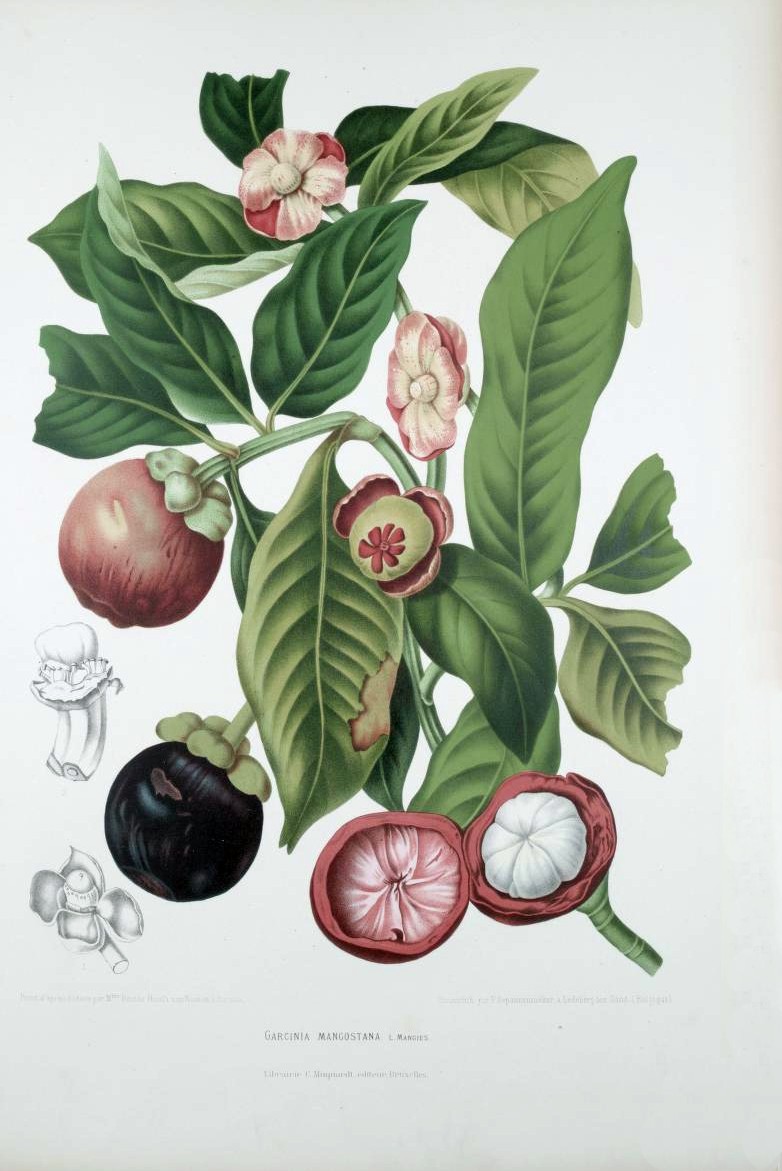
Mangosteen (Garcinia mangostana) is a slow-growing tropical tree in the family Clusiaceae native to Southeast Asia. It produces dark purple spherical fruit with a thick pericarp and sweet white arils.
Trees require continuously warm temperatures above 20 °C (68 °F) and take 8 to 15 years to bear their first crop. Young trees need shade protection for their first two years before tolerating direct tropical sunlight.
Key Facts
- Light: Full sun to partial shade when young
- Water: 25-50 mm (1-2 in) per week
- Temperature: 25-35 °C (77-95 °F); dies below 4 °C (40 °F)
- Soil pH: 5.5-6.5, rich organic loam
- Spacing: 8-10 m (26-33 ft) apart
Growing Conditions for Tropical Orchard Trees
Mangosteen requires a strictly ultra-tropical climate with year-round warmth, high humidity, and protection from strong winds.
Trees fail outside USDA hardiness zones 11 through 12, as temperatures under 4 °C (40 °F) cause fatal severe cold damage. Young saplings bought from a nursery need continuous shade for their first 2 to 3 years before surviving full sunlight exposure.
Orchardists who succeed with this crop maintain consistent soil moisture levels without waterlogging the taproot system. Companion crops like rambutan (Nephelium lappaceum) and durian (Durio zibethinus) thrive in the same humid equatorial microclimates.
- Require annual rainfall exceeding 1,500 mm (60 in)
- Die when exposed to temperatures below 4 °C (40 °F)
- Need 50-70% shade protection during seedling stages
- Require atmospheric humidity levels consistently above 70%
Identifying Leaf, Flower, and Fruit Structure
Mangosteen is recognized by its thick, leathery, dark green leaves measuring 15-25 cm (6-10 in) long paired with dark purple, rounded fruit.
The opposite leaves emerge red-green before turning glossy dark green on the upper surface and dull yellowish-green underneath. Solitary or paired flowers measuring 4-6 cm (1.6-2.4 in) across bloom on branch tips, featuring four thick greenish-pink sepals and four fleshy red petals.
The smooth, spherical fruit measures 4-8 cm (1.6-3.1 in) in diameter with a hard, reddish-purple rind that is 6-10 mm (0.24-0.39 in) thick. Inside, 4 to 8 soft, snow-white arils contain one or two fully formed seeds, while smaller segments remain seedless. The fruit tree resembles madrono (Garcinia madruno) in habit, but differs in its purple pericarp.
- Elliptic-oblong leaves 15-25 cm (6-10 in) long with short petioles
- Solitary flowers with 4 yellowish-green sepals and 4 red petals
- Purplish-red pericarp 6-10 mm (0.24-0.39 in) thick containing yellow latex sap
- White edible pulpy arils divided into 4-8 segments
Mangosteen Tree Size and Planting Distance
Maintain a minimum mangosteen planting distance of 8 to 10 m (26 to 33 ft) between trees to accommodate their ultimate canopy spread.
Mature trees reach heights of 6 to 25 m (20 to 82 ft) with a dense, pyramidal canopy spanning 4 to 10 m (13 to 33 ft) wide. Seedlings grow slowly, adding only 10-20 cm (4-8 in) of height annually during their first three seasons.
The deep taproot system requires deep, uncompacted soil, making shallow container growing impractical past the second year. High-density planting closer than 7 m (23 ft) leads to canopy overcrowding, reduced air movement, and lower fruit production.
- Mature height: 6-25 m (20-82 ft) in tropical ground
- Canopy spread: 4-10 m (13-33 ft) wide
- Annual seedling growth rate: 10-20 cm (4-8 in)
- Standard orchard grid spacing: 8×8 m to 10×10 m (26×26 ft to 33×33 ft)
Ideal Soil Type and Climate Exposure
Plant mangosteen in deep, organic-rich sandy clay loam with an acidic pH between 5.5 and 6.5.
Soil must provide rapid drainage while retaining high moisture levels around the upper lateral roots. Tropical regions with consistent rainfall, such as parts of Kerala, Bangladesh, and Malaysia, provide ideal natural humidity for field trees.
Trees planted in alkaline soils above pH 7.0 develop severe iron chlorosis and stalled shoot growth. Protect the planting site from strong coastal winds that break brittle branches and tear young mangosteen plant leaves.
- Optimal soil pH range: 5.5 to 6.5
- Direct light requirement: Partial shade for 1-3 years, full sun for mature trees
- Ideal mean annual temperature: 25-35 °C (77-95 °F)
- Wind protection: Mandatory windbreaks on exposed orchard sites
How to Plant a Young Seedling
Dig a planting hole 1 m (3.3 ft) wide and 1 m (3.3 ft) deep to allow unrestricted root establishment for nursery-bought stock.
Fill the hole with a mixture of 50% topsoil and 50% aged compost or well-rotted cattle manure. Carefully extract the sapling from its container without disturbing the fragile central taproot, which snaps easily and halts plant growth.
Set the root collar flush with the surrounding soil level and water with 20 L (5.3 gal) of water immediately. Install a temporary shade structure providing 50% shade cloth coverage directly over the newly set mangosteen plant nursery sapling.
- Dig hole 1x1x1 m (3.3×3.3×3.3 ft)
- Mix equal parts native topsoil and organic compost
- Protect fragile central taproot during transplanting
- Water deeply with 20 L (5.3 gal) upon setting
- Construct 50% shade shelter overhead for 24 months
Mangosteen Watering and Fertilizer Schedule
Apply 25 to 50 mm (1 to 2 in) of water per week during dry periods to prevent drought stress and fruit drop.
Irrigated trees produce higher yields, but require a brief 15 to 30 day dry spell to induce flower bud differentiation. Apply a balanced 14-14-14 NPK fertilizer at a rate of 200 g (7 oz) per tree in its first year, divided into four applications.
Increase fertilizer applications annually up to 2-3 kg (4.4-6.6 lb) per tree once fruiting begins at 8 to 10 years. Mulch the root zone with a 10 cm (4 in) layer of organic leaf mold, keeping it 15 cm (6 in) clear of the trunk base.
- Water frequency: 2-3 times weekly during dry spells
- Dry period induction: 2-4 weeks of reduced water to stimulate flowering
- Young tree NPK: 200 g (7 oz) split across 4 doses yearly
- Mature tree NPK: 2-3 kg (4.4-6.6 lb) split twice yearly post-harvest
- Mulch depth: 10 cm (4 in) wood chips or leaf litter
Canopy Management and Pruning Techniques
Prune mangosteen trees only to remove dead, diseased, or interior crossing branches after the annual harvest ends.
Heavy pruning reduces fruit production because flowers form on the outer tips of mature two-year-old wood. Limit pruning cuts to removing low-hanging branches within 1 m (3.3 ft) of the soil to prevent soil-borne fungal spores from reaching low fruit.
Sterilize pruning shear blades with 70% isopropyl alcohol between cuts to avoid spreading bacterial pathogens. Unlike button mangosteen (Garcinia prainiana), this species maintains a naturally symmetrical pyramidal form requiring minimal structural training.
- Timing: Immediately following post-harvest fruit pick
- Pruning intensity: Remove no more than 10-15% of total canopy
- Cleared base clearance: Keep lower canopy 1 m (3.3 ft) off the ground
- Equipment cleaning: Sanitize tools with 70% alcohol solution
Common Pests, Diseases, and Rind Disorders
Inspect trees regularly for gamboge disorder, leaf miners, and thrips, which damage both foliage and fruit quality.
Gamboge appears as yellow latex exudate leaking through the purple pericarp into the white aril segments, caused by excess water uptake right before harvest or mechanical damage. Thrips feed on young fruit surfaces, causing dark scarred webbing on the outer skin.
Root rot caused by Phellinus noxius destroys trees in waterlogged soils with poor drainage. Apply copper-based fungicides if leaf spot diseases emerge during continuous rainy periods.
- Gamboge disorder: Yellow sap inside fruit caused by heavy late rain or trunk injury
- Thrips infestation: Silvering and scarring on young fruit skin; treat with neem oil
- Leaf miners: Serpentine trails on young foliage; spray organic horticultural oil
- Root rot: Yellowing foliage and branch dieback; improve field drainage
Protecting Tropical Trees from Cold Weather
Maintain ambient temperatures above 10 °C (50 °F) at all times, as cold spells below 3 °C (37 °F) kill adult mangosteen trees.
Exposure to temperatures between 5 °C and 12 °C (41 °F to 54 °F) causes leaf shedding, tip dieback, and complete fruit abortion. In sub-tropical greenhouse installations, heat the enclosure to maintain 20-30 °C (68-86 °F) during winter months.
Outdoor trees in fringe zones require thick trunk wraps and overhead thermal blankets when nighttime temperatures drop near 10 °C (50 °F). Water the root zone thoroughly before cold snaps, as moist soil retains ground heat better than dry earth.
- Absolute minimum survival temperature: 4 °C (40 °F)
- Chilling injury threshold: 5-12 °C (41-54 °F)
- Winter greenhouse setpoint: 20-25 °C (68-77 °F)
- Thermal blankets: Apply over young trees during cold nights
Harvesting Mangosteen Fruit and Processing Rind Extracts
Harvest fruit by hand when the outer pericarp shows a light reddish-purple color blush over at least 25% of the skin.
Mature fruits are traditionally harvested using padded pole cutters to prevent fruits from dropping onto hard soil, which causes internal bruising. The thick purple pericarp contains xanthones and tannins traditionally used in herbal preparations and modern skincare like mangosteen face wash and skin lotions mixed with mangosteen & rice milk formulations.
The soft white aril offers a sweet-tart flavor profile resembling longan (Dimocarpus longan) combined with peach. Store freshly picked ripe fruits at 13-15 °C (55-59 °F) for up to two weeks; temperatures below 10 °C (50 °F) cause chilling damage to harvested fruit.
- Harvest stage: 25-50% purple skin color development
- Storage temperature: 13-15 °C (55-59 °F) for 14-21 days shelf life
- Edible portion: Snow-white aril segments eaten fresh or frozen
- Rind byproduct: Dried pericarp processed for cosmetics, face wash, and extracts
Frequently Asked Questions
How do you know when a mangosteen fruit is ripe?
A mangosteen fruit is ripe when its pericarp transitions from green to dark reddish-purple and yields slightly to gentle thumb pressure. Do not pick completely green fruits, as they fail to ripen once detached from the tree.
How do you open and eat a mangosteen fruit?
Open a mangosteen fruit by scoring the thick purple rind around its equator with a knife without cutting into the white segments inside. Twist the two halves apart to expose the white aril segments, which can be lifted out with a fork or fingers to eat fresh.
Can you grow a mangosteen tree from seed?
Yes, you can grow a mangosteen tree from seed, but fresh seeds must be planted within a few days of extraction because they lose viability rapidly. Seedling trees grow slowly and typically take 8 to 15 years to produce their first crop.
Why is mangosteen rind used in face wash and cosmetics?
Mangosteen rind contains high concentrations of xanthones, polyphenols, and tannins that have antioxidant and astringent properties. Cosmetic formulations like mangosteen face wash and mangosteen & rice milk cleansers utilize rind extracts to soothe skin and tighten pores.
How do you store fresh mangosteen fruit after buying?
Store fresh mangosteen fruit at room temperature for up to 3 to 5 days, or keep them at 13-15 °C (55-59 °F) in a high-humidity container for up to 2 weeks. Avoid keeping them below 10 °C (50 °F) in standard household refrigerators, as extreme cold hardens the pericarp and ruins the pulp.
Information about traditional or historical uses is provided for educational interest only and is not medical advice. Do not use any plant to treat a condition without speaking to a qualified professional.
Sources & Verification
Taxonomy and distribution are checked against the databases below. Care guidance is written for cultivated species only and reviewed by our editor. How We Build Plant Profiles →


