Chinese hydrangea (Hydrangea anomala) is a massive deciduous woody climber native to moist montane forests across the Himalayas and China. It climbs sheer surfaces using aerial rootlets and produces flattened lacecap flower corymbs in early summer.
Young specimens establish slowly and often take three to five years before producing their first upward surge or blooms. Once anchored, the vine grows rapidly and requires heavy structural support rather than flimsy trellising.
Key Facts
- Climbing type: Self-clinging aerial rootlets on masonry or sturdy wood
- Flowering time: June to July with flat lacecap clusters
- Soil moisture: Consistently moist, humus-rich soil without waterlogging
- Sun exposure: Partial shade to full shade; tolerates morning sun
- Mature height: Reaches 9 to 15 m (30 to 50 ft)
- Subspecies note: Subsp. petiolaris is the most common garden form
Growing Chinese Hydrangea: Garden Fit
Chinese hydrangea demands immense structural support and long-term patience before it displays its full climbing potential. The species establishes its root system underground for the first three seasons with negligible top growth, leading many growers to think it has stalled.
This vine suits large brick walls, stone retaining terraces, and stout mature tree trunks where it can scale without destroying light wooden fencing. When grown without vertical support, it functions as a sprawling, mounding woody groundcover up to 1.2 m (4 ft) tall that smothers weeds on sloped terrain.
Botanical Look and Identification
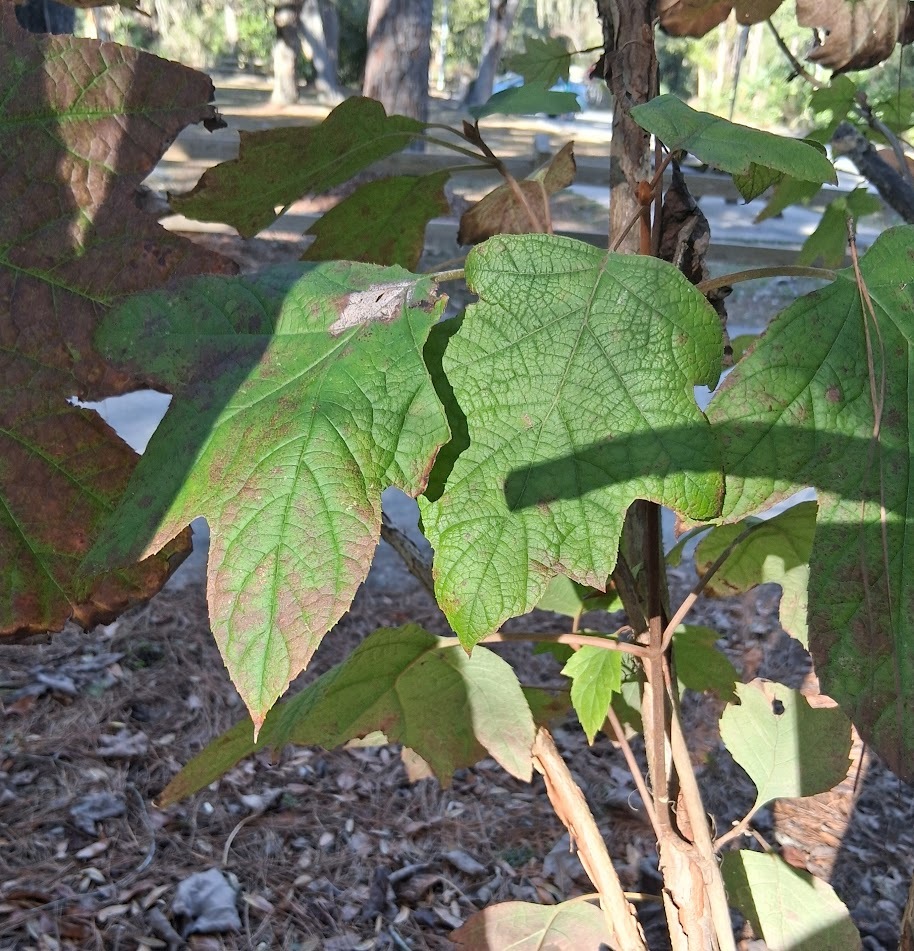
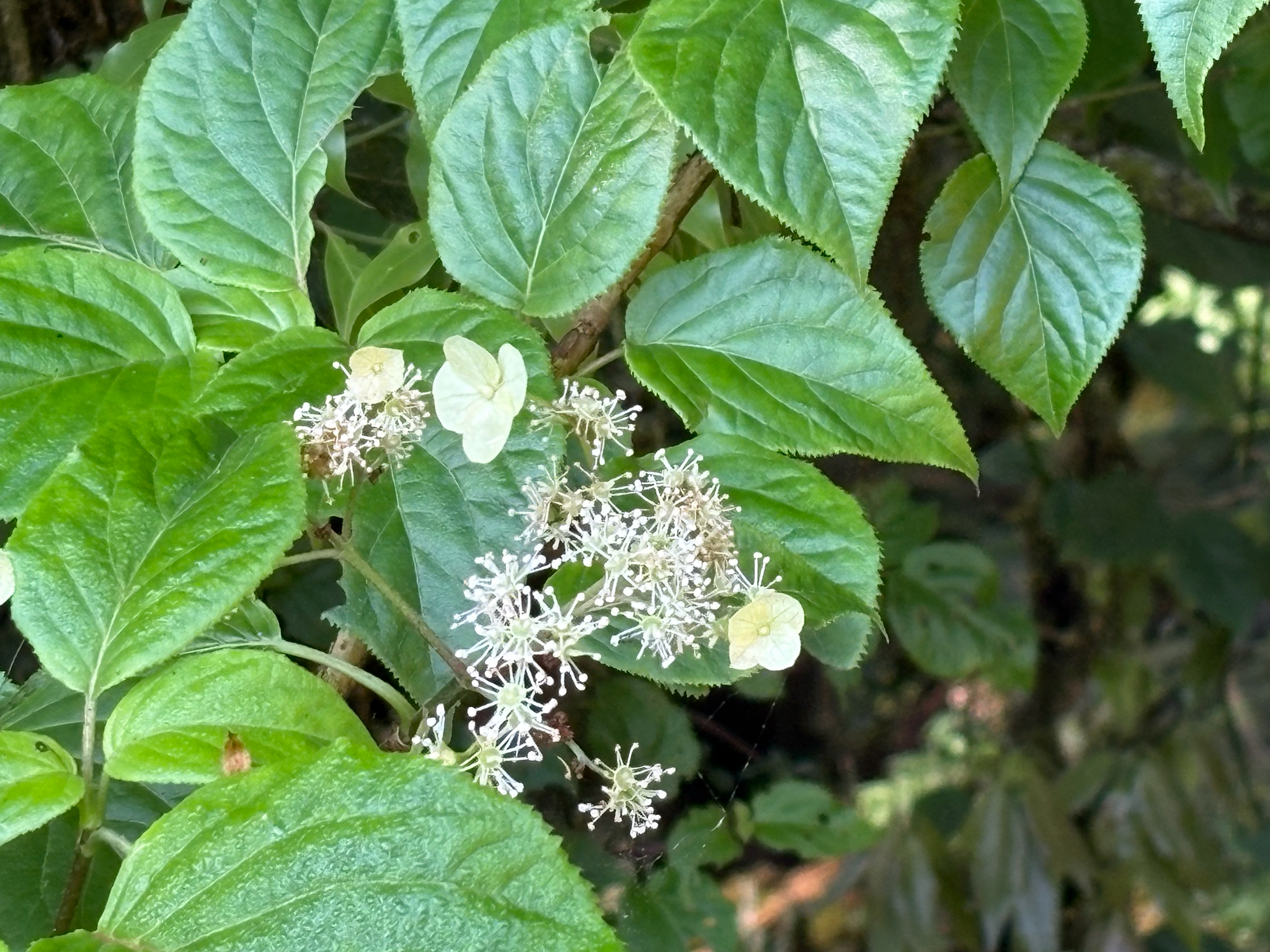
Chinese hydrangea produces flaking cinnamon-brown peeling bark on thick, woody mature stems that measure up to 10 cm (4 in) across. The opposite leaves are ovate to broadly elliptic, measuring 7 to 13 cm (3 to 5 in) long, with cordate bases, finely serrated margins, and slender petioles.
Flowering occurs in June and July on terminal, broad, flat-topped corymbs that span 15 to 25 cm (6 to 10 in) across. Each inflorescence displays two distinct flower types:
- Fertile florets: Dense, small, dull-white central flowers with early-shedding fused petals and 9 to 20 stamens
- Sterile florets: Broad, creamy-white outer florets measuring 2 to 3 cm (0.8 to 1.2 in) across on slender stalks
- Autumn foliage: Leaves turn a clear, butter-yellow before dropping in late autumn
- Winter silhouette: Persistent papery brown flower heads remain attached to the peeling, architectural stems
Ideal Site and Light Requirements
Plant Chinese hydrangea in partial shade or bright indirect light where the foliage is shielded from intense afternoon rays. A north-facing or east-facing wall provides optimal conditions by preventing leaf scorch during dry summer months.
While the vine tolerates deep shade, flowering volume decreases when direct light drops below two hours per day. Full sun positions require consistently damp, deep soil to prevent foliage burn, particularly in southern regions of its range.
Soil and Planting Guidelines
Set young root balls into deep, humus-rich soil amended with compost at least 30 to 45 cm (12 to 18 in) away from walls or foundation footings. Planting too close to building masonry leaves roots in rain-shadow pockets where moisture never penetrates.
To establish a bare-root or potted vine successfully:
- Dig a planting hole twice the width of the root ball and equal in depth.
- Loosen circling roots to encourage horizontal root growth away from the wall.
- Mix aged compost or leaf mould into the backfill to improve moisture retention.
- Install initial wooden battens or guide wires to help young stems reach the masonry until aerial rootlets grip.
- Apply a 7 cm (3 in) layer of shredded bark mulch, keeping it clear of the stem collar.
Watering and Fertilizer Needs
Keep the soil consistently moist down to 15 cm (6 in) throughout the first two growing seasons. Established specimens survive moderate dry periods, but prolonged drought causes foliage wilting, scorched leaf margins, and premature leaf drop.
Feed once in early spring as new buds swell using a balanced slow-release fertilizer or a generous top-dressing of composted manure. Avoid heavy nitrogen applications, which encourage excessive green leafy stems at the expense of floral buds.
How to Prune Chinese Hydrangea
Prune Chinese hydrangea immediately after summer flowering ceases to avoid removing the following year’s developing flower buds. Because blooms form on short, mature lateral branches that emerge from older wood, severe spring pruning eliminates all flower corymbs for the season.
Pruning involves three routine maintenance steps:
- Shorten overlong outward shoots that stray too far from the wall back to 2 to 4 buds from the main framework.
- Remove dead, damaged, or crossing woody canes close to the base.
- Clip back stray runners that attempt to creep under roof tiles, gutters, or window shutters.
Propagating Climbing Hydrangea
Propagate new plants using semi-ripe stem cuttings taken in mid-summer or through ground layering in spring. Cuttings root reliably when supplied with bottom heat and high ambient humidity.
Ground layering requires minimal intervention. Bend a low-hanging, flexible stem to the ground, scrape the bark on the underside, pin it into loosened, moist soil with a wire peg, and bury it under 5 cm (2 in) of soil until strong adventitious roots form twelve months later.
Winter Care and Dormancy
Chinese hydrangea is fully hardy down to -30 °C (-22 °F) in USDA Zone 4 and requires no special winter insulation once established. The woody structure withstands heavy snow loads against stone walls and buildings.
In regions with fluctuating late-winter temperatures, early-morning winter sun on frozen stems can cause bark splitting on exposed south-facing brickwork. Leave spent flower heads on the plant through winter to provide architectural interest and insulate lateral dormant buds from drying winds.
Seasonal Maintenance Schedule
| Spring | Top-dress the root zone with 5 cm (2 in) of compost or well-rotted manure. Secure any loose ascending stems to guide wires until aerial roots latch on. |
|---|---|
| Summer | Irrigate deeply during prolonged dry spells. Cut back unruly shoots immediately after the white lacecap flowers finish blooming in July. |
| Autumn | Rake fallen butter-yellow foliage to prevent fungal spores from overwintering. Apply a fresh 7 cm (3 in) layer of wood bark mulch over the roots. |
| Winter | Check structural anchors and ties on main framework stems during high winds. Prune away broken branches damaged by heavy ice or snow. |
Diagnosing Common Climbing Hydrangea Problems
| What you see | Likely cause | What to do |
|---|---|---|
| Vine fails to bloom despite healthy foliage | Juvenile phase, excess nitrogen, or excessive shade | Wait for the vine to mature past 3-5 years, reduce high-nitrogen feed, and ensure at least 2-3 hours of filtered sunlight. |
| Brown, crispy margins on leaf edges | Drought stress or direct midday sun exposure | Soak root zone thoroughly once weekly and maintain a thick protective layer of organic mulch. |
| Stems peeling and pulling away from masonry | Smooth, non-porous wall surface or excessive stem weight | Install tensioned eye-bolts and heavy wire cables into masonry to physically secure main structural limbs. |
| Yellow leaves with green veins (chlorosis) | High soil alkalinity (pH above 7.5) limiting iron uptake | Amend the soil around the drip line with sulfur or chelated iron to lower soil pH toward 6.0. |
Popular Chinese Hydrangea Subspecies and Cultivars
- subsp. petiolaris – dominant garden form with rounded leaves and profuse lacecaps
- ‘Miranda’ – golden-yellow variegated leaf margins on vigorous stems
- ‘Firefly’ – bright chartreuse foliage borders darkening to green by late summer
- ‘Winter Surprise’ – compact selection whose foliage turns red-bronze in autumn
- ‘Skyland Giant’ – oversized flower heads reaching up to 30 cm across
Companion Plants for Shaded Walls
Surround the base of Chinese hydrangea with shade-tolerant perennial groundcovers and shrubs that protect its root zone from baking summer heat. Its deep root system coexists well with shallow-rooted woodland perennials once established.
Excellent garden companions include:
- Japanese forest grass (Hakonechloa macra) to provide soft, arching texture at the vine’s woody base
- Cast iron plant (Aspidistra elatior) for evergreen underplanting in sheltered zones
- Siberian bugloss (Brunnera macrophylla) with heart-shaped, silver-variegated foliage
- Japanese spurge (Pachysandra terminalis) as an evergreen carpet that stabilizes soil moisture
Frequently Asked Questions
What is the difference between Chinese snowball and Chinese hydrangea?
Chinese snowball is an upright deciduous shrub known as Viburnum macrocephalum that produces rounded, ball-shaped sterile flower clusters, whereas Chinese hydrangea (Hydrangea anomala) is a true woody vine with aerial rootlets and flat lacecap flower clusters.
Does climbing hydrangea damage brick walls?
Chinese hydrangea attaches with tiny aerial rootlets rather than penetrating tendrils, meaning it will not compromise sound, modern brick masonry or stone. However, it can pull away old, crumbling lime mortar or tear off wooden clapboard siding when removed.
What is the difference between Hydrangea anomala and Hydrangea anomala subsp. petiolaris?
Subspecies petiolaris originates from Japan, Korea, and eastern Asia, featuring 15 to 20 stamens per fertile flower and slightly broader cordate leaves, while the nominal Chinese form Hydrangea anomala native to the Himalayas typically produces around 9 to 10 stamens.
Why is my Chinese hydrangea vine not flowering?
Young vines commonly require three to seven years of root and framework growth before producing their first flower heads. Lack of bloom on older vines is usually caused by excessive pruning in early spring or growing in deep, zero-light shade.
Can Chinese hydrangea be grown as a bush or tree?
Chinese hydrangea is naturally a climbing vine, but without vertical support it forms an arching, mounded woody shrub or groundcover up to 1.2 m (4 ft) tall. It cannot form a freestanding tree trunk on its own.
Sources & Verification
Taxonomy and distribution are checked against the databases below. Care guidance is written for cultivated species only and reviewed by our editor. How We Build Plant Profiles →
- Royal Horticultural SocietyMorphology, cultivation, and hardiness profile
- Missouri Botanical GardenIdentification, growth characteristics, and landscape uses
- Flora of ChinaTaxonomy and native distribution of Hydrangea anomala
- North Carolina State ExtensionLandscape management and toxicity details
- GBIF — Global Biodiversity Information Facilitytaxonomy, synonyms, occurrence records
- Plants of the World Online (Kew)accepted name, native range
- Wikipediageneral reference