
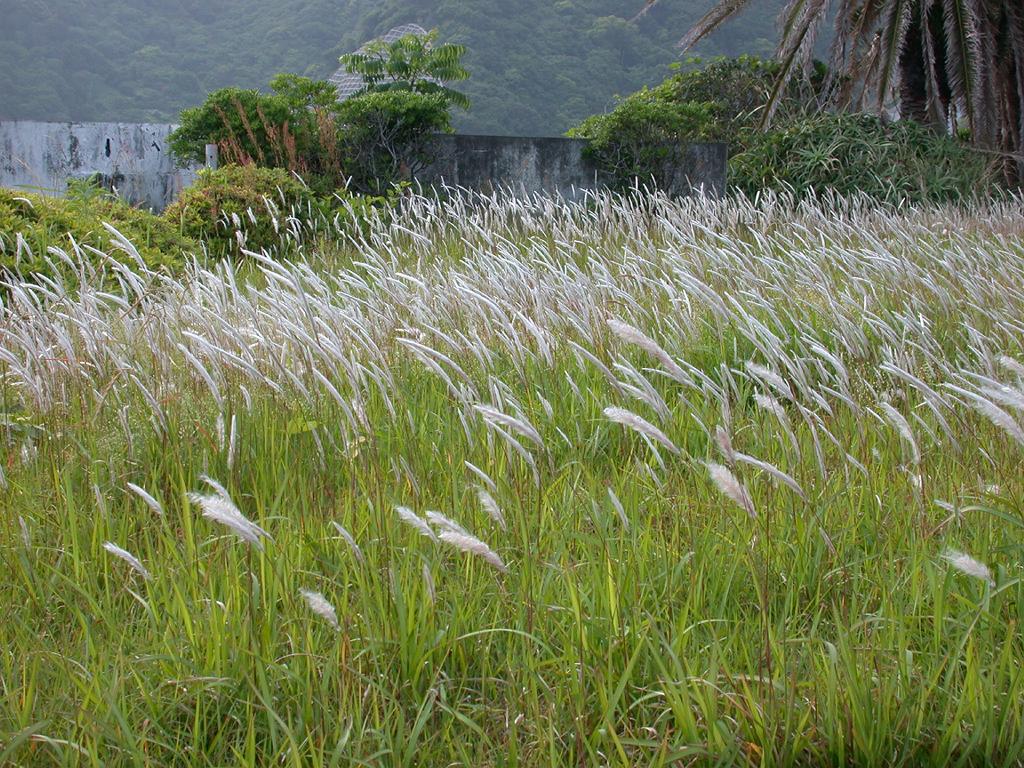
Cogon grass (Imperata cylindrica) is an upright perennial grass native to tropical and warm-temperate regions of Asia, Africa, and Australia, recognized by its sharp, silica-edged blades and silky white cylindrical flower plumes. The species includes both horticultural red-leaved selections and an aggressive green wild type that forms dense subterranean rhizome networks.
While ornamental cultivars like ‘Rubra’ remain restricted to garden beds in cooler climates, the wild form is a prohibited federal noxious weed across the southeastern United States. Planting requires strict adherence to local biosecurity regulations to prevent the escape of fertile or reverted strains.
Key Facts
- Light: Full sun to maintain intense foliage coloration
- Water: 2.5 cm (1 in) weekly during active summer growth
- Soil: Well-drained loam or sand with pH 4.5–7.5
- Winter hardiness: USDA Zones 5 through 10 depending on cultivar
- Spread rate: Up to 1.2 m (4 ft) per season via underground rhizomes
- Legal status: Federal noxious weed in the United States; check regional bans
Is Cogon Grass Right for Your Garden?
You should only cultivate cogon grass if your local agricultural department permits it and you commit to growing non-invasive ornamental clones in physical root barriers. Gardeners in the southern United States face strict legal bans because the wild species displaces native pine understories and pasture grasses across Florida, Alabama, and Mississippi. In northern zones, cold winters eliminate the risk of runaway seeding.
The ornamental selection ‘Rubra’ brings vivid wine-red foliage to borders and patio planters without producing viable seed. However, unmanaged clumps can revert over several seasons back to green, fast-spreading wild strains that threaten local habitats.
- Choose container planting: Keeps aggressive rhizomes confined to a 30–45 cm (12–18 in) pot
- Check local laws: Possession of the green wild type carries civil penalties in several US states
- Avoid open rural borders: Keeps creeping stems away from native grasslands and drainage swales
How to Identify Cogon Grass
Identify cogon grass in the field by looking for an off-centre white midrib on upright leaf blades and extremely sharp, scaly underground rhizome tips. Wild clumps reach 60–120 cm (24–48 in) tall, while red horticultural cultivars stay compact at 30–50 cm (12–20 in).
The leaf blades measure 1–2 cm (0.4–0.8 in) wide with fine serrations along the margins that cut bare skin when brushed downward. Wild plants produce dense, cylindrical, cottony seed spikes 8–20 cm (3–8 in) long covered in white silky hairs that disperse in the wind during late spring.
Subterranean growth reveals segmented white rhizomes that taper to hardened, sharp points capable of puncturing the roots of neighbouring shrubs. These underground stems form a thick carpet 5–15 cm (2–6 in) below the soil line, enabling rapid regrowth after bushfires or mowing.
Light and Soil Requirements
Cogon grass performs best in full sun receiving at least 6 to 8 hours of direct light daily to sustain rich leaf pigmentation. Cultivars planted in partial shade quickly lose their crimson tones and turn a dull olive green.
Soil adaptability is broad, though garden plantings require porous drainage to avoid winter root rot in temperate regions. The plant thrives across acidic to neutral soils with a pH between 4.5 and 7.5.
- Soil texture: Porous sandy loams prevent crown waterlogging during cold months
- Moisture tolerance: Survives extended dry spells once rooted, yet handles seasonal marsh margins
- Fertility level: Thrives in poor, low-nutrient substrates without supplemental compost
Planting Japanese Blood Grass Safely
Plant container-grown stock in spring by sinking a 40 cm (16 in) deep plastic root barrier around the perimeter of the bed. This barrier keeps the expanding creeping rhizomes from invading surrounding perennials and lawn turf.
Space individual plants 30–45 cm (12–18 in) apart, setting the root crown level with the surrounding soil surface. Firm the soil thoroughly to remove air pockets around the fibrous lower roots and water with 5 litres (1.3 gal) of water per planting hole.
If planting in patio pots, select containers with a minimum diameter of 35 cm (14 in) equipped with unobstructed base drainage holes. Use a gritty potting mix containing 60% peat-free compost and 40% coarse horticultural grit to ensure water moves freely away from the rhizomes.
Water and Fertilizer Needs
Provide 2.5 cm (1 in) of water per week during the initial four months of establishment, then water only during dry periods lasting over three weeks. Mature root systems access deep ground moisture and withstand midsummer heat without supplemental irrigation.
Avoid heavy chemical fertilization, which triggers rapid rhizome escape and causes the red cultivars to fade into green vegetative foliage. An annual light top-dressing of organic compost in early spring supplies all the required nutrients.
- Spring watering: Once weekly if rainfall remains below 25 mm (1 in)
- Summer watering: Bi-weekly deep soakings for container-bound plants
- Fertilizer ratio: Use a balanced 5-5-5 organic granular feed at half-strength (30 g/m²) once in April
- Excess nitrogen risk: High nitrogen prompts immediate reversion to aggressive green growth
Pruning and Reversion Removal
Cut back all dead foliage to 5 cm (2 in) above ground level in late winter before new spring shoots emerge from the soil. Use heavy bypass shears or a hedge trimmer, wearing thick leather gloves to shield hands from the abrasive silica edges.
Inspect ornamental clumps throughout the growing season for any fully green leaf blades. Any shoot that lacks red pigmentation indicates genetic reversion toward the invasive wild form and requires swift intervention.
Dig down immediately with a narrow trowel to excavate the reverted green shoot along with its attached rhizome segment. Leaving even a 2 cm (0.8 in) fragment of reverted rhizome allows the aggressive wild type to crowd out the ornamental plant within two growing cycles.
How to Propagate Cogon Grass
Propagate ornamental cultivars exclusively by rhizome division in early spring as new pink shoot tips push through the soil. Ornamental selections do not produce viable seed, making vegetative division the only reliable cloning method.
Lift an established three-year-old clump using a garden fork, shaking away loose topsoil to expose the interlaced white rhizomes. Use a sharp spade to divide the clump into fist-sized sections, ensuring each division contains at least three dormant buds and healthy roots.
Replant the divisions immediately into prepared containers or barred ground beds at their original growing depth. Water thoroughly and maintain moderate moisture for three weeks until upright shoots reach 10 cm (4 in) in height.
How to Control and Eliminate Invasive Cogon Grass
Eradicate invasive wild cogon grass by applying a 2% to 4% glyphosate solution in late summer or early autumn when the plant transports nutrients downward into its rhizome system. Spring mowing followed by late-season herbicide treatment produces higher kill rates than mechanical removal alone.
Mowing does not kill established cogon grass; the plant responds to defoliation by producing denser tillers and sharp shoots. Hand digging works only for small patches under 1 m² (10 sq ft) where you can excavate soil down to 60 cm (24 in) and remove all brittle rhizome fragments.
- Step 1 (Midsummer): Mow or burn the infestation to clear old dead thatch
- Step 2 (Late summer): Allow foliage to regrow to 30–45 cm (12–18 in) of fresh, active surface area
- Step 3 (Autumn): Spray foliage thoroughly with systemic glyphosate or imazapyr before the first hard frost
- Step 4 (Follow-up): Spot-treat emerging survivor sprouts the following spring and summer
Winter Hardiness and Protection
Cultivated ‘Rubra’ survives winter cold down to -20 °C (-4 °F) in USDA Zone 6 when insulated by snow cover or organic mulch. In USDA Zone 5, winter survival requires sheltered microclimates and heavy soil drainage.
Apply an 8 cm (3 in) layer of shredded bark mulch or straw over the crowns in late November once the ground freezes. This protective blanket prevents frost heaving, which pushes shallow rhizomes out of cold, wet ground during alternating freeze-thaw cycles.
Potted specimens must be moved to an unheated garage, shed, or cold frame where temperatures stay between -5 and 5 °C (23–41 °F). Check the potting soil once a month during winter, providing just enough water to keep the root ball from desiccating completely.
Flower Plumes and Seasonal Display
Cogon grass blooms from May to June with shimmering silver-white flower spikes that measure 10–20 cm (4–8 in) in length. While wild colonies flower prolifically after bushfires, cultivated red selections rarely bloom in cool northern gardens.
The primary ornamental feature of ‘Rubra’ is its foliage transformation throughout the growing year. Leaves emerge lime-green with crimson tips in April, turn half-ruby by July, and transition to deep burgundy-bronze in October before drying to straw tan in December.
Plumes on wild plants consist of paired spikelets surrounded by long silky hairs that catch early morning light. These lightweight seed heads detach easily in breezes exceeding 15 km/h (9 mph), carrying windborne seeds across distances of several miles in open rural terrain.
Companion Plants for Japanese Blood Grass
Pair Japanese blood grass with drought-tolerant perennials that offer blue, silver, or deep purple foliage for high visual contrast. Strong companion plants must share its affinity for full sun and sharp drainage.
Position low-growing groundcovers like blue fescue (Festuca glauca) and stonecrop (Sedum rupestre) along the front edge of the planting bed. The cool, powdery blue of the fescue accentuates the fiery crimson tips of the blood grass.
- Russian sage (Salvia yangii): Lavender-blue floral spikes provide a soft, airy backdrop
- Purple coneflower (Echinacea purpurea): Stiff upright stems and magenta petals match summer grass tones
- Black-eyed Susan (Rudbeckia fulgida): Golden-orange daisies bloom alongside turning burgundy autumn foliage
- Silver mound (Artemisia schmidtiana): Feathery silver mats cushion the upright, linear grass blades
Frequently Asked Questions
What is cogon grass in English?
Cogon grass is the common English name for Imperata cylindrica, a perennial grass species also known as blady grass, kunai, and Japanese blood grass.
How do you pronounce cogon grass?
It is pronounced KOH-gon grass, with the accent placed on the first syllable.
What are traditional cogon grass uses in the Philippines?
In the Philippines and across Southeast Asia, mature cogon grass is traditionally harvested and dried to weave water-shedding thatch roofs for rural homes and shade huts. The boiled rhizomes were also traditionally used in herbal decoctions as a diuretic and febrifuge.
Is cogon grass poisonous to dogs or cattle?
Cogon grass is not chemically poisonous, but mature leaves contain razor-sharp silica margins that can lacerate the mouth, tongue, and intestines of grazing animals. Young shoots under 15 cm (6 in) tall are occasionally grazed by livestock before the coarse silica stiffens the leaves.
Why is cogon grass such an ecological threat in Florida?
In Florida, wild cogon grass outcompetes native pine understory plants, forms impenetrable monocultures that eliminate wildlife forage, and burns at extreme temperatures that kill fire-adapted longleaf pine saplings.
Is cogon grass edible for humans?
The fibrous leaves are not edible, though tender young shoots and subterranean rhizomes were historically chewed or boiled for their mild sweetness and starch in survival contexts.
Information about traditional or historical uses is provided for educational interest only and is not medical advice. Do not use any plant to treat a condition without speaking to a qualified professional.
Sources & Verification
Taxonomy and distribution are checked against the databases below. Care guidance is written for cultivated species only and reviewed by our editor. How We Build Plant Profiles →
- Kew Plants of the World OnlineTaxonomic status and native distribution
- University of Florida IFAS ExtensionBiology, identification, and chemical control of cogongrass
- Royal Horticultural SocietyCultivar hardiness and border cultivation details
- USDA Forest ServiceFire ecology and invasive behavior
- GBIF — Global Biodiversity Information Facilitytaxonomy, synonyms, occurrence records
- Wikipediageneral reference