
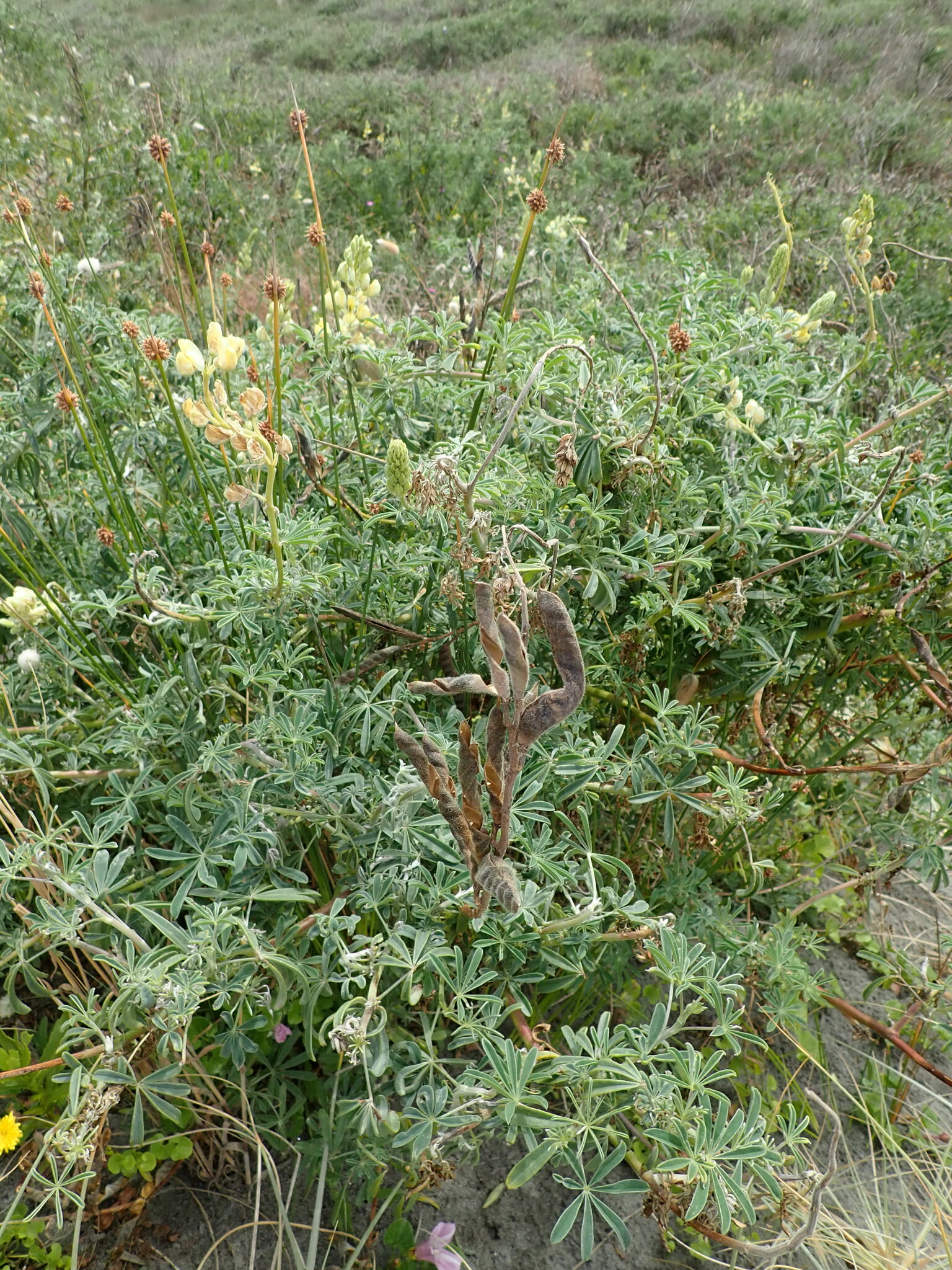
Tree lupin (Lupinus arboreus) is a fast-growing, woody evergreen shrub native to the coastal bluffs and sand dunes of California. It features fragrant yellow pea-like floral spikes and palmate foliage, reaching mature heights of 1 to 2 m (3.3 to 6.6 ft).
This species fixes atmospheric nitrogen through root nodules but declines after 4 to 7 years of growth. In coastal areas outside California, including New Zealand and parts of the UK, it spreads rapidly along sandy shores and requires active management to prevent unwanted spreading.
Key Facts
- Height: 1 to 2 m (3.3 to 6.6 ft)
- Spread: 1.2 to 2.5 m (4 to 8 ft)
- Hardiness: USDA zones 8 to 10
- Soil: Sandy, poor, well-drained
- Bloom time: May to August
- Toxicity: Toxic to humans and pets
Growing Tree Lupin in Your Garden
Tree lupin grows as a short-lived woody perennial that completes its life cycle within 4 to 7 years in poor, sandy soil. It suits coastal gardens, exposed hillside slopes, and drought-tolerant gravel borders where other shrubs struggle.
Because the plant forms a deep taproot, established specimens cannot be transplanted without causing severe root shock. In coastal California, New Zealand, and parts of Europe, self-sown seedlings colonize sandy banks rapidly, so growers should monitor seed drop near native plant habitats.
Tree Lupin Identification and Appearance
Tree lupin forms a dense woody shrub reaching 1 to 2 m (3.3 to 6.6 ft) tall with palmate leaves divided into 5 to 12 narrow leaflets. The leaflets measure 2 to 6 cm (0.8 to 2.4 in) long and feature silky, appressed hairs on their undersides.
Erect terminal racemes measuring 10 to 30 cm (4 to 12 in) long hold scented pea flowers from May to August. Natural color forms and regional varieties include:
- Yellow form: The typical species color found on California coastal dunes.
- Blue form: A wild variant with pale lavender to deep violet petals.
- Purple form: Naturally occurring coastal hybrids with rich purple blooms.
- Alba (white): A cultivated selection with pale cream to white petals.
- Var. eximius: A northern California variant with soft purple flowers and silvery leaves.
Flattened seed pods measure 4 to 8 cm (1.6 to 3.1 in) long, turning dark brown and popping open forcibly to scatter 8 to 12 smooth, mottled seeds.
Best Planting Location for Lupinus arboreus
Plant tree lupin in a location that receives at least 6 hours of direct sunlight daily. Partial shade reduces flower production and leads to weak, floppy stems that collapse under rain.
Select a site with coarse, fast-draining soil such as sand, gravel, or rocky ground. Planting in heavy clay soil leads to fungal root rot within weeks during winter rainfall.
How to Plant Tree Lupin
Plant young container-grown tree lupins in spring after soil temperatures reach 10 °C (50 °F). Dig a planting hole twice as wide as the root ball and equal in depth, keeping the root crown flush with the surrounding soil level.
Avoid adding compost, manure, or high-nitrogen soil additives to the planting hole. Incorporate coarse horticultural sand or fine gravel into fine-textured soils to ensure rapid drainage away from the stem base.
Tree Lupin Water and Fertilizer Needs
Water young plants twice weekly until established, then restrict irrigation to periods when rainfall remains below 2.5 cm (1 in) per month. Established plants absorb groundwater efficiently through their taproots and survive drought without supplemental water.
Do not apply nitrogen fertilizers to tree lupin under any circumstances. Specialized Bradyrhizobium bacteria in the root nodules fix nitrogen directly from the air, allowing the shrub to thrive in nutrient-deficient soils.
How to Prune a Tree Lupin
Prune tree lupin in late summer immediately after flowering by cutting back current season green growth by one-third. Never cut into old, bare woody branches, as old wood lacks dormant buds and will fail to re-sprout.
Regular summer trimming keeps the shrub compact and prevents premature structural splitting. Follow these steps when pruning:
- Cut spent flower racemes back to the uppermost leaf joint before seeds mature.
- Trim soft green side shoots to maintain a rounded mound shape.
- Remove broken or dead stems near the base with sharp pruners.
- Sanitise pruning blades with 70% isopropyl alcohol between plants.
How to Grow Tree Lupins from Seed and Cuttings
Propagate tree lupins from seed in early spring or from semi-ripe stem cuttings in late summer with a 60 to 70 percent success rate. Seeds possess a hard outer coat that requires mechanical scarification to allow water absorption.
To germinate seeds, nick the dark seed coat with a file or soak seeds in warm water for 24 hours until swollen. Sow scarified seeds 1 cm (0.4 in) deep in individual deep pots filled with free-draining seed mix. For cuttings, take 10 cm (4 in) heel cuttings from non-flowering shoots in August, dip in rooting powder, and place into a mixture of equal parts perlite and coarse sand kept at 18 to 21 °C (65 to 70 °F).
Winter Care and Cold Hardiness
Tree lupin withstands winter temperatures down to -7 °C (20 °F) in USDA zones 8 through 10. Prolonged freezes below this threshold cause severe wood damage or kill the entire plant to ground level.
Overwinter potted plants in a cool greenhouse or unheated cold frame. In garden beds, spread a 5 cm (2 in) layer of coarse gravel mulch around the root zone to protect roots while preventing crown dampness.
Flowering Period and Flower Colors
Tree lupin flowers continuously from May through August, with peak floral density occurring in early summer. The 10 to 30 cm (4 to 12 in) upright racemes produce a sweet, honey-like scent that attracts bumblebees and native pollinators.
In cool maritime climates like coastal Britain, New Zealand, and the Pacific Northwest, individual flower racemes remain attractive for up to 4 weeks. Removing spent flower spikes encourages lateral branches to produce secondary blooms.
Tree Lupin Through the Seasons
| Spring | Sow scarified seeds indoors at 18 to 21 °C (65 to 70 °F). Plant out container-grown specimens into dry, sandy soil once frosts subside. |
|---|---|
| Summer | Deadhead fading flower spikes before seeds set to prolong flowering. Take 10 cm (4 in) semi-ripe heel cuttings in August for propagation. |
| Autumn | Prune green shoots back by one-third after flowering ends. Clear fallen seed pods to prevent unwanted self-seeding in surrounding beds. |
| Winter | Apply a 5 cm (2 in) layer of coarse gravel around the base to shield roots. Protect container plants from freezing rainfall. |
Common Tree Lupin Problems and Solutions
| What you see | Likely cause | What to do |
|---|---|---|
| Yellowing foliage and stem wilting | Overwatering or waterlogged clay soil causing root rot | Stop watering and relocate the plant to sandy, well-drained soil. |
| White powdery patches on leaves | Powdery mildew infection in warm, humid conditions | Increase air circulation around the shrub and remove infected foliage. |
| Dark soft decay at the stem base | Crown rot from organic mulch touching main stems | Clear organic mulch 10 cm (4 in) away from the stem collar. |
| Leggy stems with sparse blooms | Insufficient direct sunlight | Prune back green stems in late summer and relocate to full sun. |
Popular Tree Lupin Varieties and Forms
- ‘Snow Queen’ – cream-white flowers on compact woody stems
- ‘Blue Form’ – soft violet to blue floral spikes from coastal habitats
- ‘Alba’ – pure white racemes with pale grey-green foliage
- ‘Eximius’ – lilac-purple flowers on spreading branches
Companion Plants for Tree Lupin
Combine tree lupin with drought-tolerant coastal plants that require full sun exposure and dry soil, maintaining a minimum spacing of 1.5 m (5 ft). Nitrogen released by decomposing lupin leaves benefits neighbouring species over time.
Recommended companion species include:
- California poppy (Eschscholzia californica) – yellow and orange annual blooms that cover bare ground beneath the lupin canopy.
- Sea holly (Eryngium maritimum) – spiky blue flower heads that contrast with yellow lupin spikes.
- Spanish broom (Spartium junceum) – drought-tolerant shrub suitable for exposed, rocky slopes.
- Rock rose (Cistus ladanifer) – broad-leaved evergreen shrub requiring identical low-water conditions.
- Tree mallow (Malva arborea) – tall coastal biennial matching the salt tolerance of tree lupin.
Frequently Asked Questions
What is a tree lupin?
Tree lupin (Lupinus arboreus) is a fast-growing evergreen woody shrub native to coastal California, producing fragrant yellow or purple flower spikes up to 2 m (6.6 ft) tall.
How fast does a tree lupin grow?
Tree lupin grows rapidly, reaching its full mature height of 1 to 2 m (3.3 to 6.6 ft) within 2 to 3 years from seed.
How long do tree lupins live?
Tree lupins are short-lived perennials that typically live for 4 to 7 years before woody stem decline occurs.
Is tree lupin invasive in New Zealand and the UK?
Yes, tree lupin spreads vigorously via self-seeding on coastal sand dunes and riverbeds in New Zealand and parts of the UK, displacing native dune vegetation.
Is Lupinus arboreus toxic to dogs and livestock?
Yes, all parts of Lupinus arboreus contain toxic quinolizidine alkaloids that cause poisoning in dogs, cats, and livestock if consumed.
Sources & Verification
Taxonomy and distribution are checked against the databases below. Care guidance is written for cultivated species only and reviewed by our editor. How We Build Plant Profiles →


