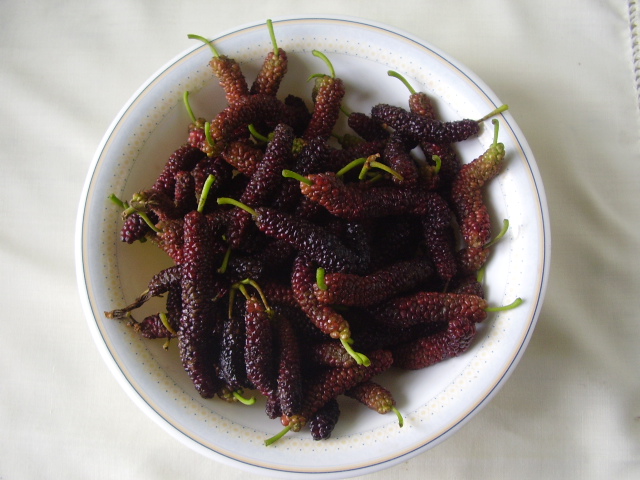
Black mulberry (Morus nigra) is a deciduous tree native to the mountainous regions of Southwestern Asia, specifically Iran and Turkey. It is widely recognized for its heart-shaped, rough-textured leaves and deep purple, almost black, fruits that resemble elongated blackberries.
This species grows more slowly than the white mulberry (Morus alba) but produces a more flavorful harvest with a complex acid-sugar balance. You should plant it away from driveways and footpaths, as the heavy summer fruit drop causes permanent purple stains on concrete, stone, and vehicles.
Key Facts
- Fruit: Ripe in mid-to-late summer
- Hardiness: USDA zones 5 to 9
- Light: Full sun for best fruiting
- Growth: Slow-growing, long-lived specimen
- Soil: Deep, well-drained, fertile loam
Why Choose a Black Mulberry Tree
Black mulberry is a legacy tree for large gardens, offering heavy harvests of gourmet fruit and a gnarled, architectural form that improves with age. Unlike many fruit trees that decline after 30 years, a healthy specimen can live and produce fruit for over 200 years. It is an ideal choice for a focal point in an orchard or a large lawn where its wide, dome-shaped canopy provides deep shade during the summer months.
The tree is genetically distinct from most other plants, possessing 308 chromosomes, which is one of the highest counts in the plant kingdom. This complexity contributes to its intense fruit flavor and its ability to adapt to various soil conditions. You should consider this species if you have the space to accommodate its broad spread and the patience for its slow initial growth rate.
- Provides high yields of fruit for jams and syrups
- Develops a rugged, characterful trunk as it matures
- Supports local bird populations during the fruiting season
- Requires less maintenance than stone fruits like peaches
How to Identify Black Mulberry
You can identify a black mulberry by its thick, heart-shaped leaves that feel rough like sandpaper on the top and soft and hairy on the underside. The leaves typically measure 10-20 cm (4-8 in) in length and are often unlobed, though younger shoots may show some variation. This distinguishes it from the white mulberry (Morus alba), which has smoother, shinier leaves that are frequently deeply lobed.
The fruit is a collective berry, 2-3 cm (0.8-1.2 in) long, turning from green to red and finally to a dark, glossy purple-black when fully ripe. The bark is another key identifier, appearing orange-brown and becoming deeply fissured and craggy as the tree ages. The overall habit is often wider than it is tall, with branches that may eventually lean or touch the ground.
How Big Does a Black Mulberry Tree Get?
A mature black mulberry tree typically reaches a height of 6-9 m (20-30 ft) with a spread that can extend to 12 m (40 ft) or more. Because of its slow growth rate, it may take several decades to reach these dimensions. In the first ten years, you can expect the tree to grow roughly 20-30 cm (8-12 in) per year, depending on soil quality and water availability.
The canopy is dense and rounded, creating a heavy shadow that prevents most grass from growing directly beneath the trunk. In older gardens, the lower branches often become heavy and may require propping or careful management to keep them off the ground. Ensure you have a clear circle of at least 10 m (33 ft) of space to allow the tree to reach its natural, sprawling shape without interference from buildings.
The Best Site for Planting Black Mulberry
The ideal site for a black mulberry is a sunny, sheltered position with deep, well-draining soil that remains moist but not waterlogged. Full sun is necessary for the fruit to develop its high sugar content and reach full maturity in late summer. While the tree is wind-tolerant, a sheltered spot prevents the heavy fruit from being blown off prematurely during summer storms.
Avoid planting near sidewalks, patios, or light-colored stone, as the falling berries will leave deep purple stains that are nearly impossible to remove. The tree is tolerant of urban pollution and can handle a range of soil pH levels, though it performs best in slightly acidic to neutral ground. Do not plant it in shallow soil over chalk or heavy clay, as this will stunt its growth and reduce fruit quality.
Planting Your Mulberry Tree
Plant your black mulberry during the dormant season, between November and March, to allow the roots to settle before the spring growth flush. Dig a hole twice as wide as the root ball and just as deep, incorporating a bucket of well-rotted organic matter into the backfill. Ensure the graft union, if visible, is at least 5 cm (2 in) above the soil line to prevent the scion from rooting.
- Drive a sturdy stake into the hole before planting to avoid root damage
- Tease out any circling roots gently if the tree is pot-bound
- Firm the soil with your heel to remove air pockets around the roots
- Apply a 5 cm (2 in) layer of mulch, keeping it away from the trunk
- Water with at least 20 liters (5 gallons) of water immediately after planting
Caring for Your Black Mulberry: Water and Feed
Water young trees weekly during their first two growing seasons, providing approximately 30 liters (8 gallons) of water during dry spells to ensure establishment. Once the tree is established, it is remarkably drought-tolerant due to its deep root system. However, consistent moisture during the fruit-set period in early summer will result in larger, juicier berries and prevent premature fruit drop.
Feed the tree in early spring with a balanced granular fertilizer or a layer of well-rotted manure spread to the drip line of the canopy. Avoid high-nitrogen fertilizers late in the season, as this encourages soft growth that is susceptible to winter frost damage. Mulching annually in spring helps retain moisture and suppresses weeds that compete for nutrients.
How to Prune Black Mulberry Tree
Prune black mulberry trees only in mid-winter, specifically December or January, to prevent the tree from bleeding a milky sap that weakens the plant. If pruned in spring or summer, the sap flow is so heavy that wounds fail to heal properly, inviting fungal infections. Pruning should be kept to a minimum, as the tree has a naturally attractive shape and does not respond well to hard cutting.
Focus on removing the “three Ds”: dead, damaged, or diseased wood. You should also thin out any branches that are crossing or rubbing against each other to improve airflow through the dense canopy. If you need to restrict the size of the tree, do so gradually over several years rather than removing large amounts of wood at once, as heavy pruning can trigger a flush of non-fruiting water sprouts.
Common Black Mulberry Problems
Birds are the most significant challenge for mulberry growers, often consuming the entire crop before the berries are fully ripe. While netting is an option for small or young trees, mature specimens are usually too large to cover, meaning you must share the harvest. Leaf spot, caused by the fungus Phloeospora maculans, can appear as small brown spots on the foliage during wet summers but rarely threatens the tree’s life.
- Canker: Sunken patches on bark; prune out affected small branches in winter
- Mildew: White coating on leaves; improve airflow by thinning the canopy
- Fruit Drop: Caused by extreme drought or late spring frosts killing blossoms
- Scale Insects: Small bumps on stems; treat with horticultural oil in dormancy
Winter Care and Hardiness
Black mulberry trees are hardy down to -20 °C (-4 °F), but they are susceptible to late spring frosts which can kill the emerging flower catkins. In colder regions, planting against a south-facing wall can provide enough radiant heat to protect the early growth. The tree enters dormancy quite late in the autumn, so avoid any late-season stimulation that might prevent the wood from hardening off.
Young trees under three years old benefit from a thick mulch of straw or bark around the base to protect the root zone from deep freezes. If a late frost is predicted after the buds have burst, covering smaller trees with horticultural fleece overnight can save the year’s fruit crop. Mature trees are generally self-sufficient in winter and require no special protection.
Harvesting and Uses for Black Mulberry Fruit
Harvest the fruit in July and August by spreading a clean sheet on the ground and gently shaking the branches to release the ripe berries. Only the fully black fruits should be collected, as they do not continue to ripen once removed from the tree. Because the fruits are extremely soft and bleed juice easily, they must be used within 24 hours of picking or processed immediately.
The fruit is traditionally used for making intense, dark red syrups and jams, or fermented into mulberry wine. In the past, the syrup was used as a gargle for sore throats due to its astringent properties. The leaves can be dried to make a mild herbal tea, which is common in some Asian cultures. Note that the name “Mulberry” is also associated with a famous British luxury bag brand, but the botanical tree is the original source of the name and the deep purple dye used in historical textiles.
Year-Round Care for Black Mulberry
| Spring | Apply a balanced fertilizer and a fresh layer of mulch in March. Watch for late frosts and cover young trees if necessary. |
|---|---|
| Summer | Water deeply every 10-14 days during dry spells. Harvest ripe fruit daily in July and August to prevent rot and staining on the ground. |
| Autumn | Rake up and compost fallen leaves. Clear any mummified fruit from the branches to prevent fungal spores from overwintering. |
| Winter | Prune for shape and health in December or January only. Check stakes and ties on young trees to ensure they are secure against winter gales. |
Black Mulberry Tree Problems Explained
| What you see | Likely cause | What to do |
|---|---|---|
| Fruit falling while still red | Drought stress or wind | Increase watering frequency and ensure the tree has a windbreak. |
| White powdery coating on leaves | Powdery mildew | Thin the canopy in winter to improve air circulation. |
| Sap leaking from trunk | Mechanical damage or wrong-season pruning | Avoid touching the wound; ensure future pruning happens only in mid-winter. |
Best Black Mulberry Cultivars
- ‘Chelsea’ – A historic variety known for high fruit quality and large leaves.
- ‘Wellington’ – Produces heavy crops of long, slender, very dark fruits.
- ‘Illinois Everbearing’ – A hybrid that fruits over a longer season, though less ‘true’ black mulberry flavor.
- ‘Black Tabor’ – A variety with particularly large, succulent berries.
Frequently Asked Questions
What is the difference between black mulberry and blackberry?
The black mulberry grows on a large tree (Morus nigra), whereas the blackberry (Rubus fruticosus) grows on thorny canes. Mulberry fruit has a small stem that remains attached when picked, while blackberries have a hollow or white core.
What are the benefits of black mulberry?
Black mulberries are high in vitamin C, iron, and anthocyanins, which are potent antioxidants. Traditionally, the fruit syrup was used to soothe sore throats and the leaves were brewed into tea for general wellness.
Is black mulberry juice good for you?
Yes, it is rich in vitamins and minerals, though it is very high in natural sugars and can stain teeth and skin. It is often used as a natural dye or a base for health tonics.
Can you eat black mulberries raw?
Yes, they are best eaten raw directly from the tree when they are fully black and soft. They have a more intense, acidic-sweet flavor than the white mulberry.
How do you make black mulberry tea?
Steep 1-2 teaspoons of dried black mulberry leaves in 250 ml (8 oz) of boiling water for 5-10 minutes. The tea has a mild, earthy flavor and is traditionally used in herbal medicine.
Information about traditional or historical uses is provided for educational interest only and is not medical advice. Do not use any plant to treat a condition without speaking to a qualified professional.
Sources & Verification
Taxonomy and distribution are checked against the databases below. Care guidance is written for cultivated species only and reviewed by our editor. How We Build Plant Profiles →