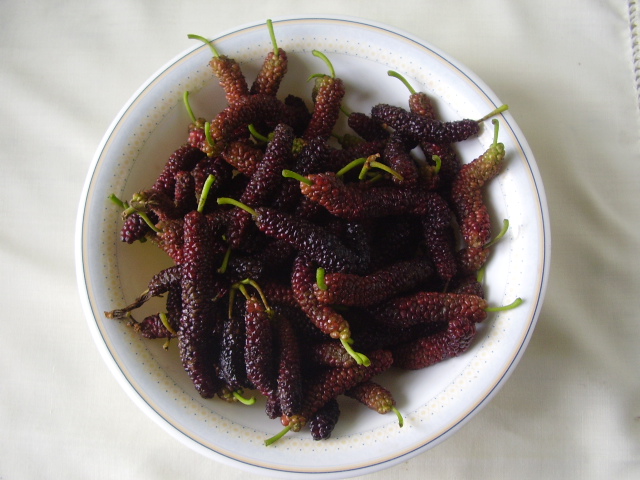
Red mulberry (Morus rubra) is a deciduous tree native to eastern and central North America, easily recognized by its large, rough-textured leaves and dark purple summer fruit. It grows naturally from Ontario down to Florida and as far west as central Texas, often found in rich floodplains or moist woodlands.
This species is frequently confused with the invasive white mulberry (Morus alba), though the native red variety produces superior, tart-sweet fruit and has significantly larger, duller leaves. It requires ample space to accommodate its wide canopy and the heavy drop of staining juice during the harvest season.
Key Facts
- Height: 10–21 m (35–70 ft) at maturity
- Light: Full sun to partial shade
- Fruit: Ripe dark purple berries in mid-summer
- Hardiness: USDA zones 4 through 9
- Soil: Deep, moist, well-drained loams
Growing Red Mulberry in Your Landscape
Red mulberry is best suited for large, rural or suburban properties where its wide spread and messy fruiting habit won’t cause maintenance issues. Because the dark berries stain concrete, decks, and vehicles, you should plant it at least 6 m (20 ft) away from any paved surfaces or structures. It is a choice for wildlife enthusiasts, as the berries attract over 60 species of birds, including cedar waxwings (Bombycilla cedrorum) and Baltimore orioles (Icterus galbula).
In states like Texas and Florida, this tree provides a dense canopy that offers significant shade during high-heat months. It is more shade-tolerant than many other fruit trees, though fruit production is highest when the crown receives at least 6 hours of direct sun. You should be aware that this native species is currently threatened by hybridization with the white mulberry (Morus alba), so sourcing from a reputable native plant nursery is necessary to ensure genetic purity.
How to Identify Red Mulberry
You can identify a red mulberry by its rough, sandpapery leaf texture and its dark, cylindrical fruit that resembles a long blackberry. The leaves are typically 7–18 cm (3–7 in) long, heart-shaped at the base, and may be unlobed or feature 2-3 deep lobes on the same branch. Unlike the glossy, smooth leaves of the white mulberry, the native red mulberry leaf is dull green on top and covered in soft white hairs on the underside.
- Bark: Grey-brown with flattened scaly ridges.
- Buds: Pointed, reddish-brown, and slightly pressed against the twig.
- Fruit: 2–3 cm (1 inch) long, turning from green to red, then dark purple-black.
- Sap: Stems and petioles exude a milky white latex when broken.
Red Mulberry Tree Size and Growth Habit
A mature red mulberry typically reaches a height of 10–15 m (35–50 ft), though exceptional specimens in forest settings can hit 21 m (70 ft). The tree develops a short, sturdy trunk and a dense, spreading crown that can reach a width of 12 m (40 ft) or more. Its growth rate is moderate, often putting on 30–60 cm (1–2 ft) of height per year during its first decade.
Because the wood is relatively soft and prone to decay if wounded, the tree’s habit can become somewhat irregular as it ages. The low-branching structure makes it an excellent climbing tree for children, provided the limb diameter is sufficient. In home gardens, the size can be managed through regular pruning, though it is naturally a medium-to-large canopy tree.
Choosing the Best Planting Site
The ideal site for a red mulberry features deep, moist, well-drained soil with a neutral to slightly alkaline pH. While it is adaptable to various soil types, including clay and sand, it performs poorly in areas with standing water or extreme drought. In its native range from Nebraska to Vermont, it is often found on the edges of woods where it receives a mix of sun and wind protection.
Consider the wind when selecting a spot, as the large leaves can act like sails, potentially stressing the root system in open, gale-prone areas. If you are planting in the southern United States, such as Georgia or Texas, provide a site with good air circulation to prevent fungal leaf spots. Ensure there is enough vertical clearance from power lines, as the tree’s broad crown will eventually interfere with overhead utilities.
Planting and Establishing Young Trees
You should plant young trees in early spring before the buds break or in late autumn after the leaves have fallen. Dig a hole twice as wide as the root ball but no deeper, ensuring the flare at the base of the trunk remains at or slightly above the soil line. Backfill with the native soil without adding heavy fertilizers, which can burn the sensitive young roots of this species.
- Spacing: Allow at least 9 m (30 ft) between trees for full canopy development.
- Mulching: Apply a 5–10 cm (2–4 in) layer of wood chips around the base, keeping it away from the trunk.
- Staking: Only stake in very windy sites, using flexible ties to allow for trunk movement.
- Initial Water: Provide 20 litres (5 gallons) of water immediately after planting.
Watering and Feeding Requirements
Established trees require approximately 2.5 cm (1 inch) of water per week during the growing season to produce juicy, high-quality fruit. While the species is moderately drought-tolerant once the root system is deep, prolonged dry spells will cause the fruit to drop prematurely or shrivel on the branch. If you live in an arid region, a deep soaking every two weeks during summer is better than frequent light watering.
Fertilization is rarely necessary for red mulberry if the soil is healthy and mulched with organic matter. If growth appears stunted or leaves are pale, apply a balanced 10-10-10 fertilizer in early spring just as new growth begins. Avoid high-nitrogen fertilizers late in the summer, as this encourages soft new growth that may be damaged by the first frosts of winter.
Pruning for Health and Fruit Production
The best time to prune a red mulberry is in late winter or very early spring while the tree is still dormant. This species is a “bleeder,” meaning it will leak significant amounts of sap if cut during the spring sap-rise, which can attract pests and pathogens. Focus on removing dead, damaged, or crossing branches to maintain an open structure that allows light into the center of the canopy.
If you are growing the tree specifically for fruit, you can head back long, vigorous shoots to encourage the development of lateral fruiting spurs. Remove any suckers arising from the base of the trunk or the roots immediately, as these drain energy from the main tree. Always use sharp, sterilized bypass pruners or a pruning saw to ensure clean cuts that heal quickly without the need for pruning paint.
Common Red Mulberry Tree Problems
The most frequent issue for this tree is Popcorn Disease (Ciboria carunculoides), a fungus that causes individual fruit drupelets to swell and look like unpopped corn. This disease is not fatal to the tree but renders the fruit inedible; you can manage it by raking up and destroying all fallen fruit and leaves in the autumn. Bacterial blight can also occur, causing black spots on leaves and dieback of young twigs during wet springs.
- Webworms: Social caterpillars that spin silken nests in late summer; prune out infested branch tips.
- Leaf Spot: Fungal spots that appear in humid weather; ensure proper tree spacing for airflow.
- Cankers: Sunken areas on bark caused by fungi; prune out affected limbs 15 cm (6 in) below the canker.
- Root Rot: Occurs in poorly drained soil; improve drainage or relocate young trees.
Winter Hardiness and Seasonal Protection
Red mulberry is hardy down to -34 °C (-30 °F), making it suitable for northern climates in USDA zone 4. In these colder regions, the tree enters a deep dormancy and requires no special wrapping or heating. However, young saplings can be susceptible to frost cracking on the trunk if they experience rapid temperature swings in late winter; a white tree wrap can help reflect winter sun and prevent this.
In the southern part of its range, the tree may not receive enough “chill hours” if the winter is exceptionally mild, which can lead to poor fruit set the following year. Ensure the tree is well-watered going into the first hard freeze, as desiccated roots are more prone to winter kill. Once the leaves drop in autumn, the tree is very low-maintenance until the following spring.
Harvesting and Using Red Mulberry Fruit
Harvest the fruit in June or July when the berries have turned a deep, dark purple and come away from the stem with a gentle tug. The most efficient way to harvest large quantities is to spread a clean sheet or tarp under the tree and gently shake the branches. The berries are highly perishable and should be eaten or processed within 24 hours of picking.
The fruit was traditionally used by Indigenous North Americans for both food and medicinal purposes, including a tea made from the bark to treat various ailments. In modern kitchens, red mulberries are used in pies, jams, and wine, or dried for use in granola. They are significantly sweeter and more flavorful than the fruit of the white mulberry, though they contain a small, edible green stem in the center of each berry.
Year-Round Care for Red Mulberry
| Spring | Apply a fresh layer of organic mulch 5-10 cm (2-4 in) deep. Monitor for bacterial blight during wet weather and prune out any dead wood before leaves fully expand. |
|---|---|
| Summer | Harvest ripe fruit daily in June and July to prevent ground mess. Provide 2.5 cm (1 inch) of water weekly during dry spells to maintain fruit size. |
| Autumn | Rake up and destroy all fallen fruit and leaves to prevent the spread of Popcorn Disease. Plant new saplings once the tree enters dormancy. |
| Winter | Perform structural pruning in late winter while the tree is dormant. Check for scale insects or cankers on the bark of the main trunk. |
Common Red Mulberry Problems Explained
| What you see | Likely cause | What to do |
|---|---|---|
| Fruit looks like unpopped popcorn | Popcorn Disease fungus | Rake and destroy all fallen fruit and mulch the area heavily in spring. |
| Milky sap leaking from trunk | Mechanical injury or pruning | Avoid pruning during the spring sap-flow period; let the wound air-dry naturally. |
| Yellowing leaves in mid-summer | Drought stress or poor drainage | Check soil moisture 10 cm (4 in) deep and adjust watering to keep soil moist but not soggy. |
| Silken webs on branch tips | Fall webworms | Prune out the affected branch tips or use a pole to break open the webs for birds. |
Red Mulberry Cultivars for Home Orchards
- ‘Hicks’ – an older variety known for heavy fruit production in the South.
- ‘Stubbs’ – features very large fruit, often exceeding 3 cm in length.
- ‘Townsend’ – a cold-hardy selection with excellent flavor profiles.
- ‘Johnson’ – known for a long harvest window and consistent yields.
Frequently Asked Questions
What is the difference between red mulberry and white mulberry?
Red mulberry (Morus rubra) has rough, dull leaves with hairy undersides and dark fruit, while white mulberry (Morus alba) has glossy, smooth leaves and often (but not always) lighter fruit.
How big does a red mulberry tree get?
A typical red mulberry reaches 10–15 m (35–50 ft) in height with a similar spread, though wild trees can grow taller.
Are red mulberries invasive in North America?
No, red mulberry is a native species; it is the white mulberry (Morus alba) from Asia that is considered invasive.
Can you grow red mulberry in Texas or Florida?
Yes, red mulberry is native to both states and thrives in their warm climates, though it needs consistent moisture in sandy Florida soils.
What are the benefits of eating red mulberries?
The fruit is high in Vitamin C, iron, and antioxidants, and was traditionally used in teas to treat fevers and dysentery.
How do I stop my mulberry tree from staining my driveway?
There is no way to stop the fruiting; the best solution is to plant the tree at least 6 m (20 ft) away from pavement or choose a fruitless male cultivar.
Information about traditional or historical uses is provided for educational interest only and is not medical advice. Do not use any plant to treat a condition without speaking to a qualified professional.
Sources & Verification
Taxonomy and distribution are checked against the databases below. Care guidance is written for cultivated species only and reviewed by our editor. How We Build Plant Profiles →