
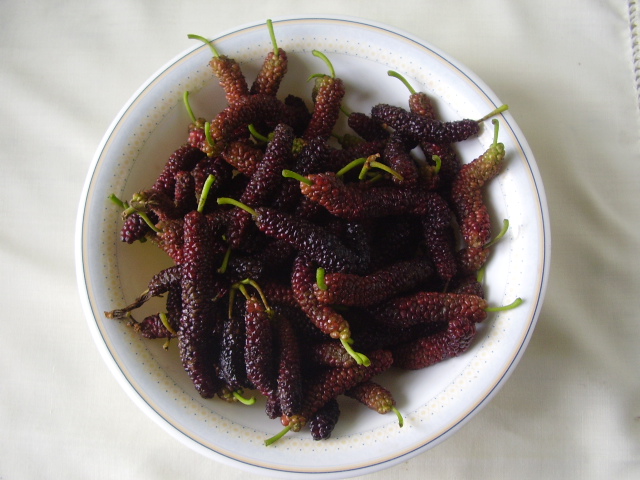
Long mulberry (Morus macroura) is a deciduous fruit tree native to the Himalayan foothills, southern China, and Indochina, recognized by its cylindrical berries that reach up to 12 cm (5 in) long. The pale ivory or ruby-purple fruits deliver a rich honey flavor entirely free from the sharp acidity found in common berries.
A grafted sapling will begin cropping within two to three years, but the tree requires substantial garden space to accommodate its wide, weeping branch canopy. In regions with late spring frosts, budding trees must be shielded to prevent flower and early crop loss.
Key Facts
- Mature height: 7–12 m (23–40 ft)
- Fruit length: 6–12 cm (2.5–5 in)
- Hardiness: USDA Zones 8 to 11
- Sunlight: full sun (6+ hours daily)
- Soil: well-drained loamy soil, pH 6.0–7.0
- First fruit: 2–3 years from grafting
Is Long Mulberry Right for Your Garden?
Long mulberry suits spacious, sunny gardens in USDA zones 8 to 11 where winter cold rarely dips below -7 °C (20 °F). Because a mature canopy spreads up to 10 m (33 ft) across with weeping, pendulous branches, it is too large for compact suburban borders or small container culture.
Unlike the staining purple juices of black mulberry (Morus nigra), white-fruited selections of this species drop clean, pale berries that do not mark stone paths or driveways. It performs best for growers seeking massive seasonal fruit crops without the constant spraying schedules demanded by apples or stone fruits.
How to Identify Long Mulberry Trees and Fruit
Long mulberry is distinguished by its narrow, finger-shaped aggregate fruit measuring between 6 and 12 cm (2.5 and 5 in) in length. Ripe fruit colors range from pale greenish-white to deep reddish-purple, depending on whether you grow the white Himalayan form or the darker Pakistani selections.
The tree develops a spreading, weeping habit with smooth, pale grey-brown bark that furrows lightly with age. Its alternate, heart-shaped leaves measure 10–20 cm (4–8 in) long with serrated margins and pointed tips, appearing alongside pendulous green catkin flowers in early spring.
Sun, Soil, and Climate Requirements
Grow long mulberry in a position that receives at least six to eight hours of direct sun every day during the growing season. Inadequate light results in weak, leggy branch growth and significantly reduces fruit sweetness.
The tree thrives across diverse ground conditions but requires well-drained ground to prevent fungal root issues:
- Soil texture: deep sandy loam or loamy garden soil
- Drainage: rapid percolation; trees will not tolerate standing water
- Soil pH: slightly acidic to neutral, between 6.0 and 7.0
- Wind shelter: protection from strong winds that can snap brittle, fruit-laden limbs
Planting and Establishing Long Mulberry
Always establish your orchard using a grafted long mulberry plant, because seed-grown trees take up to a decade to fruit and yield unpredictable berry quality. Plant dormant bare-root stock in late winter, or container-grown specimens from early spring through autumn.
Follow these planting steps to give young trees the best foundation:
- Dig a planting hole twice as wide as the root ball and equal in depth.
- Position the tree so the graft union rests 8–10 cm (3–4 in) above the surrounding soil level.
- Backfill with native topsoil, firming gently to eliminate subterranean air pockets.
- Drench the root zone with 30 L (8 gal) of water immediately after planting.
- Spread a 7 cm (3 in) layer of organic wood mulch around the base, keeping it clear of the trunk.
Watering, Feeding, and Pruning Care
Provide your tree with 25 to 50 mm (1 to 2 in) of water weekly throughout the spring blooming and fruit-swelling periods. Mature trees withstand moderate seasonal drought, but dry soil during crop development causes berries to shrivel and drop prematurely.
Feed trees in early spring just as leaf buds swell by broadcasting a balanced 10-10-10 organic fertilizer or applying 5 cm (2 in) of well-rotted compost around the drip line. Avoid high-nitrogen feeds after midsummer, which stimulate soft autumn growth prone to frost damage.
Prune in midwinter while the tree is fully dormant. Shorten long weeping limbs to maintain picking height below 4 m (13 ft), and remove crossing or dead wood to promote light penetration into the center of the crown.
Harvesting Long Mulberry Fruit
Harvest long mulberries across their four-to-six-week ripening window from late spring into early summer as the fruit softens completely. The berries do not ripen all at once, requiring harvest passes every two days.
Unlike red mulberry (Morus rubra), ripe long mulberries hold firmly to the stems and do not fall cleanly when the tree is shaken. Clip or gently pull individual berries by hand with the central stem attached to prevent tearing the fragile flesh and leaking sugary juices.
Culinary Uses and Cooking with Mulberries
Long mulberries are primarily consumed fresh off the branch, but their high natural sugar makes them versatile in baking, syrups, and preserves. When making long mulberry jam, simmer crushed berries with sugar, citrus pectin, and lemon juice for 15 to 20 minutes until reaching 105 °C (221 °F).
Beyond the fruit, other parts of the plant offer domestic uses:
- Mulberry leaf tea: boil washed fresh leaves for 3 to 5 minutes, or steep dried leaves in boiling water for 5 to 7 minutes for a mild herbal infusion.
- Baking: fold whole raw berries into tarts, cakes, and morning pancakes alongside common figs (Ficus carica).
- Firewood: allow dense hardwood pruning logs to season under cover for 12 to 18 months before burning in wood stoves.
Common Long Mulberry Problems and Pests
The most persistent problem when growing long mulberry is severe crop loss from wild birds as soon as the fruit turns sweet. Netting branches or draping individual fruit clusters with exclusion bags is the only reliable method to save ripening berries.
Keep watch for these common cultural and environmental issues:
- Premature fruit drop: triggered by sudden soil drying or cold wind; maintain consistent ground moisture with thick mulch.
- Powdery mildew: appears as a white coating on foliage during humid, still weather; thin out interior branches to boost air circulation.
- Bacterial blight: black lesions on leaves and shoots during damp springs; prune out infected branches using sterilized shears.
- Root rot: leaf yellowing and dieback in waterlogged beds; relocate trees to raised mounds if drainage is inadequate.
How to Store and Preserve Long Mulberries
Fresh long mulberries keep for only two to three days in the refrigerator before mold begins to develop on their sugary skins. Place unwashed berries in a shallow, paper-towel-lined container in a single layer to avoid crushing bottom fruits.
For long-term preservation, choose one of these methods:
- Freezing: arrange whole dry berries on a baking sheet at -18 °C (0 °F) for 4 hours, then store in airtight bags for up to 12 months.
- Dehydrating: dry whole fruits in a food dehydrator at 55 °C (130 °F) for 12 to 16 hours until chewy and leathery like raisins.
- Canning: cook whole berries down into rich compotes or jars of jam with added lemon juice to ensure safe food acidity levels.
Frequently Asked Questions
How long do mulberry trees live?
Mulberry trees routinely live for 100 to 250 years when planted in well-drained soil with full sunlight. Grafted long mulberry trees remain vigorously productive for over 75 years with routine winter maintenance.
How long until a long mulberry tree bears fruit?
A grafted long mulberry plant bears its first fruit in two to three years after planting. Seedling-grown trees take between six and ten years to crop and rarely produce the long fruit sizes of named varieties.
What are the health benefits of long mulberry fruit?
Long mulberries are packed with vitamin C, iron, and dietary fiber, while containing natural antioxidants like anthocyanins in purple varieties. Their high natural sugar level provides instant culinary sweetness without requiring added processed sugar.
How long to boil mulberry leaves for tea?
Boil fresh mulberry leaves for three to five minutes in water, or steep dried crushed leaves in freshly boiled water for five to seven minutes. Strain through a fine mesh sieve before serving warm or iced.
How long to season mulberry firewood?
Mulberry firewood must season for 12 to 18 months in a dry, ventilated shed before it is ready to burn. The wood is exceptionally dense and retains water, but once cured it burns hot with long-lasting coals.
How long to cook mulberry jam?
Simmer long mulberry jam for 15 to 20 minutes on medium heat once pectin and lemon juice are incorporated. Because mulberries have very low natural acidity and pectin, adding citrus juice is mandatory for the preserve to set firmly at 105 °C (221 °F).
Sources & Verification
Taxonomy and distribution are checked against the databases below. Care guidance is written for cultivated species only and reviewed by our editor. How We Build Plant Profiles →


