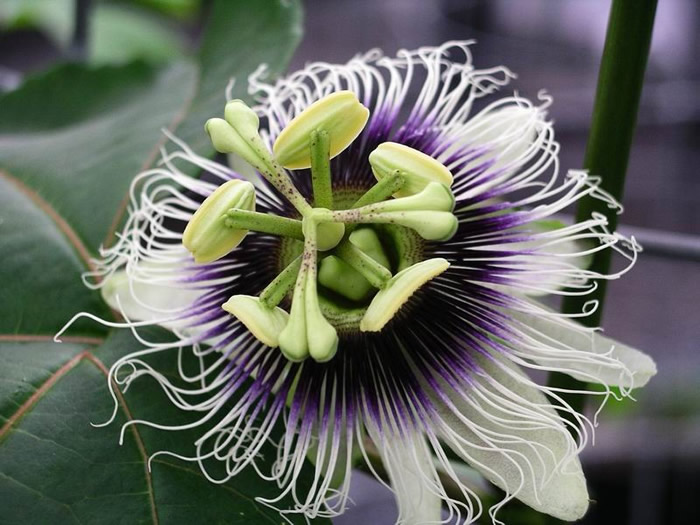
Stinking passionflower (Passiflora foetida) is a perennial creeping vine native to the tropical Americas, recognizable by its sticky webbed floral bracts and foul-smelling foliage.
Its ripe orange fruits are edible and sweet, though the green plant tissue contains toxic cyanogenic glycosides. This vine thrives in disturbed soils across USDA hardiness zones 9 to 11.
Key Facts
- Type: Perennial tropical trailing vine
- Native Range: Southwestern US, Caribbean, Central and South America
- Fruit: Edible ripe orange berries 2-3 cm wide
- Toxicity: Unripe fruit and leaves contain toxic glycosides
- Habitat: Disturbed soil, coastal scrub, road margins
Where Stinking Passionflower Fits
Stinking passionflower is a wild tropical vine suited for naturalized wildlife habitats in USDA zones 9 through 11.
This fast-growing creeper spreads up to 4 m (13 ft) across fences and scrubland. It thrives in high heat and disturbed soils where sensitive plants fail. Avoid planting it near delicate native flora because its dense wiry tendrils can overpower smaller vegetation.
How to Identify Passiflora foetida
You can identify Passiflora foetida by its three-lobed hairy leaves that release a sharp, unpleasant odor when crushed.
The plant produces distinct features throughout its growing season:
- Flowers: White to pale pink blooms measuring 2 to 5 cm (0.8 to 2 in) across with a fringed purple corona.
- Bracts: Deeply divided moss-like green bracts covered in sticky glandular hairs that surround each flower and fruit.
- Fruit: Spherical berries transitioning from green to bright orange or red, reaching 2 to 3 cm (0.8 to 1.2 in) in diameter.
- Stems: Slender herbaceous stems covered in fine stiff hairs and wiry climbing tendrils.
Native Range and Natural Habitat
The native range of Passiflora foetida extends from Texas and Mexico south through Central America, the Caribbean, and tropical South America down to 28° S latitude.
It naturally inhabits sandy coastal thickets, riverbanks, forest clearings, and roadside ditches from sea level up to 1,500 m (4,900 ft) elevation. Outside its native range, seed trade has naturalized this species in Southeast Asia, Queensland, Hawaii, and East Africa.
Ecology and Sticky Insect Traps
The modified glandular bracts surrounding the flowers trap small crawling insects using a sticky mucilage containing digestive enzymes.
Research shows these protocarnivorous bracts shield developing flower buds and fruit from sap-sucking insects and egg-laying caterpillars. The white flowers attract major pollinators including carpenter bees (Xylocopa species) and Heliconius butterflies, which deposit eggs on the hairy leaves.
Conservation Status and Weedy Spread
The IUCN categorizes Passiflora foetida as Least Concern because of its large wild population and aggressive opportunistic growth.
In countries such as Australia, Singapore, and Sri Lanka, land managers consider it an environmental weed. Birds and small mammals digest the sweet orange arils and scatter seeds across degraded pastures and forest margins.
Corona Di La Birgen Uses and Edible Fruit
The fully ripe orange fruit of Passiflora foetida is edible with a sweet, aromatic pulp, while the plant is locally called corona di la birgen in Curaçao and parts of Latin America.
In traditional Caribbean and South American herbal practices, leaf decoctions were historically applied to soothe skin rashes or prepared into tea for nervousness. Unripe green berries and raw leaves contain dangerous cyanogenic glycosides and should never be eaten raw.
Similar Passionflower Species
You can distinguish Passiflora foetida from related vines by its sticky moss-like bracts encircling the flowers and fruit.
Key differences among similar species include:
- Blue passionflower (Passiflora caerulea): Features smooth five-lobed leaves and survives winter frosts down to -10 °C (14 °F).
- Yellow passionfruit (Passiflora edulis): Bears smooth purple or yellow fruit measuring 6 to 8 cm (2.4 to 3.1 in) across without webbed bracts.
- Maypop (Passiflora incarnata): Native to the southeastern US with larger 7 cm (2.8 in) purple flowers and non-fetid leaves.
- Winged-stem passionflower (Passiflora alata): Displays square four-angled stems and fragrant deep red blooms.
Frequently Asked Questions
Is Passiflora foetida fruit edible?
Yes, the fully ripe orange or red fruit pulp is edible and sweet. However, unripe green fruit and foliage contain toxic cyanogenic compounds and must not be eaten.
What does corona di la birgen mean?
Corona di la birgen translates to 'crown of the Virgin Mary' in Papiamento and Spanish, referring to the intricate floral corona that resembles a religious crown.
Why does Passiflora foetida smell bad?
Bruised leaves and stems release volatile sulfur compounds that produce a foul, fetid odor, which deters grazing herbivores.
How do you germinate Passiflora foetida seeds?
Extract seeds from ripe orange fruit, soak them in warm water for 24 hours, and sow 0.5 cm (0.2 in) deep in warm soil kept at 22-28 °C (72-82 °F).
Is Corona de la Virgen toxic to pets?
Yes, green foliage and unripe fruit contain cyanogenic glycosides that cause vomiting and drooling in dogs and cats if chewed.
Information about traditional or historical uses is provided for educational interest only and is not medical advice. Do not use any plant to treat a condition without speaking to a qualified professional.
Sources & Verification
Taxonomy and distribution are checked against the databases below. Care guidance is written for cultivated species only and reviewed by our editor. How We Build Plant Profiles →