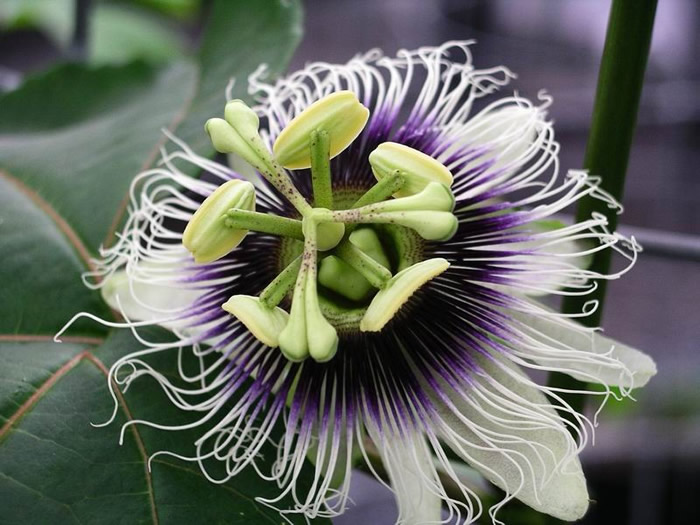
Purple Passionflower is a fast-growing perennial vine native to the Southeastern United States, easily recognized by its complex, fringed flowers and three-lobed leaves. Scientifically known as Passiflora incarnata, it is the hardiest of the passionflower genus, capable of surviving freezing winters by dying back to the roots.
You can expect this vine to reach lengths of 2-9 m (6-30 ft) in a single season, producing air-filled green fruits called maypops. While it provides edible yields and supports local pollinators, its aggressive root suckers require management to prevent it from overtaking garden beds.
Key Facts
- Hardiness: USDA zones 6 to 9
- Light: Full sun for at least 6-8 hours
- Water: 2.5 cm (1 in) per week during summer
- Growth: Up to 9 m (30 ft) per season
- Fruit: Edible green berries that ripen to yellow
How Purple Passionflower Fits Your Garden
Purple Passionflower is best used as a fast-covering screen for fences, trellises, or arbors where its aggressive climbing habit can be utilized. Because it spreads via underground runners, you should plant it in areas where these suckers can be mowed or contained by root barriers. It is a functional choice for native plant gardens in the Southern US, where it serves as the primary host for Gulf Fritillary (Agraulis vanillae) butterflies.
The vine provides a tropical appearance in temperate climates where other Passiflora species would fail. In Zone 6, it will disappear completely in winter and may not emerge until late May, hence the name Maypop. It requires a sturdy support structure, as a mature vine can weigh significantly when laden with fruit in August.
Identifying the Maypop Vine
You can identify Passiflora incarnata by its intricate 6-9 cm (2.5-3.5 in) flowers featuring a central crown of wavy, purple filaments. The leaves are alternate and deeply divided into three finely serrated lobes, usually measuring 10-15 cm (4-6 in) across. Stems are smooth, green or tinged with purple, and utilize axillary tendrils to coil around supports.
The fruit, known as a maypop, is an oval berry roughly the size of a hen’s egg, 5 cm (2 in) long. It begins as a smooth green fruit and develops a yellowish hue as it matures and begins to wrinkle. When stepped on, the hollow fruit makes a distinct popping sound due to the air trapped inside the casing.
Best Light and Soil for Passionflower
Purple Passionflower requires full sun to produce its maximum number of flowers and fruit. While it can survive in partial shade, the vine will become leggy and the flowering period will be significantly shortened. In hotter regions like Florida or Texas, some afternoon shade can prevent the foliage from wilting during peak temperatures above 35 °C (95 °F).
The soil must be well-drained, as this species is prone to root rot in standing water. It thrives in loamy or sandy soils with a neutral to slightly alkaline pH. If your garden has heavy clay, you should amend the planting site with organic matter or grit to ensure the roots do not sit in saturated soil during the winter dormancy period.
Planting and Supporting the Vines
Space your plants 90-150 cm (3-5 ft) apart to allow for adequate air circulation and growth. Because the vine climbs via tendrils rather than twining stems, it needs thin supports like wire mesh, netting, or thin wooden slats it can easily grasp. Plant the root ball at the same depth it was in the nursery pot, firming the soil to remove air pockets.
If you wish to prevent the plant from spreading throughout the garden, install a 30 cm (12 in) deep plastic root barrier around the planting site. This helps contain the rhizomes that would otherwise send up new shoots several meters away from the main plant. Mulch the base with 5 cm (2 in) of wood chips to retain moisture after initial planting.
Watering and Feeding Schedules
Provide 2.5 cm (1 in) of water per week during the active growing season from May to September. Purple Passionflower is moderately drought-tolerant once established, but consistent moisture is required to prevent the fruit from dropping prematurely. During periods of extreme heat, you may need to water twice weekly if the top 5 cm (2 in) of soil feels dry.
Feed the vine with a balanced 10-10-10 fertilizer in early spring when new growth first appears. Avoid over-fertilizing with high-nitrogen products, as this will result in excessive leaf growth at the expense of flowers. A second application of a high-potassium feed in mid-summer can help support fruit development and winter hardiness of the root system.
Controlling Growth with Pruning
Prune your Purple Passionflower back to 30 cm (12 in) above the ground in late winter or early spring before new growth begins. Since flowers are produced on new wood, this heavy pruning encourages a flush of fresh, flowering stems. Throughout the summer, you can trim back stray runners that have grown beyond their designated trellis or support.
Remove any dead or diseased stems as soon as they are spotted to maintain vine health. If the vine becomes too dense, thin out the interior stems to improve light penetration to the lower leaves. This helps prevent fungal issues that occur when the foliage remains damp for extended periods after rain.
Propagating Purple Passionflower from Seeds and Cuttings
Propagate by seed by scarifying the seed coat with sandpaper and soaking them in warm water for 24 hours. Sow the seeds 1 cm (0.4 in) deep in a seed-starting mix and maintain a temperature of 21-27 °C (70-80 °F). Germination can be erratic, sometimes taking 2 to 8 weeks, so do not discard pots prematurely.
Softwood cuttings are an alternative method for mid-summer propagation. Follow these steps for success:
- Take a 15 cm (6 in) cutting from a healthy, non-flowering stem.
- Remove the lower leaves and dip the cut end in rooting hormone.
- Place the cutting in a mix of perlite and peat moss.
- Keep the cutting under a plastic dome in bright, indirect light for 4 weeks.
Managing Pests and Diseases
The most common visitors are Gulf Fritillary caterpillars, which can quickly defoliate a young vine. While these are beneficial butterflies, a heavy infestation on a small plant may require manual relocation of the larvae to a larger specimen. In most cases, a healthy, established Purple Passionflower will quickly regrow any lost foliage without chemical intervention.
Watch for spider mites and whiteflies during hot, dry spells, particularly if the plant is grown in a greenhouse or sheltered corner. Fungal leaf spot can occur during humid summers; ensure the plant has 360-degree air circulation to minimize this risk. If root rot occurs, it is usually a sign of poor drainage rather than a specific pathogen, requiring a change in soil structure.
Winter Protection and Hardiness
In zones 6 and 7, apply a 10 cm (4 in) layer of mulch over the root zone in late autumn to protect the crown from deep freezes. While the top growth will turn brown and die after the first hard frost, the roots can survive temperatures as low as -15 °C (5 °F). Do not prune the dead stems until late winter, as they provide a small amount of insulation for the crown.
Be patient in the spring, as this species is one of the last perennials to emerge from dormancy. It often waits until the soil temperature consistently reaches 18 °C (65 °F) before sending up new shoots. If the plant is grown in a container, move it to an unheated garage or basement for the winter to prevent the roots from freezing through.
The Flowering and Fruiting Cycle
Flowering typically begins in late June and continues through August, with each individual blossom lasting only about 24 hours. The flowers are self-compatible but benefit from the presence of large bees, such as carpenter bees (Xylocopa), for effective pollination. If flowers are falling off without forming fruit, it is often due to a lack of pollinators or extreme temperature fluctuations.
The maypop fruit takes approximately 60 days to ripen after pollination. You will know they are ready to harvest when the skin turns from bright green to a dull, slightly wrinkled yellow and the fruit feels light for its size. The interior consists of small seeds surrounded by a tart, aromatic pulp that can be eaten fresh or used to make jellies and juices.
Year-Round Care for Purple Passionflower
| Spring | Prune dead stems to 30 cm (12 in) and apply a balanced 10-10-10 fertilizer. Wait for new shoots to emerge in late May. |
|---|---|
| Summer | Provide 2.5 cm (1 in) of water weekly and monitor for Gulf Fritillary caterpillars. Train new runners onto the trellis. |
| Autumn | Harvest yellow, wrinkled fruits for eating. Apply 10 cm (4 in) of mulch over the root zone after the first frost. |
| Winter | Leave dead vines in place to protect the crown or clear them for aesthetics. Ensure the site remains well-drained. |
Common Maypop Problems and Solutions
| What you see | Likely cause | What to do |
|---|---|---|
| Yellow leaves and wilting | Overwatering or root rot | Reduce watering frequency and ensure the soil has adequate drainage. |
| No flowers on mature vine | Too much nitrogen or shade | Switch to a high-potassium fertilizer and ensure the plant gets 6+ hours of sun. |
| Fruit dropping before ripe | Inconsistent watering | Maintain steady soil moisture, especially during heatwaves. |
| Small holes in leaves | Fritillary caterpillars | Allow the caterpillars to feed as they are the larvae of a native butterfly. |
Recommended Passionflower Cultivars
- ‘Alba’ – pure white flowers, slightly less vigorous than the species.
- ‘Inspiration’ – deep purple filaments, hybrid with improved cold tolerance.
- ‘Incense’ – a hybrid (P. incarnata x P. cincinnata) with very fragrant, dark purple blooms.
Companion Plants for Passionflower
Select companions that can withstand the vigorous growth of the vine without being smothered. Good choices include other hardy climbers or tall perennials that share similar sun requirements. Consider these species for a balanced garden:
- Trumpet Honeysuckle (Lonicera sempervirens) for contrasting red flowers.
- Clematis (Clematis viticella) for complementary bloom shapes.
- Joe Pye Weed (Eutrochium purpureum) to provide a sturdy vertical backdrop.
- Switchgrass (Panicum virgatum) to hide the bare lower stems of the vine.
Frequently Asked Questions
Are purple passion flowers poisonous?
No, Purple Passionflower is generally considered non-toxic to humans and pets, and the ripe fruit is edible. However, the leaves contain small amounts of cyanogenic glycosides and should not be consumed in large quantities.
Can you make tea from Purple Passionflower?
Yes, the leaves and flowers of Passiflora incarnata have been traditionally used to make a herbal tea. It was historically used as a mild sedative to help with anxiety and insomnia.
Why is it called a Maypop?
The name refers to the fact that the plant 'pops' out of the ground in May and the hollow, air-filled fruits make a popping sound when crushed. It is a common folk name in the Southern United States.
How fast does Purple Passionflower grow?
It is an extremely fast grower, capable of reaching 6 to 9 meters (20 to 30 feet) in a single growing season. This rapid growth makes it ideal for covering large fences quickly.
Is Purple Passionfruit the same as Maypop?
No, the commercial Purple Passionfruit is Passiflora edulis, which is a tropical species. Maypop (Passiflora incarnata) is its cold-hardy relative with a more tart, complex flavor.
Information about traditional or historical uses is provided for educational interest only and is not medical advice. Do not use any plant to treat a condition without speaking to a qualified professional.
Sources & Verification
Taxonomy and distribution are checked against the databases below. Care guidance is written for cultivated species only and reviewed by our editor. How We Build Plant Profiles →
- North Carolina Extension Gardener Plant Toolboxplants.ces.ncsu.edu
- Missouri Botanical Gardenmissouribotanicalgarden.org
- USDA PLANTS Databaseplants.usda.gov
- GBIF — Global Biodiversity Information Facilitytaxonomy, synonyms, occurrence records
- Plants of the World Online (Kew)accepted name, native range
- Wikipediageneral reference