
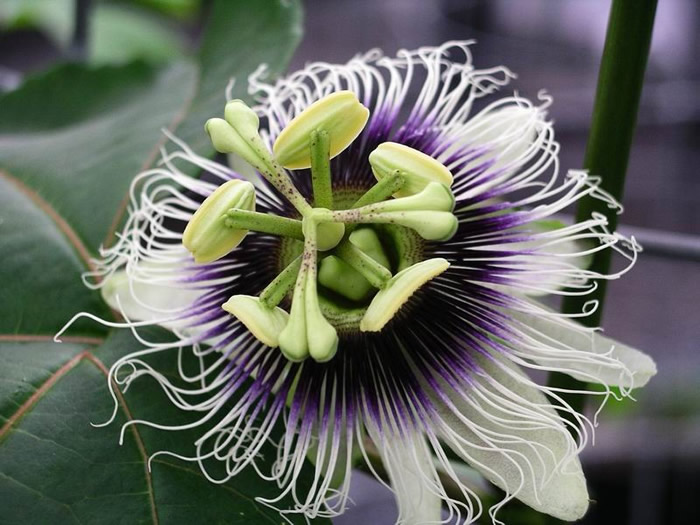
Passiflora edulis is a vigorous climbing vine native to South America, primarily Brazil, Paraguay, and northern Argentina. It is recognized by its glossy, three-lobed leaves and complex, fringed flowers that appear in the warmth of summer.
Growing this vine indoors requires a large container and a sturdy trellis to manage its 9 m (30 ft) potential length. While the purple variety is most common, the yellow form (Passiflora edulis f. flavicarpa) is often larger and requires more heat to produce fruit.
Key Facts
- Light: at least 6-8 hours of direct sunlight
- Water: when the top 2.5 cm (1 in) of soil is dry
- Support: requires a strong trellis or wire support
- Temperature: keep between 18-28 °C (65-82 °F)
- Growth: can grow up to 1 m (3 ft) per month
Growing Passion Fruit Indoors
Growing Passion Fruit indoors is a commitment to managing a vigorous climber that needs significant vertical space. You must provide a heavy pot and a trellis at least 1.5 m (5 ft) tall to support the weight of the dense foliage and developing fruit. It suits bright sunrooms or south-facing windows where it can receive intense light throughout the day.
This vine is often used to create a living screen against a window, but it requires regular pruning to stay within bounds. Because it grows so quickly, you may need to repot it every year into a container 5-10 cm (2-4 in) larger than the previous one. It is a productive plant that can provide fruit for cocktails or desserts if you manage its high light and humidity requirements.
Identifying Passiflora edulis
The Passion Fruit vine features glossy green leaves that are usually 10-18 cm (4-7 in) long with three distinct, pointed lobes. Its flowers are 5-8 cm (2-3 in) wide, consisting of five white petals and five sepals topped with a crown of purple and white wavy filaments. The fruit is a round or oval berry, 4-7 cm (1.5-3 in) in diameter, which turns deep purple or yellow when fully mature.
You can distinguish it from similar species by its smooth, hairless stems and the presence of two small glands on the leaf stalk. Some related species you might encounter include:
- Blue passionflower (Passiflora caerulea) – more cold-hardy with five-lobed leaves.
- Sweet granadilla (Passiflora ligularis) – heart-shaped leaves and orange-skinned fruit.
- Giant granadilla (Passiflora quadrangularis) – square stems and much larger, melon-sized fruit.
- Stinking passionflower (Passiflora foetida) – hairy leaves and small red fruit.
Light Requirements for Passion Fruit
Provide at least 6 to 8 hours of direct sunlight every day to ensure the plant remains healthy and productive. If the vine is kept in a spot that is too dark, the stems will become leggy, the leaves will lose their luster, and the plant will fail to produce flower buds. South-facing windows are the best indoor location, though a very bright west-facing window may suffice in summer.
If your indoor light is insufficient, use full-spectrum LED grow lights positioned 30-60 cm (12-24 in) above the foliage for 12-14 hours a day. Without high light intensity, the plant will rarely flower or set fruit. During the peak of summer, ensure there is some air circulation to prevent the leaves from scorching against the window glass.
Watering Your Vine
Keep the soil consistently moist but never waterlogged during the active growing season from spring to autumn. Water the plant when the top 2.5 cm (1 in) of soil feels dry to the touch, which may be as often as twice a week in warm weather. Ensure the pot has large drainage holes, as sitting in water will cause the roots to rot within days.
In the winter, reduce watering to once every 10-14 days, allowing the soil to dry out more significantly between sessions. Use room-temperature water to avoid shocking the tropical roots. If the leaves begin to wilt, it is usually a sign that the root ball has dried out completely, requiring an immediate deep soak.
The Best Soil and Potting Mix
Use a rich, well-draining potting mix with a pH between 6.5 and 7.5 for the best growth results. A mixture of two parts peat moss or coco coir, one part perlite, and one part aged compost provides the necessary drainage and nutrients. Avoid heavy garden soils which can compact in containers and restrict oxygen to the 15-25 cm (6-10 in) root zone.
Adding a handful of orchid bark or coarse sand can further improve aeration for the roots. Because the vine is a heavy feeder, the soil should be refreshed annually or supplemented with organic matter. Ensure the container is made of a heavy material like terracotta or ceramic to prevent the top-heavy vine from tipping over.
Humidity and Temperature Needs
Maintain a humidity level of 60% to 70% to prevent the leaves from drying out at the edges and to encourage flowering. You can achieve this by placing the pot on a tray filled with pebbles and water or by using a dedicated humidifier nearby. Low humidity often leads to spider mite infestations and causes flower buds to drop before they have a chance to open.
The ideal temperature range for growth is 18-28 °C (65-82 °F). While the vine can survive short periods at 10 °C (50 °F), prolonged cold will cause leaf drop and dormancy. Keep the plant away from cold drafts or air conditioning vents, as sudden temperature fluctuations can stress the vine and stop fruit development.
Feeding for Flowers and Fruit
Apply a liquid high-potassium fertilizer every two weeks from early spring through late summer. Avoid fertilizers with very high nitrogen levels, as these encourage excessive leaf growth at the expense of flowers and fruit. A formula designed for tomatoes or citrus plants often works well for this species.
Switch to a balanced 10-10-10 formula once a month during the autumn and stop feeding entirely during the winter months. If the leaves appear pale or yellow between the veins, the plant may be suffering from a magnesium or iron deficiency. Adding a small amount of Epsom salts (magnesium sulfate) to the water once a season can help correct this.
How to Propagate Passion Fruit
You can grow new vines from semi-hardwood cuttings taken in early summer for the highest success rate. Cut a 15 cm (6 in) stem just below a leaf node, remove the lower leaves, and dip the end in rooting hormone. Place the cutting in a mix of perlite and sand, keeping it under a plastic dome at 21 °C (70 °F) until roots form in about 4 weeks.
Seeds can also be used, though they should be fresh from a ripe fruit for the best germination. Soak the seeds in warm water for 24 hours before planting them 1 cm (0.4 in) deep in a seed-starting mix. Germination can take anywhere from 2 weeks to 3 months depending on the temperature and seed age.
Common Passion Fruit Pests and Problems
Watch for spider mites and mealybugs, which are the most common pests for indoor vines. Spider mites appear as tiny red dots and fine webbing on the undersides of leaves, usually when the air is too dry. Mealybugs look like small tufts of white cotton and tend to hide in the leaf axils or under the fruit’s calyx.
If the plant is not flowering, it usually needs more light or a transition to a fertilizer with higher phosphorus. Yellowing leaves can indicate overwatering, root rot, or a nitrogen deficiency. If the fruit is falling off before it is ripe, check for inconsistent watering or extreme temperature swings that may be stressing the plant.
Is Passion Fruit Toxic?
The ripe fruit of the Passion Fruit is non-toxic to humans and pets and is traditionally used for its high Vitamin C content. However, the foliage and unripe green fruit contain small amounts of cyanogenic glycosides, which can be harmful if eaten in large quantities. Ingesting the leaves may cause stomach upset, vomiting, or lethargy in cats and dogs.
Always ensure the fruit is fully wrinkled and has turned deep purple or yellow before consumption to ensure it is safe and sweet. While the seeds are edible and provide fiber, they should be consumed in moderation. Keep the vine pruned and out of reach of curious pets who might be tempted to chew on the trailing stems.
Year-Round Care for Passion Fruit
| Spring | Prune back old growth by one-third to encourage new fruiting wood. Begin feeding with a balanced fertilizer every 14 days. |
|---|---|
| Summer | Monitor soil moisture daily as water needs peak. Hand-pollinate flowers in the morning to ensure fruit set indoors. |
| Autumn | Reduce feeding to once a month. Bring the plant indoors if it was kept outside and night temperatures drop below 10 °C (50 °F). |
| Winter | Stop all fertilizing. Keep the soil on the drier side and maintain humidity above 50% to prevent leaf drop. |
Why Is My Passion Fruit Dying? Quick Diagnosis
| What you see | Likely cause | What to do |
|---|---|---|
| No flowers | Low light or high nitrogen | Move to a sunnier window and use a high-potassium bloom-booster fertilizer. |
| Dropping buds | Low humidity or dry soil | Increase misting, use a humidifier, and ensure the soil stays consistently moist. |
| Yellow leaves | Overwatering or drainage issues | Check for root rot and ensure the pot has clear drainage holes. |
| Sour fruit | Harvesting too early | Wait until the fruit skin is wrinkled and it falls off the vine naturally. |
Popular Passion Fruit Cultivars Compared
- ‘Nellie Kelly’ – hardy purple fruit, common in cooler climates
- ‘Possum Purple’ – self-fertile with large purple fruit, ideal for pots
- ‘Panama Gold’ – large yellow fruit, requires high tropical heat
- ‘Frederick’ – very vigorous with large purple-red fruit
- ‘Black Knight’ – compact variety with dark purple fruit
Frequently Asked Questions
What are the benefits of passion fruit?
Passion fruit is a source of Vitamin C, Vitamin A, and dietary fiber. It was traditionally used in South America as a mild sedative and to support digestive health.
Why is my passion fruit sour?
The fruit is likely being picked before it is fully ripe. For the sweetest flavor, wait until the skin is deeply colored and significantly wrinkled.
Can I grow passion fruit from store-bought seeds?
Yes, you can plant seeds from a fresh fruit, but the resulting plant may take 2-3 years to flower and may not produce the same quality fruit as the parent.
How do I make passion fruit juice?
Scoop the pulp and seeds into a blender, pulse briefly to loosen the juice without crushing the seeds, and then strain the mixture through a fine sieve.
Does passion fruit need two plants to fruit?
Many purple varieties are self-fertile, but yellow varieties often require a second plant for cross-pollination. Hand-pollinating with a brush increases the success rate indoors.
Information about traditional or historical uses is provided for educational interest only and is not medical advice. Do not use any plant to treat a condition without speaking to a qualified professional.
Sources & Verification
Taxonomy and distribution are checked against the databases below. Care guidance is written for cultivated species only and reviewed by our editor. How We Build Plant Profiles →


