
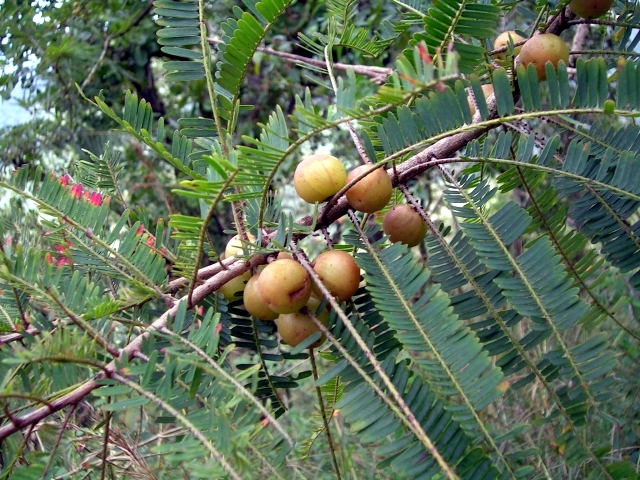
Indian gooseberry (Phyllanthus emblica) is a small to medium deciduous tree native to tropical and southern Asia, recognised by its feathery foliage and pale green, sour berries. It belongs to the Phyllanthaceae family and sheds its branchlets alongside its leaves in dry or cool periods.
Grown primarily for culinary pickling and fruit production, saplings take 4 to 7 years to bear their first harvest from seed. A single mature tree requires warm, frost-free conditions and open space to produce heavy crops each winter.
Key Facts
- Hardiness: USDA Zones 10 to 11 (survives light frosts to -1 °C / 30 °F once mature)
- Mature height: 8 to 18 m (26 to 59 ft)
- Time to fruit: 3 to 4 years for grafted plants; 5 to 8 years from seed
- Sun needs: Full sun (minimum 6 hours direct light daily)
- Soil pH: Tolerates 6.5 to 8.5; performs well on sodic soils
Growing Indian Gooseberry in Home Gardens
Indian gooseberry demands unrestricted sunlight and warm seasons to set viable flower buds and swell fruit. It suits warm-temperate to tropical climates where winters stay largely frost-free. Gardeners in cooler areas struggle to keep saplings alive without a greenhouse or deep sheltering microclimate.
While young trees require regular moisture to anchor their taproots, established specimens withstand prolonged dry seasons by dropping foliage. Space is a primary consideration before planting, as the branching canopy spreads 6 to 10 m (20 to 33 ft) wide at maturity.
Identifying the Tree, Leaves, and Fruit
Indian gooseberry displays feathery branchlets of tiny linear-oblong leaflets that resemble pinnate leaves but are actually individual leaves clustered along slender twigs. The trunk features flaking, mottled bark in shades of grey, pink, and brown, often exposing paler inner layers beneath.
The flowers and fruit have distinct characteristics:
- Foliage: Simple, distichous leaves measuring 10 to 20 mm (0.4 to 0.8 in) long and 2 to 4 mm (0.08 to 0.16 in) wide, arranged closely along deciduous twigs.
- Blossoms: Minute, greenish-yellow flowers grouped in dense axillary clusters along the lower part of bare branches in spring.
- Fruit: Spherical berries measuring 2 to 4 cm (0.8 to 1.6 in) across, smooth-skinned, pale green to translucent yellow, marked with 6 vertical stripes.
- Stone: A hard, six-ribbed endocarp containing 4 to 6 small dark brown seeds.
Mature Size and Fruit Timeline
A healthy tree reaches 8 to 18 m (26 to 59 ft) in height with an open, spreading crown. Seedlings develop slowly during their first year, putting substantial energy into a long downward taproot before accelerating to 45 to 60 cm (18 to 24 in) of top growth annually.
Patience determines the harvest window based on propagation method:
- Budded or grafted saplings: Begin flowering in year 3 and achieve commercial yields around year 7.
- Seed-grown trees: Rarely set reliable fruit before year 6 to 8 and often exhibit variable fruit size.
- Production span: Productive trees continue yielding 50 to 150 kg (110 to 330 lb) of fruit annually for 30 to 50 years.
Best Site and Soil Requirements
Plant this tree in full sun with at least 8 hours of direct exposure each day. Shaded locations result in weak, spindly limbs, sparse blooms, and premature fruit shed.
The root system adapts to adverse soils better than many other orchard species:
- Drainage: Prefers light sandy loam to heavy clay, provided water never pools for more than 48 hours.
- Soil alkalinity: Successfully tolerates sodic, saline, and calcareous grounds with pH levels up to 8.5.
- Wind tolerance: Established wood is brittle; select a site sheltered from severe storm gales to prevent branch breakage.
Planting and Growing from Seed
Plant dormant bare-root trees or container specimens in early spring or at the onset of monsoon rains. Dig a planting hole twice as wide as the root mass and set the collar level with the surrounding ground.
To grow from seed, follow these steps:
- Extract seeds from ripe winter fruit by drying the inner stones until they split naturally.
- Soak the extracted seeds in warm water (35 to 40 °C / 95 to 104 °F) for 24 hours to break hard coat dormancy.
- Sow in deep pots filled with free-draining seed compost at a depth of 1 cm (0.4 in).
- Maintain soil moisture at 25 to 30 °C (77 to 86 °F); germination takes 15 to 30 days.
- Shield seedlings from hot midday sun until they reach 30 cm (12 in) tall, then begin gradual hardening.
Watering and Feeding Routine
Water young trees once every 7 to 10 days during their first two dry seasons to encourage a deep, resilient root system. Established trees rarely require supplementary irrigation outside of severe drought, though moisture during fruit set in early summer increases final berry size.
Fertiliser application supports consistent fruiting:
- Apply 10 to 15 kg (22 to 33 lb) of well-rotted farmyard manure around the drip line in late winter.
- Supplement commercial trees with a balanced NPK fertiliser (such as 10-10-10) split into two doses: post-harvest and mid-monsoon.
- Avoid heavy nitrogen inputs during autumn, which promote tender shoots prone to winter dieback.
Pruning and Canopy Care
Train young trees to a modified central leader system with 4 to 6 main scaffolds spaced along the trunk. Pruning is carried out in early spring when the tree is dormant and leafless.
Mature maintenance focuses on light penetration:
- Remove vertical water sprouts and suckers emerging below the graft union immediately.
- Thin crossed, rubbing, or dead branches annually to let air move through the center of the crown.
- Avoid shearing branch tips, as flowers form along mature one-year-old wood.
Pests, Diseases, and Premature Drop
The most frequent problem is premature fruit drop in early summer, triggered by drought stress or unfertilised flowers. Maintaining steady soil moisture when the fruit reaches pea size keeps the crop intact.
Watch for several specific garden ailments:
- Bark-eating caterpillar (Indarbela quadrinotata): Leaves ribbons of sawdust and webbing along trunk crotches; clear silk tunnels and seal entry holes.
- Rust (Ravenelia emblicae): Forms dusty purplish-brown pustules on leaves and fruit during humid spells; spray copper fungicide if severe.
- Blue mold rot (Penicillium islandicum): Attacks damaged fruit near harvest; handle berries carefully to avoid skin tears.
Winter Care and Frost Protection
Mature trees survive brief cold snaps down to -1 °C (30 °F), but young saplings suffer top-kill whenever temperatures dip below freezing. Cold wind dries evergreen foliage and damages soft growth.
Protect non-dormant specimens with basic seasonal measures:
- Mulch the root zone with 8 to 10 cm (3 to 4 in) of woodchips or straw to insulate the soil.
- Erect a temporary burlap frame over saplings under three years old before hard winter frosts.
- Withhold nitrogen fertilizers and reduce watering from mid-autumn to harden wood ahead of freezing weather.
Culinary Uses and Nutritional Content
Fresh amla berries are known for their high concentration of ascorbic acid (vitamin C), containing roughly 400 to 700 mg per 100 g of edible pulp. The raw fruit has an astringent, sour taste that shifts to a sweet aftertaste after drinking water.
Traditional preparations include:
- Culinary pickles and preserves: Boiled and steeped in spicy oil or preserved in concentrated sugar syrup as murabba.
- Dried powder: Dehydrated pulp ground into a shelf-stable powder used in cooking, teas, and herbal preparations.
- Juices: Pressed fresh and diluted with ginger juice or water to offset strong acidity.
- Traditional medicine: The fruit, bark, and seeds were historically used in Ayurvedic remedies, including the polyherbal preparation chyawanprash.
Year-Round Indian Gooseberry Care
| Spring | Prune out dead, damaged, or overcrowded branches before buds swell. Apply well-rotted compost and balanced organic fertiliser around the drip line. |
|---|---|
| Summer | Provide deep watering every 10 to 14 days during dry periods while fruit is swelling. Monitor lower branches for bark-eating caterpillar webbing. |
| Autumn | Cease nitrogen applications to encourage branch hardening. Begin harvesting early-ripening cultivars once green berries turn a slight translucent yellow. |
| Winter | Complete main fruit harvest between November and February. Wrap trunk bases of young trees in cold regions to prevent frost splitting. |
Common Indian Gooseberry Problems
| What you see | Likely cause | What to do |
|---|---|---|
| Berries falling off tree when pea-sized | Moisture stress or unpollinated blossoms during early summer heat | Deep-soak the root zone weekly during the post-bloom swell period. |
| Brown or purplish rings on leaves and berries | Amla rust fungus favored by high humidity | Spray an approved copper fungicide and rake up fallen diseased leaves. |
| Frass and sawdust ribbons along trunk joints | Bark-eating caterpillar boring into wood | Clean away webbing and inject a mineral oil or neem solution into the bore holes. |
| Blackened shoot tips in early spring | Light freeze damage on tender unhardened growth | Prune back shoots to healthy green wood and avoid late-autumn feeding. |
Top Cultivars of Indian Gooseberry
- ‘Banarasi’ – early season, large fruit, prone to fruit drop
- ‘Chakaiya’ – heavy bearer, fibrous medium berries, excellent pickling
- ‘Francis’ – large fruit, high yields, susceptible to necrosis
- ‘NA-7’ – prolific seedling selection, low fibre, uniform size
- ‘Kanchan’ – vigorous grower, round yellow-tinged fruit, high yield
Frequently Asked Questions
What does Indian gooseberry do for you?
Indian gooseberry provides significant dietary ascorbic acid (vitamin C) alongside polyphenols and dietary fibre. It has traditionally been consumed across South Asia to support digestion, promote skin health, and season savoury foods.
How to eat Indian gooseberry?
You can eat it raw with a sprinkle of salt to cut the sourness, grate it into fresh chutneys, or slice and steep it in honey. It is also commonly boiled, preserved in spiced oil pickles, or consumed as dried powder mixed into water.
Is Indian gooseberry safe?
Yes, the whole culinary fruit is safe for human consumption as a standard food ingredient. People on blood-thinning medications or scheduled for surgery should consult a doctor before consuming high-dose concentrated supplements due to potential antiplatelet activity.
How long does an Indian gooseberry tree take to produce fruit?
A grafted or budded tree begins producing fruit within 3 to 4 years of planting. Seed-grown trees require 5 to 8 years before yielding their first harvest.
What is the difference between Indian gooseberry and European gooseberry?
Indian gooseberry (Phyllanthus emblica) is a subtropical tree producing hard, smooth, ribbed berries, whereas European gooseberry (Ribes uva-crispa) is a spiny, cool-climate temperate bush that produces soft, translucent, bristled fruit.
Information about traditional or historical uses is provided for educational interest only and is not medical advice. Do not use any plant to treat a condition without speaking to a qualified professional.
Sources & Verification
Taxonomy and distribution are checked against the databases below. Care guidance is written for cultivated species only and reviewed by our editor. How We Build Plant Profiles →

