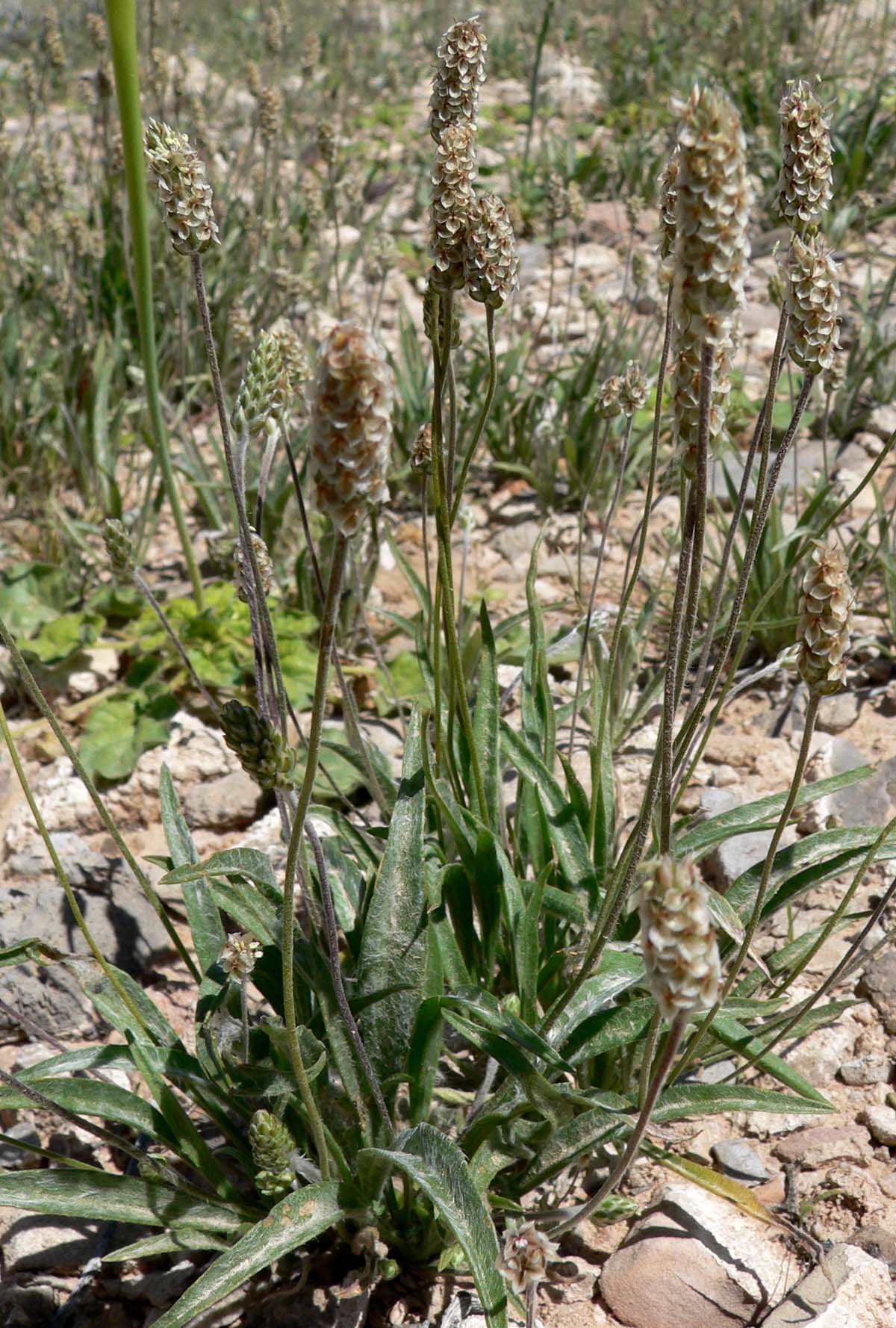
Branched Plantain, scientifically known as Plantago arenaria, is an annual herb within the Plantaginaceae family. It is widely recognised for its branched, leafy stems that distinguish it from the more common ground-hugging plantains.
You will typically find this plant thriving in dry, sandy environments across parts of Africa, Europe, and Asia. It is often encountered as a coloniser of disturbed ground, roadsides, and open meadows where competition from other vegetation is minimal.
Key Facts
- Scientific Name: Plantago arenaria
- Family: Plantaginaceae
- Life Cycle: Annual
- Preferred Habitat: Dry, sandy, or disturbed soils
- Key Use: Seeds traditionally used as a laxative
How to Identify Branched Plantain
You can identify Plantago arenaria by its upright, branched stems which can reach heights of 40 cm (16 in). Unlike its low-growing relatives, this species features a distinct vertical habit that sets it apart in the landscape.
- Leaves are narrow, linear, and arranged in an opposite or whorled pattern along the stem.
- Flowers are small, inconspicuous, and clustered into dense, cylindrical spikes at the stem tips.
- The entire plant is often covered in fine, glandular hairs that give it a slightly sticky texture.
- Seeds are small, dark brown to black, and are the primary part of the plant harvested for use.
Native Habitat and Distribution
The natural range of Branched Plantain spans across Africa, Europe, Russia, and Asia, where it prefers open, sun-drenched locations. It is highly adapted to arid conditions and is frequently observed in inland regions with sandy or gravelly substrates.
Beyond its native range, this species has successfully naturalised in parts of Australia and North America. It is considered a ruderal species, meaning it is one of the first to colonise disturbed sites like roadsides, railway embankments, and abandoned agricultural fields.
Ecological Role of Sand Plantain
As a coloniser of poor soils, Plantago arenaria provides essential ground cover in areas where other plants struggle to establish. Its presence helps stabilise loose, sandy soils, preventing erosion in fragile, dry ecosystems.
- The small flowers provide a modest source of pollen for various generalist insects.
- The seeds serve as a food source for small birds and granivorous insects in arid habitats.
- By growing in disturbed areas, it acts as a pioneer species that prepares the soil for more complex plant communities.
Traditional Medicinal Uses of Black Psyllium
The seeds of Branched Plantain have been traditionally used as a bulk-forming laxative to support digestive health. The outer coating of the seed contains mucilage, which absorbs water and expands significantly when ingested.
Historically, these seeds were harvested and processed for use in herbal preparations. It is important to note that while the seeds are a known source of psyllium, they should only be used under professional guidance. Never consume plant material without verifying its identity and potential side effects.
What Is Plantago and Its Genus
The genus Plantago comprises over 200 distinct species of herbs and small shrubs found worldwide. While many people are familiar with the common lawn weed Plantago major, the genus includes significant diversity in form and ecological preference.
Historically, some botanists classified species like Plantago arenaria into a separate genus called Psyllium due to their branched, leafy stems. Modern genetic studies have largely folded these back into Plantago, though the common name “psyllium” remains in use for species that produce mucilaginous seeds.
Similar Species to Branched Plantain
You might confuse Plantago arenaria with other members of the plantain family that share similar flower spikes. However, the branched, leafy stem is the most reliable feature to distinguish it from the basal-rosette growth habit of most other Plantago species.
- Greater Plantain (Plantago major): Features broad, basal leaves and lacks a branched, leafy stem.
- Ribwort Plantain (Plantago lanceolata): Has lance-shaped leaves in a basal rosette and a single, unbranched flowering stalk.
- Buck’s-horn Plantain (Plantago coronopus): Recognised by its deeply divided, feathery leaves and low-growing habit.
Frequently Asked Questions
What is Plantago arenaria?
Plantago arenaria is an annual herb in the Plantaginaceae family, commonly known as Branched Plantain or Sand Plantain. It is native to parts of Africa, Europe, and Asia, and is known for its upright, branched stems.
What are Plantago drops used for?
Plantago drops are typically herbal preparations derived from the seeds or leaves of various Plantago species. They are traditionally used to support digestive health or respiratory function, though you should always consult a healthcare professional before use.
Is Branched Plantain the same as common plantain?
No, Branched Plantain is distinct because it grows an upright, branched stem with leaves, whereas common plantain (Plantago major) grows leaves only in a basal rosette at ground level.
Where does Sand Plantain grow?
Sand Plantain grows in dry, sandy, or disturbed inland areas. You will often find it on roadsides, in meadows, and on sandy embankments across its native range in Europe, Asia, and Africa.
Information about traditional or historical uses is provided for educational interest only and is not medical advice. Do not use any plant to treat a condition without speaking to a qualified professional.
Sources & Verification
Taxonomy and distribution are checked against the databases below. Care guidance is written for cultivated species only and reviewed by our editor. How We Build Plant Profiles →