
Black cherry (Prunus serotina) is a large deciduous forest tree native to eastern North America, recognized by its dark, broken bark that resembles burnt potato chips and cylindrical clusters of late-spring white flowers.
Its ripe fruit feeds dozens of bird species and produces traditional culinary syrups, but wilted foliage contains lethal concentrations of cyanide that pose a severe threat to browsing livestock.
Key Facts
- Light: Full sun to partial shade (at least 6 hours sun)
- Height: 18–27 m (60–90 ft) at full maturity
- Water: Moderate moisture; drought-tolerant once established
- Growth rate: Fast, often 60–90 cm (24–36 in) per year
- Hardiness: USDA Zones 3 through 9
- Toxicity: Seeds, twigs, and wilted leaves are toxic to animals
Is Black Cherry Right for Your Yard?
Black cherry requires at least 15 m (50 ft) of open overhead clearance and should never be planted within reach of horse pastures or livestock pens. This fast-growing pioneer tree demands expansive lawns, open acreages, or woodland borders where dropping fruit and falling twigs will not stain driveways or foul gutters.
You should consider this tree if you want to support native pollinators and songbirds, as it hosts hundreds of native caterpillar species. Avoid planting it in cramped urban lots or near outdoor patios due to seasonal litter from fallen fruit and discarded seed pits.
How to Identify Prunus serotina
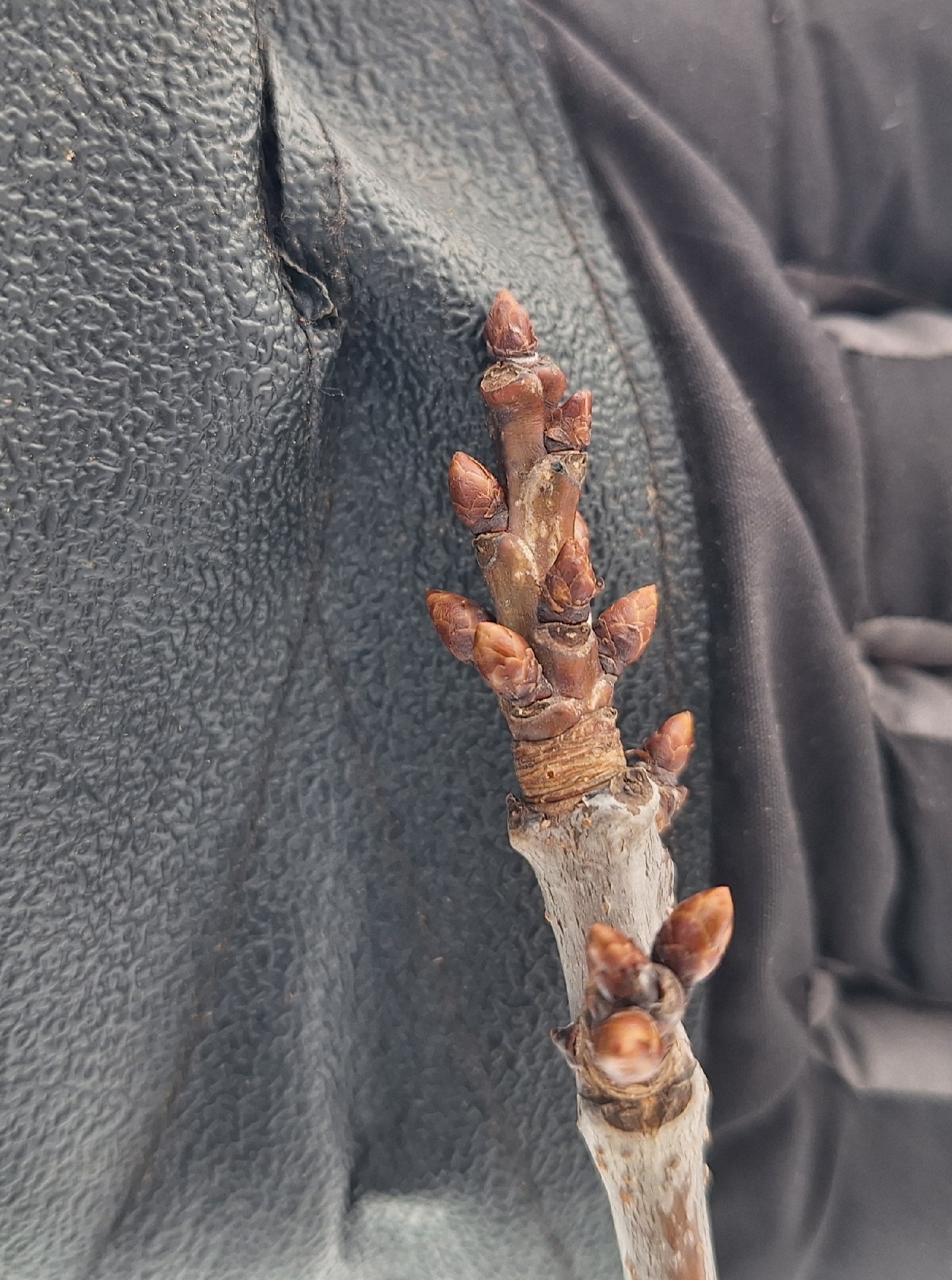
You can identify Prunus serotina through its dark, scaly mature bark that curls outward at the edges and looks like burnt cornflakes. Young saplings have smooth, reddish-bronze bark speckled with horizontal lenticels, resembling common birch.
Its leaves are alternate, simple, and narrowly oblong, measuring 5–13 cm (2–5 in) long with fine, blunt teeth curving inward. Look along the underside of the leaf: the lower portion of the central midrib displays distinctive reddish-brown fuzz that persists throughout the summer.
- Flowers: Pendulous racemes 10–15 cm (4–6 in) long with 30–50 small, five-petaled white flowers.
- Fruit: Pea-sized drupes 8–10 mm (0.3–0.4 in) across, turning from green to red to purplish-black in late summer.
- Foliage: Glossy, dark green above, paler beneath, turning yellow to warm rose-orange in autumn.
Mature Size and Growth Rate
A healthy black cherry reaches 18–27 m (60–90 ft) tall with a spread of 10–18 m (35–60 ft) in open landscape conditions. In crowded forest stands, competition pushes trunks up to 38 m (125 ft) with narrow crowns, whereas solitary trees develop broad, rounded canopies.
Growth is rapid during the first two decades, frequently adding 60–90 cm (24–36 in) of vertical height annually in moist, sunny sites. The trunk diameter expands steadily, eventually reaching 60–120 cm (24–48 in) across at breast height.
Sunlight and Soil Requirements
Black cherry performs best in full sun with at least 6 hours of direct light daily. Saplings survive moderate understory shade for a few years, but shaded crowns thin quickly and produce few blooms.
Soil should be deep, fertile, and free draining, with a pH between 5.5 and 7.5. The tree tolerates coarse sandy loams and acidic gravelly soils, but it fails in poorly drained, waterlogged clay that suffocates its root system.
How to Plant a Black Cherry Tree
Plant container-grown or bare-root saplings during early spring before bud break to allow root establishment before summer heat. Dig a hole two to three times wider than the root ball, keeping the root flare level with or slightly above the surrounding grade.
Backfill the hole using native soil without heavy amendments to encourage outward root extension. Water deeply with 38–57 L (10–15 gal) immediately after planting to eliminate air pockets, then apply a 7–10 cm (3–4 in) layer of woodchip mulch around the base, keeping it 10 cm (4 in) clear of the trunk.
Black Cherry Tree Care and Maintenance
Established trees require no supplemental irrigation except during severe droughts lasting longer than four consecutive weeks. Young trees need 20–30 L (5–8 gal) of water weekly throughout their first two growing seasons whenever rainfall drops below 2.5 cm (1 in) per week.
Fertilizer is rarely necessary unless a soil test reveals severe nutrient deficiencies. An annual top-dressing of organic compost over the root zone in autumn provides adequate nutrients without triggering rapid, weak wood growth that invites pest damage.
When and How to Prune Black Cherry
Prune black cherry trees only during late winter while the tree is fully dormant to prevent fungal spores and bacterial pathogens from entering open cut wounds. Summer pruning increases the risk of spreading disease and attracts borers.
Focus cuts on maintaining a dominant central leader and eliminating narrow branch angles that split under wind load.
- Remove all dead, diseased, or crossing branches back to the branch collar.
- Thin out crowded secondary branches to improve interior air circulation.
- Prune out water sprouts and root suckers as soon as they appear.
- Never top the tree or remove more than 20% of the active canopy in a single year.
Common Pests, Diseases, and Leaf Problems
The most frequent problem on black cherry is black knot fungus (Apiosporina morbosa), which causes elongated, rough, charcoal-black swellings along branches. Prune infected stems at least 15–20 cm (6–8 in) below the knot during dormant winter months and burn the debris.
Eastern tent caterpillars (Malacosoma americanum) regularly build silk nests in branch forks each spring, stripping fresh leaves. Hand-pull nests on cool mornings or use targeted applications of Bacillus thuringiensis on young larvae before defoliation spreads across the crown.
Winter Hardiness and Cold Tolerance
Black cherry easily tolerates winter temperatures down to -40 °C (-40 °F), making it fully cold-hardy across USDA Zones 3 through 9. Its dormant flower buds require several hundred chilling hours below 7 °C (45 °F) to break dormancy uniformly in spring.
Late-spring frosts occasionally damage emergent blossoms, which reduces fruit yield for that season but does not harm the overall health of the tree. Protect young sapling trunks from gnawing rabbits and voles during snowy winters by wrapping the base in wire mesh hardware cloth.
Wood, Wildlife, and Fruit Uses
The fine-grained reddish timber of black cherry is one of the most valuable North American cabinet hardwoods, prized for its dimensional stability and deep lustrous finish. In native ecology, it serves as an essential larval host for the eastern tiger swallowtail butterfly and feeds robins, cedar waxwings, and black bears.
Humans traditionally boiled the ripe fruit pulp to make jelly, pancake syrup, and cherry bounce liqueur. The outer bark was traditionally used in Native American and settler herbal syrups for persistent coughs, though home preparations carry cyanogenic risks and should be avoided.
Year-Round Black Cherry Tree Care
| Spring | Inspect branch forks for early eastern tent caterpillar webs and remove them by hand. Monitor blooming racemes for frost damage and ensure saplings receive 2.5 cm (1 in) of water weekly. |
|---|---|
| Summer | Water young trees during prolonged hot, dry spells with 20–30 L (5–8 gal) every 10 days. Rake up fallen, rotting fruit promptly if located near lawns, walkways, or areas where domestic pets roam. |
| Autumn | Collect and discard fallen wilted leaves away from horse paddocks or pasture fencing. Apply a fresh 7 cm (3 in) layer of arborist woodchips over the drip line, keeping mulch pulled back from the trunk. |
| Winter | Prune out dead wood, crossing limbs, and black knot galls while the canopy is completely dormant. Wrap wire tree guards around young saplings to deter bark chewing by voles and deer. |
Diagnosing Common Black Cherry Problems
| What you see | Likely cause | What to do |
|---|---|---|
| Lumpy, swollen black galls on twigs and branches | Black knot fungal infection (Apiosporina morbosa) | Cut affected branches 15–20 cm (6–8 in) below the swellings during winter dormancy and destroy the infected cuttings. |
| Dense webbing in branch forks with missing foliage | Eastern tent caterpillars feeding on emerging spring leaves | Wind the silk nests onto a gloved stick on cool mornings and submerge them in soapy water. |
| Shot-hole perforations and small purple spots on leaves | Cherry leaf spot fungus (Blumeriella jaapii) | Rake up and dispose of fallen autumn leaves to eliminate overwintering spores, improving canopy air circulation. |
| Yellowing foliage dropping prematurely in midsummer | Drought stress or root suffocation from compacted, waterlogged soil | Check soil drainage; provide deep, slow watering during severe dry spells or correct standing water issues. |
Frequently Asked Questions
Are black cherry leaves poisonous to cattle and horses?
Yes, black cherry foliage contains prunasin, a cyanogenic glycoside that hydrolyzes into lethal prussic acid (cyanide) when leaves are broken, frosted, or wilted. Browsing livestock can die within minutes of ingesting wilted storm-damaged branches.
Can you eat the fruit from a black cherry tree?
Yes, the ripe dark purple fruit flesh is edible and traditionally used for jams, jellies, and brandies, though it has a tart, slightly astringent flavor. You must never crush, chew, or swallow the inner seed pits, as they contain toxic cyanide compounds.
What is the difference between black cherry and chokecherry?
Black cherry grows into a large canopy tree with scaly burnt-cornflake bark and blunt inward-curving leaf teeth, whereas chokecherry (Prunus virginiana) remains a multi-stemmed shrub with smooth gray bark and sharply pointed outward-spreading leaf teeth.
Is the black cherry tree related to black cherry tomatoes?
No, black cherry (Prunus serotina) is a woody deciduous tree in the rose family, while the 'Black Cherry' tomato is an heirloom cultivar of the nightshade family species Solanum lycopersicum.
Which native companion trees grow well alongside black cherry?
Black cherry thrives naturally alongside white oak (Quercus alba), red maple (Acer rubrum), sugar maple (Acer saccharum), and black walnut (Juglans nigra), as it demonstrates strong tolerance to juglone.
Information about traditional or historical uses is provided for educational interest only and is not medical advice. Do not use any plant to treat a condition without speaking to a qualified professional.
Sources & Verification
Taxonomy and distribution are checked against the databases below. Care guidance is written for cultivated species only and reviewed by our editor. How We Build Plant Profiles →
- USDA Forest Service Silvics ManualComprehensive ecological and silvicultural reference for Prunus serotina.
- NC State Extension Gardener Plant ToolboxIdentification, landscape considerations, and toxicity data.
- Missouri Botanical Garden Plant FinderHorticultural traits, hardiness zones, and maintenance.
- GBIF — Global Biodiversity Information Facilitytaxonomy, synonyms, occurrence records
- Plants of the World Online (Kew)accepted name, native range
- Wikipediageneral reference
More in Prunus

Gray’s Bird Cherry
Prunus grayana
☀️ Full Sun 💧 High

Winter-Flowering Cherry
Prunus subhirtella
☀️ Full Sun 💧 Moderate

Portugal Laurel
Prunus lusitanica
☀️ Full Sun 💧 Moderate
Sour Cherry
Prunus cerasus
☀️ Full Sun 💧 Moderate

Peach
Prunus persica
☀️ Full Sun 💧 Moderate

Japanese Apricot
Prunus mume
☀️ Full Sun 💧 Moderate