
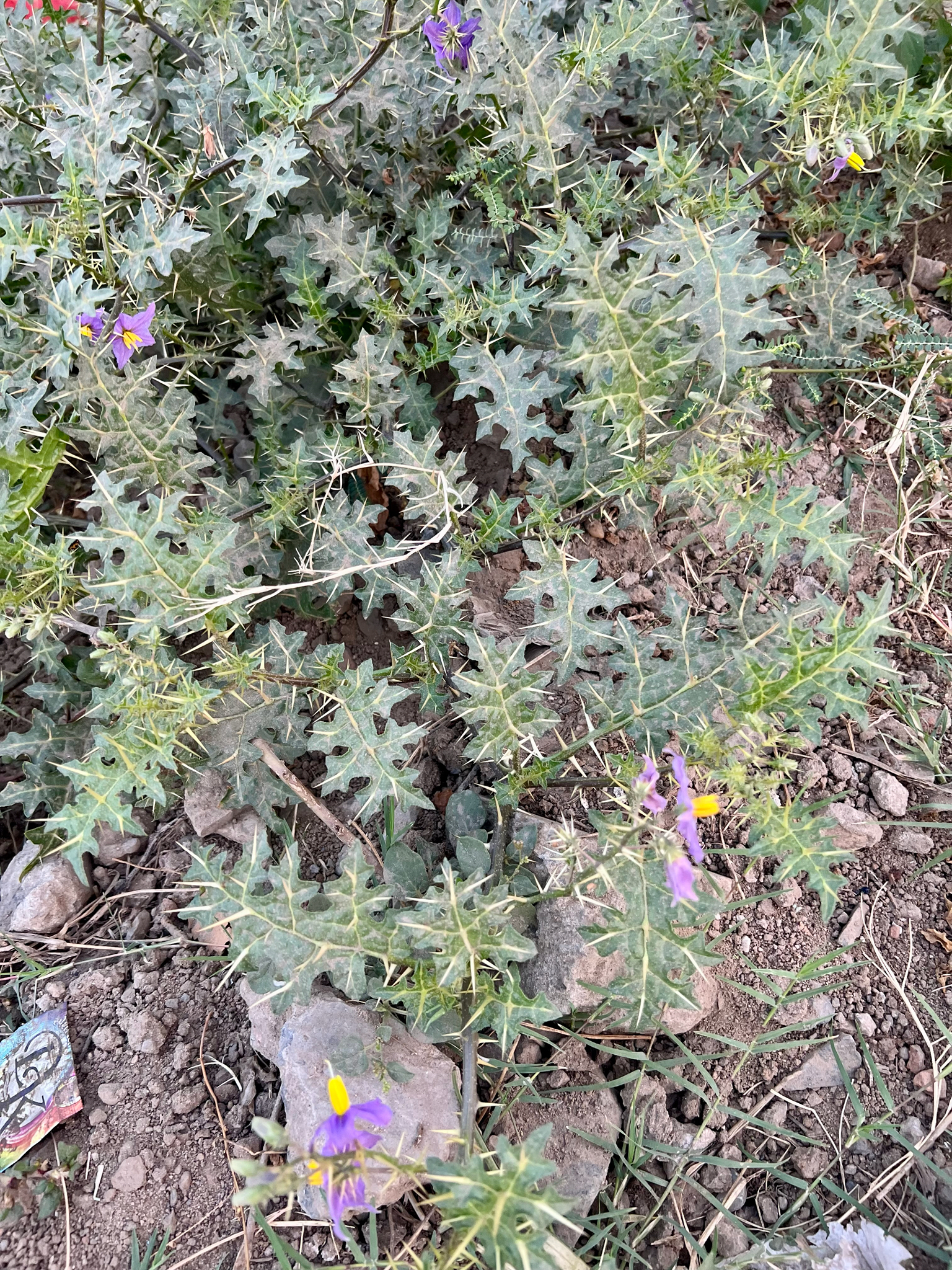
Surattense nightshade is a sprawling, spiny perennial herb native to South and Southeast Asia. Recognized by its Solanum virginianum scientific name, it is characterized by sharp yellow spines and globular yellow berries that appear after purple flowers.
This species thrives in disturbed ground and arid climates where many other plants fail. While it is a significant component of traditional Ayurvedic medicine, the wild fruits contain toxic alkaloids that require careful handling and identification.
Key Facts
- Type: Spiny perennial herb
- Height: 30-60 cm (12-24 in)
- Fruit: Yellow berries, 1.5-2 cm diameter
- Spines: Yellow, straight, up to 1.5 cm long
- Native Range: India, Thailand, Pakistan, Sri Lanka
Is Surattense Nightshade Right for Your Area?
You will encounter Solanum virginianum as a wild, prickly herb that requires full sun and well-drained soil to thrive in its natural environment. It is not a typical garden plant due to its extensive spines, but it is highly valued by those interested in ethnobotany or traditional South Asian medicine. The one thing to get right when identifying it is distinguishing its sprawling, ground-hugging form from taller, shrubby nightshade species.
This plant is best suited for arid and semi-arid regions where it can colonize open, sandy ground. It is frequently found in USDA zones 10 through 12, as it cannot survive freezing temperatures. Because it spreads via a deep taproot and resilient seeds, it can become difficult to manage if it enters agricultural land or home gardens where it was not invited.
Identifying Surattense Nightshade in the Wild
Identifying this plant is easiest by looking for its 1.5 cm (0.6 in) yellow spines that cover both the stems and the leaf veins. The plant exhibits a prostrate, sprawling habit, rarely growing taller than 60 cm (2 ft) but spreading significantly wider. The leaves are ovate or elliptic, measuring 5-10 cm (2-4 in) in length, with deeply lobed margins that are also armed with sharp prickles.
The flowers are typically purple or bluish-purple, featuring five fused petals and prominent yellow anthers clustered in the center. The fruit is a smooth, globular berry that transitions from green with white stripes to a solid yellow when mature, reaching 1.5-2 cm (0.6-0.8 in) in diameter. These berries are often found in clusters along the spiny stems, persisting on the plant even after the leaves have withered.
Where Does Solanum virginianum Grow Naturally?
This species naturally populates arid and semi-arid zones across India, Pakistan, and Southeast Asia. It is a pioneer species that thrives in disturbed habitats, such as abandoned fields, roadsides, and dry riverbeds, where it colonizes bare soil quickly. The plant is particularly common across the Indian subcontinent, including Sri Lanka, and extends into tropical countries like Thailand and Vietnam.
It prefers sandy or rocky soils that provide excellent drainage, often appearing in areas where competition from taller grasses is minimal. In its native range, it is frequently seen on the margins of coastal sands and in overgrazed pastures. Its ability to tolerate high light intensity and low moisture allows it to persist in environments that would be too harsh for most other nightshades.
Traditional Medicinal Uses and Benefits
Known as Kantakari in traditional Ayurvedic medicine, this plant has been used for centuries to treat respiratory ailments like asthma and coughs. It was historically prepared as a decoction or powder using the roots, stems, and fruits to manage chronic bronchitis and fevers. Modern pharmacological studies have investigated the plant’s potential anti-inflammatory and antipyretic properties, though these traditional uses should never replace professional medical consultation.
The plant contains several active alkaloids, including solasodine and solamargine, which are of interest in biochemical research. In some regions, the juice of the berries was traditionally applied topically to treat skin conditions or sore throats. Because of its high chemical potency, the plant has a long history of use as a therapeutic agent in rural communities across South Asia.
Is Surattense Nightshade Edible or Poisonous?
Wild berries of the Surattense nightshade are toxic to humans and pets due to high solanine content. While specific cultivars are grown as Thai green eggplants for culinary use, the fruits of wild plants can cause severe gastrointestinal distress if consumed raw or in large quantities. Symptoms of poisoning include nausea, vomiting, abdominal pain, and in severe cases, neurological symptoms.
It is critical to distinguish between the wild medicinal herb and the domestic vegetable varieties. The wild version is heavily armed with spines and contains higher concentrations of glycoalkaloids than the bred food varieties. Livestock generally avoid the plant due to the sharp spines, but accidental ingestion of the berries can lead to poisoning in cattle and goats.
The Ecological Role of Yellow-Fruit Nightshade
This plant relies on buzz pollination by bees to produce its characteristic yellow fruit. Large bees, particularly carpenter bees (Xylocopa species), vibrate their flight muscles to release pollen from the tubular anthers of the purple flowers. This specialized interaction ensures that the plant can reproduce even in environments with limited pollinator diversity.
Once the yellow berries mature, they are consumed by birds and small mammals, which سپس disperse the seeds across wide areas through their droppings. The sharp spines serve as a physical defense against grazing livestock, allowing the plant to survive in overgrazed pastures where other vegetation is depleted. By colonizing disturbed soil, it also helps prevent wind erosion in arid landscapes.
Growth Habit and Life Cycle
The growth habit of Solanum virginianum is diffuse and prostrate, meaning it spreads along the ground rather than growing tall. It possesses a deep taproot that allows it to access moisture in arid soils, making it highly drought-tolerant. The stems are woody at the base and can spread to a width of 1.2 m (4 ft), creating a prickly mat that protects the soil from erosion.
During the monsoon season in its native range, the plant undergoes rapid vegetative growth, followed by a long period of flowering and fruiting. In frost-free climates, it can produce flowers and berries throughout the year. The seeds are resilient and can remain dormant in the soil for several years, waiting for the right moisture conditions to germinate and colonize new areas.
Conservation Status and Distribution
Currently, this species maintains a stable population and is often regarded as a resilient weed in its native range. It is listed as Least Concern in many regional biodiversity databases because it thrives in human-altered landscapes. However, in some parts of the world, it is classified as a noxious weed because its spines can injure livestock and its presence reduces the quality of pasture land.
It is not easily eradicated once established because the seeds are widely dispersed by wildlife. Control measures usually involve manual removal before the yellow berries drop, though the spines make this a difficult task without heavy protective clothing. Despite its weedy nature, it remains an ecologically important species for native pollinators and traditional medicinal practitioners in Asia.
Similar Species and Look-Alikes
Distinguishing it from look-alikes requires checking for deeply lobed leaves and a sprawling growth habit. It is often confused with the tropical soda apple (Solanum viarum), which also bears yellow berries but has much wider leaves and white flowers. Another look-alike is the black nightshade (Solanum nigrum), though it lacks the sharp spines and produces much smaller, black berries when ripe.
The turkey berry (Solanum torvum) grows as a taller, upright shrub rather than a sprawling herb and has smaller, green-to-yellow berries. While it is related to the common eggplant (Solanum melongena), the latter has been bred to be mostly spineless with significantly larger, edible fruits. Identifying the straight yellow spines is the most reliable way to separate Solanum virginianum from these other species.
Frequently Asked Questions
Is Surattense nightshade edible?
While specific cultivars are grown as Thai green eggplants for cooking, the fruits of wild Surattense nightshade are generally considered toxic. They contain solanine, which can cause vomiting and stomach pain if eaten raw.
What are the benefits of Solanum virginianum?
In traditional medicine, it is used for respiratory health, specifically to help manage asthma and chronic coughs. It contains alkaloids that are believed to have anti-inflammatory effects.
Is it poisonous to dogs?
Yes, the plant is poisonous to dogs and cats because it contains glycoalkaloids. Ingestion can lead to drooling, lethargy, and gastrointestinal upset.
What is the common name of Solanum virginianum?
The most common names are Surattense nightshade and yellow-fruit nightshade. In India, it is frequently called Kantakari.
What is the difference between S. virginianum and S. xanthocarpum?
There is no difference; Solanum xanthocarpum is simply an older scientific synonym for Solanum virginianum. They refer to the exact same spiny, yellow-berried plant.
Information about traditional or historical uses is provided for educational interest only and is not medical advice. Do not use any plant to treat a condition without speaking to a qualified professional.
Sources & Verification
Taxonomy and distribution are checked against the databases below. Care guidance is written for cultivated species only and reviewed by our editor. How We Build Plant Profiles →
More in Solanum

Tamarillo
Solanum betaceum
☀️ Full Sun 💧 Moderate
Carolina Horsenettle
Solanum carolinense
☀️ Full Sun 💧 Low

Chilean Potato Vine
Solanum crispum
☀️ Full Sun 💧 Moderate

Jerusalem Cherry
Solanum pseudocapsicum
☀️ Full Sun 💧 Moderate

Turkey Berry
Solanum torvum
☀️ Full Sun 💧 Moderate

Apple of Sodom
Solanum campylacanthum
☀️ Full Sun 💧 Low