
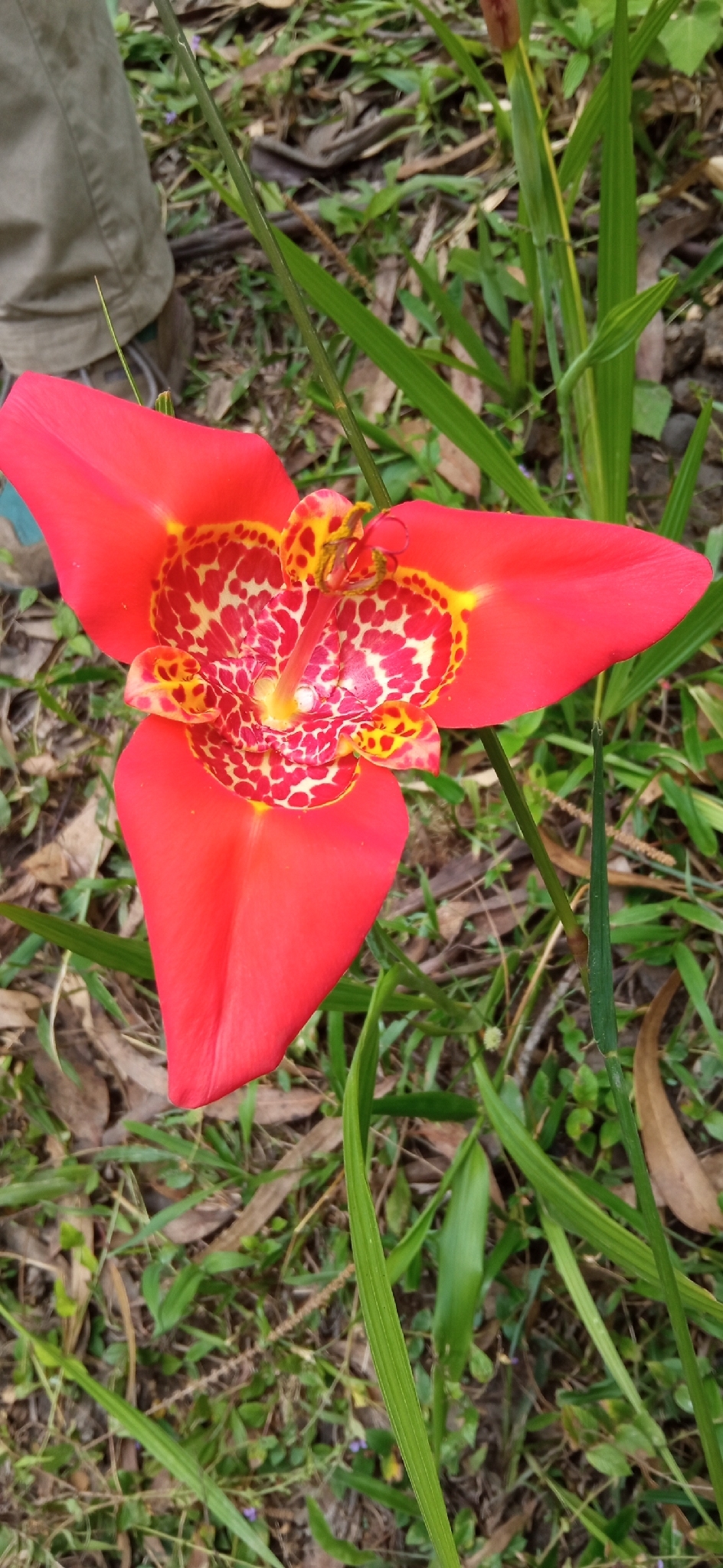
Tigridia pavonia is a summer-blooming perennial from the iris family, native to the highlands of Mexico and Central America. It is recognized by its large, three-petaled flowers that feature a distinctively spotted central cup.
While the individual blooms last only 24 hours, each stem produces multiple buds that open in succession. This species requires a period of winter dormancy and is often treated as an annual in temperate climates where the ground freezes.
Key Facts
- Sun: at least 6 hours of direct light
- Depth: plant corms 10 cm (4 in) deep
- Bloom: each flower lasts one day
- Soil: must be gritty and well-drained
Growing Mexican Shellflower in Your Garden
Mexican shellflower is best suited for sunny borders where its fleeting but intense colors can be appreciated up close. It is a choice plant for collectors who enjoy the theatre of a garden, as the blooms change daily. Because the foliage is relatively sparse, it works best when tucked between low-growing perennials that can hide its base.
It is not a “set and forget” plant; it requires the gardener to be present to witness the daily transformation. Those living in colder climates should view it as a rewarding seasonal project rather than a permanent fixture. The one thing to get right is drainage; the corms are extremely sensitive to rot in heavy or wet soils.
Identifying Tiger Flower
The plant produces upright, sword-shaped leaves that are deeply pleated and reach heights of 45-60 cm (18-24 in). The flowers are 10-15 cm (4-6 in) wide, consisting of three large outer petals and three smaller inner petals forming a cup. These inner parts are heavily mottled with dark spots, resembling a leopard or tiger pattern, on backgrounds of white, yellow, orange, or red.
The stems are slender but stiff, usually bearing two to five flowers each. The root system consists of a tunicated corm, which is a swollen underground stem base that stores nutrients through the winter. The Aztecs of Mexico called the flower ocēlōxōchitl, meaning jaguar flower, due to these distinctive markings.
Choosing the Right Planting Site
Locate your tiger flower in a position that receives full sun for at least six to eight hours a day. In hotter climates, a spot with light afternoon shade can help the delicate petals last a few hours longer before they wilt. The site must have excellent drainage; corms planted in heavy, wet soil will succumb to fungal rot before they can sprout.
If your garden has heavy clay, consider building a raised bed or using large terracotta pots to ensure aeration. Wind protection is vital, as the tall flower spikes can be top-heavy when multiple buds are ready to open. In their native Mexican highlands, they often grow in rocky or volcanic soils that drain rapidly after rain.
How to Plant Tigridia Corms
Plant the corms in late spring when the risk of frost has passed and the soil has warmed to 15 °C (60 °F). Dig a hole 8-10 cm (3-4 in) deep and space the corms 12 cm (5 in) apart to allow for clump expansion. If planting in containers, use a gritty potting mix and ensure the pot has multiple drainage holes to prevent water from pooling at the base.
Group the corms in clusters of seven or more for the best visual impact, as single plants can look sparse. Adding a handful of bone meal or a bulb-specific starter fertilizer to the planting hole can encourage stronger root establishment. Ensure the pointed end of the corm is facing upwards before backfilling with soil.
Watering and Feeding Schedule
Maintain a consistent moisture level by providing 2.5 cm (1 in) of water per week during the heat of summer. Avoid overhead watering, which can damage the fragile petals and lead to spotting on the foliage. Apply a high-potassium liquid fertilizer every two weeks once the flower spikes emerge to support the continuous production of new buds.
During prolonged dry spells, increase watering to twice a week to prevent the soil from baking hard around the corms. If the leaves start to wilt or turn brown at the tips, it is often a sign that the root zone is too dry or the salt levels from fertilizer are too high. Stop fertilizing once the final blooms have faded in late summer.
Pruning and Deadheading
Deadheading is necessary to stop seed production and keep the plant’s energy focused on the corm. Snip off the faded flowers daily, being careful not to damage the emerging buds hidden in the same bract. Do not remove the green leaves after the flowering season ends; they must remain until they turn brown to photosynthesize and store energy for next year’s growth.
Use sharp, sterilized snips to avoid spreading viruses between plants during the deadheading process. If you are growing them in a wilder garden style, you can leave a few seed pods to mature, but be aware that the parent corm may be smaller the following year. Once the foliage is completely yellow, it can be cut back to 2 cm (1 in) above the soil line.
Propagating Mexican Shellflower
The most reliable method of propagation is dividing the offsets that form around the base of the mature corm. Every three to four years, lift the clumps during their dormant period and gently snap off the smaller bulblets for replanting. You can also sow seeds in early spring under glass, though these seedlings will not produce flowers until their second or third year of growth.
Seeds should be sown thinly in a seed tray using a mix of compost and sharp sand. Keep the tray at 20 °C (68 °F) and ensure the medium stays damp but not saturated. Transplant the young plants into individual pots once they are large enough to handle, usually when they have developed two true leaves.
Common Pests and Problems
The primary threat to Mexican shellflower is root rot caused by poorly drained soil or excessive winter moisture. Thrips can also be a nuisance, causing silvery streaks on the pleated leaves and distorted flower buds. If you notice small holes in the foliage, check for slugs and snails at night, as they find the succulent young shoots particularly attractive.
To manage thrips, use a blast of water or an insecticidal soap, ensuring you reach into the folds of the pleated leaves. For slugs, organic iron phosphate pellets or beer traps placed near the base of the plants are effective during the spring growth spurt. If a plant shows stunted growth and yellowing despite proper water, inspect the corm for soft spots or mold.
Winter Care and Lifting Corms
In USDA zones 7 and colder, you must lift the corms in autumn once the foliage has been nipped by the first light frost. Clean off the soil, cut the stems to 2 cm (1 in), and allow the corms to dry in a shaded area for several days. Store them in a breathable bag or box filled with dry sand or vermiculite at a temperature of 5-10 °C (41-50 °F).
Check the stored corms once a month during the winter to ensure they are not shriveling or rotting. If they appear too dry, a very light misting of water can help, but they should never feel damp to the touch. In warmer zones 8-10, the corms can remain in the ground if the soil is kept dry and covered with a thick layer of mulch.
Managing the Summer Bloom
Flowering occurs from July to September, with each stalk producing a succession of two to five buds. To maximize the display, plant corms in batches two weeks apart to extend the overall blooming period of the garden bed. The architectural shape of the leaves also pairs well with the soft, airy habit of baby’s breath (Gypsophila paniculata) or the fine texture of blue fescue (Festuca glauca).
Because the foliage is vertical and thin, pair tiger flower with mounding perennials that provide a green backdrop. Silver-leaved plants like wormwood (Artemisia ludoviciana) contrast well with the saturated reds and oranges of the blooms. Other suitable companions include blue-flowered species like Russian sage (Salvia yangii) or yellow coreopsis (Coreopsis grandiflora).
Year-Round Care for Mexican Shellflower
| Spring | Plant corms 10 cm (4 in) deep once soil reaches 15 °C (60 °F). Apply a balanced slow-release fertilizer. |
|---|---|
| Summer | Water weekly to provide 2.5 cm (1 in) of moisture. Deadhead spent blooms daily to encourage bud succession. |
| Autumn | Lift corms after the first frost in cold zones. Dry them for 7 days before storing in vermiculite. |
| Winter | Store corms at 5-10 °C (41-50 °F) in a frost-free location. Check monthly for signs of rot or desiccation. |
Tiger Flower Problems and Solutions
| What you see | Likely cause | What to do |
|---|---|---|
| Yellowing leaves in mid-summer | Root rot or waterlogging | Improve soil drainage and reduce watering frequency. |
| Silvery streaks on foliage | Thrips infestation | Treat with insecticidal soap, focusing on the leaf pleats. |
| Buds fail to open | Insufficient sunlight | Ensure the plant receives at least 6 hours of direct sun. |
| Holes in new spring growth | Slugs or snails | Apply iron phosphate pellets or use physical grit barriers. |
Popular Tigridia Cultivars
- ‘Alba’ – pure white petals with red-spotted cups
- ‘Aurea’ – bright yellow petals with orange spots
- ‘Canariensis’ – soft primrose yellow with red centers
- ‘Lilacea’ – rosy-pink petals with dark mottling
- ‘Speciosa’ – deep scarlet red with yellow centers
Frequently Asked Questions
What does the name Maravilla mean?
Maravilla is the Spanish word for 'marvel' or 'wonder' and is a common name for Mexican shellflower. The term is also used by various organizations like the Maravilla Foundation or Maravilla Gardens, which are unrelated to the plant itself.
Is Tigridia pavonia the same as a Four O'clock plant?
No, while both are sometimes called Maravilla, the Four O'clock is Mirabilis jalapa. Tigridia grows from a corm and has large triangular flowers, whereas Mirabilis is a bushy tuberous perennial with tubular flowers.
How long do the flowers last?
Each individual flower lasts for only one day, typically opening in the morning and wilting by evening. However, each stalk produces multiple buds that open one after another over several weeks.
Are the bulbs of Mexican shellflower edible?
Yes, the corms were traditionally roasted and eaten by the Aztecs, reportedly tasting similar to chestnuts. However, they should only be consumed if grown without systemic pesticides and properly identified.
Why is my Maravilla plant not blooming?
The most common reason is a lack of sunlight or corms that are too small. Ensure they receive at least 6 hours of full sun and have been fed with a high-potassium fertilizer during the growing season.
Information about traditional or historical uses is provided for educational interest only and is not medical advice. Do not use any plant to treat a condition without speaking to a qualified professional.
Sources & Verification
Taxonomy and distribution are checked against the databases below. Care guidance is written for cultivated species only and reviewed by our editor. How We Build Plant Profiles →