
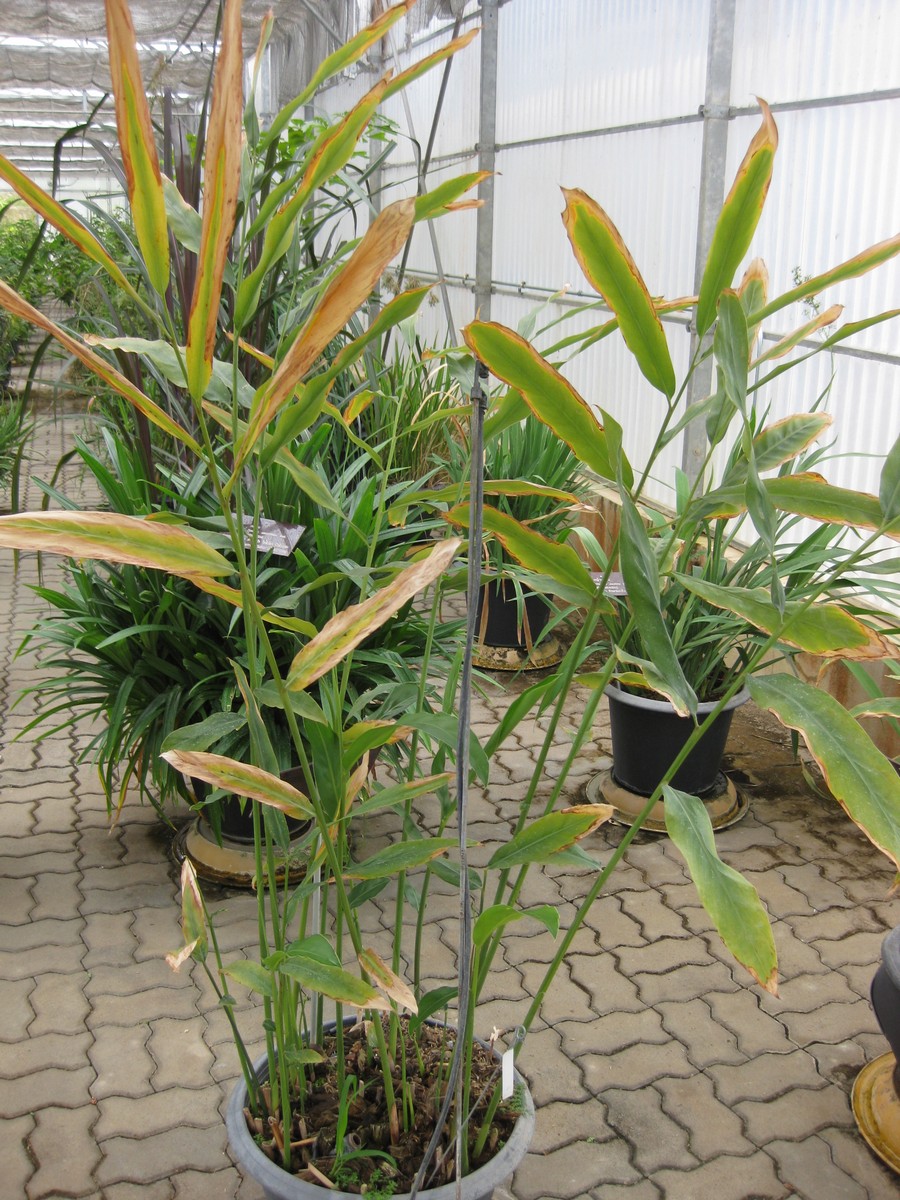
Greater galangal (Alpinia galanga) is a clumping perennial herb in the ginger family, native to tropical Southeast Asia and recognized by its rigid, pine-scented rhizomes and tall reed-like foliage. It provides the signature citrus-and-camphor base notes in classical Thai curry pastes, Indonesian rendang, and Vietnamese broths.
A full crop demands warm temperatures and a long growing season of at least 10 to 12 months before rhizomes mature to full size. Outside tropical or warm subtropical regions, the root systems require deep winter mulching or greenhouse protection to survive.
Key Facts
- Light: Full sun to bright partial shade
- Water: 3–5 cm (1–2 in) per week during active growth
- Soil: Rich, moisture-retentive, well-draining loam
- Hardiness: USDA Zones 9–11; dormant below 10 °C (50 °F)
- Maturity: 10–12 months from rhizome planting to main harvest
- Spacing: 90–120 cm (3–4 ft) between crowns
Growing Greater Galangal at Home
Greater galangal requires at least 1 m (3.3 ft) of lateral space and uninterrupted warm weather to produce a worthwhile harvest. It behaves as a tall, vigorous clump former that develops heavy subterranean stems over a year-long cycle.
This crop suits open raised beds in subtropical climates or heavy containers of at least 45 L (12 gal) in cooler regions. In cool temperate areas, growth slows significantly when soil drops below 18 °C (65 °F). Container growers can shift pots under cover before the arrival of autumn chills.
How to Identify the Galangal Plant
A mature greater galangal plant forms dense stands of cane-like pseudostems reaching 1.8 to 2.5 m (6 to 8 ft) in height. The vegetative canopy resembles a robust ornamental ginger, creating an upright screen of arching foliage.
Key structural markers distinguish it from close relatives:
- Foliage: Glossy, lance-shaped leaves measuring 30–60 cm (12–24 in) long and 7–15 cm (3–6 in) wide, arranged alternately along stout stalks.
- Rhizome: Dense, fibrous subterranean root with pale pink outer rings and ivory-to-pale-yellow interior flesh that remains woody rather than succulent.
- Inflorescence: Upright terminal flower spikes 10–30 cm (4–12 in) long, carrying white petals streaked with reddish-violet veins on the lip.
- Fruit: Small, round capsules 1–1.5 cm (0.4–0.6 in) across that mature from green to red, containing dark angled seeds.
Ideal Growing Conditions for Galangal
Greater galangal grows best in temperatures between 22 and 32 °C (72 and 90 °F) under morning sun with dappled midday shelter. High humidity and warmth replicate its native monsoon-forest margins across Java and Malaysia.
Full sun is tolerated where soil moisture remains consistently high, but intense solar exposure in dry climates causes scorched margins on upper leaves. The ideal substrate is an open, humic loam enriched with well-rotted compost. Heavy clay impedes rhizome expansion and traps stagnant water, which damages dormant crowns during seasonal cool spells.
How to Plant Galangal Rhizomes
Plant fresh rhizome divisions containing at least two viable eye buds 5 to 8 cm (2 to 3 in) deep once soil temperatures reach 20 °C (68 °F). Planting too deeply slows shoot emergence, while shallow planting exposes developing storage stems to desiccating air.
Follow these steps to establish a productive patch:
- Select plump rhizome pieces measuring 7–10 cm (3–4 in) long showing visible, unblemished growth buds.
- Allow cut ends to air-cure in a shaded room for 24 to 48 hours to form a protective callous before planting.
- Lay the rhizome horizontal in the planting furrow with the eye buds pointing upward.
- Space individual divisions 90–120 cm (3–4 ft) apart to accommodate multiple years of crown expansion.
- Water thoroughly once, then withhold heavy watering until initial green shoots break through the soil surface.
Watering, Feeding, and Ongoing Care
Supply the plant with 3 to 5 cm (1 to 2 in) of water per week throughout the peak summer growing period. Consistent moisture drives rapid stalk development, whereas irregular irrigation causes fibrous, woody rhizomes with low oil content.
Top-dress beds with a 5–7 cm (2–3 in) layer of shredded bark, straw, or sugar-cane mulch to insulate shallow roots and preserve surface humidity. Feed every 4 to 6 weeks with a balanced organic fertiliser or fish emulsion high in potassium and phosphorus. Avoid excessive nitrogen applications, which produce immense leaf stalks at the expense of dense rhizome growth.
When and How to Harvest Galangal Root
Harvest mature galangal rhizomes 10 to 12 months after planting, when outer stalks begin to yellow and base diameter thickens. You can also dig juvenile root pieces at 6 to 8 months for tender, mild flesh suited for fresh salads.
Because the plant forms a continuous perennial clump, you can harvest continuously without destroying the entire stand:
- Loosen soil 30 cm (12 in) away from the outer edge of the clump using a sturdy garden fork.
- Lift an outer rhizome segment while leaving the central core firmly rooted.
- Sever the selected piece using a clean, sharp hori-hori knife or pruning saw.
- Wash away clinging soil using a targeted jet of water to inspect the pale skin for blemishes.
- Firm the soil back around the remaining clump and water deeply to encourage new side shoots.
Culinary Uses and Flavour Profile
Galangal possesses an intense, earthy flavour defined by resinous pine, camphor, and citrus oils that remains distinct from common culinary ginger. Its woody density requires either fine pounding in a mortar or thin cross-grain slicing prior to simmering.
It is indispensable in Thai tom kha soups, Indonesian spice pastes (bumbu), and traditional Malaysian laksa, where it tempers rich coconut milk with sharp fragrance. In Unani and Ayurvedic traditions, the rhizome was prepared as an infusion for digestive support and respiratory catarrh. The tender young pink shoots can also be steamed or eaten fresh as an aromatic potherb.
Managing Common Galangal Pests and Diseases
Bacterial soft rot and rhizome rots caused by poor drainage during cold conditions represent the main threats to a galangal patch. Maintaining loose, raised planting beds prevents the saturated, anaerobic conditions that initiate root decay.
Look out for these common pest and disease occurrences:
- Rhizome rot: Stems turn mushy at soil level and pull away easily; dig out affected crowns and relocate new stock to free-draining soil.
- Spider mites: Fine webbing and stippling appear on leaf undersides in dry weather; spray foliage with water jets or insecticidal soap.
- Ginger leaf rollers (Caloptilia species): Leaves curl inward and become held by silk threads; unroll and hand-remove caterpillars.
- Root-knot nematodes: Stunted shoot growth accompanied by swollen root nodules; incorporate compost and rotate crop sites.
How to Store Galangal Fresh, Frozen, or Dried
Unpeeled fresh galangal rhizomes keep in the refrigerator for 2 to 3 weeks when wrapped loosely in dry paper towels inside an unsealed bag. Moisture trapped directly against the skin encourages surface mold, so replace damp towels periodically.
For long-term storage, wash the root thoroughly, cut it into 3 mm (0.1 in) slices or mince it, and freeze it in single layers on parchment paper before bagging; it will maintain full aroma for 10 to 12 months. You can also dry thin slices in a dehydrator at 45 °C (113 °F) until brittle. Pulverize the dried chips in a spice grinder to produce homemade galangal powder, keeping it sealed in airtight amber glass jars.
Year-Round Galangal Crop Management
| Spring | Divide overwintered rhizome clumps as ground temperatures exceed 18 °C (65 °F). Work 5 cm (2 in) of aged compost into the soil and plant fresh divisions 5–8 cm (2–3 in) deep. |
|---|---|
| Summer | Maintain 3–5 cm (1–2 in) of water weekly and replenish organic mulch to cool the root zone. Apply a high-potassium liquid feed once a month during rapid vegetative expansion. |
| Autumn | Begin harvesting mature rhizomes from outer edges of established clumps. Reduce watering frequency as ambient temperatures drop to prevent root decay in wet autumn soils. |
| Winter | In USDA Zones 9–11, top beds with 10–15 cm (4–6 in) of straw mulch after top growth dies back. In colder zones, dig rhizomes before ground freezing and overwinter them in dry peat indoors. |
Galangal Growing Problems and Solutions
| What you see | Likely cause | What to do |
|---|---|---|
| Yellowing lower leaves and collapsing stalks | Overwatering or waterlogged soil causing rhizome rot | Cease irrigation, improve bed drainage with organic matter, and prune away decayed pseudostems. |
| Pale green leaves with bleached, scorched margins | Excessive direct afternoon sun combined with dry air | Erect 30% shade cloth or relocate container plants to receive filtered morning light. |
| Extremely hard, fibrous rhizomes lacking aroma | Harvesting prematurely or growing in drought-stressed conditions | Allow roots to mature for a full 10–12 months and maintain steady soil moisture throughout the season. |
| Stunted shoot emergence in late spring | Soil temperature remains below 18 °C (65 °F) | Place clear plastic sheeting over the soil bed to warm the earth until green shoots appear. |
Cultivated Galangal Forms
- ‘White Galangal’ – Common commercial strain producing large ivory rhizomes with mild, citrus-forward essential oils
- ‘Red Galangal’ – Compact selection with smaller, pinkish-red rhizomes noted for strong pungent heat
Frequently Asked Questions
What is the difference between galangal and ginger?
Galangal (Alpinia galanga) has a rigid, woody texture with pale skin and a pine-and-citrus flavor, whereas common ginger (Zingiber officinale) has fibrous, juicy flesh with a warm, peppery sweetness. You cannot grate raw galangal easily; it must be thinly sliced or pounded in a heavy mortar.
What is the best galangal substitute in cooking?
No single ingredient matches galangal, but an equal mix of fresh culinary ginger (Zingiber officinale) and fresh kaffir lime zest provides a workable alternative in curries and soups. Lemongrass (Cymbopogon citratus) paired with ginger also helps mimic its bright herbal bite.
How long does fresh galangal last in the fridge?
Fresh unpeeled galangal rhizomes keep for 2 to 3 weeks in the refrigerator when wrapped in clean paper towels inside a loose plastic bag. For storage exceeding one month, slice the unpeeled root and freeze it in airtight containers.
What is the meaning and origin of the name galangal?
The word galangal comes from the Arabic khalanjan, adapted from the Chinese gaoliangjiang, which translates as mild ginger from the ancient region of Gaoliang in southern China.
What are the traditional health benefits of galangal?
Galangal was traditionally utilized in Southeast Asian, Unani, and Ayurvedic herbal medicine to alleviate stomach cramps, stimulate appetite, and treat bronchial congestion. Its aromatic properties stem from concentrated essential oils, notably 1,8-cineole and alpha-pinene.
Information about traditional or historical uses is provided for educational interest only and is not medical advice. Do not use any plant to treat a condition without speaking to a qualified professional.
Sources & Verification
Taxonomy and distribution are checked against the databases below. Care guidance is written for cultivated species only and reviewed by our editor. How We Build Plant Profiles →
- Kew Plants of the World OnlineTaxonomic baseline and native distribution
- Missouri Botanical GardenBotanical traits and cultivation details
- NC State ExtensionHardiness, cultural requirements, and landscape habits
- GBIF — Global Biodiversity Information Facilitytaxonomy, synonyms, occurrence records
- Wikipediageneral reference
