
Mediterranean amaranth (Amaranthus graecizans) is a sprawling annual plant in the family Amaranthaceae, native to Africa, southern Europe, and Central Asia. It spreads low across warm, disturbed soils and open ground.
While often categorized as an agricultural weed, the young foliage has a long history of collection as a wild edible green across the Mediterranean basin. The species breaks off at ground level when mature to scatter black seeds as a tumbleweed.
Key Facts
- Plant Type: Sprawling annual herbaceous wild plant
- Native Range: Africa, southern Europe, Central and South Asia
- Height: 10–50 cm (4–20 in) tall
- Seed Production: Up to 10,000 glossy black seeds per plant
- Family: Amaranthaceae
How Mediterranean Amaranth Fits into Wild Ecosystems
Mediterranean amaranth functions as an early-successional colonizer of bare ground, disturbed soils, and agricultural margins across warm temperate and tropical regions.
The species rapidly roots into loose earth, providing ground cover that protects exposed soil from erosion during summer droughts. Its dense clusters of tiny green flowers offer forage for small wind-pollinating insects and wild bees.
Granivorous birds, including finches and sparrows, consume the small seeds late in the season. In overgrazed pastures, the prostrate habit allows stems to survive grazing pressure that strips upright vegetation.
Identifying Amaranth Graecizans in the Field
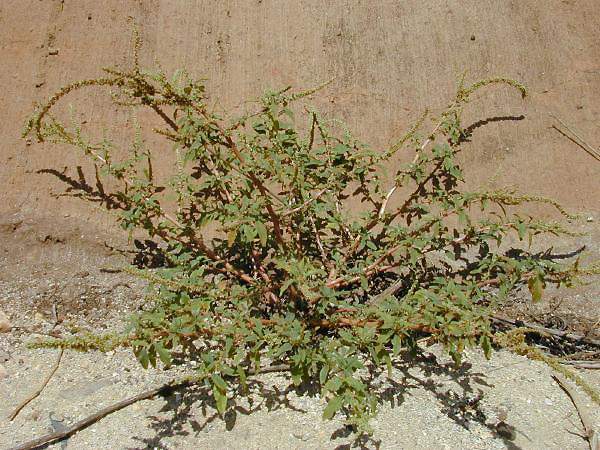
Mediterranean amaranth forms a low, branched mat standing 10 to 50 cm (4 to 20 in) tall with prostrate or ascending pale stems.
The leaves are arranged alternately, measuring 1 to 4 cm (0.4 to 1.6 in) long and 0.5 to 2 cm (0.2 to 0.8 in) wide. They feature an obovate to spatulate blade with a small notch or short bristle tip at the apex.
Inflorescences consist of small axillary clusters tucked into the leaf axils rather than long terminal spikes. Each flower contains 3 tepals measuring 1.5 to 2.5 mm (0.06 to 0.10 in) in length, which gives rise to its common name short-tepalled pigweed.
The fruit is a smooth capsule containing a single shiny black seed measuring 1 to 1.4 mm (0.04 to 0.055 in) across. As mature stems dry in late autumn, the main stem snaps off at the root crown, transforming the plant into a windblown tumbleweed.
Native Habitat and Global Distribution
Mediterranean amaranth is native to warm regions across Africa, southern Europe, the Middle East, and Central Asia, extending east into India.
The species thrives in arid to semi-arid environments, favoring gravelly riverbeds, fallow fields, roadsides, and urban waste ground. It grows from sea level up to elevations of 2,200 m (7,200 ft) in mountainous Mediterranean zones.
Outside its native range, Mediterranean amaranth has naturalized in parts of North America, including California and the southwestern United States. It colonizes disturbed soils where annual rainfall drops below 400 mm (16 in) per year.
Germination and Seed Survival of Mediterranean Amaranth
Individual plants produce between 5,000 and 10,000 seeds each season, which remain viable in soil seed banks for over 10 years.
Seeds germinate rapidly once soil temperatures exceed 20 °C (68 °F) following late spring or summer rain. Growth accelerates in full sun, with plants reaching reproductive maturity within 30 to 45 days of germination.
Taxonomists recognize several wild variants, including Amaranthus graecizans subsp. silvestris, which exhibits narrower leaves and smaller flower clusters in Mediterranean scrub habitats. Drought stress triggers early seed set rather than plant death, ensuring seed survival during dry summers.
Conservation Status and Impact on Farmland
Mediterranean amaranth holds a global IUCN status of Least Concern due to its expansive range and stable wild populations.
In agricultural settings, Mediterranean amaranth behaves as an opportunistic weed in summer crops like sorghum, corn, and cotton. Its deep taproot competes with crops for moisture during dry spells, though it rarely forms dense monocultures.
Like many members of the family Amaranthaceae, the foliage can accumulate high levels of nitrates and soluble oxalates when grown in nitrogen-rich or drought-stressed soils. These compounds make mature plants potentially toxic to grazing livestock if consumed in large quantities.
Traditional Edible Uses and Mediterranean Diet Context
Young shoots and tender leaves of Mediterranean amaranth were traditionally harvested in spring as a wild pot-herb across Greece, Turkey, and North Africa.
In traditional cooking across the Aegean, rural communities collected wild greens, known locally as horta, boiling young pigweed leaves with olive oil and lemon juice. This historical foraging tradition makes Mediterranean amaranth one of several wild Mediterranean examples of gathered leafy greens used in rural diets.
Boiling removes water-soluble oxalates from young leaves before consumption. However, wild populations growing near agricultural runoff or chemically treated roadsides should not be harvested due to heavy nitrate accumulation.
Distinguishing Mediterranean Amaranth from Similar Species
Mediterranean amaranth differs from look-alike species by its axillary flower clusters and 3 short tepals per flower.
You can tell Mediterranean amaranth apart from other wild amaranths by examining flower arrangements and growth habits:
- Prostrate pigweed (Amaranthus blitoides): Has mat-forming stems, but features 4 or 5 tepals and larger seeds measuring 1.3 to 1.7 mm (0.05 to 0.07 in).
- White pigweed (Amaranthus albus): Forms a rigid tumbleweed with erect pale stems and spiny bracts that exceed the flower clusters.
- Redroot pigweed (Amaranthus retroflexus): Grows tall and erect up to 1.5 m (5 ft) with dense terminal flower spikes rather than axillary clusters.
- Green amaranth (Amaranthus viridis): Features wrinkled seed capsules and slender terminal spikes rather than smooth axillary capsules.
Frequently Asked Questions
What is the common name of Amaranthus graecizans?
The primary common name of Amaranthus graecizans is Mediterranean amaranth. It is also known as short-tepalled pigweed, spreading pigweed, and tumbleweed.
Is Mediterranean amaranth edible in the Mediterranean diet?
Tender young leaves of Mediterranean amaranth were historically gathered as a wild spring green in Greece and Turkey. Wild pigweed species are historical Mediterranean examples of leafy pot-herbs, though mature foliage accumulates toxic nitrates in dry or heavily fertilized soils.
What family does Amaranthus graecizans belong to?
Amaranthus graecizans L. belongs to the family Amaranthaceae, a large group of plants that includes beets, spinach, and cultivated grain amaranths.
How do Amaranthus graecizans seeds spread?
Seeds scatter when the mature dried stem breaks off at ground level during late autumn winds, rolling across open land as a tumbleweed. Each plant produces up to 10,000 tiny black seeds that persist in the soil for over a decade.
What is Amaranthus graecizans subsp silvestris?
Amaranthus graecizans subsp. silvestris is a recognized subspecies native to Southern Europe and the Mediterranean basin, characterized by narrower leaves and smaller axillary flower clusters than the nominate subspecies.
Sources & Verification
Taxonomy and distribution are checked against the databases below. Care guidance is written for cultivated species only and reviewed by our editor. How We Build Plant Profiles →
More in Amaranthus

Tumble Pigweed
Amaranthus albus
☀️ Full Sun 💧 Low

Spleen Amaranth
Amaranthus dubius
☀️ Full Sun 💧 Moderate
Spiny Amaranth
Amaranthus spinosus
☀️ Full Sun 💧 Moderate
Green Amaranth
Amaranthus hybridus

Thunberg’s Amaranth
Amaranthus thunbergii
☀️ Full Sun 💧 Moderate
Purple Amaranth
Amaranthus blitum
☀️ Full Sun 💧 Moderate