
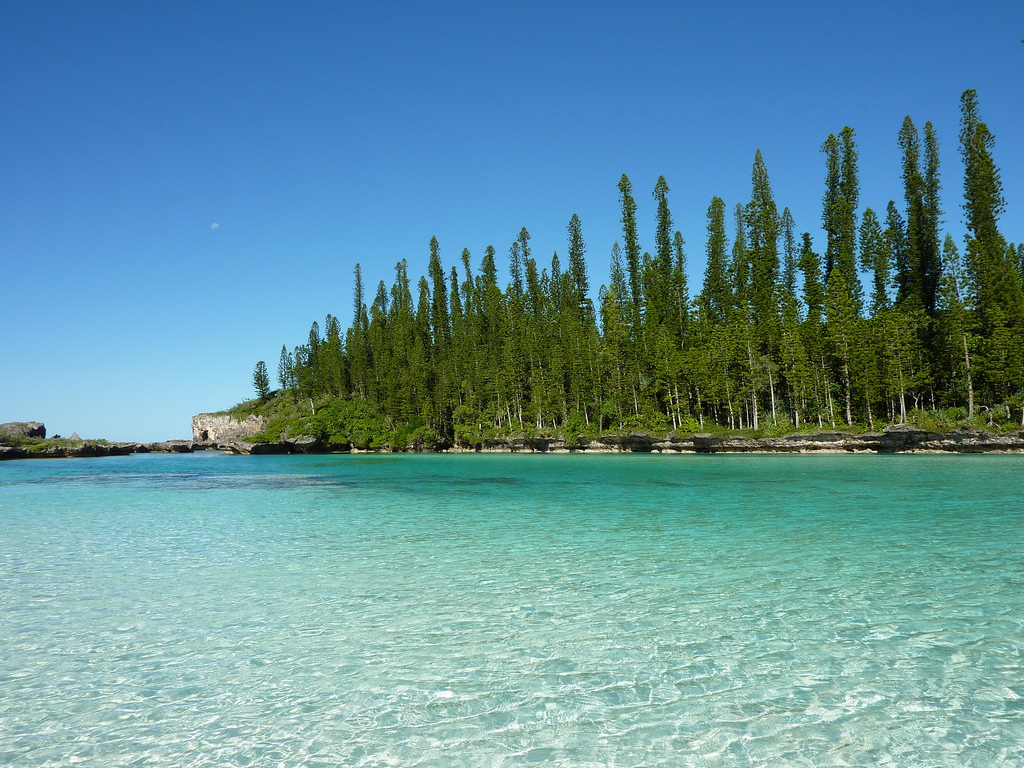
The Cook pine, Araucaria columnaris, is a narrow, evergreen conifer native to New Caledonia that is frequently used in tropical and subtropical landscapes for its distinctively slender silhouette. It is often mistaken for the Norfolk Island pine, but it is distinguished by its much tighter, columnar habit and bark that peels in horizontal, papery flakes.
This species is unique among trees for its tendency to lean toward the equator, with the degree of tilt increasing the further it is planted from the tropical center. It requires significant vertical space, often reaching heights of 60 m (197 ft), making it unsuitable for small residential lots or areas with overhead power lines.
Key Facts
- Height: reaches up to 60 m (197 ft) in maturity
- Light: requires full sun for at least 6 hours daily
- Hardiness: thrives in USDA zones 9 through 11
- Growth Rate: adds 60-90 cm (2-3 ft) of height annually
- Soil: prefers well-drained, sandy or loamy soils
Is Cook Pine Right for Your Garden?
The Cook pine is best suited for large, open landscapes in tropical or subtropical climates where its 60 m (197 ft) height can be accommodated. Because the tree maintains a very narrow spread of only 3-5 m (10-16 ft), it is often used as a vertical accent or a living boundary in coastal regions of Hawaii, Florida, and Australia. You should avoid planting it near structures, as its famous equatorial tilt can cause the trunk to lean significantly over time.
This species is highly salt-tolerant, making it a reliable choice for seaside gardens where other conifers might suffer from salt spray. It is a low-maintenance tree once established, but it lacks the cold hardiness required for temperate regions. If you have a small garden, the sheer scale of a mature Araucaria columnaris will likely overwhelm the space within a decade.
Identifying the Cook Pine
You can identify a Cook pine by its narrow, columnar silhouette and bark that peels in thin, papery flakes. While the Norfolk Island pine (Araucaria heterophylla) has a wider, triangular shape with distinct gaps between branch whorls, the Cook pine is much denser and more cylindrical. The leaves are small, green, and scale-like, measuring about 5-10 mm (0.2-0.4 in) long, and are spirally arranged along the branches.
The bark is a key diagnostic feature, appearing grey and rough but shedding in horizontal strips like birch bark. The branches are short and grow in regular whorls, but they are often so densely packed that the individual layers are less obvious than in other Araucaria species. In the Northern Hemisphere, you will notice the trunk leaning distinctly toward the south, a trait not shared by the Norfolk Island pine.
Site Selection and Planting
Choose a planting site with full sun exposure and at least 5 m (16 ft) of clearance from any buildings or power lines. The Cook pine requires deep, well-drained soil to support its tall structure, as it can be prone to toppling in high winds if the root system is shallow or restricted. It performs well in sandy soils common in coastal Florida and Hawaii, provided there is sufficient organic matter.
When planting, dig a hole twice as wide as the root ball but no deeper than the original container. Backfill with native soil and water deeply to remove air pockets around the roots. Staking is generally not recommended for this species unless the site is exceptionally windy, as the tree needs to develop trunk strength to support its eventual tilt and height.
Watering and Fertilizing Requirements
Young Cook pines require weekly watering during their first two years to establish a deep root system. Once the tree reaches a height of 3-4 m (10-13 ft), it becomes quite drought-tolerant and typically relies on natural rainfall in tropical zones. In areas with prolonged dry seasons, provide a deep soak every 2-3 weeks to prevent the lower branches from browning and dropping.
Apply a balanced, slow-release fertilizer (such as a 10-10-10 NPK) twice a year in spring and late summer to support the fast growth rate. Mature trees in fertile soil rarely need supplemental feeding, but if the foliage appears pale green or yellowish, a dose of magnesium sulfate (Epsom salts) can help restore the deep green color. Avoid high-nitrogen fertilizers in late autumn, as this can stimulate soft growth that is more susceptible to winter chill.
Pruning and Maintaining the Columnar Shape
Pruning should be limited to the removal of dead or damaged lower branches to maintain the tree’s natural columnar form. The Cook pine naturally sheds its lowest branches as it grows taller, a process that can be accelerated by shaded conditions. You should never top a Cook pine, as this destroys the central leader and ruins the symmetrical, vertical habit of the tree.
If you must prune for clearance, always cut back to the branch collar without leaving a stub, which can invite fungal infections. The tree’s whorled branching pattern means that removing one branch in a layer may leave a visible gap for several years. Because the wood is relatively soft, use sharp, sterilized saws to ensure clean cuts that heal quickly in humid climates.
Growing Cook Pine from Seeds and Cuttings
The most reliable way to propagate a Cook pine is by sowing fresh seeds immediately after they fall from the female cones. The seeds have a very short viability period, often losing the ability to germinate within 4-6 weeks of harvest. Sow them in a well-draining seed-starting mix, keeping the temperature around 25 °C (77 °F) and the soil consistently moist but not waterlogged.
Cuttings are significantly more difficult to root and must be taken from the vertical terminal leader to produce a tree with a straight trunk. If you take cuttings from lateral (side) branches, the resulting plant will grow horizontally along the ground rather than upward. Rooting hormone and a high-humidity environment are essential for success with terminal cuttings, which typically take 3-6 months to develop roots.
Why Do Cook Pine Trees Tilt?
The Cook pine is famous for its pronounced lean toward the equator, an unusual trait that is more extreme the further the tree is from the equator. Research suggests this tilt is a response to the Earth’s magnetic field or the angle of the sun, causing trees in the Northern Hemisphere to lean south and those in the Southern Hemisphere to lean north. The angle of the tilt can reach up to 20 degrees in some specimens.
While the tilt is a natural characteristic, it can be mistaken for wind damage or root failure. If the lean is accompanied by soil heaving at the base or cracked bark, it may indicate a structural problem rather than the natural equatorial lean. In most cases, the tree remains stable despite the tilt, as it compensates by growing thicker wood on the side of the lean.
Winter Care and Cold Tolerance
Cook pines are sensitive to frost and will suffer foliage damage if temperatures drop below -1 °C (30 °F). While mature trees can sometimes survive short bursts of slightly lower temperatures, prolonged freezing will kill the growing tip and eventually the entire tree. In marginal zones like USDA 9a, you should plant them in a protected spot, such as near a south-facing wall that radiates heat.
If a cold snap is predicted, water the tree deeply beforehand, as hydrated tissues are more resistant to cold damage. You can wrap young trees in burlap or frost blankets, but this becomes impossible once the tree exceeds 5 m (16 ft) in height. If the leader is killed by frost, the tree will lose its columnar shape and may develop multiple, misshapen trunks.
Cones and Reproduction
As a gymnosperm, the Cook pine produces separate male and female cones on the same tree rather than flowers. The male cones are small, cylindrical, and produce yellow pollen in late spring, while the female cones are larger, egg-shaped, and grow near the top of the canopy. Mature female cones can reach 10-15 cm (4-6 in) in length and take about 18 months to fully ripen.
When the female cones mature, they turn brown and disintegrate while still on the tree, releasing winged seeds that are dispersed by the wind. You will notice the ground beneath a mature tree littered with cone scales and seeds in late summer or autumn. Unlike the edible seeds of the Bunya pine (Araucaria bidwillii), Cook pine seeds are small and not typically harvested for food.
Year-Round Care for Cook Pine
| Spring | Apply a balanced slow-release fertilizer and check for new growth on the terminal leader. Clear any fallen debris from the base to prevent fungal issues. |
|---|---|
| Summer | Monitor soil moisture during heatwaves and provide deep watering if the top 10 cm (4 in) of soil is dry. Collect fresh seeds from fallen cone scales for propagation. |
| Autumn | Apply a second round of fertilizer in early autumn. Prune away any dead or storm-damaged branches before the winter season begins. |
| Winter | In cooler zones, monitor for frost warnings and protect young saplings with frost cloth. Reduce watering as the tree’s growth slows down. |
Cook Pine Health and Growth Problems
| What you see | Likely cause | What to do |
|---|---|---|
| Trunk leaning significantly | Natural equatorial tilt | No action needed unless the soil is heaving or the tree is unstable. |
| Lower branches turning brown | Insufficient light or drought | Increase deep watering and ensure the tree isn’t being shaded by buildings. |
| Yellowing needles | Magnesium deficiency | Apply Epsom salts (magnesium sulfate) to the soil around the drip line. |
| White cottony spots on bark | Mealybugs | Treat with horticultural oil or a strong spray of water to dislodge pests. |
Companion Plants for Araucaria
The best companions for Cook pine are tropical shrubs and groundcovers that thrive in full sun and don’t compete with its deep root system. Because the tree is so tall and narrow, it provides very little shade, allowing sun-loving plants to grow right up to its trunk. Consider planting the following species nearby:
- Hibiscus: Hibiscus rosa-sinensis provides bright color at the base of the dark green trunk.
- Coconut Palm: Cocos nucifera shares the same salt tolerance and tropical aesthetic.
- Ti Plant: Cordyline fruticosa offers colorful foliage that contrasts with the pine’s texture.
- Natal Plum: Carissa macrocarpa works well as a salt-tolerant hedge around the base.
Frequently Asked Questions
What is the difference between a Cook pine and a Norfolk Island pine?
The Cook pine (Araucaria columnaris) is much narrower and more columnar than the Norfolk Island pine (Araucaria heterophylla), which has a wider, triangular shape. Additionally, the Cook pine's bark peels in papery flakes, and the tree often tilts toward the equator.
How fast does a Cook pine grow?
Cook pines are relatively fast-growing for conifers, typically adding 60-90 cm (2-3 ft) of height per year under ideal tropical conditions. They can reach their mature height of 60 m (197 ft) in several decades.
Why do Cook pines lean?
Cook pines exhibit a unique phototropic or magnetoreceptive response that causes them to lean toward the equator. Trees in the Northern Hemisphere lean south, while those in the Southern Hemisphere lean north, with the tilt becoming more pronounced at higher latitudes.
Can Cook pine grow in Florida?
Yes, Cook pine is a common landscape tree in Central and Southern Florida (zones 9b-11) due to its high salt tolerance and preference for warm, humid climates. It is frequently seen in coastal areas and around public buildings.
Are Cook pine trees messy?
They can be somewhat messy as they drop small branchlets, papery bark flakes, and large cone scales throughout the year. The falling female cones can be heavy, so they should be cleared from walkways and lawns regularly.
Sources & Verification
Taxonomy and distribution are checked against the databases below. Care guidance is written for cultivated species only and reviewed by our editor. How We Build Plant Profiles →


