

Common dogwood is a deciduous shrub native to Europe and Western Asia, recognized by its Cornus sanguinea scientific name and its striking red winter twigs. It is a frequent sight in European hedgerows and woodlands, where it provides structural density and food for local bird populations.
This species is primarily grown for its winter bark color, which intensifies after the first frost. While it is a hardy plant, it requires a specific pruning regime to prevent the stems from turning a dull, woody brown as they age.
Key Facts
- Water: Keep soil consistently moist for the first two years
- Pruning: Cut back to 10 cm (4 in) in late winter
- Light: Full sun is required for the brightest red stem color
- Berries: Small black fruits are bitter and mildly toxic to humans
- Hardiness: Fully hardy in USDA zones 4 through 7
How Common Dogwood Fits Your Landscape
Common dogwood is a structural shrub that demands a regular maintenance cycle to look its best in a garden setting. You should choose this plant if you want a naturalistic hedge or a focal point for the winter months when other plants have gone dormant. It is not a plant-and-forget species; without annual or biennial pruning, the stems turn a dull grey-brown and lose their ornamental value.
It works well in damp corners or on the edges of woodland gardens where other shrubs might struggle with heavy clay soil. Because it spreads via suckers, it is excellent for stabilizing banks or filling large gaps in a boundary. If you have a small garden, you must be prepared to manage its fast growth rate to keep it from overwhelming nearby perennials.
Identifying Common Dogwood
You can identify common dogwood by its opposite leaf arrangement and the 3 to 5 pairs of prominent, curving veins on each leaf. The leaves are oval, 4–8 cm (1.5–3 in) long, and turn a deep burgundy or purple in autumn. In late spring, the shrub produces flat-topped clusters of small, four-petaled white flowers that have a slightly medicinal scent.
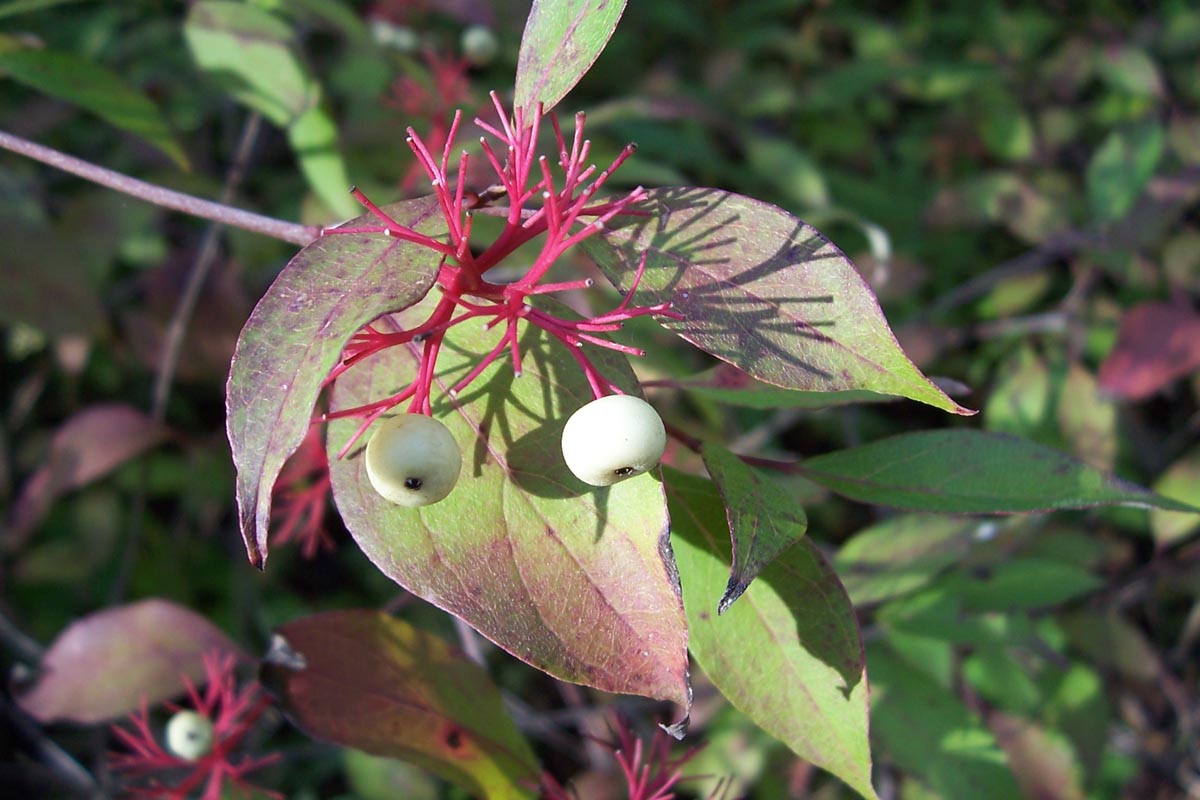
The most distinctive feature is the young bark, which transitions from green to a deep blood-red as temperatures drop in autumn. The fruit consists of small black drupes, roughly 5–8 mm (0.2–0.3 in) in diameter, which hang in clusters during the late summer. Unlike the white berries of the red-osier dogwood (Cornus alba), these berries are strictly black when ripe.
Mature Size and Growth Habit
Common dogwood typically reaches a height of 2 to 5 meters (6.5 to 16 feet) if left to grow naturally without pruning. It has a multi-stemmed, upright habit that becomes more spreading and arching as the plant matures. In a single growing season, a healthy specimen can put on 40 to 60 cm (16 to 24 in) of new growth.
The width of the shrub usually matches its height, often reaching a spread of 4 meters (13 feet). Because it produces underground suckers, a single plant can eventually form a dense thicket if not contained. This growth habit makes it a primary choice for thick, stock-proof hedges in rural areas.
Choosing the Best Site for Planting
Common dogwood grows best in full sun to partial shade, though full sun is required to produce the most intense red stem color. In deep shade, the stems will remain green or a muddy brown throughout the winter. It is highly adaptable to various soil types but thrives in moist, well-drained loams and is particularly tolerant of alkaline or chalky soils.
Avoid planting in areas with standing water for long periods, as this can lead to root rot. However, it is more tolerant of heavy clay than many other ornamental shrubs. Ensure the site has enough room for the plant to spread, or plan to install a root barrier if you wish to prevent suckering in a formal border.
Planting Common Dogwood
Space individual plants 60 to 90 cm (2 to 3 feet) apart if you are creating a dense, informal hedge. For specimen planting, give each shrub at least 2 meters (6.5 feet) of space to allow for its natural spread. The best time to plant is in late autumn or early spring while the shrub is dormant.
- Dig a hole twice as wide as the root ball.
- Mix in organic matter if the soil is very poor or sandy.
- Set the plant at the same depth it was in its container.
- Backfill and firm the soil to remove air pockets.
- Water deeply immediately after planting to settle the roots.
Watering and Feeding Care
Water common dogwood once a week during its first two growing seasons to ensure the root system establishes properly. Once established, it is relatively drought-tolerant but will lose leaves early in the autumn if the soil becomes bone-dry. During periods of extreme heat, a deep soaking every 10 days will prevent leaf scorch.
Feeding is rarely necessary if the soil is healthy. You can apply a balanced 10-10-10 fertilizer in early spring just as the buds begin to break, but avoid over-fertilizing as this can lead to weak, sappy growth that is more susceptible to pests. A 5 cm (2 in) layer of wood chip or bark mulch applied in spring will help retain moisture and suppress weeds.
Pruning for Brightest Winter Stems
To maintain the signature red bark, you must prune the shrub every 1 to 2 years in late winter. This technique, known as coppicing, involves cutting all stems down to about 10–15 cm (4–6 in) above the ground. The plant will respond by sending up vigorous new shoots that display the most vivid coloration the following winter.
If you prefer a taller screen, you can use pollarding, where you cut the branches back to a permanent framework of older wood at a height of 1 meter (3 feet). Unpruned plants will eventually lose their red color on the lower sections, with only the tips of the branches showing any pigment. Always use sharp, clean loppers to ensure clean cuts that heal quickly.
Common Dogwood Tree Problems and Diseases
Common dogwood is susceptible to leaf spot fungi, which appear as small purple or brown circles on the foliage during wet summers. While rarely fatal, severe infections can cause premature leaf drop. To manage this, remove fallen leaves in autumn and avoid overhead watering which keeps the foliage damp.
- Anthracnose: Look for tan spots with purple borders on leaves.
- Aphids: Check new growth for clusters of small green insects.
- Scale Insects: Watch for small, waxy bumps on the stems.
- Horse Chestnut Scale: Often affects dogwoods, appearing as white fluffy spots on bark.
Winter Maintenance and Stem Color
The stems of common dogwood turn their most intense red after the first hard frost of the season. No special winter protection is required as the plant is extremely cold-hardy. However, you should avoid pruning during the early winter, as the colorful stems are the primary reason for growing the plant.
In late winter, check the base of the plant for any damaged or diseased wood and remove it before the main pruning session. If you live in an area with heavy snow, the flexible stems of the dogwood are less likely to snap than more brittle shrubs. The red color will persist until the sap begins to rise in early spring, at which point the stems will gradually fade back to green.
Uses in the Garden and Wildlife
Common dogwood is a primary choice for wildlife hedges because its flowers attract bees and its berries are a vital food source for birds like thrushes and bullfinches. The dense branching provides excellent nesting cover for small birds. In traditional crafts, the hard wood was used to make skewers, arrows, and bobbins.
The plant has been used in folk medicine as an astringent, and the oil from the seeds was historically used in soap making. In modern landscapes, it is frequently paired with other winter-interest plants like willow (Salix alba ‘Britzensis’) or silver birch (Betula pendula). It is also effective for erosion control on steep banks due to its extensive root system.
Year-Round Care for Common Dogwood
| Spring | Apply a 5 cm (2 in) layer of mulch and a balanced fertilizer. Monitor for aphid outbreaks on new shoots. |
|---|---|
| Summer | Water deeply during dry spells. Check leaves for fungal spots and remove any heavily infected foliage. |
| Autumn | Enjoy the burgundy leaf color and black berries. Clear away fallen leaves to prevent disease carry-over. |
| Winter | Hard prune (coppice) the stems to 10 cm (4 in) in late February. Take hardwood cuttings for propagation. |
Common Dogwood Shrub Problems Explained
| What you see | Likely cause | What to do |
|---|---|---|
| Dull brown or grey stems | Old wood or lack of sunlight | Hard prune the plant to the ground in late winter and ensure it gets full sun. |
| Purple spots on leaves | Leaf spot fungus (Septoria) | Improve air circulation and remove fallen debris in autumn. |
| Wilting leaves in summer | Drought stress or heavy clay compaction | Water deeply at the base and apply mulch to retain moisture. |
Popular Common Dogwood Cultivars
- ‘Midwinter Fire’ – orange, yellow, and red stems, very popular.
- ‘Compressa’ – dwarf variety with crinkled, upright leaves.
- ‘Winter Beauty’ – similar to Midwinter Fire but more compact.
- ‘Anny’s Winter Orange’ – intense orange-red winter bark.
- ‘Magic Flame’ – yellow-orange stems with red tips.
Frequently Asked Questions
Are common dogwood berries edible?
No, the berries of common dogwood are bitter and contain saponins that can cause nausea and stomach upset in humans.
Is common dogwood poisonous to dogs?
Yes, ingesting the berries or leaves can cause vomiting and diarrhea in dogs and cats, though it is rarely life-threatening.
Can I grow common dogwood as a hedge?
Yes, common dogwood makes an excellent informal or wildlife hedge when spaced 60-90 cm (2-3 feet) apart.
Why is it called dogwood?
The name likely comes from 'dagwood,' as the hard wood was used to make 'dags' or skewers, or from its traditional use in treating mange in dogs.
How do I tell common dogwood apart from red-osier dogwood?
Common dogwood (Cornus sanguinea) has black berries, while red-osier dogwood (Cornus alba) produces white or bluish berries.
Information about traditional or historical uses is provided for educational interest only and is not medical advice. Do not use any plant to treat a condition without speaking to a qualified professional.
Sources & Verification
Taxonomy and distribution are checked against the databases below. Care guidance is written for cultivated species only and reviewed by our editor. How We Build Plant Profiles →
More in Cornus

Flowering Dogwood
Cornus florida
☀️ Partial Sun 💧 Moderate

Asiatic Dogwood
Cornus officinalis
☀️ Full Sun 💧 Moderate
Red-Osier Dogwood
Cornus sericea
☀️ Full Sun 💧 High
Kousa Dogwood
Cornus kousa
☀️ Full Sun 💧 Moderate

Siberian Dogwood
Cornus alba
☀️ Full Sun 💧 High

Bunchberry Dogwood
Cornus canadensis
☀️ Partial Shade 💧 Moderate