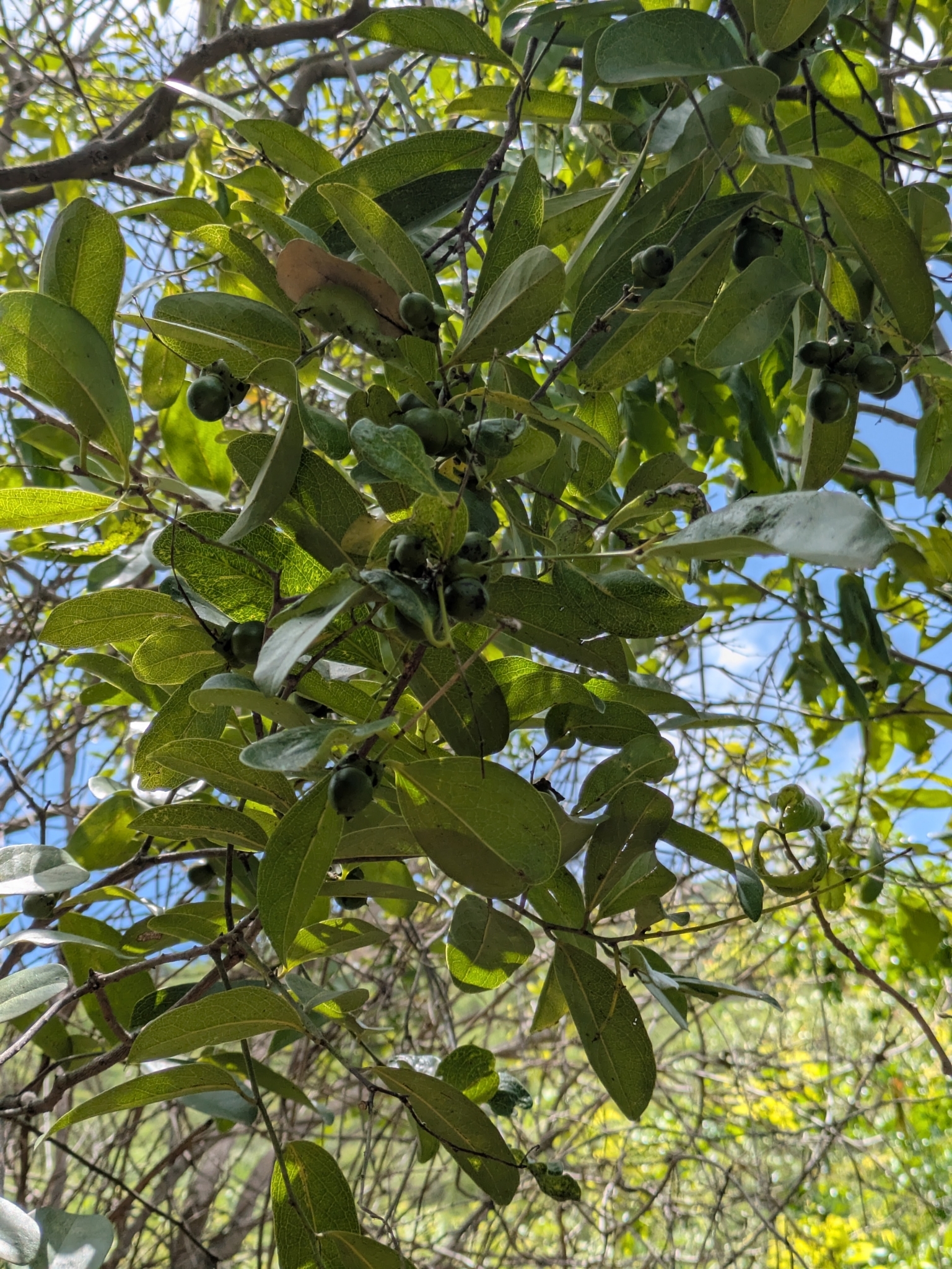
Japanese persimmon (Diospyros kaki) is a deciduous fruit tree native to East Asia, cultivated for over 2,000 years for its smooth, bright orange autumn fruit. It develops a rounded canopy with glossy leaves that turn yellow, orange, and red before shedding to reveal heavy crops of fruit on bare branches.
This tree requires winter chilling between 100 and 500 hours to trigger flowering, making it reliable across temperate and warm climates. It tolerates hot summers once established but drops fruit early if soil moisture fluctuates severely during early summer development.
Key Facts
- Hardiness: USDA zones 7a through 10b
- Height: 4.5–9 m (15–30 ft) at maturity
- Light: Full sun (minimum 6 hours daily)
- Water: 25 mm (1 in) per week for young trees
- Soil pH: 6.0–7.0, well-draining loam
- Fruit Type: Astringent or non-astringent cultivars
Is Japanese Persimmon Right for Your Garden?
Japanese persimmon thrives in USDA hardiness zones 7 through 10, requiring warm summers and low chill hours to produce fruit. It fits medium-to-large home gardens, suburban orchards, and edible landscapes where a single tree can yield 25–50 kg (55–110 lb) of fruit annually.
Most cultivated varieties are self-fertile, meaning you only need one tree to get a full crop. It requires low maintenance compared to apples or peaches, as it rarely suffers from major fungal diseases or plum curculio attacks in home settings.
You must allow space for a mature branch spread of up to 7.5 m (25 ft). Avoid planting next to paved walkways or parked vehicles, as falling unharvested fruit creates slick, soft orange debris in late autumn.
Identifying Japanese Persimmon Trees
A mature Japanese persimmon displays leathery oval leaves 7–15 cm (3–6 in) long with dark green glossy tops and paler, slightly downy undersides. Leaves turn crimson, yellow, and deep orange in October before dropping entirely.
The greyish-brown bark splits into distinct rectangular blocks, creating a fissured pattern on mature trunks. In late spring, small creamy-yellow flowers about 1.5 cm (0.6 in) wide open along young shoots, hidden beneath the leaf canopy.
- Leaf shape: Alternate, simple, ovate with smooth margins
- Fruit size: 5–10 cm (2–4 in) wide, orange to reddish-orange
- Calyx: Four prominent woody green sepals atop the fruit
- Comparison: American persimmon (Diospyros virginiana) has smaller fruit 2–5 cm (1–2 in) wide and darker, blockier bark
Japanese Persimmon Size and Growth Rate
Grafted Japanese persimmon trees grow at a rate of 30–60 cm (12–24 in) per year, reaching a final height of 4.5–9 m (15–30 ft). Trees grafted onto rootstocks like Diospyros lotus or Diospyros virginiana adapt reliably to varied soil conditions.
Nursery-bought grafted specimens begin bearing fruit within 3–4 years after planting. Trees raised directly from seed grow slower, taking 6–9 years to fruit, and rarely reproduce the fruit quality or exact traits of the parent cultivar.
Best Growing Zones and Site Selection
Plant Japanese persimmon in a position receiving at least 6 hours of direct sunlight daily for optimal flower bud formation and fruit sweetening. Full sun reduces fungal risks and encourages strong main scaffold branches.
Select a location sheltered from strong prevailing winds. The wood of Japanese persimmon is somewhat brittle, and heavy crops of maturing fruit in late autumn can snap branches during intense windstorms.
Soil should be deep, fertile, and free-draining. While tolerant of temporary clay moisture, trees develop root rot in stagnant water; avoid low spots or poorly drained depressions.
Planting a Japanese Persimmon Tree
Space Japanese persimmon trees 4.5–6 m (15–20 ft) apart when planting in rows or garden borders during late winter or early spring dormancy. Dormant bare-root or containerized trees establish fastest before summer heat arrives.
Dig a planting hole twice as wide as the root mass and equal in depth. Position the tree so the graft union sits 5–7 cm (2–3 in) above the surrounding soil level to prevent rootstock suckering.
- Backfill with unamended native soil to avoid water-trapping pockets
- Water deeply with 20 L (5 gal) of water immediately after backfilling
- Apply a 7.5 cm (3 in) layer of wood chip mulch in a 1 m (3 ft) ring
- Keep mulch 10 cm (4 in) away from the trunk base to prevent bark rot
Japanese Persimmon Tree Care and Watering
Provide 25 mm (1 in) of water weekly during dry periods for the first two growing seasons after planting. Established trees possess deep taproots and generally require supplemental irrigation only during droughts exceeding 3 weeks.
Avoid over-fertilizing with high-nitrogen synthetic fertilizers, which causes vigorous leafy growth and triggers wholesale fruit drop in June. Apply 2–3 kg (4–6 lb) of well-rotted compost around the drip line in early spring.
If annual branch growth falls below 30 cm (12 in) on young trees, broadcast 200 g (0.5 lb) of balanced 10-10-10 organic fertilizer around the drip line in March.
Pruning Japanese Persimmon Trees
Prune Japanese persimmon trees during late winter dormancy in February or March before buds begin to swell. Maintain a modified central leader or open-vase form with 4–6 well-spaced main branches.
Because Japanese persimmon bears fruit on current season growth arising from shoots produced the previous year, avoid heavy heading cuts that remove terminal buds. Thin out overcrowded interior shoots to let light reach the inner canopy.
- Remove water sprouts and rootstock suckers as soon as they appear
- Cut away dead, damaged, or crossing branches back to the branch collar
- Shorten unusually long, drooping scaffold limbs to prevent fruit breakage
- Keep branch crotch angles wide (45–60 degrees) for structural strength
Common Japanese Persimmon Pest and Disease Problems
Premature fruit shedding in early summer is usually caused by irregular watering or excessive nitrogen fertilization rather than insect pests. Maintaining uniform soil moisture through mulching stops severe drop.
Watch for scale insects and persimmon psylla (Trioza diospyri), which cluster on branch undersides and secret honeydew that fosters black sooty mold. Spray dormant horticultural oil in late winter before bud break to smother overwintering scale scales and eggs.
Leaf spot fungi like anthracnose (Pseudocercospora fuliginosa) cause tiny dark spots on foliage during humid summers. Rake up and destroy fallen leaves every autumn to eliminate fungal spores in the soil layer.
Winter Care and Frost Protection
Young trees under three years old require trunk wrapping or frost cloth protection when ambient temperatures drop below -10 °C (14 °F). Mature trees tolerate brief winter lows down to -15 °C (5 °F) without major wood damage.
Late spring frosts present the greatest climate risk, killing early leaf growth and developing flower buds. In colder zone 7 regions, plant on elevated ground or near a south-facing masonry wall to capture radiant heat and delay spring bud break.
Uses for Japanese Persimmon Fruit and Extracts
Japanese persimmon fruit contains 3–4 g of dietary fibre per 100 g serving along with vitamins A and C, and is classified into non-astringent and astringent cultivars. Non-astringent cultivars like ‘Fuyu’ are crisp and sweet when firm, eaten sliced like apples.
Astringent varieties like ‘Hachiya’ contain high concentrations of soluble tannins that cause mouth pucker unless the fruit is allowed to ripen until completely soft and jelly-like, or peeled and air-dried into dried persimmons known as hoshigaki.
Extracts from the fruit skin and unripe persimmons are rich in condensed tannins (epigallocatechin gallate). These extracts are formulated into Japanese persimmon body wash and soap products designed to neutralize nonenal, an organic compound responsible for age-related body odor.
Year-Round Japanese Persimmon Maintenance
| Spring | Apply a 2 cm (0.8 in) layer of compost around the drip line before bud break. Inspect shoots for persimmon psylla and spray soft soap if leaf curling occurs. |
|---|---|
| Summer | Provide 25 mm (1 in) of water weekly during drought to prevent early fruit drop. Thin heavy clusters down to 1–2 fruits per shoot if branches bend excessively. |
| Autumn | Harvest non-astringent fruit when fully orange but firm; clip astringent types with shears when deep red-orange. Clear fallen foliage to reduce anthracnose carryover. |
| Winter | Prune dormant scaffold branches and remove dead wood in February. Apply dormant oil spray to the trunk and main limbs on a mild day above 5 °C (41 °F). |
Troubleshooting Common Japanese Persimmon Problems
| What you see | Likely cause | What to do |
|---|---|---|
| Green fruits dropping in June | Irregular watering or excess nitrogen fertilizer | Maintain a consistent mulched root zone and eliminate high-nitrogen spring fertilizers. |
| Black coating on leaves and stems | Sooty mold growing on psylla or scale honeydew | Apply horticultural soap or neem oil to eliminate honeydew-producing scale insects. |
| Mouth puckering, dry sensation when eating fruit | Eating an astringent cultivar before it softens fully | Allow astringent varieties to ripen at room temperature until jelly-soft before eating. |
| Small brown spots on leaves in late summer | Anthracnose leaf spot fungal infection | Rake and destroy all fallen foliage in autumn to remove winter spore sources. |
Popular Japanese Persimmon Cultivars Compared
- 'Fuyu' – non-astringent, squat tomato-shaped fruit eaten firm
- 'Hachiya' – astringent, large acorn-shaped fruit used for drying and baking
- 'Jiro' – non-astringent, flattened yellow-orange fruit with strong cold hardiness
- 'Saijo' – astringent, small sweet oval fruit traditional for hoshigaki drying
- 'Izu' – non-astringent, early-ripening compact cultivar suited for small yards
Frequently Asked Questions
How do you ripen a Japanese persimmon?
Place astringent persimmons in a closed paper bag with a ripe banana or apple at 18–22 °C (65–72 °F) for 3–7 days. The ethylene gas released by the apple speeds up the softening process and breaks down soluble tannins.
Can you eat the skin of a Japanese persimmon?
You can eat the skin of non-astringent persimmon varieties like 'Fuyu' when crisp, though some prefer peeling because the skin can be tough. The skin of astringent varieties should be avoided until the fruit is completely soft or peeled before drying.
How do you dry Japanese persimmons to make hoshigaki?
Peel firm astringent persimmons leaving the stem attached, tie them with twine, and hang them in a cool, dry area with good airflow for 4–6 weeks. Massaging the fruit gently every few days after two weeks crystallizes natural sugars throughout the pulp.
How do you grow a Japanese persimmon tree from seed?
Extract seeds from fresh fruit, store them in damp peat moss inside a refrigerator at 2–4 °C (36–39 °F) for 60–90 days, then sow 2 cm (0.8 in) deep in potting soil. Note that seed-grown trees take 6–9 years to fruit and do not grow true to the parent variety.
What are the benefits of Japanese persimmon soap and extract?
Japanese persimmon fruit extract contains condensed tannins that bind to and neutralize nonenal, the chemical compound responsible for age-related body odor. Soaps containing persimmon extract act as natural deodorizers without using synthetic fragrance masks.
Information about traditional or historical uses is provided for educational interest only and is not medical advice. Do not use any plant to treat a condition without speaking to a qualified professional.
Sources & Verification
Taxonomy and distribution are checked against the databases below. Care guidance is written for cultivated species only and reviewed by our editor. How We Build Plant Profiles →
- Kew Plants of the World OnlineTaxonomic baseline for Diospyros kaki
- RHS Plant FinderCultivation and hardiness data
- NC State University ExtensionPlant characteristics and culture
- UC Agriculture and Natural ResourcesPruning, pest control, and harvest advice
- GBIF — Global Biodiversity Information Facilitytaxonomy, synonyms, occurrence records
- Wikipediageneral reference