
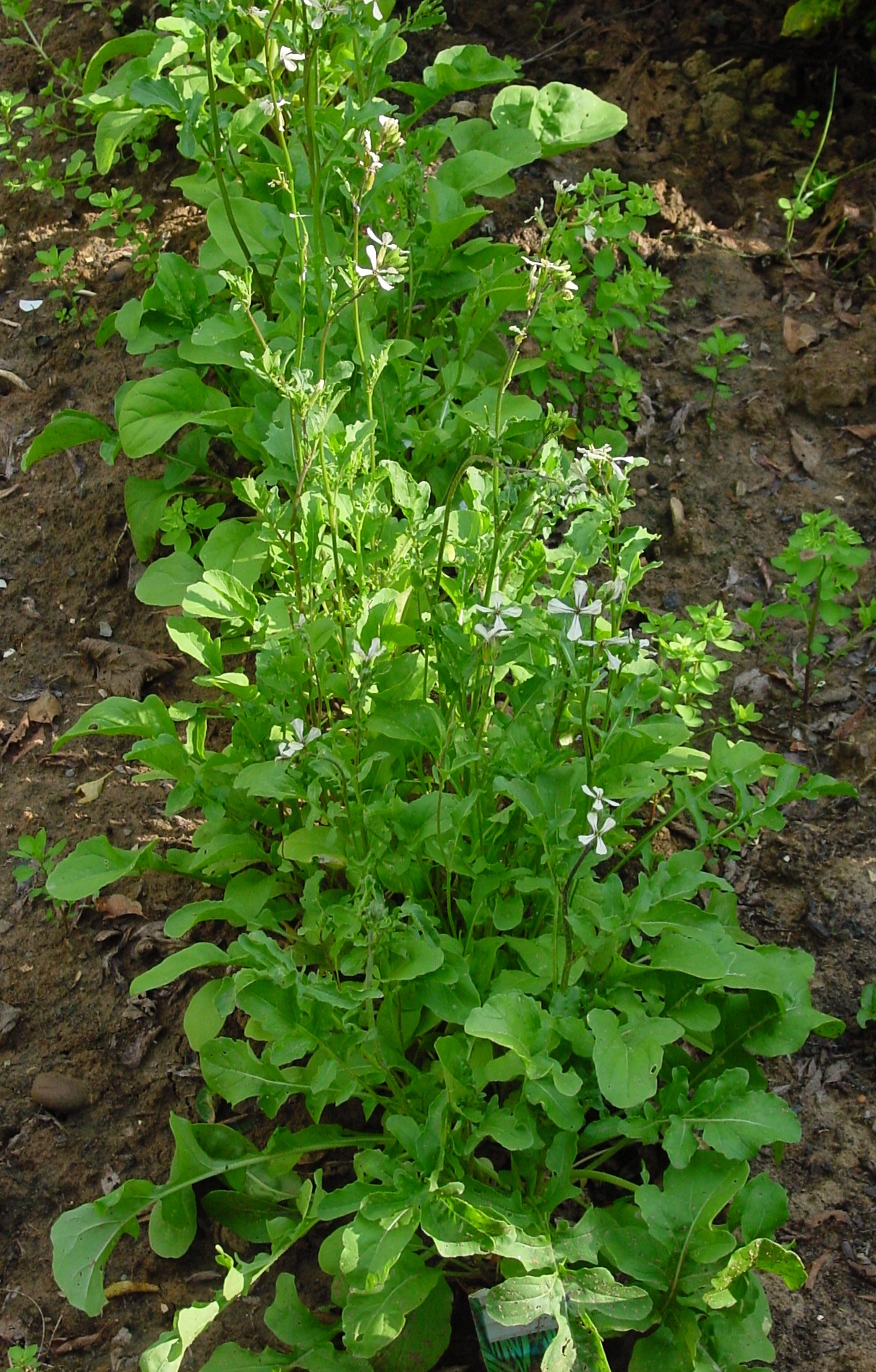
Rocket (Eruca sativa) is an annual leafy green native to the Mediterranean basin, grown for its pungent, mustard-flavoured foliage. It reaches culinary maturity in as few as 20 to 30 days from germination.
Hot weather triggers rapid bolting, which causes the leaves to turn sharply bitter and tough. Success depends entirely on timing your sowings for cool spring or autumn weather.
Key Facts
- Germination: 4 to 7 days at 10–20 °C (50–68 °F)
- Harvest time: 21 to 40 days from sowing
- Sunlight: full sun in spring; light afternoon shade in summer
- Watering: keep the top 2 cm (0.8 in) consistently moist
- Soil pH: 6.0 to 7.0 in free-draining loam
Is Rocket Right for Your Garden?
Rocket suits growers who want a fast-turnaround crop that delivers continuous fresh greens from minimal container or bed space. It works well on balconies, in raised timber planters, and along vegetable plot edges between slower crops like tomato (Solanum lycopersicum).
Because it runs to seed when soil temperatures climb above 24 °C (75 °F), it is not a summer-long crop in hot climates. You will succeed if you can offer regular moisture and cool spring or autumn growing windows.
How to Identify Rocket
Vegetative rocket forms an open rosette of deeply pinnatifid leaves measuring 7 to 20 cm (2.8 to 8 in) long with rounded lateral lobes and a larger terminal lobe. The foliage produces a characteristic pungent, sulphur-rich aroma when crushed between your fingers.
Mature plants bolt to produce branched flower stalks reaching 60 to 80 cm (24 to 31 in) tall. Features to look for include:
- Flowers: four petals arranged in a cross, cream to pale straw-yellow with distinct violet-brown veins, 15 to 20 mm (0.6 to 0.8 in) across.
- Stems: sparsely bristly, ribbed, erect, and branched near the top.
- Fruit: an erect, beak-tipped silique pod 1.5 to 3.5 cm (0.6 to 1.4 in) long holding two rows of small yellowish seeds.
- Differences from wild rocket: wild rocket (Diplotaxis tenuifolia) has bright yellow petals without dark veins and finer, deeper leaf serrations.
Growing Conditions and Soil
Salad rocket produces its tenderest foliage in cool, moisture-retentive soil with 4 to 6 hours of direct sunlight daily. In early spring and autumn, plants thrive in full sun, but hot midday sunlight in late spring accelerates flower stem elongation.
Incorporate garden compost into the top 10 cm (4 in) of soil before planting to retain uniform moisture without waterlogging. Aim for a soil pH between 6.0 and 7.0. Heavy clay soils should be aerated with grit or planted in raised rows, as waterlogged ground rots root systems rapidly.
Sowing Rocket Seeds
Sow seeds outdoors 6 mm (0.25 in) deep directly into finely raked soil from early spring onwards. Space drill rows 20 to 30 cm (8 to 12 in) apart, scattering seeds thinly along the trench.
Follow this routine for steady germination:
- Succession interval: sow fresh seed every 14 to 21 days for an unbroken harvest window.
- Soil temperature: sow when the ground sits between 10 and 18 °C (50 and 64 °F).
- Emergence: seedlings appear within 4 to 7 days if the seedbed remains damp.
- Thinning: thin seedlings to 10 to 15 cm (4 to 6 in) apart once they develop their first true leaves.
Everyday Rocket Care
Consistent moisture is the primary rule; provide 25 mm (1 in) of water per week to keep the foliage tender and reduce bitter glucosinolate buildup. Drought stress causes immediate bolting and tough, unpalatable texture.
Weed the bed hand-to-hand while plants are small, because young seedlings struggle against vigorous broadleaf weeds like chickweed (Stellaria media). Established beds rarely require supplemental fertiliser if compost was applied at sowing; excessive nitrogen fertiliser causes soft, sappy leaves prone to fungal blight.
Harvesting Rocket Leaves
Begin harvesting leaves when they reach 7 to 10 cm (3 to 4 in) in length, roughly 25 to 30 days after sowing. Picking the outer leaves allows the central crown to continue generating new foliage for three to four subsequent cuttings.
Use clean scissors to cut stems 2 cm (0.8 in) above the soil crown rather than pulling the whole plant. Harvest in the early morning before heat wilts the stems. Edible flower buds and young cream petals can also be clipped as peppery additions to meals.
Culinary Uses and Preparation
Rocket is consumed raw in green salads or tossed into hot dishes right at the end of cooking. Its sharp, nutty profile cuts through rich ingredients like olive oil, aged parmesan, and cured meats.
Traditional Mediterranean uses include:
- Pizza topping: scattered fresh over hot baked crusts just before serving.
- Pesto base: blended with garlic, pine nuts, olive oil, and pecorino cheese.
- Pasta stir-in: folded through warm orecchiette alongside garlic and cherry tomatoes.
- Meat garnish: piled beneath thin slices of warm beef tagliata.
Pests and Crop Problems
Flea beetles are the most frequent challenge, chewing dozens of small circular shot-holes through young seedling leaves during warm, dry spells. Cover newly seeded drills immediately with fine horticultural fleece or insect mesh with a mesh size under 0.8 mm (0.03 in).
Damping-off fungal pathogens affect crowded, over-watered seedlings in poor light. Downy mildew presents as pale yellow patches on the upper leaf surfaces with greyish mould beneath during damp, cloudy autumn periods; spacing plants 15 cm (6 in) apart maintains adequate airflow to suppress spore growth.
Storing and Preserving Fresh Rocket
Store unwashed leaves in the refrigerator crisping drawer at 1 to 4 °C (34 to 39 °F) for up to 5 days. Place the harvested leaves inside an airtight container or perforated plastic bag lined with a dry paper towel to absorb excess surface humidity.
Because the foliage contains high water levels, it does not freeze well whole; frozen leaves collapse into an unpalatable slime upon thawing. To preserve a surplus harvest, puree the leaves with extra-virgin olive oil and freeze the puree in ice cube trays for winter cooking.
Frequently Asked Questions
What is the difference between rocket and arugula?
Rocket and arugula are two common names for the same botanical plant, Eruca sativa. Rocket is the standard British English term, derived from the French roquette, while arugula is the common North American term derived from Italian dialects.
Why does rocket bolt and how do I prevent it?
Rocket bolts into flower in response to soil temperatures exceeding 20 °C (68 °F), lengthening daylight, and dry soil. To delay bolting, sow crops in early spring or late summer, keep the bed consistently watered, and position summer plantings in partial shade.
Can you eat rocket after it flowers?
Yes, both the leaves and the flowers remain edible after bolting, but the leaves become markedly tougher and much more peppery. The cream-coloured flowers have a milder, nutty-radish taste that works well in salads.
How many times can you harvest from one rocket plant?
You can harvest single plants three to four times using a cut-and-come-again method. Cut individual outer leaves 2 cm (0.8 in) above the ground, allowing two weeks of regrowth between pickings before the plant runs to seed.
What is eating small holes in my rocket leaves?
Flea beetles (Phyllotreta species) cause tiny round holes in the leaves, especially during warm, dry weather. Protecting plants beneath insect mesh netting from the day of sowing is the most reliable remedy.
Sources & Verification
Taxonomy and distribution are checked against the databases below. Care guidance is written for cultivated species only and reviewed by our editor. How We Build Plant Profiles →
- Kew Plants of the World OnlineTaxonomic status and native distribution records for Eruca sativa.
- Royal Horticultural SocietyCultivation timings, spacing, and pest management guidelines.
- North Carolina State ExtensionMorphology, growing requirements, and botanical characteristics.
- GBIF — Global Biodiversity Information Facilitytaxonomy, synonyms, occurrence records
- Wikipediageneral reference
