
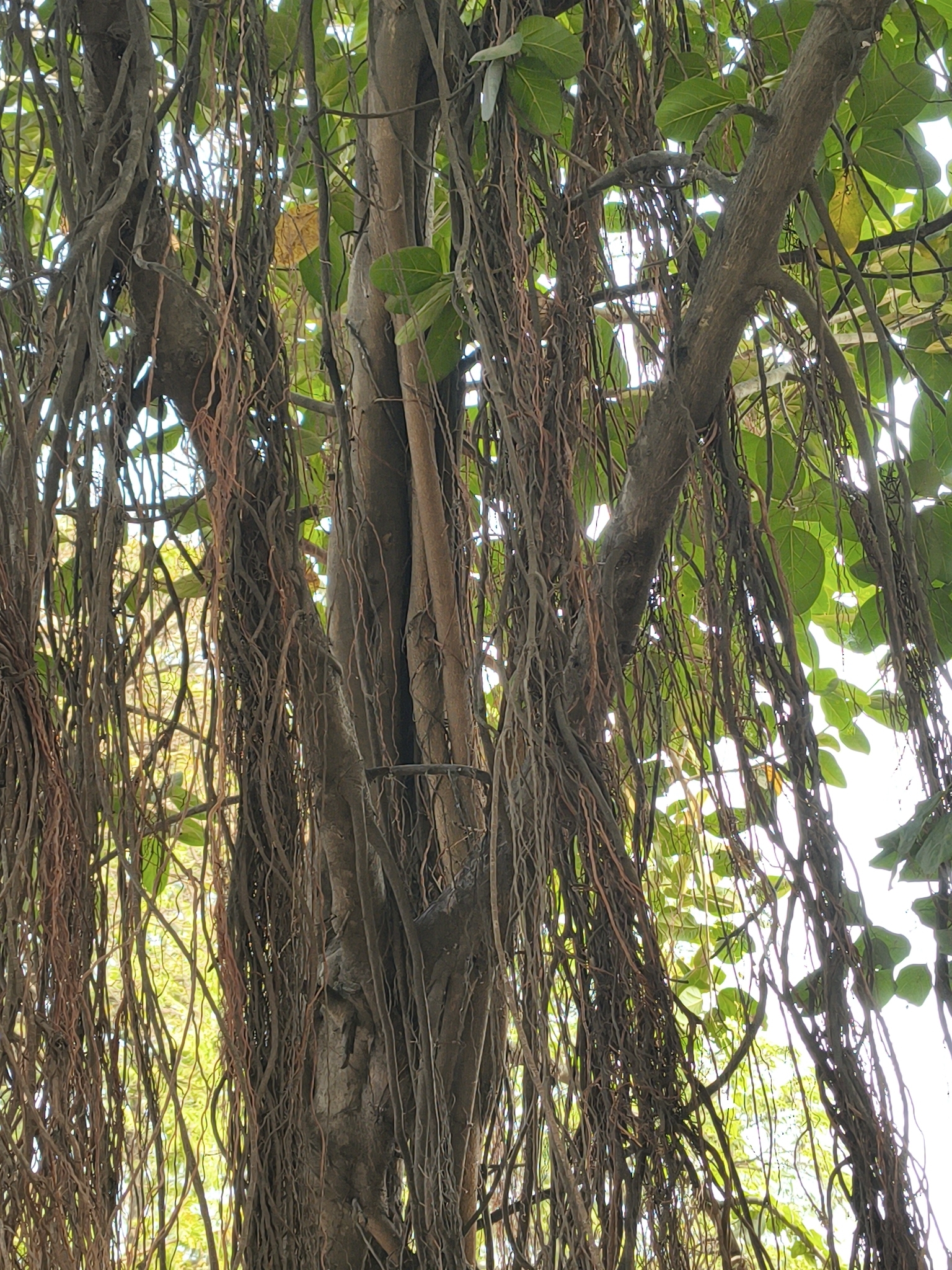
Chinese banyan (Ficus microcarpa) is a fast-growing tropical tree native to a wide range spanning from India through Southeast Asia to Northern Australia. It is recognized by its smooth grey bark and the ability to produce thick, woody aerial roots that eventually reach the ground to form secondary trunks.
While it can reach 15 m (50 ft) in the wild, you will most likely encounter it as a compact “Ginseng” bonsai or a braided indoor tree. It requires consistent light and temperature to prevent the sudden leaf drop common to the Ficus genus when stressed by environmental changes.
Key Facts
- Light: Requires bright indirect sunlight for 6-8 hours daily
- Water: Saturate when the top 2 cm (1 in) of soil is dry
- Temperature: Maintain a minimum of 15 °C (60 °F) year-round
- Humidity: Prefers levels above 50% to support aerial root growth
- Toxicity: Sap is toxic to cats, dogs, and horses
Growing Chinese Banyan as a Houseplant
Chinese banyan is a rewarding choice for indoor spaces if you can provide consistent light and warmth. It is a forgiving species for those new to bonsai, as its thick trunk stores water, making it more drought-tolerant than the common weeping fig (Ficus benjamina). You should place it in a permanent spot immediately, as moving the pot frequently often triggers a defensive leaf drop.
In frost-free regions like Florida or Hawaii, this tree can become invasive, with roots capable of damaging sidewalks and foundations. Keep your Chinese banyan in a container to manage its size and prevent it from spreading into the local ecosystem. Indoor specimens rarely exceed 2 m (6.5 ft) unless they are grown in large floor planters.
How to Identify Chinese Banyan
You can identify Chinese banyan by its glossy, dark green oval leaves that typically measure 5-10 cm (2-4 in) in length. Unlike the pointed tips of Ficus benjamina, these leaves have a more rounded or blunt apex. The bark is notably smooth and light grey, often marked with small horizontal lenticels that look like tiny scars.
- Leaves: Thick, leathery, and arranged alternately along the stems.
- Roots: Aerial roots hang from branches in humid conditions, turning woody upon reaching soil.
- Trunk: Often swollen at the base in “Ginseng” cultivars, resembling a ginger root.
- Fruit: Small, stalkless figs that turn from green to yellow or dark red when ripe.
Best Light for Chinese Banyan Tree
The Chinese banyan tree thrives in bright, indirect sunlight for most of the day. While it can tolerate a few hours of direct morning sun, harsh afternoon rays in mid-summer may scorch the foliage, leading to brown patches. If you notice the stems becoming “leggy” with large gaps between leaves, the plant is likely reaching for more light.
During the winter months in temperate zones, you may need to use a full-spectrum grow light to maintain its density. Rotating the pot 90 degrees every week ensures that all sides of the canopy receive equal exposure, preventing the lopsided growth often seen in window-facing plants.
Watering and Soil Requirements
Water your Chinese banyan when the top 2 cm (1 in) of soil feels dry to the touch. Pour water evenly over the soil surface until it drains out of the bottom holes, then discard any excess in the saucer to prevent root rot. During the peak growing season in summer, you may need to water twice a week, while once every ten days is usually sufficient in winter.
Use a well-draining potting mix with a pH between 6.0 and 7.5. A mixture of two parts peat moss, one part pine bark, and one part perlite provides the aeration these roots need. If you are growing it as a bonsai, use a specialized akadama or pumice-based grit to ensure rapid drainage and healthy root development.
Humidity and Temperature Needs
Chinese banyan requires temperatures between 18-24 °C (65-75 °F) to maintain active growth. It is highly sensitive to cold drafts from windows or air conditioning vents; exposure to temperatures below 13 °C (55 °F) will cause the plant to shed its leaves rapidly. If your home is dry, especially during winter heating, the plant will benefit from a humidifier.
To encourage the development of decorative aerial roots, you must maintain humidity levels above 50%. You can achieve this by placing the pot on a tray filled with pebbles and water or by misting the trunk and branches daily. In very dry air, the leaf margins may turn brown and crispy.
Pruning and Shaping Chinese Banyan Bonsai
Prune your Chinese banyan regularly to maintain its compact shape and encourage denser foliage. Because it is a vigorous grower, you can prune back to two leaves after a branch has grown six to eight new leaves. This species bleeds a sticky white latex when cut, which will stop on its own but can irritate your skin.
- Structural Pruning: Remove crossing or vertical branches in early spring.
- Defoliation: Some growers remove all leaves in summer to force smaller leaf growth.
- Wiring: Use anodized aluminum wire to shape branches, but check weekly to prevent bark scarring.
- Root Pruning: Repot and trim one-third of the root mass every two years.
Fertilizing for Growth
Apply a balanced liquid fertilizer every two weeks during the spring and summer. A standard 10-10-10 NPK formula diluted to half-strength is ideal for supporting the rapid leaf production of Ficus microcarpa. Avoid fertilizing immediately after repotting; wait at least four weeks for the roots to settle.
In the winter, reduce feeding to once every six to eight weeks, or stop entirely if the plant is not showing new growth. Over-fertilizing can lead to salt buildup in the soil, which manifests as white crusting on the surface and burnt leaf tips. Flush the soil with plain water once a season to remove these minerals.
How to Propagate Chinese Banyan
Propagation is most successful using stem cuttings taken in early summer. Select a healthy, semi-hardwood branch and cut a 10-15 cm (4-6 in) segment just below a leaf node. Dip the cut end in water to stop the latex flow, then apply rooting hormone before planting in a moist perlite and peat mix.
Keep the cuttings in a warm, humid environment, ideally under a plastic dome or inside a clear bag. Roots typically develop within three to six weeks. You can also propagate via air layering on larger branches, which allows you to create a new tree with a significant trunk diameter in a single season.
Is Chinese Banyan Toxic to Cats?
The Chinese banyan is toxic to cats, dogs, and horses due to the presence of ficin and psoralen in its sap. If a pet chews on the leaves or stems, the milky latex can cause irritation of the mouth and drooling. Ingestion often leads to vomiting and diarrhea, and skin contact may cause localized dermatitis.
Keep this plant on high shelves or in rooms inaccessible to curious pets. If you suspect your pet has eaten any part of a Ficus, monitor them for signs of lethargy or loss of appetite. While rarely fatal, the gastrointestinal distress can be significant for smaller animals.
Flowers and Fruit Production
Indoor Chinese banyan plants rarely produce fruit because they lack their specific pollinator wasp, Eupristina verticillata. In the wild, the “flowers” are actually contained inside the syconium (the fig structure). The wasps enter through a tiny hole at the end of the fig to lay eggs and transfer pollen.
If your plant does produce figs, they appear as small green spheres that grow in pairs at the leaf axils. They are not considered edible for humans and have a dry, mealy texture. In outdoor tropical settings, these fallen fruits can be messy and may attract birds or small mammals that further disperse the seeds.
Year-Round Care for Chinese Banyan
| Spring | Repot every 2 years in March or April. Begin bi-weekly fertilizing and perform heavy structural pruning to shape the canopy. |
|---|---|
| Summer | Monitor soil moisture daily as evaporation increases. Move plants outdoors to a shaded spot if temperatures stay above 15 °C (60 °F) at night. |
| Autumn | Bring outdoor plants back inside before the first frost. Gradually reduce watering frequency and stop heavy pruning as growth slows. |
| Winter | Maintain high humidity with a pebble tray. Protect the plant from cold drafts and reduce fertilizer to once every two months. |
Why Is My Chinese Banyan Shedding Leaves? Common Problems
| What you see | Likely cause | What to do |
|---|---|---|
| Massive leaf drop | Environmental shock or drafts | Move the plant to a stable location away from vents and stop moving the pot. |
| Yellowing lower leaves | Overwatering | Allow the top 2 cm of soil to dry completely before the next watering session. |
| Sticky residue on leaves | Scale insects or aphids | Wipe leaves with neem oil or insecticidal soap every 7 days until pests are gone. |
| Dry, brown leaf margins | Low humidity | Mist the plant daily or use a room humidifier to keep levels above 50%. |
Popular Chinese Banyan Cultivars
- ‘Ginseng’ – characterized by a thick, pot-bellied trunk and grafted foliage.
- ‘Moclame’ – features more upright growth and very round, emerald green leaves.
- ‘Green Island’ – a low-growing, spreading variety often used as groundcover in zone 10.
- ‘Tiger Bark’ – displays attractive white spots and stripes on the bark, popular for bonsai.
Frequently Asked Questions
What are the benefits of a Chinese banyan tree?
Chinese banyan is effective at filtering indoor air pollutants like formaldehyde and xylene. It is also traditionally used in folk medicine, where bark and leaf extracts were applied to treat skin irritations and wounds.
Can I grow Chinese banyan from a store-bought fruit?
No, because the fruits require a specific species of wasp for pollination to produce viable seeds. It is much more effective to propagate this plant from stem cuttings or air layers.
How do I make my Ficus microcarpa grow aerial roots?
You must maintain extremely high humidity, ideally above 75%, to trigger aerial root growth. You can wrap the trunk in moist sphagnum moss and plastic wrap to encourage roots to emerge and grow downward.
Is Chinese banyan the same as a Money Tree?
No, the Chinese banyan is often confused with the Money Tree (Pachira aquatica), but the latter has palmate leaves with five to seven leaflets, while the banyan has single, oval leaves.
How fast does Chinese banyan grow?
In ideal tropical conditions, it is a fast grower that can add 60-90 cm (2-3 ft) of height per year. Indoors, growth is slower but still vigorous, requiring pruning at least twice a year to maintain its shape.
Information about traditional or historical uses is provided for educational interest only and is not medical advice. Do not use any plant to treat a condition without speaking to a qualified professional.
Sources & Verification
Taxonomy and distribution are checked against the databases below. Care guidance is written for cultivated species only and reviewed by our editor. How We Build Plant Profiles →
More in Ficus
Indian Banyan
Ficus benghalensis
☀️ Bright Indirect 💧 Moderate

Sacred Fig
Ficus religiosa
☀️ Full Sun 💧 Moderate
Sycamore Fig
Ficus sycomorus
☀️ Full Sun 💧 Moderate
Weeping Fig
Ficus benjamina
☀️ Bright Indirect 💧 Moderate

Sweet Sandpaper Fig
Ficus opposita

Cluster Fig
Ficus racemosa
☀️ Full Sun 💧 Moderate