
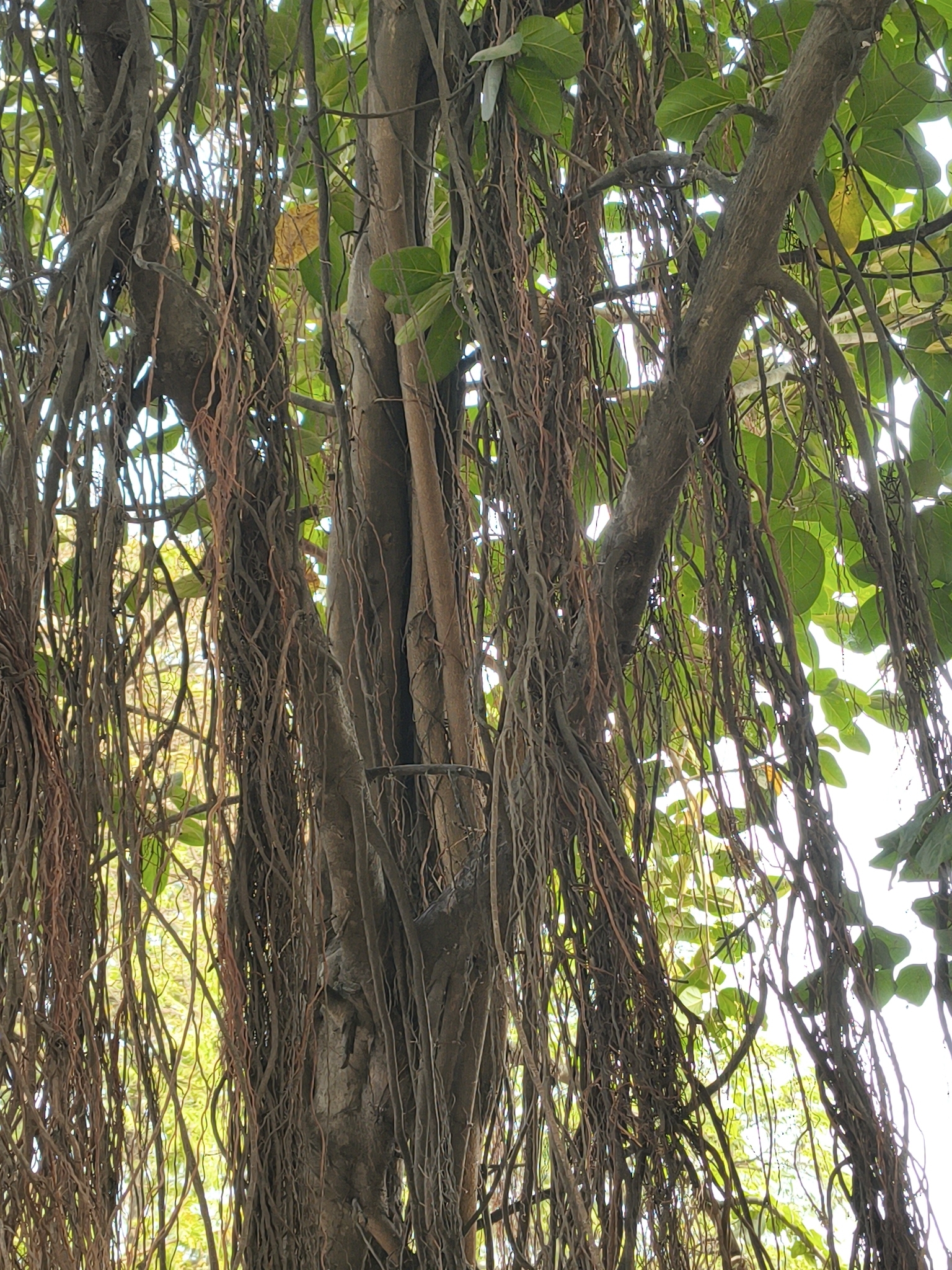
Indian Banyan (Ficus benghalensis) is a massive tropical tree native to the Indian subcontinent that develops thick aerial prop roots and broad, leathery leaves with fine surface hairs when young. Seed dropped by birds in canopy forks germinates epiphytically before sending aerial roots down to reach the forest floor.
As a potted indoor plant, container restriction keeps growth to a manageable 1 to 2.5 m (3 to 8 ft) tall. It requires consistent temperatures above 15 °C (59 °F) and steady soil moisture to prevent rapid lower leaf drop.
Key Facts
- Light: Bright indirect light to 4 hours direct sun
- Water: Allow top 5 cm (2 in) soil to dry
- Temperature: 18–29 °C (64–84 °F)
- Toxicity: Toxic to cats, dogs, and humans (sap)
- Growth Rate: Moderate indoor height gain of 30 cm (12 in) annually
Living with Indian Banyan Indoors
Indoor Banyan specimens require consistent warmth and dedicated floor space away from cold drafts and heating vents. While wild mature specimens cover hundreds of square meters in tropical landscapes, container plants maintain a controlled size of 1.5 to 2.5 m (5 to 8 ft) in home environments. They suit bright sunrooms, high-ceilinged foyers, or open living areas.
Unlike fiddle-leaf fig (Ficus lyrata) or rubber plant (Ficus elastica), young leaves on Indian Banyan feature velvety surface hairs and distinct pale green main veins. Growth rates slow when container root volume becomes restricted, making height management straightforward through pruning and pot sizing.
How to Identify Banyan Tree Features
Indian Banyan is identified by ovate, leathery leaves measuring 10 to 20 cm (4 to 8 in) long with light primary veins and fine hairs on emerging foliage. Stems produce a thick white latex sap when cut. Bark shifts from smooth light grey on young wood to rough furrowed grey-brown on mature stems.
In high humidity environments, indoor plants occasionally form slender aerial roots that drop from horizontal branches toward the potting medium. Key diagnostic physical traits include:
- Leaf arrangement: Alternate, elliptical leaves with prominent pale veins
- Foliage texture: Pubescent (fuzzy) when young, maturing to smooth leathery blades
- Sap: Opaque white milky latex that exudes from stem wounds
- Roots: Aerial roots that harden into rigid supportive pillars
- Fruit: Pairs of stalkless red syconia measuring 1.5 to 2 cm (0.6 to 0.8 in) wide
Light Requirements for Banyan Plants
Indian Banyan thrives best in bright, indirect sun with up to 4 hours of direct morning sunlight per day. Position the pot within 1 to 2 m (3 to 6 ft) of an east-facing or south-facing window. Insufficient light leads to leaf drop, elongated stem internodes, and reduced foliage density.
During winter months in northern latitudes, supply supplemental full-spectrum LED grow lights for 12 to 14 hours daily to sustain leaf retention. Rotate the container 90 degrees every two weeks to encourage symmetric canopy development and prevent stems from bending toward light sources.
How Often to Water Banyan Trees
Water your Banyan tree when the top 5 cm (2 in) of potting mix has completely dried out. Pour water evenly across the soil surface until moisture drains freely from the bottom holes, then empty the drip saucer after 15 minutes to avoid root rot.
In warm summer months, active foliage growth requires watering every 5 to 7 days, whereas cooler winter periods reduce water uptake to once every 12 to 16 days. Overwatering manifests as yellowing lower leaves and mushy black stems, while underwatering causes crisp brown leaf margins and leaf drop.
Best Potting Mix for Indoor Banyan
Plant Indian Banyan in a coarse, aerated potting mix with a pH range between 6.0 and 7.0. Combine 2 parts standard potting soil, 1 part coarse perlite or pumice, and 1 part pine bark chips to ensure high oxygen movement and thorough drainage.
Avoid dense garden topsoil or clay mixes that retain water around root zones. Repot every 2 to 3 years during spring when roots fill the container, selecting a new pot 5 cm (2 in) wider in diameter with open bottom drainage holes. Ensure the drainage holes remain unblocked by coarse potting materials.
Humidity and Temperature Needs for Banyan
Maintain indoor ambient temperatures between 18 °C and 29 °C (64 °F to 84 °F) with relative humidity levels kept above 50 percent. Temperature drops below 12 °C (54 °F) induce rapid foliage drop within 48 hours.
Maintain indoor atmospheric humidity during dry winter heating periods through specific physical interventions:
- Humidifiers: Place a cool-mist ultrasonic unit 1 m (3 ft) away from the main canopy
- Pebble trays: Set the container on a tray filled with wet gravel and standing water
- Plant grouping: Cluster Banyan alongside weeping fig (Ficus benjamina) and monstera (Monstera deliciosa)
- Misting: Spray emerging foliage with tepid water twice weekly during morning hours
How to Fertilize Banyan Trees
Feed indoor Banyan specimens every 4 weeks from April through September using a balanced liquid houseplant fertilizer diluted to half strength. Apply liquid fertilizer formulations containing a 10-10-10 N-P-K ratio directly to damp soil after regular watering to protect fine roots from salt burn.
Discontinue fertilizer applications completely during autumn and winter when plant metabolism slows. Flush the substrate with clear water every 3 months to clear accumulated mineral salts that create white residue on container rims.
How to Propagate Banyan Tree Roots and Cuttings
Propagate Banyan trees using 15 cm (6 in) tip cuttings taken in late spring or via air layering on semi-woody branches. Tip cuttings must retain 2 upper leaves with lower foliage trimmed away.
Follow these specific steps for stem cutting propagation:
- Stem cut: Slice a semi-hardwood stem directly below a node using sharp bypass shears
- Sap wash: Submerge the cut stem base in cool water for 5 minutes to stop latex flow
- Hormone application: Coat the cut base in 0.1% indole-3-butyric acid rooting powder
- Potting: Insert the stem 5 cm (2 in) deep into a damp perlite and peat moss mixture
- Enclosure: Cover the pot with a clear plastic bag at 22 °C (72 °F) to maintain 85% humidity
- Root formation: Adventitious roots emerge in the substrate within 4 to 6 weeks
Is Banyan Toxic to Pets and Humans?
Indian Banyan is toxic to dogs, cats, and humans due to gastroirritant proteolytic enzymes (ficain) and insoluble latex compounds throughout its tissues. Ingestion of stems or leaves causes oral burning, hypersalivation, vomiting, and diarrhea in animals.
Contact with cut stem latex causes localized dermatitis or itching in skin sensitive to latex. Wear nitrile gloves during pruning or repotting operations, and position potted plants beyond the reach of household pets and toddlers. Contact a veterinarian promptly if pets consume foliage.
Indoor Banyan Flowering and Syconia
Indoor Banyan trees rarely set flowers or fruit outside tropical native environments. The flowers are small and enclosed within specialized fleshy structures called syconia, which mature into red figs measuring 1.5 to 2 cm (0.6 to 0.8 in) across.
In nature, pollination relies on a specific obligate mutualist fig wasp (Eupristina masoni) that enters through an apical opening (ostiole) in the fruit. Because these specialized wasps do not inhabit indoor residential settings, container-grown plants operate strictly as foliage specimens without seed formation.
Frequently Asked Questions
How do you pronounce banyan tree?
Banyan tree is pronounced "BAN-yuhn tree" (/ˈbæn.jən/). The name derives from Indian merchants known as banyans, who historically set up trade stalls underneath the canopy shade.
How fast do banyan tree roots grow?
Banyan tree roots grow at a moderate rate indoors, adding 20 to 30 cm (8 to 12 in) of root length each season. In humid outdoor climates like Krabi, Thailand, aerial roots drop rapidly from branches to form thick auxiliary trunks.
What is the banyan tree called in Bangla?
In Bangla, the banyan tree is called "Bot" (वट) or "Bot Gach". It carries deep historical significance across Bengal and Bangladesh, where large outdoor specimens serve as traditional village gathering locations.
What are the main benefits of a banyan tree?
As an indoor specimen, Indian Banyan enhances room humidity, filters interior volatile compounds, and provides architectural foliage. Historically in Ayurvedic medicine, bark and latex extracts were used in traditional topical treatments, though plant parts are toxic and must not be consumed.
Why are my banyan leaves turning yellow and falling off?
Leaf drop in Indian Banyan stems from overwatering, sudden temperature drops below 15 °C (59 °F), or inadequate indirect sunlight. Keep the potting substrate evenly moist, shield the pot from drafts, and provide 4 hours of bright light.
What is the difference between Indian Banyan and Fiddle-Leaf Fig?
Indian Banyan (Ficus benghalensis) forms ovate leaves with velvety surface hairs when young and pale veins, whereas fiddle-leaf fig (Ficus lyrata) features glossy, violin-shaped foliage with wavy margins. Banyan also forms aerial prop roots under high ambient humidity.
Information about traditional or historical uses is provided for educational interest only and is not medical advice. Do not use any plant to treat a condition without speaking to a qualified professional.
Sources & Verification
Taxonomy and distribution are checked against the databases below. Care guidance is written for cultivated species only and reviewed by our editor. How We Build Plant Profiles →
- Kew Plants of the World Onlinepowo.science.kew.org
- Missouri Botanical Garden Plant Findermissouribotanicalgarden.org
- NC State University Plant Toolboxplants.ces.ncsu.edu
- ASPCA Animal Poison Controlaspca.org
- GBIF — Global Biodiversity Information Facilitytaxonomy, synonyms, occurrence records
- Wikipediageneral reference


