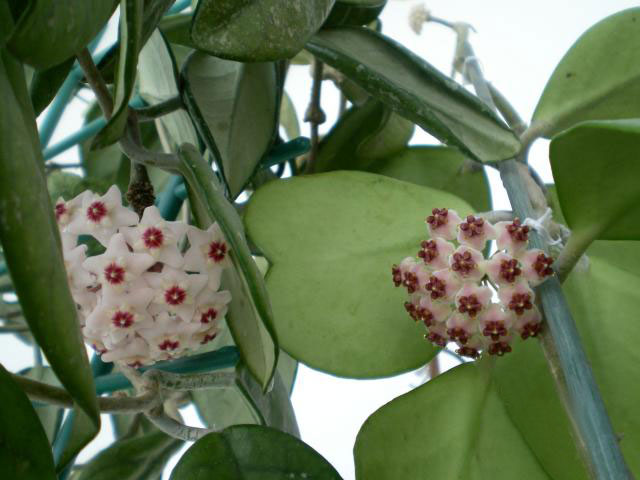
Samoan Waxplant (Hoya australis) is a vigorous climbing vine native to the rainforest edges and rocky coastal regions of Australia, Papua New Guinea, and the Pacific Islands. It is widely recognised by its thick, waxy foliage and clusters of star-shaped, porcelain-like flowers that release a spicy, vanilla-like scent at night.
This species grows significantly faster than many other members of its genus, making it an excellent choice for those wanting to cover a trellis or moss pole quickly. Unlike some finicky tropical plants, it can tolerate lower humidity for short periods, though it requires bright light to produce its famous umbels of 20 to 40 flowers.
Key Facts
- Water: soak only when soil is 75% dry
- Light: 4-6 hours of bright indirect sunlight daily
- Growth: vigorous climber reaching 4 m (13 ft)
- Temperature: keep between 18-27 °C (65-80 °F)
- Bloom: highly fragrant white flowers with red centers
Living with Samoan Waxplant
Samoan Waxplant is a fast-growing, twining vine that suits indoor environments with plenty of vertical space. It is less demanding than the common wax plant (Hoya carnosa), but it does require a sturdy support system like a trellis or a wire hoop to prevent its long, searching tendrils from latching onto nearby furniture. Because it is a succulent, it is forgiving of the occasional forgotten watering, making it a reliable companion for busy owners.
You should place this plant in a spot where you can enjoy its evening fragrance, as the scent intensifies after sunset. It is particularly well-suited for bright kitchens or sunrooms where air circulation is good. While it is a vigorous grower, it remains manageable through regular pruning and can live for decades in the same pot if the soil is refreshed occasionally.
Identifying Hoya australis
The Samoan Waxplant is a succulent subshrub or vine with leaves that are typically 4-15 cm (1.5-6 in) long and 3-12 cm (1-4.7 in) wide. The foliage is broadly elliptic to ovate, with a glossy, deep green surface that feels thick and leathery to the touch. In high light, some cultivars may develop a slight bronze tint on new growth before maturing to green.
The flowers are the most distinctive feature, appearing in rounded clusters called umbels. Each individual flower is:
- Star-shaped with five fleshy, cream-white petals
- Marked with a distinct red or pink spot under the central corona
- Approximately 2 cm (0.8 in) in diameter
- Arranged in clusters of up to 40 blooms
- Produced on a permanent woody spur called a peduncle
The Best Light for Hoya australis Flowers
To see your Samoan Waxplant bloom, you must provide bright, indirect light for at least 6 hours every day. While the plant can survive in medium light, it will produce long, leggy stems with few leaves and will likely never flower. An east or west-facing window is usually ideal, providing the intensity it needs without the scorching heat of direct midday sun.
If you notice the leaves turning yellow or developing dry, brown patches, the plant is likely getting too much direct afternoon sun. Conversely, if the internodes (the space between leaves) are longer than 10 cm (4 in), move it closer to a light source. Many growers use LED grow lights during the darker winter months to maintain the plant’s energy levels for its late-season blooming cycle.
Watering and Soil for Succulent Vines
You should only water your Samoan Waxplant when the potting mix is almost entirely dry, usually every 10 to 14 days depending on the season. This plant is highly susceptible to root rot if left in standing water or soggy soil. When you do water, soak the soil thoroughly until water drains from the bottom, then discard any excess from the saucer.
Standard potting soil is too dense for this species and will suffocate the roots. A proper mix should include:
- 1 part high-quality potting soil
- 1 part orchid bark or coco coir chunks
- 1 part perlite or pumice for aeration
- A handful of horticultural charcoal to keep the mix fresh
Managing Humidity and Temperature Indoors
The Samoan Waxplant thrives in temperatures between 18-27 °C (65-80 °F) and should never be exposed to temperatures below 10 °C (50 °F). It is more tolerant of average household humidity (40-50%) than many other hoyas, but it will grow much faster if humidity is kept above 60%. Avoid placing the plant near air conditioning vents or drafty windows, as sudden temperature drops can cause it to drop its flower buds.
During hot summer spells, ensure there is adequate air movement around the foliage to prevent fungal issues. If your home is very dry, you can use a pebble tray or a humidifier, but avoid misting the leaves directly, as trapped water can lead to leaf spot diseases. The plant’s succulent leaves are efficient at storing moisture, but they will pucker or wrinkle if the air is consistently too dry and the roots are thirsty.
Feeding for Growth and Bloom
Apply a balanced liquid fertilizer every 4 weeks during the active growing season from spring through early autumn. A formula with a 2-1-2 or 1-1-1 ratio works well for general foliage health. To encourage the plant to set flower buds, you can switch to a high-phosphorus “bloom booster” fertilizer in late summer, following the package instructions at half-strength.
Never fertilize a dry plant, as this can burn the sensitive roots; always water the plant first to dampen the soil. Stop feeding entirely during the winter months when the plant’s growth slows down. Over-fertilizing is a common mistake that leads to salt buildup in the soil, which manifests as brown leaf tips or stunted growth.
Propagating Samoan Waxplant from Cuttings
The easiest way to propagate this plant is by taking stem cuttings with at least two nodes during the spring or summer. Use a sharp, sterilized blade to cut just below a node, and remove the bottom set of leaves to expose the area where roots will grow. You can root these cuttings in water, but many enthusiasts prefer using damp sphagnum moss or perlite for better oxygen flow.
The propagation process typically follows these steps:
- Dip the cut end in rooting hormone (optional but helpful)
- Place the cutting in a glass of water or a pot of moist perlite
- Keep the cutting in a warm, bright spot out of direct sun
- Wait 3-6 weeks for roots to reach 5 cm (2 in) long
- Pot the new plant in a chunky hoya mix
Common Hoya australis Problems and Pests
The most frequent issue with the Samoan Waxplant is root rot caused by overwatering or heavy soil. If the leaves feel soft and limp despite the soil being wet, check the roots immediately; healthy roots are firm and white, while rotted ones are black and mushy. You must trim away any rot and repot the plant in fresh, dry substrate to save it.
Pests are rarely a major problem, but you should watch for:
- Mealybugs: white, cottony tufts in leaf axils
- Aphids: small green insects on soft new growth
- Spider mites: fine webbing on the undersides of leaves
- Scale: small, brown bumps on the stems
Treat infestations early with neem oil or insecticidal soap, ensuring you reach the crevices where Hoyas like to hide.
Is Hoya australis Toxic to Cats and Dogs?
The Samoan Waxplant is considered non-toxic to cats, dogs, and horses according to the ASPCA. This makes it a safe choice for pet owners who want to grow climbing indoor vines without the risks associated with pothos (Epipremnum aureum) or ivy (Hedera helix). While the plant is safe, the milky white sap can be a mild skin irritant for some people and pets, so it is best to wash your hands after pruning.
Even though it is non-toxic, you should discourage pets from chewing on the leaves. Ingesting large amounts of any plant material can cause mild stomach upset or vomiting in domestic animals. The thick, waxy leaves are generally not appealing to most pets, but the long, swinging tendrils may attract curious cats.
Year-Round Care for Samoan Waxplant
| Spring | Resume monthly feeding and increase watering frequency as new growth appears. This is the best time to repot or take cuttings for propagation. |
|---|---|
| Summer | Check soil moisture every 7 days and provide extra humidity during heatwaves. Ensure the plant is shielded from harsh, direct midday sun to prevent leaf scorch. |
| Autumn | Reduce watering as temperatures drop and stop fertilizing by late October. Watch for the development of flower peduncles, as many varieties bloom in late autumn. |
| Winter | Keep the plant in its brightest possible spot and water only when the soil is completely dry. Maintain a minimum temperature of 10 °C (50 °F) and avoid cold drafts. |
Common Samoan Waxplant Problems Explained
| What you see | Likely cause | What to do |
|---|---|---|
| Yellowing leaves and mushy stems | Overwatering or poor drainage | Stop watering immediately and repot into a chunkier, well-draining mix. |
| Wrinkled or puckered leaves | Underwatering or extreme low humidity | Give the plant a deep soak and move it away from heaters or vents. |
| Dropping flower buds | Temperature shock or dry soil | Keep the environment stable and do not move the plant once buds appear. |
| Long stems with no leaves | Insufficient light | Move the plant to a brighter location with more indirect sun. |
Popular Hoya australis Cultivars
- ‘Lisa’ – striking variegated leaves with cream and lime centers
- ‘Peacock’ – larger, more rounded leaves with a matte finish
- ‘Tricolor’ – new growth emerges pink before turning cream and green
- ‘Mrs G’ – known for exceptionally large, highly fragrant flower clusters
- subsp. tenuipes – the most common subspecies with glossy, pointed leaves
Frequently Asked Questions
What is the difference between Hoya australis Lisa and Hoya Krimson Princess?
Hoya australis 'Lisa' has thinner leaves with variegation in the center that is creamy-yellow or lime, while Hoya carnosa 'Krimson Princess' has thicker, waxier leaves and often features more distinct pink tones in its central variegation.
Why is my Samoan Waxplant not blooming?
The most common reason is a lack of light; it needs very bright indirect sun to trigger flowering. Additionally, ensure you never cut off the woody spurs (peduncles), as the plant re-blooms from these same spots every year.
How fast does Hoya australis grow?
Under ideal conditions with bright light and high humidity, it is one of the fastest-growing hoyas, capable of putting on 60-100 cm (2-3 ft) of vine length in a single growing season.
Does Hoya australis smell at night?
Yes, the flowers produce a very strong, spicy fragrance reminiscent of vanilla and chocolate that becomes most intense after sunset to attract nocturnal pollinators.
Can I grow Samoan Waxplant outdoors?
You can grow it outdoors year-round only in USDA zones 10-11. In cooler climates, it must be brought indoors before the night temperature falls below 10 °C (50 °F).
Sources & Verification
Taxonomy and distribution are checked against the databases below. Care guidance is written for cultivated species only and reviewed by our editor. How We Build Plant Profiles →