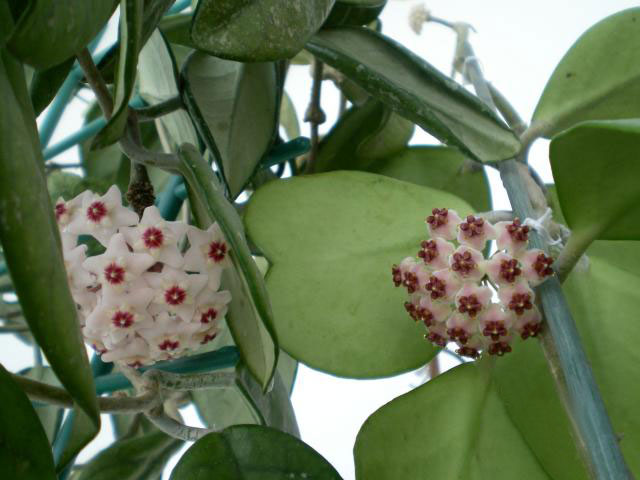
Wax plant (Hoya carnosa) is a perennial climbing epiphyte native to East Asia, recognizable by its thick, leathery leaves and spherical clusters of porcelain-textured blossoms. In natural forest habitats, it scales tree trunks using adventitious roots to access canopy light.
In the home, flowering depends on high light levels and leaving the woody flowering spurs untouched year after year. Plants kept in low light will produce vine growth but rarely form bloom trusses.
Key Facts
- Light: Bright indirect light with 2-4 hours of gentle morning sun
- Water: Soak thoroughly when soil dries out 70-80%
- Temperature: 16-29 °C (60-85 °F); keep above 10 °C (50 °F)
- Toxicity: Non-toxic to cats, dogs, and humans
- Bloom time: Late spring through summer on mature stems
- Growth rate: Slow to moderate climbing or trailing vine
Living with Wax Plant Indoors
Wax plant suits busy indoor growers who tend to underwater rather than overwater. Because its thick, succulent foliage stores moisture, it tolerates dry household air and brief periods of neglect far better than thin-leaved tropicals such as peace lily (Spathiphyllum wallisii).
The plant produces long, leafless tendrils that reach outward before developing foliage, which leads some beginners to cut them off prematurely. Give those runners a sturdy trellis, hoop, or moss pole to climb, as upward training mimics its natural epiphytic habit and triggers larger leaf development. As a hanging basket plant, it drapes neatly over shelf edges, provided it receives sufficient light from above.
Wax Plant Appearance and Identifying Features
A mature wax plant produces smooth, succulent, ovate-elliptic leaves measuring 5-11 cm (2-4.3 in) long and 2.5-5 cm (1-2 in) wide. Foliage grows in opposite pairs along smooth, pale green to greyish climbing stems that produce aerial roots at the nodes.
The identifying traits of this species include:
- Foliage texture: Thick, stiff, and glossy dark green, frequently dotted with small, irregular silvery specks.
- Flower clusters: Tight, convex umbels containing 10-30 individual star-shaped florets.
- Corolla: White to pale flesh-pink, covered in dense, microscopic hairs that create a velvety, porcelain sheen.
- Corona: A central, five-pointed star structure that is glossy white with a deep crimson center.
- Peduncles: Permanent, woody, peg-like stems measuring 2-4 cm (0.8-1.6 in) long from which repeated flushes of flowers emerge.
Light Requirements for Wax Plant
Wax plant performs best in bright, indirect sunlight with 2 to 4 hours of gentle morning sun. Direct, harsh midday sun through unshaded southern glass will scorch the fleshy leaves, turning them pale yellow or leaving dry brown patches.
Low light levels cause stems to stretch out, resulting in long, empty intervals between leaf nodes and a total absence of blooms. An east-facing windowsill provides ideal natural exposure. If placing your plant near a west- or south-facing window, set it back 1-2 m (3-6 ft) or filter the light with a sheer curtain to protect the foliage.
How Often to Water Wax Plant
Water thoroughly only when the top 70% to 80% of the potting medium feels completely dry. Epiphytic roots require rapid drainage and air circulation; soggy, saturated soil causes root rot within days.
Adjust your watering cadence across the calendar:
- Spring and summer: Water every 10 to 14 days, saturating the pot until water flows freely through the drainage holes.
- Autumn and winter: Reduce frequency to every 3 to 4 weeks as active growth slows and daylight hours decrease.
- Tactile check: Slightly flexible, soft leaves signal that the plant has drawn down its water reserves and needs a drink.
- Safety rule: Always empty the saucer 15 minutes after watering so the base never stands in water.
The Best Soil Mix for Hoya carnosa
A suitable substrate for wax plant must be exceptionally chunky and well-aerated with a pH between 6.1 and 7.5. Standard commercial potting soil packs down too tightly, suffocating the fine epiphytic root system and trapping excess water.
Combine equal volumes of pine bark chips, coarse perlite or pumice, and standard peat-free potting compost. This porous blend holds enough humidity around root hairs while permitting excess water to run straight through. Wax plant blooms most reliably when slightly root-bound, so choose containers with drainage holes that are only 2-5 cm (1-2 in) wider than the root ball, repotting only every two or three years in early spring.
Temperature and Humidity Needs
Maintain indoor temperatures between 16 °C and 29 °C (60-85 °F) throughout the year. Temperatures dipping below 10 °C (50 °F) cause leaf drops and chill damage, so keep pots clear of draughty winter windowpanes and unheated entryways.
Average household humidity levels between 40% and 50% are tolerable, but foliage grows more vigorously and flowers open more reliably when relative humidity sits between 50% and 70%. Avoid dry airflow directly from radiators, air conditioners, or forced-air vents, which causes flower buds to shrivel and drop before opening.
Fertilizing Your Wax Plant
Feed your wax plant with a balanced liquid houseplant fertilizer diluted to half-strength once every four weeks throughout the active growing season. Apply food only from late March through August, when roots are actively taking up nutrients to sustain new vines and developing flower heads.
Always hydrate the root zone with plain water before applying fertilizer to avoid chemical burning on sensitive epiphytic roots. Use a balanced NPK formula such as 10-10-10 or a bloom-support formula with slightly elevated phosphorus (such as 5-10-5) in mid-spring as bud formation begins. Cease all feeding completely from October through February during winter dormancy, as unused salts accumulate in the potting media and damage root tips.
How to Propagate Wax Plant
Propagate wax plant using stem cuttings that contain one to two nodes and at least one pair of healthy leaves. Single-leaf cuttings without an attached piece of stem node may produce roots, but they will never generate an active growth point to produce a full vine.
Follow these steps to root cuttings successfully:
- Cut a healthy, non-flowering stem just below a leaf node using clean, sharp pruning shears.
- Let the cut end sit on a paper towel for 4 to 8 hours so the milky white sap calluses over.
- Insert the cut node into moist perlite, coarse vermiculite, or a loose mixture of equal parts perlite and sphagnum moss.
- Cover the container loosely with a clear plastic bag to maintain 70-80% humidity and set it in bright indirect light at 21-24 °C (70-75 °F).
- Check for root development after 4 to 6 weeks by giving the cutting a gentle upward tug; once roots measure 3-5 cm (1-2 in), pot it into standard chunky mix.
Common Wax Plant Pests and Problems
The primary threats to indoor wax plants are mealybugs and fungal root rot caused by wet substrate. Mealybugs gather in leaf axils and beneath flower clusters, resembling small tufts of white cotton and secreting sticky honeydew that fosters black sooty mould.
Inspect foliage regularly and address problems quickly:
- Mealybugs and scale: Dab individual pests with a cotton swab soaked in 70% isopropyl alcohol, or spray with horticultural insecticidal soap.
- Wrinkled foliage: Indicates either severe dehydration or dead roots from overwatering; unpot to inspect root health.
- Bud blast: Premature drop of unopened flower buds occurs when the plant is moved, exposed to dry drafts, or allowed to dry out completely during flowering.
- Yellowing lower leaves: Often caused by cold drafts or soil that has stayed soggy for more than 7 days.
Is Wax Plant Toxic to Cats and Pets?
Wax plant is entirely non-toxic to cats, dogs, and humans according to the ASPCA. It contains no insoluble calcium oxalates, toxic alkaloids, or cardiac glycosides, making it a pet-safe alternative to trailing plants like golden pothos (Epipremnum aureum) or heartleaf philodendron (Philodendron hederaceum).
The plant does exude an opaque white latex sap when cut or broken. While not chemically poisonous, ingesting large amounts of fibrous, waxy leaves can cause mild mechanical stomach upset or vomiting in curious cats. Keep mature trailing vines out of reach to protect both the plant’s growth points and your pet’s digestion.
How to Encourage Wax Plant Flowers
The key to flowering is leaving the woody flower spurs (peduncles) completely intact after blooming finishes. Wax plant reblooms from the exact same woody spur year after year, so deadheading or cutting back old flower stalks prevents future flowering on that vine.
To encourage flower development, ensure the plant receives high indirect light throughout spring, accompanied by night temperatures that are 5-8 °C (10-15 °F) cooler than daytime levels. Restricting root space in a slightly snug pot also promotes bud set. When buds swell, maintain consistent moisture without soaking the soil, and never relocate the pot, as sudden shifts in orientation cause buds to abort.
Frequently Asked Questions
Why is my wax plant not blooming?
Low light is the most frequent reason wax plant fails to bloom. Move the pot to a spot receiving bright indirect light with 2-4 hours of gentle morning sun, keep the root system snug in its pot, and never prune away the short, woody peduncles from past blooms.
Is wax plant safe for cats?
Yes, wax plant is non-toxic to cats, dogs, and humans. Ingesting large quantities of the thick, fibrous leaves may trigger mild, temporary stomach irritation, but the plant carries no chemical toxins.
Should I cut off long, bare wax plant vines?
No, do not cut leafless runners. Wax plant naturally sends out bare scouting tendrils that later develop foliage and flower spurs once they locate climbing support or adequate light.
What do wax plant flowers smell like?
The flowers release a sweet, honey- or chocolate-like fragrance that becomes strongest in the evening. Individual florets also produce small droplets of clear, sugary nectar.
How often should I water wax plant in winter?
Water every 3 to 4 weeks during winter. Allow at least 80% of the potting medium to dry out completely before wetting the root ball again.
Sources & Verification
Taxonomy and distribution are checked against the databases below. Care guidance is written for cultivated species only and reviewed by our editor. How We Build Plant Profiles →
- Kew Plants of the World OnlineTaxonomic baseline and distribution data
- North Carolina State ExtensionCultivar profiles and indoor cultural requirements
- ASPCA Animal Poison ControlToxicity verification for cats, dogs, and horses
- Royal Horticultural SocietyHardiness ratings and indoor growth habits
- GBIF — Global Biodiversity Information Facilitytaxonomy, synonyms, occurrence records
- Wikipediageneral reference