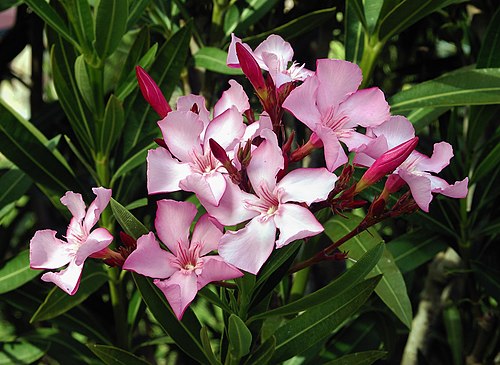
Oleander (Nerium indicum) is a fast-growing evergreen shrub native across southern Asia, widely recognised for its leathery foliage and clusters of fragrant, five-petalled flowers. It thrives in hot, arid conditions where few other flowering ornamentals survive.
Every part of the plant contains lethal cardiac glycosides that disrupt heart function if ingested. It demands full sun to bloom and survives severe drought, but winter frost below -6 °C (20 °F) kills top growth to the ground.
Key Facts
- Light: Full sun, minimum 6 hours daily
- Water: Soak deeply, dry out between waterings
- Toxicity: Severe; all parts lethal if ingested
- Hardiness: USDA zones 8 to 11
- Mature Size: 2 to 4 m tall
Is Oleander Right for Your Garden?
Oleander suits gardeners who need extreme heat and drought tolerance combined with uninterrupted flowering from May through October. It excels in hot, sunny gardens across Mediterranean and arid climates such as Arizona and southern Europe, surviving reflective wall heat and poor soils that desiccate delicate perennials.
You should reconsider planting this shrub if you keep curious pets, have young children, or maintain livestock nearby. The severe toxicity means even dried fallen leaves or smoke from burning branches present serious physical hazards. In temperate zones like the UK or USDA zones 7 and below, it functions strictly as a seasonal patio container specimen that must move under glass before freezing weather arrives.
Identifying Oleander Leaves, Flowers, and Growth Habit
Oleander grows as a multi-stemmed, upright woody shrub reaching 2 to 4 m (6.5 to 13 ft) in height and 1.5 to 3 m (5 to 10 ft) in width. If lower shoots are pruned away over several seasons, gardeners can train it into a single-trunk small tree form.
Its foliage and branch structure show clear botanical markers:
- Leaves: Thick, leathery, narrow lanceolate blades measuring 10 to 20 cm (4 to 8 in) long and 1 to 3 cm (0.4 to 1.2 in) wide, arranged in whorls of three along pale green stems.
- Venation: A prominent, pale central midrib with dozens of fine, parallel lateral veins running straight to the margins.
- Flowers: Terminal cymes of funnel-shaped blossoms 3 to 5 cm (1.2 to 2 in) across, featuring five twisted petals in shades of deep rose, pink, white, or pale yellow, often delivering a musky vanilla scent.
- Fruit: Paired, narrow cylindrical seed follicles 10 to 18 cm (4 to 7 in) long that split open when ripe to release tufted, wind-borne brown seeds.
Choosing the Best Planting Site
Oleander requires at least six hours of direct sunlight daily to maintain dense growth and set abundant flower buds. Shaded positions produce weak, leggy stems, sparse foliage, and drastically reduced blooming, while making the plant vulnerable to fungal attacks.
The plant tolerates heavy clay, limestone, pure sand, and saline coastal air, provided water never stands around the root zone for prolonged periods. Position it away from pedestrian paths, livestock fences, and play areas to prevent accidental ingestion or contact with toxic, skin-irritating sap.
How to Plant Oleander in the Ground and in Pots
Plant container-grown oleander in mid-spring after the final frost so the root system establishes thoroughly before the onset of peak summer heat. Always wear thick, water-resistant gloves and protective eyewear when handling bare stems and root balls to prevent sap transfer to broken skin or eyes.
Follow these steps to establish your plant:
- Dig a planting hole twice as wide as the root ball and exactly the same depth as the nursery container.
- Backfill with the native garden soil without adding heavy manure or rich peat, as overly rich organic matter encourages soft, disease-prone growth.
- Water thoroughly to settle the soil and eliminate air pockets around the root mass.
- Apply a 5 cm (2 in) layer of wood bark mulch, keeping the mulch 10 cm (4 in) away from the main woody stems to deter collar rot.
- For container care in pots outdoors, select a heavy terracotta or stone pot at least 45 cm (18 in) wide with large drainage holes, filled with a loam-based potting mix amended with 20 percent coarse grit.
Watering and Fertiliser Requirements
Water young oleander shrubs once or twice a week during their first growing season to build an extensive root system. Established specimens planted in open ground in regions like Arizona need deep irrigation only every two to three weeks during blistering summer droughts, and can survive on natural rainfall alone in milder climates.
For potted oleander outdoors or under glass, follow these guidelines:
- Water thoroughly when the top 3 cm (1.2 in) of container compost dries out during spring and summer.
- Empty excess drainage water from saucers within 20 minutes to prevent fatal root rot.
- Apply a balanced, slow-release granular fertiliser (such as NPK 10-10-10) once in early spring as new growth starts.
- Feed potted shrubs with a high-potassium liquid feed every three weeks from May to August to prolong bloom duration.
- Cease all fertilisation by late August so new shoots harden before cold weather arrives.
Pruning Oleander Bush and Tree Forms
Prune oleander in late winter or early spring just before vegetative growth resumes, cutting back immediately above an outward-facing leaf whorl. Because oleander flowers on new wood produced during the current season, spring pruning preserves the upcoming floral display.
Never burn pruned trimmings, as the smoke carries toxic aerosolised oleandrin that causes acute lung irritation and severe systemic poisoning. Instead, seal clippings inside heavy bags for municipal disposal or landfill removal. To maintain a compact bush, head back shoots by one-third annually, and thin out dead, crossing, or weak branches. To train a tree form, choose a strong central leader, stake it securely, and systematically rub out lower lateral growth up to 1 m (3.3 ft) from the ground.
How to Propagate Oleander from Cuttings
Propagate oleander using semi-ripe stem cuttings taken in midsummer from firm, non-flowering shoots. Stems root with high success rates in either coarse propagation substrate or plain water.
Execute this propagation procedure carefully:
- Cut a 15 cm (6 in) stem tip using a clean, sharp knife just below a leaf node.
- Strip the leaves from the lower half of the cutting, retaining 3 to 4 leaves at the top.
- Dip the cut base into synthetic rooting hormone powder containing IBA (indole-3-butyric acid).
- Insert the cutting 5 cm (2 in) deep into a mix of equal parts perlite and coarse horticultural sand.
- Enclose the pot in a clear plastic bag or heated propagator kept at 20 to 24 °C (68 to 75 °F) out of direct sun.
- Roots develop in four to six weeks, after which you can harden the plant off and pot it into individual containers.
Oleander Aphids, Caterpillars, and Common Problems
Control oleander pests by targeting bright yellow oleander aphids and oleander caterpillars as soon as populations emerge in late spring. Oleander aphids (Aphis nerii) swarm tender new stems and leaf undersides, sucking sap and exuding sticky honeydew that fosters black sooty mould.
Inspect your shrub regularly for these specific pest and disease symptoms:
- Oleander caterpillar (Syntomeida epilais): Striped orange-and-black larvae chew extensive ragged holes through leaf margins; handpick wearing gloves or spray with biological Bacillus thuringiensis (Bt).
- Oleander aphids: Blast off colonies with a firm jet of garden hose water, or spray thoroughly with horticultural insecticidal soap.
- Oleander gall (Pseudomonas savastanoi pv. nerii): Bacterial knots and warty brown growths erupt along stems, flowers, and leaves; prune diseased limbs 15 cm (6 in) below galls and sterilise tools between cuts with 70% alcohol.
- Winter freeze damage: Foliage turns papery and black after sub-zero temperatures; delay pruning until green shoots break in late spring to accurately assess living tissue.
Oleander Care in Winter and Freeze Recovery
Oleander requires protection whenever temperatures drop below -6 °C (20 °F), which causes leaf scorch and branch dieback on mature plants. In colder zones and throughout the UK, keep oleander in large pots and move them indoors to an unheated greenhouse, conservatory, or cool garage maintained between 5 and 10 °C (41 and 50 °F) before the first hard frost.
For in-ground plants recovering after severe winter freezes:
- Leave damaged, blackened branches intact through winter, as dead wood insulates lower buds against subsequent freezes.
- Wait until late spring when daytime temperatures reliably exceed 18 °C (64 °F) before assessing recovery.
- Scratch the outer bark with a fingernail; cut stems back to where moist green cambium tissue remains visible.
- If the entire top has perished, cut all stems down to 10 cm (4 in) above the soil level; undamaged root systems will regenerate vigorous new canes rapidly.
- Reduce watering to once a month for overwintering potted plants kept in cool, dormant storage indoors.
Companion Plants for Oleander
Combine oleander with sun-loving, drought-tolerant Mediterranean perennials and shrubs that share its affinity for poor, gritty soil and dry heat. Pairing it with complementary foliage textures softens the rigid, upright habit of the oleander bush.
Excellent garden companions include:
- Olive tree (Olea europaea), providing silver-grey, fine-textured canopy foliage that contrasts with dark green oleander leaves.
- Spanish lavender (Lavandula stoechas), forming dense, aromatic purple mounds at the sunlit base of taller oleander stems.
- Rosemary (Salvia rosmarinus), offering needle-like evergreen foliage and pale blue flowers while thriving under identical low-water regimes.
- Century plant (Agave americana), contributing sharp architectural forms that ground the looser canopy of flowering shrubs in hot, dry borders.
Frequently Asked Questions
How poisonous is an oleander plant to humans and pets?
All parts of oleander contain cardiac glycosides, primarily oleandrin, which are lethal if ingested. Chewing a single leaf can cause severe vomiting, slowed cardiac rhythm, seizures, and fatal heart failure in small pets and children.
What is the traditional meaning or symbolism of oleander?
Historically in the Victorian language of flowers, oleander symbolised caution and danger due to its lethal toxicity, while in some Mediterranean cultures it represents everlasting desire and perseverance in harsh climates.
Can I grow oleander indoors as a houseplant?
Oleander does not thrive as a permanent indoor houseplant because typical indoor rooms lack the intense direct sunlight and air circulation it requires to bloom. You can, however, overwinter potted oleanders in a bright, unheated sunroom or glasshouse kept cool during winter.
How do I care for oleander in pots in the UK?
Position the pot in the sunniest, most sheltered courtyard spot from May to September, watering when the top soil dries and feeding fortnightly with tomato fertiliser. Before autumn frosts hit in October, move the container into a frost-free porch, greenhouse, or shed with some light.
How do you care for an oleander bush after a hard freeze?
Do not prune immediately after a freeze; wait until mid-to-late spring when new growth emerges so you can identify living wood. Scratch the stems to find green tissue under the bark, then prune all dead, brittle wood back to those healthy buds or down to ground level if completely killed back.
Information about traditional or historical uses is provided for educational interest only and is not medical advice. Do not use any plant to treat a condition without speaking to a qualified professional.
Sources & Verification
Taxonomy and distribution are checked against the databases below. Care guidance is written for cultivated species only and reviewed by our editor. How We Build Plant Profiles →
- Kew Plants of the World OnlineTaxonomic status and distribution of Nerium indicum / Nerium oleander
- Royal Horticultural SocietyHardiness, pruning, and cultivation practices
- University of Arizona Cooperative ExtensionDesert landscape care, freeze recovery, and heat tolerance
- ASPCA Animal Poison ControlCardiac glycoside toxicity in domestic animals
- GBIF — Global Biodiversity Information Facilitytaxonomy, synonyms, occurrence records
- Wikipediageneral reference