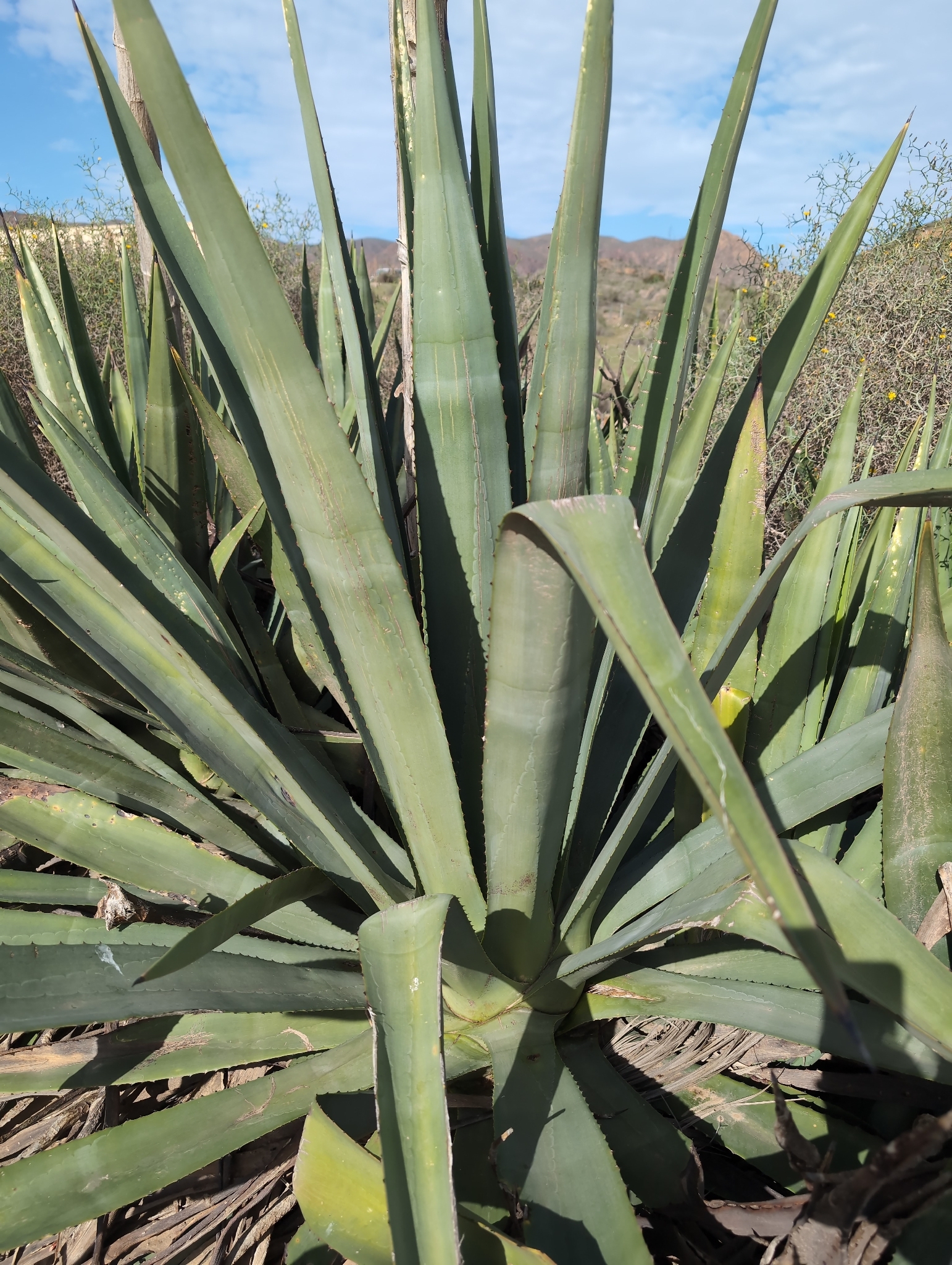
The Century Plant (Agave americana) is a perennial succulent native to Mexico and the southern United States, specifically Texas. It is known for its massive, architectural rosette of blue-green leaves that feature sharp terminal spines and serrated edges.
Despite the name, this species typically lives for 10 to 30 years before producing a single, towering flower stalk and then dying. It is often confused with Aloe vera, but the Century Plant grows significantly larger and produces offsets or “pups” at its base to ensure survival after its monocarpic bloom.
Key Facts
- Light: Full sun, minimum 6 hours daily
- Water: Soak and dry, every 2-4 weeks
- Hardiness: USDA zones 8-11, hardy to -9 °C (15 °F)
- Size: 2 m (6.5 ft) tall, 4 m (13 ft) wide
- Bloom: Once per lifetime, reaching 8-9 m (25-30 ft)
Growing Century Plant in Your Garden
The Century Plant requires a large, open space away from foot traffic due to its sharp spines. It is an architectural choice for xeriscaping or Mediterranean gardens where it can reach its full 4 m (13 ft) spread without obstruction. Because the roots are relatively shallow, it can grow on rocky slopes where other large plants fail.
You should avoid planting this agave near driveways or sidewalks because the terminal spines can puncture tires and skin. If space is limited, consider a large container to restrict growth, though the plant will still eventually outgrow most standard pots. It is highly heat-tolerant and can survive in temperatures exceeding 45 °C (113 °F) without wilting.
- Select a site with at least 8 hours of direct sun
- Ensure the location has excellent drainage to prevent crown rot
- Allow a 3-meter radius of clear space for mature growth
- Avoid low-lying areas where cold air or water settles
How to Identify Agave americana
Identification is based on the massive rosette of 20 to 40 fleshy leaves that curve slightly outward. Each leaf is 1-2 m (3.3-6.6 ft) long and 15-25 cm (6-10 in) wide, possessing a distinct blue-gray or gray-green waxy coating. The leaf margins are lined with recurved teeth, and the tip ends in a dark brown spine up to 5 cm (2 in) long.
The plant lacks a visible trunk for most of its life, with the leaves emerging directly from a central base. As it matures, it may produce numerous small clones or “pups” around its perimeter. The flower stalk is a branched panicle, resembling a giant asparagus shoot when it first emerges in late spring.
- Leaf shape: Lanceolate and deeply guttered
- Color: Blue-green or variegated (yellow/white edges in cultivars)
- Margin: Spiny teeth spaced 2-5 cm apart
- Habit: Symmetrical basal rosette
Century Plant Light Requirements
This species must have full sun to maintain its structural integrity and leaf color. In shaded conditions, the leaves become weak, elongated, and may flop over, ruining the symmetrical rosette shape. If grown indoors, it requires a south-facing window or a high-output LED grow light for 12 hours a day.
Outdoor plants in hot climates like Arizona or Texas do not need afternoon shade. The waxy cuticle on the leaves protects them from intense UV radiation and prevents moisture loss. If you move a plant from a nursery or a shaded area into direct sun, introduce it gradually over 10 days to prevent permanent sunscald, which appears as white or tan bleached patches.
Watering and Soil Needs
Water established plants once every 3-4 weeks during the peak of summer and withhold water entirely in winter. The Century Plant is highly susceptible to root rot if the soil remains damp for more than 48 hours. In many temperate regions, natural rainfall is sufficient, and additional irrigation is only necessary during prolonged droughts.
The soil must be gritty and fast-draining, such as a mix of 50% pumice or perlite and 50% coarse sand or decomposed granite. Avoid using standard garden soil or heavy clay, as these trap moisture against the roots. For container growing, use a terracotta pot which allows the soil to “breathe” and dry out faster than plastic or glazed ceramic.
- Wait for the top 10 cm (4 in) of soil to dry before watering
- Pour water at the base, not into the center of the rosette
- Reduce watering frequency as temperatures drop in autumn
- Ensure pots have large drainage holes
Temperature and Hardiness
The Century Plant is hardy to -9 °C (15 °F), making it one of the more cold-tolerant large agaves. It thrives in USDA zones 8 through 11 and can tolerate brief periods of frost, though ice crystals on the leaves can leave permanent black pits. In regions with wet winters, the combination of cold and moisture is often fatal.
If a hard freeze is predicted, cover the central bud of the plant with a burlap sack or a frost blanket. Mature plants are more cold-hardy than young pups, which should be moved indoors or protected more rigorously. Once the temperature stays consistently below 5 °C (41 °F), the plant enters a dormant phase and its metabolic rate slows significantly.
How to Propagate Century Plant Pups
Propagate by removing basal offsets or “pups” that appear around the mother plant in spring or summer. These clones are genetically identical to the parent and have a high success rate once they have developed their own small root system. You can also grow them from seed, though this takes years longer to reach a significant size.
To transplant a pup, use a sharp spade to sever the underground runner connecting it to the mother. Lift the pup with as many roots as possible and let it sit in a shaded, dry area for 3-5 days to allow the wound to callus. Plant it in a well-draining cactus mix and wait one week before watering to prevent rot in the fresh cut.
- Choose pups that are at least 15 cm (6 in) wide
- Wear heavy gloves and long sleeves to avoid sap irritation
- Keep newly planted pups in partial shade for the first month
- Avoid overwatering until new leaf growth is visible
Why Is My Century Plant Turning Yellow?
Yellowing leaves usually indicate excessive soil moisture or poor drainage, leading to the early stages of root rot. If the lower leaves turn yellow and soft, check the base of the plant for mushy tissue. If the center leaves turn yellow, it may be a sign of the Agave Snout Weevil (Scyphophorus acupunctatus), a pest that eats the heart of the plant.
In sandy soils, yellowing can also be a sign of nitrogen deficiency, which can be corrected with a balanced, low-nitrogen liquid fertilizer applied once in spring. If only the tips are yellow or brown, it may be caused by salt buildup from tap water or fertilizer. Flush the soil with rainwater or distilled water to clear the salts.
Understanding the Death Bloom
The Century Plant is monocarpic, meaning it flowers once and then dies. The process begins in late spring when the plant redirects all its energy into a central stalk that can grow up to 30 cm (12 in) in a single day. This stalk eventually branches out, producing hundreds of yellow-green flowers that attract bats, bees, and hummingbirds.
After the flowers fade, the plant produces seed pods and then slowly withers over several months. This is a natural part of its life cycle and cannot be stopped by pruning the stalk. Before it dies, the plant usually produces numerous offsets at its base, which will grow to take the place of the mother plant in the landscape.
Toxicity and Safety Warnings
The sap of Agave americana contains calcium oxalate crystals and acrid oils that are highly irritating to the skin. Contact often results in a painful, red, blistering rash known as agave dermatitis that can last for several days. Always wear thick leather gloves, long sleeves, and eye protection when trimming or moving this plant.
The plant is also toxic to dogs, cats, and horses if ingested. Symptoms include drooling, vomiting, and swelling of the mouth or throat. Furthermore, the terminal spines are a physical hazard; many gardeners clip the sharp tips off with pliers to prevent injury, especially in households with children or pets.
Year-Round Century Plant Maintenance
| Spring | Remove any dead lower leaves with a sharp saw. This is the best time to harvest and transplant pups or apply a light dose of cactus fertilizer. |
|---|---|
| Summer | Monitor for Agave Snout Weevil activity. Water every 2-3 weeks if there is no rain, ensuring the soil dries out completely between applications. |
| Autumn | Gradually reduce watering frequency as days shorten. Clean debris from the base of the plant to prevent moisture traps that cause rot. |
| Winter | Stop all watering for outdoor plants. Protect the central growth point with frost cloth if temperatures are expected to drop below -7 °C (20 °F). |
Common Century Plant Problems and Fixes
| What you see | Likely cause | What to do |
|---|---|---|
| Soft, mushy leaf bases | Overwatering or crown rot | Stop watering immediately and improve soil drainage or replant in a grittier mix. |
| Wilting center leaves and foul smell | Agave Snout Weevil infestation | Remove and destroy the infected plant to prevent the weevils from spreading to nearby agaves. |
| White bleached spots on leaves | Sunscald | Provide temporary shade during the hottest part of the day until the plant acclimates. |
| Black pits on leaf surfaces | Frost damage | Leave the damaged leaves until spring, then trim them off once the threat of frost has passed. |
Popular Century Plant Cultivars
- ‘Marginata’ – Green leaves with bright yellow margins.
- ‘Mediopicta’ – A cream-colored central stripe with green edges.
- ‘Mediopicta Alba’ – Smaller variety with a white central stripe.
- ‘Striata’ – Features multiple yellow or white longitudinal stripes.
- ‘Variegata’ – Twisted leaves with white to pale yellow margins.
Frequently Asked Questions
Does the Century Plant really take 100 years to bloom?
No, it typically blooms after 10 to 30 years depending on the climate and care. The name is a common exaggeration of its long lifespan compared to other garden perennials.
What is the 4-letter crossword clue for Century Plant?
The most common 4-letter answers for a Century Plant crossword clue are 'ALOE' (due to its similar look) or 'AGAV' (short for Agave).
Can I grow a Century Plant indoors?
Yes, but it requires a very large pot and the brightest possible light. It will eventually outgrow most indoor spaces and must be handled carefully due to its toxic sap and sharp spines.
What is the difference between Agave and Century Plant?
The Century Plant is a specific species (Agave americana) within the larger Agave genus. While all Century Plants are agaves, not all agaves are Century Plants.
How do you trim a Century Plant without getting hurt?
Wear thick leather gloves and use a long-handled pruning saw to remove lower leaves. Many people use pliers to snip the sharp terminal spines off for safety.
Information about traditional or historical uses is provided for educational interest only and is not medical advice. Do not use any plant to treat a condition without speaking to a qualified professional.
Sources & Verification
Taxonomy and distribution are checked against the databases below. Care guidance is written for cultivated species only and reviewed by our editor. How We Build Plant Profiles →