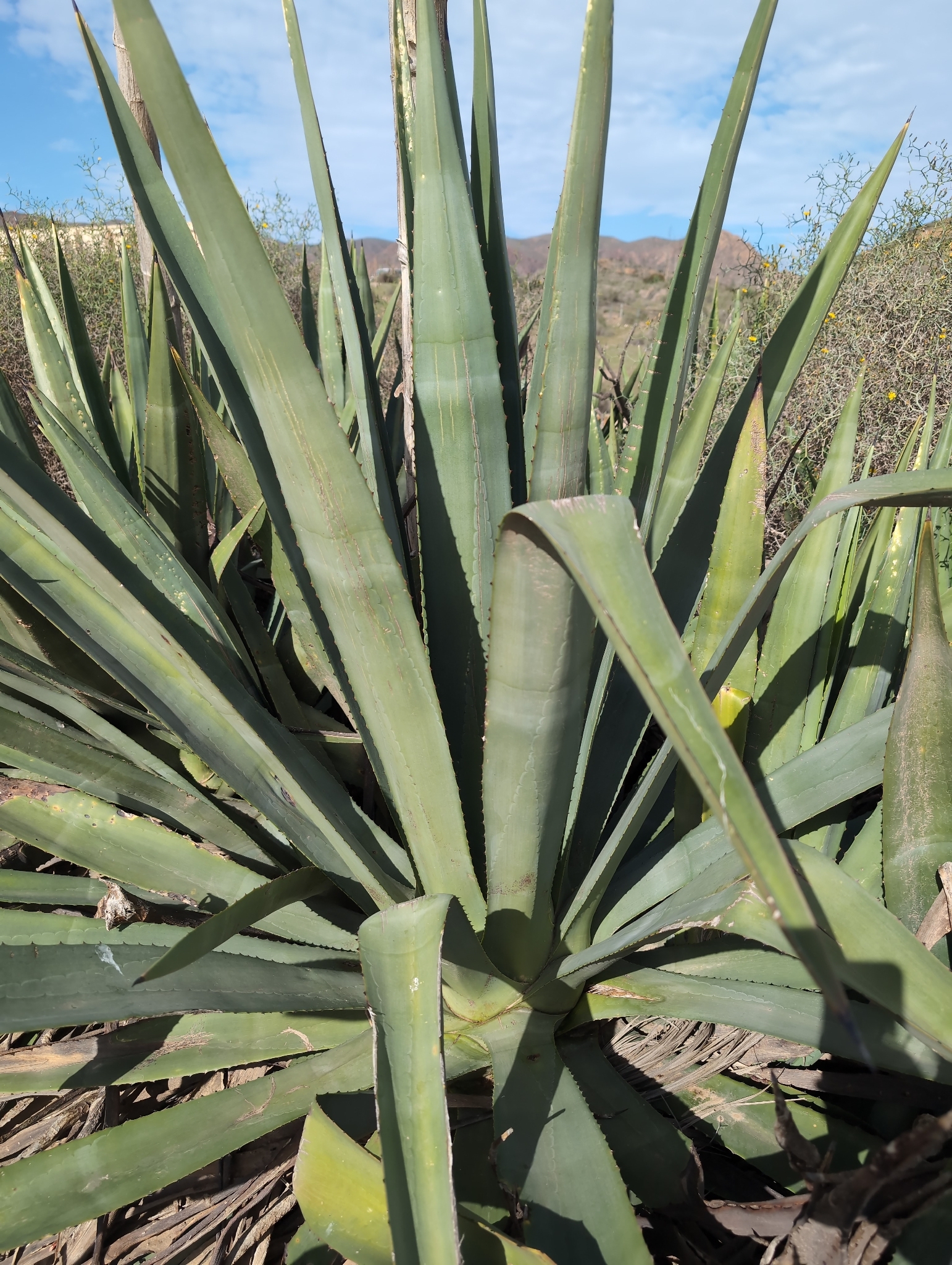
Caribbean Agave (Agave angustifolia) is a perennial succulent native to Mexico and Central America, recognized by its dense, spherical rosette of stiff, narrow leaves. It is the primary species used for the production of mezcal in the Mexican state of Oaxaca.
While often confused with the blue agave (Agave tequilana), this species is distinguished by its shorter, more numerous leaves and its ability to thrive in coastal conditions. It requires very little maintenance once established but demands significant space due to its sharp terminal spines.
Key Facts
- Light: Full sun, minimum 6 hours daily
- Water: Monthly in winter; every 2 weeks in summer
- Hardiness: USDA Zones 9b to 11
- Size: Reaches 1.2 m (4 ft) height and spread
- Lifespan: 10 to 30 years before flowering
Caribbean Agave in the Landscape
Plant Caribbean Agave in a location with at least 1.5 meters (5 feet) of clearance from walkways or seating areas. Because of the needle-sharp terminal spines and serrated leaf margins, it functions effectively as a security hedge or a focal point in xeriscapes where foot traffic is minimal.
This species is well-suited for coastal gardens in Florida and the Southwest because it tolerates salt spray and intense heat better than many other Agave species. It is a monocarpic plant, meaning the main rosette will die after it produces its massive flower spike, but it usually leaves behind several “pups” or offsets at the base.
- Best for rock gardens and Mediterranean themes
- Provides nectar for bats and moths when blooming
- Requires no supplemental irrigation after the first year
- Deters intruders when planted under windows
Caribbean Agave Identification and Size
A mature Caribbean Agave typically forms a uniform mound 90 to 120 cm (3 to 4 ft) tall and wide. The leaves are straight, rigid, and narrow, measuring roughly 5 to 10 cm (2 to 4 in) wide, which is significantly thinner than the broad leaves of the Century Plant (Agave americana).
The foliage color ranges from a pale glaucous green to a striking variegated pattern in the ‘Marginata’ cultivar. When the plant reaches maturity, it sends up a branched inflorescence that can reach heights of 3 to 5 meters (10 to 16 ft), bearing greenish-yellow flowers.
- Leaves are concave on the upper surface
- Terminal spines are dark brown or black
- Rosettes are more densely packed than Agave tequilana
- Produces bulbils (miniature plants) on the flower stalk
How Much Light Does Caribbean Agave Need
Caribbean Agave requires full sun to maintain its tight, symmetrical rosette shape. In shaded conditions, the leaves will become elongated, weak, and may droop, losing the architectural form that defines the species.
In regions with extreme desert heat exceeding 40 °C (104 °F), the variegated variety ‘Marginata’ may benefit from light afternoon filtered shade to prevent the white edges from scorching. However, the standard green form is highly resistant to sunburn and thrives in the most exposed positions.
- Minimum 6-8 hours of direct sunlight daily
- Indoor specimens must be placed in south-facing windows
- Insufficient light leads to “etiolation” or stretching
- Reflected heat from concrete or stone is well-tolerated
Watering Caribbean Agave Correctly
Water this plant only when the soil is completely dry to a depth of 10 cm (4 in). Overwatering is the most frequent cause of failure, as the thick roots are highly susceptible to fungal rot in damp conditions.
During the active growing season in spring and summer, a deep soaking every 14 to 21 days is sufficient if there is no rainfall. In the winter months, the plant enters a dormant phase and may only require watering once every 4 to 6 weeks, or not at all if kept outdoors in a humid climate.
- Avoid getting water into the center “crown” of the rosette
- Use a “soak and dry” method
- Container plants require more frequent watering than ground plants
- Signs of thirst include slightly shriveled or curling leaves
Best Soil for Agave angustifolia
The ideal substrate is a sandy, gravelly mix with a pH between 6.5 and 8.5. This plant is naturally adapted to limestone-rich soils and rocky slopes where water moves away from the roots instantly.
If planting in heavy clay soil, you must amend the site with expanded shale, poultry grit, or coarse sand to improve aeration. For container growth, a specialized cactus and succulent potting mix is required, ideally supplemented with 30% perlite or pumice to ensure the roots never sit in standing water.
- Avoid peat-heavy mixes that retain moisture
- Ensure the planting hole is twice as wide as the root ball
- Top-dress with gravel to keep the lower leaves off damp soil
- Does not require high organic matter or compost
Temperature and Cold Hardiness
Caribbean Agave is hardy down to -4 °C (25 °F) for short durations. Prolonged exposure to freezing temperatures will cause the water-filled cells in the leaves to burst, resulting in black, mushy spots that eventually turn into permanent scarring.
In regions like the northern parts of Zone 9, it is safer to grow this species in large pots that can be moved indoors or under a porch during frost events. It is exceptionally heat-tolerant and can survive temperatures well above 45 °C (113 °F) without showing signs of stress, provided it is established.
- Protect with frost cloth if temperatures drop below freezing
- Thrives in high humidity unlike many desert agaves
- Ideal growth occurs between 21-32 °C (70-90 °F)
- Keep dry during cold snaps to prevent root rot
How to Propagate and Trim Caribbean Agave
Propagate by removing the offsets (pups) that emerge from the base of the parent plant in spring. These small clones can be severed with a sharp, clean knife, allowed to callous for three days, and then tucked into dry sandy soil where they will root within weeks.
Trimming is generally unnecessary except for removing dead lower leaves. If you must trim for space, use long-handled loppers and wear thick leather gloves to avoid the spines; cut the leaf as close to the trunk as possible without damaging the core.
- Propagate via bulbils from the flower stalk after blooming
- Never trim the top of a leaf; it will not regrow and looks unsightly
- Clean tools with rubbing alcohol between plants
- Seeds are viable but much slower than using offsets
Is Caribbean Agave Invasive
In certain tropical environments like Florida and parts of Hawaii, Agave angustifolia is considered a category II invasive species or a species of concern. It spreads via underground rhizomes and by dropping bulbils from its flower stalks, which can displace native vegetation in coastal dunes.
Homeowners in these regions should monitor the plant and remove offsets regularly to prevent it from escaping the garden. In its native Mexico, it is a vital part of the ecosystem, but in sensitive island or coastal habitats, its aggressive growth can be problematic.
- Check local invasive lists before planting in Florida
- Remove flower stalks before bulbils mature to prevent spreading
- Container planting is the safest way to control its footprint
- Displace native Agave decipiens in some Florida habitats
Year-Round Care for Caribbean Agave
| Spring | Remove pups from the base to propagate or maintain shape. Begin watering every 2 weeks as new growth appears. |
|---|---|
| Summer | Monitor for Agave Snout Weevil. Provide deep waterings during heatwaves if the soil is bone dry. |
| Autumn | Reduce watering frequency as growth slows. Check for mealybugs hiding in the leaf axils. |
| Winter | Stop all watering if temperatures drop below 10 °C (50 °F). Cover with burlap or frost cloth during rare freezes. |
Common Caribbean Agave Problems
| What you see | Likely cause | What to do |
|---|---|---|
| Yellow, mushy base | Root rot from overwatering | Stop watering immediately and replant in faster-draining soil if possible. |
| Tiny holes in leaves | Agave Snout Weevil | Apply a systemic insecticide in spring to prevent the larvae from eating the heart. |
| White cottony spots | Mealybugs | Blast off with a strong stream of water or treat with neem oil. |
| Black scorched leaf tips | Frost damage | Wait until spring to prune away damaged leaves once the threat of frost has passed. |
Popular Caribbean Agave Cultivars
- ‘Marginata’ – The most common cultivar with creamy-white leaf edges.
- ‘Woodedge’ – Features wider white margins and a more compact growth habit.
- ‘Variegata’ – Often used interchangeably with Marginata, featuring yellow-white stripes.
- ‘Rubra’ – A rare form where the leaf edges take on a reddish tint in high sun.
Frequently Asked Questions
How long does it take for Caribbean agave to bloom?
It typically takes 10 to 20 years to bloom, though it can take up to 30 years depending on the climate. The plant dies shortly after the seeds and bulbils on the stalk mature.
What is the difference between Caribbean agave and blue agave?
Caribbean Agave (Agave angustifolia) is smaller, has narrower leaves, and is used for mezcal, whereas Blue Agave (Agave tequilana) is larger, has wider blue-tinted leaves, and is the only species permitted for tequila production.
Is the sap of Caribbean agave dangerous?
Yes, the sap contains calcium oxalate crystals which can cause painful skin rashes, itching, and burning. Always wear gloves and eye protection when cutting or removing this plant.
Can I grow Caribbean agave indoors?
You can grow it as a houseplant if you have a spot with very high light, such as a sunroom. However, it will eventually outgrow most indoor spaces and its sharp spines make it a hazard in tight rooms.
How do you make mezcal from this plant?
Traditionally, the heart or 'piña' of the plant is harvested after 6-10 years, roasted in underground pits to give it a smoky flavor, crushed, fermented, and then distilled.
Information about traditional or historical uses is provided for educational interest only and is not medical advice. Do not use any plant to treat a condition without speaking to a qualified professional.
Sources & Verification
Taxonomy and distribution are checked against the databases below. Care guidance is written for cultivated species only and reviewed by our editor. How We Build Plant Profiles →