
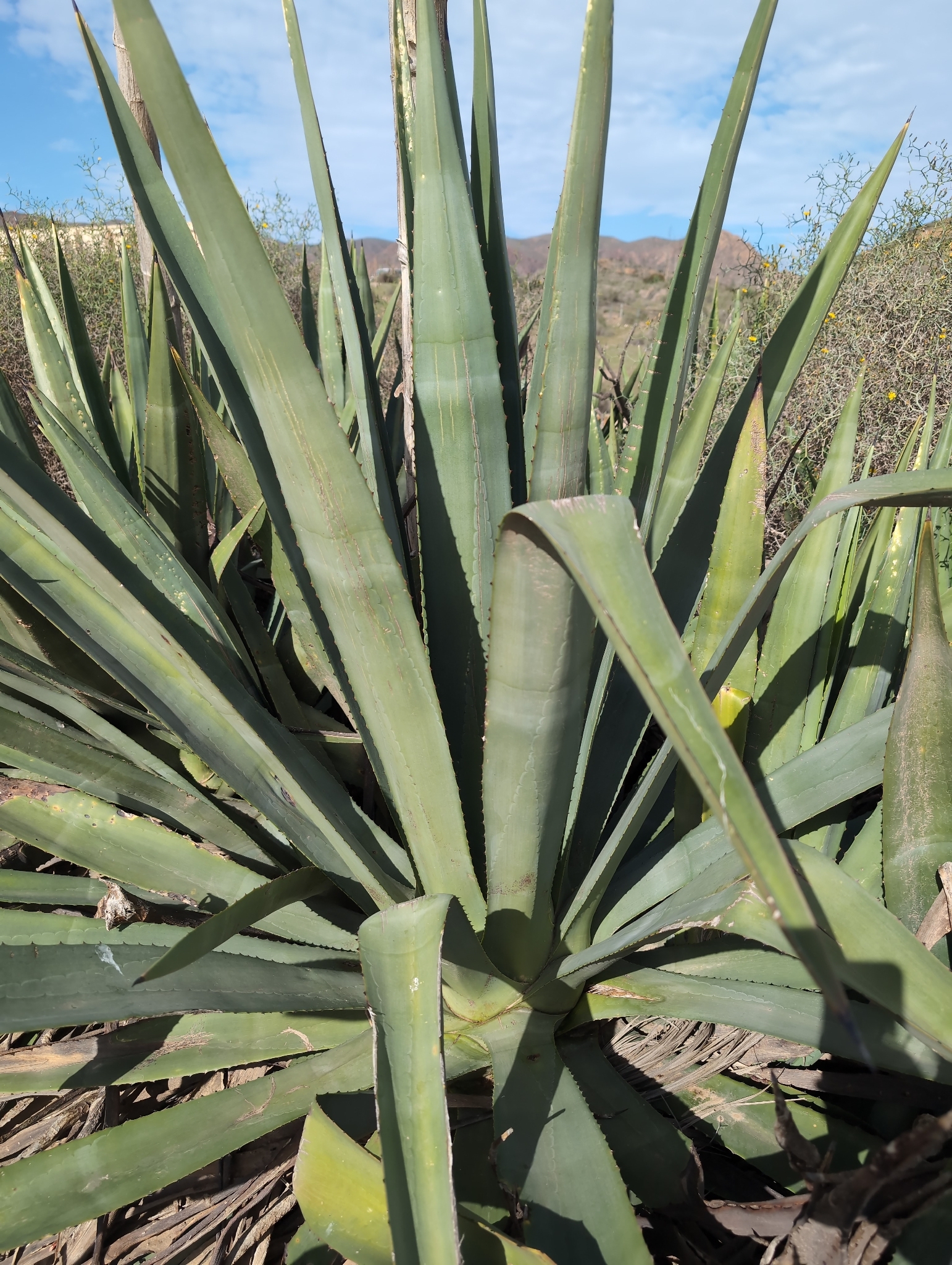
Henequen (Agave fourcroydes) is a large, spiny succulent native to southern Mexico and Guatemala, distinguished by its sword-shaped, grey-green leaves arranged around a stout, upright trunk. Yucatan farmers cultivated it for centuries as the primary source of natural binder twine and industrial rope, earning it the regional moniker ‘green gold’.
Unlike tender garden crops, this arid perennial demands brutal heat, thin limestone soil, and virtually no irrigation once established. It takes six to eight years of field growth before you can begin harvesting leaves, after which a healthy plant produces foliage for over two decades.
Key Facts
- Light: Full, intense sun throughout the year
- Water: Drought tolerant; requires dry soil between soakings
- Soil: Rocky, shallow, highly drained limestone soils
- Hardiness: USDA Zones 9b to 11
- Maturity: First fiber harvest at 6–8 years
- Lifespan: 20–25 years before flowering and dying
Growing Henequen in Hot Climates
Henequen requires blazing sunlight, minimal moisture, and frost-free conditions to survive outdoors. Because it develops rigid leaf blades armed with sharp margins and grows over 2 m (6.5 ft) across, give it wide spacing away from pedestrian footpaths and domestic animals.
This crop thrives where agricultural soils are too thin or rocky for conventional crops. In its historical center around Merida, Yucatan, it grows directly in cracked limestone karst with little topsoil.
Key site characteristics include:
- Unobstructed overhead sunlight for at least 8 hours daily
- Porous soil that drains surface water within minutes of heavy downpours
- Warm temperatures that remain reliably above 10 °C (50 °F)
- Ample perimeter space to safely manage spine-tipped foliage
Botanical Features and Identification
The plant forms an upright rosette atop an apparent woody trunk that reaches 1 to 2 m (3.3 to 6.6 ft) in height as lower leaves are stripped away over time. The stiff, straight leaves are sword-shaped, measuring 1.2 to 1.8 m (3.9 to 5.9 ft) long and 8 to 12 cm (3 to 4.7 in) wide, colored a pale glaucous grey-green.
Every leaf margin bears evenly spaced, curved marginal spines 3 to 6 mm (0.12 to 0.24 in) long, ending in a stout, dark brown terminal spine up to 3 cm (1.2 in) long. This armament distinguishes it in field identification from the smoother margins of cultivated sisal (Agave sisalana).
At the end of its life cycle, after 15 to 25 years, the plant sends up a single paniculate flowering pole 5 to 7 m (16 to 23 ft) tall. The inflorescence carries greenish-yellow flowers followed by hundreds of bulbils (vegetative plantlets) rather than seed capsules.
Soil and Sun Conditions
Henequen performs best in calcareous, alkaline soils with a pH between 7.0 and 8.5 and rapid percolation. Planting in heavy clay or waterlogged earth induces basal root rot within weeks.
If planting outside native limestone regions, amend sandy or loamy garden beds with crushed limestone, pumice, or gravel to reproduce its native drainage. The plant tolerates coastal salt spray and reflective stone heat without leaf scorching.
Maintain these critical soil properties:
- Coarse aggregate mix with at least 50% grit, perlite, or limestone gravel
- Low organic matter content to prevent unwanted fungal development
- Continuous full sun exposure without overhead canopy competition
Propagating Henequen from Offsets and Bulbils
Propagate new specimens by digging up rhizomatous basal suckers (hijuelos) measuring 30 to 50 cm (12 to 20 in) tall during early spring or summer. You can also establish bulbils collected directly from post-bloom flower stalks.
Never plant freshly severed suckers directly into wet ground. Sever the runner with a disinfected spade, trim damaged roots, and allow the base to callous in dry shade for 7 to 10 days before planting.
Planting steps for field establishment:
- Excavate a shallow hole equal to the depth of the root flare
- Position the sucker upright and firm coarse mineral soil around the base
- Withhold water for the first 14 days to prevent subterranean rotting
- Apply one deep watering at two weeks, then rely strictly on seasonal rainfall
Long-Term Field Care and Maintenance
Established henequen plants require zero supplemental irrigation in climates receiving at least 600 mm (24 in) of annual rain. Overwatering dilutes the structural fiber density within the leaves and encourages fungal crown rot.
Keep the ground directly around young plants cleared of invasive grasses and woody scrub for the first three years. Weeding prevents saplings from being shaded out before they develop an elevated woody trunk.
Fertilizer is unnecessary in rocky mineral soils, though commercial plantations historically benefit from returning shredded leaf pulp (bagasse) to the surrounding soil base. Pruning is limited to harvesting the lower mature foliage or cutting away frost-damaged leaf ends.
Harvesting Henequen Leaves
You should harvest foliage only after the plant reaches six to eight years of age, removing leaves from the lowest tiers with an upward-angled cut close to the stem. The central leaf spear and the newest upright leaves must remain untouched to sustain continuous growth.
Commercial plantation workers, known as henequeneros, use a curved machete called a corba to sever the leaf base and slice off the terminal spine in a single fluid motion. A single mature plant yields between 25 and 35 leaves per year across two or three harvest rounds.
Key harvest guidelines:
- Select only horizontal or descending leaves positioned at least 45 degrees from vertical
- Cut within 2 cm (0.8 in) of the central stem without scarring the trunk
- Strip marginal thorns immediately if processing leaves by hand
- Discontinue all harvesting when the central bud initiates its vertical flowering pole
What Is Henequen Used For?
The plant is prized for its durable, coarse leaf fiber known as henequen or sosquil, historically manufactured into marine rope, agricultural baler twine, sacks, and rugs. The fiber is stiff, pale yellow, and naturally resistant to saltwater degradation.
In Yucatan and southern Mexico, regional artisans weave this natural cordage into bags, hammocks, and coarse shoe textiles. The plant’s high sugar content also supports the production of licor de henequen, a clear distilled spirit produced from the roasted heart (piña) much like tequila from blue agave (Agave tequilana).
Traditional applications include:
- Industrial twine, cordage, and shipping cables
- Durable coarse textiles, footwear, and decorative floor rugs
- Distilled spirits and fermented beverages made from stem sugars
- Dense perimeter security hedging to deter livestock and trespassers
Managing Pests and Foliage Diseases
The agave snout weevil (Scyphophorus acupunctatus) is the most damaging insect pest, drilling into the crown to lay eggs whose larvae consume the plant from the inside out. Once a plant experiences core collapse from weevil infestation, it cannot be saved and must be incinerated.
Anthracnose, caused by Colletotrichum fungi, creates sunken, necrotic spots on leaf surfaces during prolonged humid or wet spells. Good spacing and full sun prevent most foliar blights by accelerating surface drying.
Monitor for these symptoms:
- Soft, wrinkling leaf bases with an unpleasant fermented odor (bacterial soft rot)
- Circular, dark lesions on the upper leaf surfaces (anthracnose)
- A sudden tilt or wobble in the main trunk (snout weevil larvae feeding)
- Wilting accompanied by brown underground roots (overwatering or poor drainage)
Post-Harvest Processing and Fiber Storage
Fresh leaves must undergo mechanical scraping (decortication) within 24 to 48 hours of harvest to separate the long fiber strands from the juicy green pulp. Leaving cut foliage in the field longer allows sap to ferment, discoloring and weakening the fibers.
Once decorticated, wash the fibers in clean water to purge acidic residues, then dry them on elevated racks in direct sunlight for 2 to 3 days. Once moisture levels drop below 10%, store the combed fibers in compact, ventilated bales off damp concrete floors.
Safe storage rules:
- Dry strands completely until brittle and pale ivory before pressing
- Store in a low-humidity warehouse protected from direct rain and rodents
- Keep bales separated by pallets to ensure air circulation and prevent spontaneous heating
Year-Round Henequen Maintenance
| Spring | Sever and pot up basal suckers (hijuelos) before summer heat sets in. Remove dead, dry leaves from the lowest tier of mature specimens. |
|---|---|
| Summer | Inspect leaf axils for exit holes from the agave snout weevil. In home plantings, withhold all irrigation unless rain is absent for more than 8 consecutive weeks. |
| Autumn | Complete the final leaf harvest of the season, taking 10 to 15 mature lower leaves. Clear fallen leaf litter from around the base to reduce pest sheltering. |
| Winter | Protect young rosettes if local temperatures are forecast to dip below -2 °C (28 °F). Avoid adding any supplemental moisture to cold winter soil. |
Common Henequen Problems and Solutions
| What you see | Likely cause | What to do |
|---|---|---|
| Crown suddenly collapses sideways | Agave snout weevil larvae boring through the core | Dig up and burn the entire plant to kill grubs before they migrate to adjacent agaves. |
| Soft, black, foul-smelling leaf bases | Bacterial soft rot from waterlogged soil | Cease all irrigation immediately and replant into pure gravel or coarse limestone rubble. |
| Yellowing leaf tips with reddish-brown spots | Anthracnose fungus during persistent rain | Clear surrounding brush to improve air circulation and allow the foliage to dry in full sun. |
| Pale, elongated leaves that droop loosely | Insufficient direct sunlight | Relocate the plant to an open site receiving at least 8 hours of unfiltered overhead sun. |
Frequently Asked Questions
What is henequen in English?
Henequen in English refers both to the succulent species Agave fourcroydes and to the coarse natural leaf fiber extracted from it. It is also known as Mexican sisal or Yucatan sisal.
What is the difference between henequen and sisal?
Henequen (Agave fourcroydes) has conspicuous spines along its leaf edges and grows an apparent trunk, while true sisal (Agave sisalana) has nearly smooth, spineless margins and a much shorter trunk. Henequen produces a slightly coarser, darker fiber with higher elasticity than sisal.
Is henequen an agave or a maguey?
Henequen is an agave belonging to the genus Agave, and 'maguey' is simply the traditional Spanish word used across Mexico for large agaves. In the Yucatan Peninsula, it is specifically called henequen or its indigenous Mayan name, sak-ki.
How do you pronounce henequen?
It is pronounced HEN-eh-ken (or eh-neh-KEN in Mexican Spanish, spelled henequén with an accent on the final syllable). The word derives from Taíno and Mayan linguistic roots adopted during early Spanish colonial trade.
Can henequen fiber be used for clothing?
Henequen fiber is generally too coarse and stiff for soft next-to-skin clothing, but it is traditionally woven into durable shoes, hats, belts, and utilitarian outerwear. Most commercial fiber goes into rope, sacks, and woven home accessories.
Is the sap of henequen toxic?
Yes, raw henequen sap is mildly toxic to humans and pets, containing sharp microscopic calcium oxalate crystals and irritating saponins. Skin contact causes painful rashes and swelling, requiring gloves when cutting or processing leaves.
Information about traditional or historical uses is provided for educational interest only and is not medical advice. Do not use any plant to treat a condition without speaking to a qualified professional.
Sources & Verification
Taxonomy and distribution are checked against the databases below. Care guidance is written for cultivated species only and reviewed by our editor. How We Build Plant Profiles →

