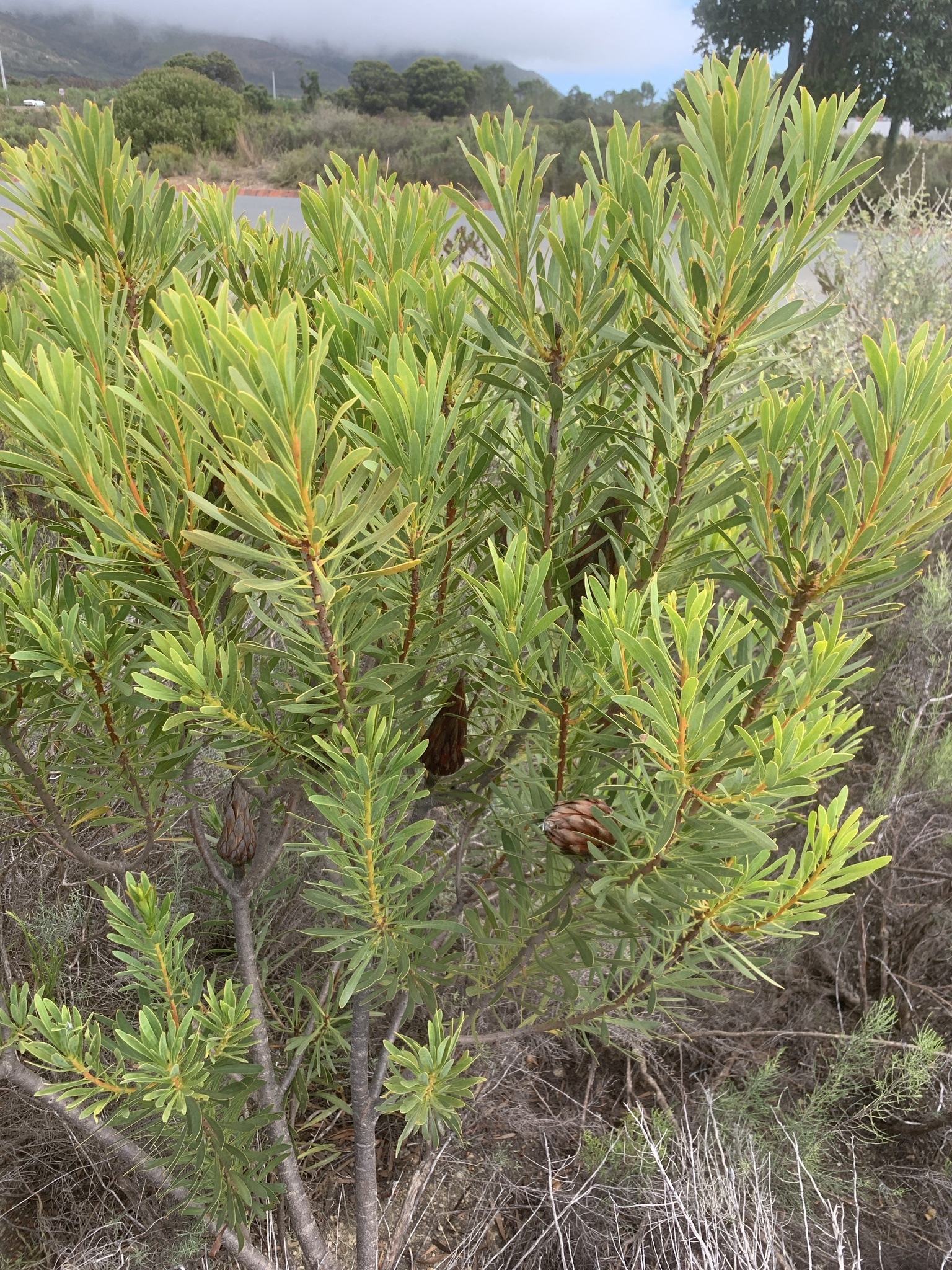
Forest Sugarbush is a large, upright shrub or small tree native to the forest margins of South Africa, known scientifically as Protea mundii. It stands out from its relatives by its significant height and ivory-white to cream-coloured flower heads.
Unlike many members of the Proteaceae family that demand full, blistering sun, this species handles partial shade and moist conditions. It serves as a vital nectar source for Cape sugarbirds and sunbirds during the winter flowering season.
Key Facts
- Height: Reaches up to 8 m (26 ft) tall
- Light: Prefers full sun to very light shade
- Soil: Requires acidic, well-drained, sandy soil
- Water: Needs moderate watering during dry summer months
- Hardiness: Hardy to -4 °C (25 °F) once established
Is Forest Sugarbush Right for Your Garden?
Forest Sugarbush is a large, fast-growing shrub that requires more vertical space than most other Protea species. It is an ideal choice for gardeners in Mediterranean climates who want to attract nectar-feeding birds or create a tall, flowering screen. Because it naturally grows on forest edges from 200 to 1,300 m (650 to 4,260 ft) elevation, it is more tolerant of humidity and moisture than the King Protea (Protea cynaroides).
You must have acidic soil to grow this plant successfully, as it will develop chlorosis in alkaline conditions. It is well-suited for coastal gardens but needs protection from the most severe salt-laden winds. This species is often selected for its ability to grow in partial shade, a rarity for the genus.
Identifying the Forest Sugarbush
Forest Sugarbush features ivory-white flower heads that measure 6 to 8 cm (2.4 to 3.1 in) in length. The flowers are oblong and topped with silvery-white hairs, giving them a soft, shimmering appearance. Unlike the Common Sugarbush (Protea repens), which has sticky bracts, the bracts of this species are smooth and range from cream to pale green.
- Leaves are elliptic, 6 to 12 cm (2.4 to 4.7 in) long, and a dull green colour.
- Stems are smooth and greyish-brown, becoming woody with age.
- Mature plants form a single-stemmed small tree or a multi-stemmed large shrub.
- Seed heads are persistent, woody cones that remain on the plant for several seasons.
Mature Size and Growth Rate
This species can reach a mature height of 8 m (26 ft) in ideal conditions, though it typically stays around 4 to 5 m (13 to 16 ft) in garden settings. It has a moderate to fast growth rate, often putting on 30 to 50 cm (12 to 20 in) of new growth annually when young. The spread is usually about half of the height, creating a narrow, upright silhouette.
In the wild, it competes with forest canopy trees, which drives its vertical habit. In a garden, you can maintain a more compact shape through consistent pruning. If left unpruned, the lower branches may become sparse as the plant focuses energy on the top canopy.
Choosing the Best Planting Site
Select a site with full sun and acidic soil with a pH between 5.0 and 6.5. While it tolerates more shade than other proteas, a minimum of six hours of direct sunlight ensures the best flower production. The site must have excellent air circulation to prevent fungal leaf diseases, which are common in stagnant, humid air.
Avoid areas with heavy clay or standing water, as the specialized proteoid roots are highly susceptible to rot. If your garden has heavy soil, plant the Forest Sugarbush on a mound or in a raised bed filled with a mix of coarse sand and peat. Keep it away from areas where you regularly use high-phosphorus fertilisers, which can kill the plant.
Managing the Forest Sugarbush
Prune the Forest Sugarbush every year after flowering to maintain a height of 3 to 4 m (10 to 13 ft) and encourage a bushier habit. Management involves removing the spent flower heads by cutting the stem back to a point just above a healthy leaf node. Never cut back into old, leafless wood, as the plant lacks the dormant buds required to sprout from bare branches.
- Thin out crowded internal branches to improve airflow through the canopy.
- Remove any dead or diseased wood as soon as it appears in spring.
- Mulch with pine bark or leaf mould to keep the roots cool and acidic.
- Avoid digging around the base of the plant to protect the shallow root system.
Watering and Feeding Requirements
Water your Forest Sugarbush twice a week during its first two summers to help it establish a deep root system. Once established, it is relatively drought-tolerant but will produce more flowers if given a deep soak every 10 to 14 days during dry spells. Always water at the base of the plant to keep the foliage dry.
Feeding must be done with extreme care; use only low-phosphorus organic fertilisers or a dedicated protea food. Proteas have evolved to scavenge phosphorus from nutrient-poor soils and can easily suffer from phosphorus toxicity. An annual application of well-rotted compost or a light dusting of ammonium sulphate in spring is usually sufficient.
Winter Protection and Cold Hardiness
Protect plants from temperatures below -4 °C (25 °F) using frost cloth or burlap during the coldest nights. While mature specimens can survive light, short-lived frosts, young plants are easily killed by freezing temperatures. In regions with cold winters, planting near a north-facing wall (in the southern hemisphere) or south-facing wall (in the northern hemisphere) can provide a warmer microclimate.
If the ground is likely to freeze, apply a thick layer of mulch to insulate the roots. Avoid heavy pruning in late autumn, as new growth is particularly vulnerable to frost damage. If frost does nip the branch tips, wait until the following spring to prune away the damaged tissue.
Traditional Uses and Wildlife Value
The nectar of the Forest Sugarbush was traditionally harvested to produce a sweet syrup known as bossiestroop, used in the past to treat coughs and chest complaints. The flowers produce copious amounts of nectar, which drips from the heads and attracts a wide range of pollinators. In South Africa, it is a primary food source for the Cape Sugarbird (Promerops cafer).
Historically, the wood was used for small furniture items and wagon work because of its relative size compared to other shrubs in the Cape. Today, it is primarily grown as an ornamental plant and for the cut-flower industry. The ivory-white blooms are long-lasting in vases and are often used in floral arrangements alongside Silver Tree (Leucadendron argenteum) foliage.
Year-Round Management of Forest Sugarbush
| Spring | Prune back spent flower heads to the next healthy node. Apply a light layer of acidic mulch and a low-phosphorus fertiliser if growth appears sluggish. |
|---|---|
| Summer | Water deeply once a week during heatwaves. Monitor for scale insects or leaf-mining larvae on the new foliage. |
| Autumn | Reduce watering as temperatures drop. This is the best time to plant new specimens so they can establish roots before the winter bloom. |
| Winter | Enjoy the peak flowering period and watch for nectar-feeding birds. Provide frost protection if temperatures are forecast to drop below -4 °C (25 °F). |
Common Forest Sugarbush Problems and Solutions
| What you see | Likely cause | What to do |
|---|---|---|
| Yellowing leaves with green veins | Iron chlorosis from alkaline soil | Apply chelated iron and mulch with acidic organic matter like pine needles. |
| Sudden wilting and death | Phytophthora root rot | Ensure soil is sandy and well-drained; avoid overwatering or planting in clay. |
| Black soot-like coating on leaves | Sooty mould from scale insects | Treat the underlying scale infestation with horticultural oil or neem oil. |
| Brown, crispy leaf edges | Phosphorus toxicity | Stop all fertiliser use and flush the soil with water if drainage allows. |
Frequently Asked Questions
How tall does Forest Sugarbush actually grow?
In its native South African habitat, it can reach up to 8 m (26 ft), making it one of the tallest Protea species. In home gardens, it is usually managed as a large shrub between 3 and 5 m (10 and 16 ft).
Can Protea mundii grow in the shade?
Yes, it is one of the few proteas that tolerates partial shade and forest-margin conditions. However, for the most prolific ivory-white flowers, it should receive at least six hours of sun.
Is the Forest Sugarbush attractive to birds?
It is highly attractive to nectar-feeding birds like sugarbirds and sunbirds. The flowers produce large volumes of nectar during the winter months when other food sources may be scarce.
How do you manage a Forest Sugarbush in a small garden?
Manage the plant by pruning it annually after flowering to prevent it from becoming leggy. You can keep it to a height of 3 m (10 ft) by cutting back the flowering stems each year.
Why are the flowers on my Forest Sugarbush turning brown?
Flowers naturally turn brown as they age and go to seed, but premature browning can be caused by grey mould (Botrytis) in very humid or wet weather. Ensure good air circulation to prevent this.
Information about traditional or historical uses is provided for educational interest only and is not medical advice. Do not use any plant to treat a condition without speaking to a qualified professional.
Sources & Verification
Taxonomy and distribution are checked against the databases below. Care guidance is written for cultivated species only and reviewed by our editor. How We Build Plant Profiles →