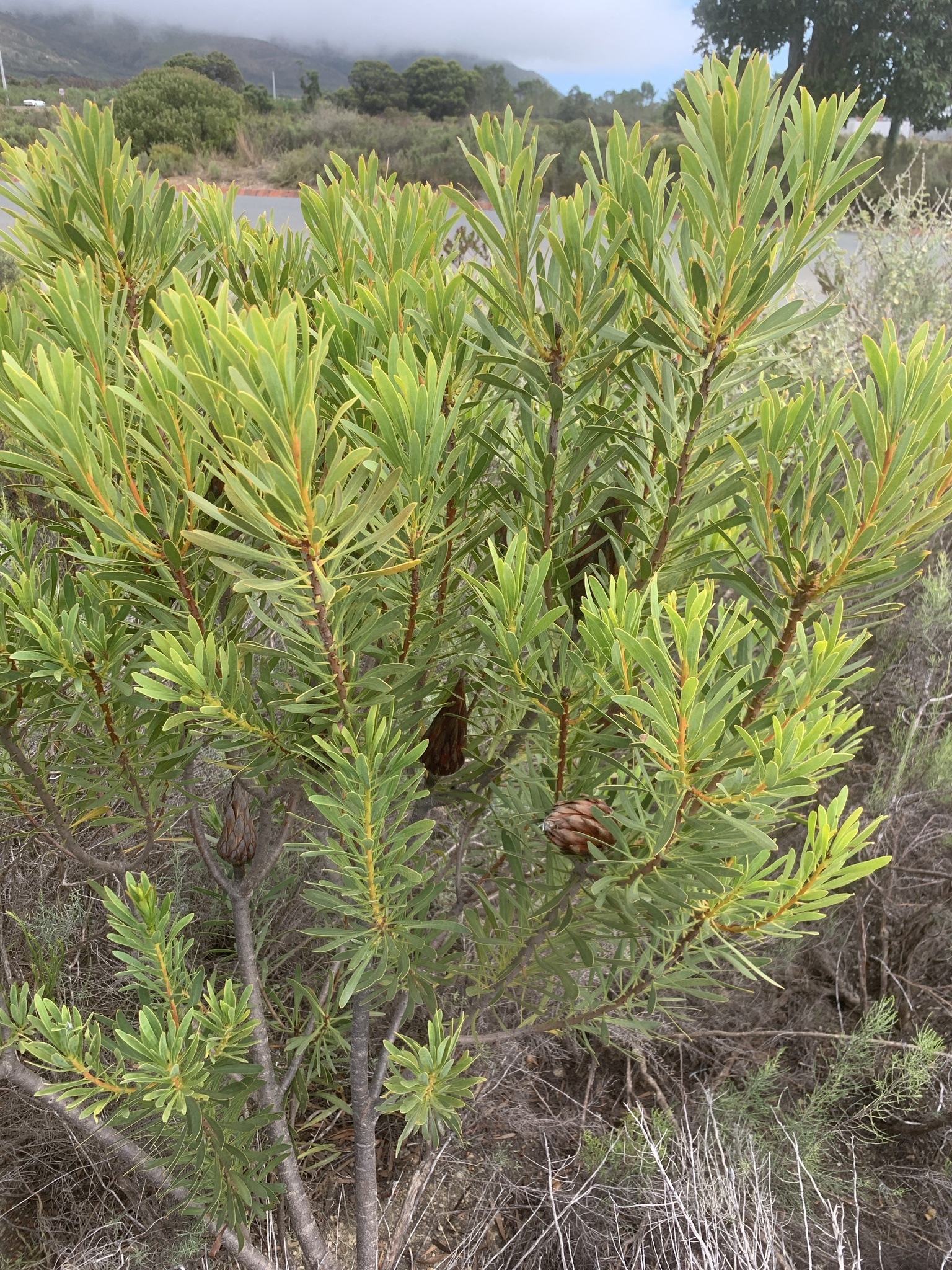
Bot River Protea (Protea compacta) is an evergreen woody shrub native to the coastal fynbos region between Kleinmond and Bredasdorp in South Africa. It forms a single-stemmed bush with narrow leaves that curve upwards toward the branch tips and produces deep pink bloom heads in late autumn.
This species serves as a major commercial cut flower crop due to its stem length of 40 to 80 cm (16 to 31 in). Soil phosphorus levels above 20 ppm cause severe root necrosis and leaf scorch in this plant.
Key Facts
- Light: Full sun (6+ hours daily)
- Soil pH: Acidic (5.0 to 6.0)
- Water: Low after initial root establishment
- Hardiness: USDA zones 9 to 11
- Mature Size: 2 to 3 m (6.5 to 10 ft) high
- Bloom Time: Autumn through early winter
Is Bot River Protea Right for Your Garden?
Bot River Protea grows best in Mediterranean climates with acidic, free-draining soil and low phosphorus levels. It suits gardens in Mediterranean-type zones where winter rainfall matches its native Western Cape precipitation pattern of 400 to 800 mm (16 to 31 in) annually.
This shrub requires open air movement to prevent fungal spot diseases on its dense foliage. It fails rapidly in heavy clay soils or areas with humid summer air, where root rot fungi thrive.
- Requires well-aerated soil with high sand or granite grit content
- Needs full sun exposure away from dense tree canopies
- Sensitive to artificial fertilizers containing phosphate
Identifying Bot River Protea
Bot River Protea forms an erect shrub reaching 2 to 3 m (6.5 to 10 ft) tall with distinctly upward-curving leaves and deep pink flower heads. The leaf blades measure 9 to 13 cm (3.5 to 5.1 in) in length and fold upward, closely hugging the upright woody branches.
The floral head measures 10 to 12 cm (4 to 4.7 in) long and 7 to 9 cm (2.8 to 3.5 in) across when open. The outer involucral bracts display a range from clear pink to crimson, covered in fine white hairs along their upper margins.
It resembles the broad-leaf sugarbush (Protea eximia), but that species features flat, spreading leaves rather than upward-curving foliage that grips the stems.
Sun and Soil Requirements for Bot River Protea
Plant Bot River Protea in full sun receiving at least 6 hours of direct sunlight daily and acidic soil with a pH of 5.0 to 6.0. Shaded sites cause weak, floppy growth and suppress flower bud initiation during late summer.
The root system relies on specialized proteoid (cluster) roots designed to absorb trace nutrients from nutrient-poor sandstones. High levels of soil phosphorus toxicity cause leaf tip burn and plant decline within one season.
- Select slopes or raised beds with rapid drainage
- Test soil pH to confirm acidic conditions below 6.5
- Avoid sites recently treated with bone meal or high-N-P-K lawn fertilizers
How to Plant Bot River Protea
Space young plants 1.5 to 2 m (5 to 6.5 ft) apart in clear soil without disturbing the delicate Proteaceae root ball. Dig a planting hole twice as wide as the root mass but equal in depth.
Never add compost, animal manure, or standard planting mixes into the hole during installation. Native sandstone soil mixed with clean quartz sand or decomposed granite provides the correct rooting medium.
Apply a 5 cm (2 in) mulch layer of pine needles or bark chips around the base, keeping the mulch 10 cm (4 in) away from the stem base to prevent collar rot.
Watering and Fertilizer Requirements
Water deep once every 7 to 14 days during the first summer, and never apply phosphorus-rich fertilizers. Once established after two growing seasons, natural rainfall satisfies water requirements in winter-rainfall regions.
Irrigate early in the morning directly at ground level. Overhead watering wet the dense leaf axils, creating optimal microclimates for leaf spot fungi like Colletotrichum.
- First year: Water deeply when top 5 cm (2 in) of soil dries
- Established plants: Supplemental water only during extreme drought
- Nutritional feeding: Organic seaweed extract at half-strength in early spring
How to Prune Bot River Protea for Bouquets
Prune spent flower stems back to 10 cm (4 in) above the main branches immediately after flowering finishes in late winter. Harvesting stems for floral arrangements serves as annual pruning.
Never cut back into old grey wood that lacks green leaves, as Bot River Protea lacks epicormic buds on mature wood and will not resprout. Always leave at least 4 to 6 leafy nodes on each remaining stem stub.
Remove weak, thin shoots from the center of the bush to maintain air circulation through the canopy structure.
Growing Bot River Protea from Seeds and Cuttings
Propagate Bot River Protea using semi-hardwood cuttings taken in autumn or from seeds sown at 15 to 20 °C (59 to 68 °F) in autumn. Seeds feature a hard coat that benefits from smoke treatment or hydrogen peroxide soaking prior to planting.
Sow seeds in a mixture of equal parts coarse sand and acidic peat moss. Germination typically occurs within 30 to 60 days under cool night temperatures.
- Cuttings: Take 10 to 15 cm (4 to 6 in) side shoots in late summer
- Dip cutting bases in 3,000 ppm IBA rooting hormone powder
- Place under mist in sharp sand and peat (3:1 ratio) for 6 to 10 weeks
Flowering Season and Cut Flower Care
Bot River Protea blooms from autumn through early winter (April to September in the Southern Hemisphere), producing rigid pink flower heads that last up to 3 weeks in a floral bouquet. The nectar attracts sugarbirds and sunbirds in wild stands.
Cut stems for floral design when the outer bracts begin to unfurl but before the central floral styles expand fully. Trim 2 cm (0.8 in) from the lower stem under water and strip leaves from the lower two-thirds of the stem length.
Change vase water every 2 days and keep arrangements away from direct sunlight and air drafts to prolong vase life.
Cold Hardiness and Winter Protection
Bot River Protea withstands short temperature drops down to -4 °C (25 °F) once mature but requires frost protection when young. Prolonged freezes below -5 °C (23 °F) kill soft stem tissue and flower buds.
In zones with occasional winter frost, site plants against a south-facing wall or under a light high canopy that captures radiant ground heat. Cover young plants with breathable frost cloth during freezing nights.
Year-Round Care for Bot River Protea
| Spring | Prune back spent flowering stems to leafy nodes, leaving 10 cm (4 in) of green growth. Apply a fresh 5 cm (2 in) layer of pine bark mulch around the root zone while avoiding stem contact. |
|---|---|
| Summer | Water young bushes deeply every 10 to 14 days during warm dry spells. Monitor leaf axils for scale insects and fungal leaf spots. |
| Autumn | Sow smoke-treated seeds in sandy seed trays. Take semi-hardwood stem cuttings for propagation. Stem growth slows as flower buds develop. |
| Winter | Harvest open flower heads for floral displays. Protect young plants with frost fleece when temperatures drop near -4 °C (25 °F). |
Bot River Protea Health Problems Explained
| What you see | Likely cause | What to do |
|---|---|---|
| Yellow leaf tips turning brown and dry | Phosphorus toxicity from chemical fertilizer or compost | Flush soil with clean water and stop applying all phosphate-bearing feeds. |
| Black spots on upper leaf surfaces | Fungal leaf spot from overhead watering or high humidity | Switch to drip irrigation and prune dense inner branches to increase airflow. |
| Sudden wilting of whole branch and stem blackening | Phytophthora root rot in waterlogged soil | Improve bed drainage immediately and reduce watering frequency. |
| Failure to produce flower buds | Insufficient sunlight or heavy summer pruning | Move to a full sun location and prune only in late winter right after flowering. |
Popular Protea compacta Hybrids
- ‘Pink Ice’ – hybrid (Protea compacta x neriifolia) with deep rose-pink heads and frost tolerance to -6 °C (21 °F)
- ‘Donna’ – hybrid (Protea compacta x susannae) with wide pink bracts and adaptability to heavier soils
Companion Plants for Protea compacta
Pair Bot River Protea with low-phosphorus fynbos plants such as pincushion (Leucospermum cordifolium), conebush (Leucadendron laureolum), and heather (Erica verticillata). These species share identical soil, light, and drainage preferences.
In landscape design, combine it with silver tree (Leucadendron argenteum) or blue chalksticks (Curio repens) to create textural contrast in gravel beds. Avoid companion plants that require regular lawn feeding or summer irrigation schedules.
Frequently Asked Questions
What is the common name of Protea compacta?
The primary common name of Protea compacta is Bot River Protea. It is also known as Bot River Sugarbush, Pink Protea, and Prince Sugarbush.
Is the Bot River in Botswana?
No, the Bot River is located in the Western Cape province of South Africa, not in Botswana. Bot River Protea originates in the coastal mountain ranges near this South African river.
How long do Bot River Protea cut flowers last in a bouquet?
Bot River Protea flowers last 2 to 3 weeks in a vase when stems are re-trimmed and water is replaced every 2 days. Their rigid bracts retain shape and pink color as they slowly dry.
What is the hybrid Protea compacta x susannae?
The hybrid Protea compacta x susannae (commonly sold under the cultivar name 'Donna') is a garden cross between Bot River Protea and Susanna's protea (Protea susannae). It tolerates slightly heavier soil types than pure Bot River Protea.
What is the difference between Protea compacta and Protea neriifolia?
Bot River Protea features upward-curving leaves that wrap around the stem and clear pink bracts, while bearded sugarbush (Protea neriifolia) has narrow, straight leaves and distinct black fur trim along its top bract edges.
Sources & Verification
Taxonomy and distribution are checked against the databases below. Care guidance is written for cultivated species only and reviewed by our editor. How We Build Plant Profiles →