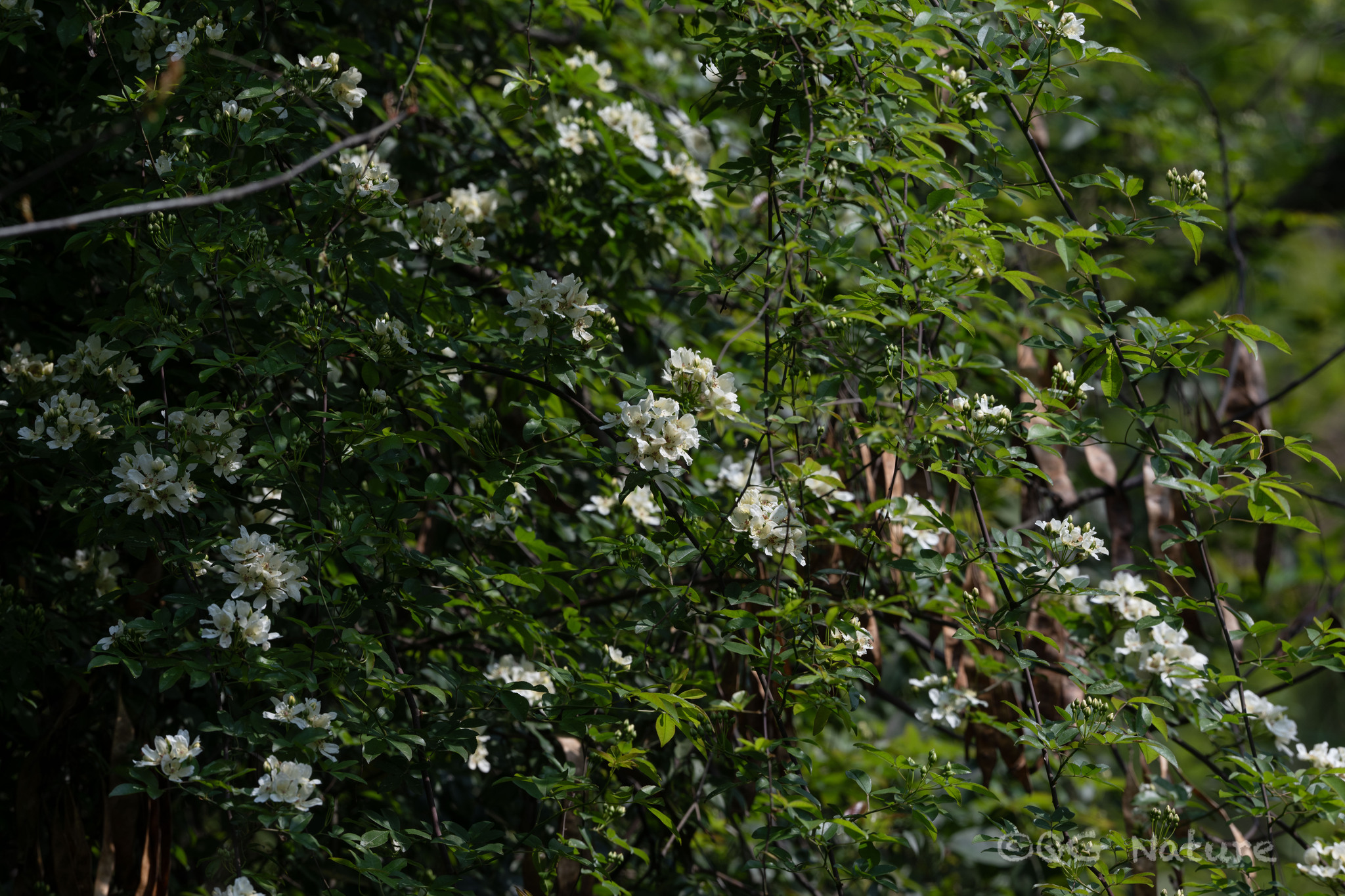
Multiflora rose is a deciduous perennial shrub native to China, Japan, and Korea, characterized by its sprawling, arching stems and clusters of small white flowers. Known scientifically as Rosa multiflora, it was introduced to North America in the late 19th century as a rootstock for ornamental roses and later for erosion control.
This species is highly competitive and is classified as a noxious weed in many regions, including Ohio and Nova Scotia. It forms dense, thorny thickets that displace native vegetation and alter local soil chemistry through its vigorous root system.
Key Facts
- Identification: Fringed stipules (leaf-like structures) at the base of leaf stalks
- Flowers: Clusters of white to pink blossoms, 1.5-4 cm (0.6-1.5 in) wide
- Stems: Arching canes reaching 3-5 m (10-16 ft) in length
- Thorns: Sharp, recurved prickles shaped like cat claws
- Hardiness: Extremely cold tolerant, surviving down to -30 °C (-22 °F)
Is Multiflora Rose a Good Choice for Your Landscape?
You should only grow multiflora rose if you live within its native East Asian range or have a specific heritage cultivar that is non-invasive. In North America, planting this species is often discouraged or legally restricted because a single plant can produce 500,000 seeds per year. Birds eat the small red hips and spread the seeds across forests and pastures.
This shrub is best suited for large, rural properties where it was historically used as a “living fence” to contain livestock. Its dense growth provides excellent cover for nesting birds, but it will quickly overwhelm smaller garden beds. If you choose to manage an existing plant, be prepared for significant annual maintenance to prevent it from spreading into neighboring properties.
Identifying Multiflora Rose via Thorns and Leaves
You can identify Rosa multiflora by looking for fringed stipules at the base of every leaf stalk. These stipules have distinct, hair-like projections that distinguish this species from native North American roses. Most native species have smooth-edged or entire stipules without these deep fringes.
- Leaflets: 5 to 11 (usually 7 or 9) oval leaflets with serrated edges.
- Thorns: Curved, reddish prickles that point downward to help the plant climb.
- Flowers: Numerous 5-petaled white flowers arranged in a pyramid-shaped cluster.
- Hips: Smooth, red, globular fruits about 6 mm (0.25 in) in diameter.
How Big Does a Multiflora Rose Bush Get?
A mature multiflora rose typically reaches a height of 3 to 5 meters (10 to 16 feet) with a spread of up to 6 meters (20 feet). The stems are arching and can climb even higher if they find support from nearby trees or fences. This growth habit allows it to create impenetrable walls of thorns within just a few growing seasons.
In open fields, the plant forms a rounded mound, but in wooded areas, it acts more like a vine. The canes can root wherever they touch the ground, a process known as tip-layering. This allows a single individual to expand horizontally and form a massive colony without relying on seed dispersal alone.
Best Soil and Sun for Rosa multiflora
This rose grows best in full sun and well-drained loamy soil, but it is highly adaptable to poor conditions. It will tolerate partial shade, though flower production and growth rate will decrease. It is frequently found along forest edges and roadsides where light is abundant but soil may be compacted or nutrient-poor.
While it prefers a slightly acidic pH of 5.5 to 7.0, it can survive in moderately alkaline soils. It does not tolerate permanently waterlogged ground but thrives in moist lowlands and floodplains. Its ability to grow in diverse conditions is why it has successfully naturalized across most of the eastern United States and parts of Canada.
Planting and Preventing Invasive Spread
If you are planting a cultivar like ‘Seven Sisters’, place it at least 3 meters (10 feet) away from other structures to allow for its sprawling habit. Dig a hole twice as wide as the root ball and set the plant at the same depth it was in its container. Water deeply once a week during the first year to establish the root system.
To prevent invasive spread, you must remove the flowers before they turn into seed-bearing hips. If you find wild multiflora rose on your property, do not plant more near it. Native alternatives that provide similar aesthetic value include:
- Virginia rose (Rosa virginiana)
- Swamp rose (Rosa palustris)
- Prairie rose (Rosa setigera)
- Pasture rose (Rosa carolina)
Basic Care and Drought Resistance
Once established, multiflora rose requires minimal to no supplemental watering except during extreme droughts. It is a highly self-sufficient shrub that draws nutrients efficiently from the soil. In most climates, natural rainfall is sufficient to maintain its vigorous growth throughout the summer.
Fertilization is rarely necessary and may actually contribute to unmanageable growth. If the plant shows signs of yellowing in early spring, a light application of a balanced 10-10-10 fertilizer can be used. However, most growers find that the primary care task is restricting growth rather than encouraging it.
Pruning and How to Kill Multiflora Rose
To keep the plant tidy, prune arching canes back by one-third in early spring before new growth begins. Use sharp loppers and wear thick leather gauntlets to protect your arms from the recurved thorns. If you are trying to eradicate the plant, you must be persistent as it will resprout from the crown.
Killing multiflora rose often requires a combination of mechanical and chemical methods. Options for control include:
- Mowing: Repeat 3-6 times per season for several years to starve the roots.
- Cutting: Cut stems to the ground and immediately apply a systemic herbicide to the stump.
- Foliar Spray: Apply herbicide to leaves in late summer when the plant is moving nutrients to the roots.
- Excavation: Dig out the entire root crown using a grubbing tool or tractor.
Rose Rosette Disease and Other Problems
The most significant threat to this plant is Rose Rosette Disease (RRD), a virus spread by microscopic mites. Symptoms include rapid, succulent growth with a bright red or purple hue and an excessive number of thorns. This disease is fatal to the plant and can spread to expensive ornamental roses in your garden.
Because multiflora rose acts as a reservoir for RRD, many rose enthusiasts choose to remove it from their property entirely. It is also susceptible to common rose ailments like powdery mildew and black spot, though these rarely kill the plant. In its native range, it is fed upon by various beetles and sawflies that help keep its population in check.
Winter Interest and Red Rose Hips
During winter, the plant is notable for its bright red hips that persist on the branches until spring. These small fruits provide a vital food source for cedar waxwings and Northern cardinals when other forage is scarce. The arching, leafless canes remain green or reddish-brown throughout the cold months.
The plant is fully hardy in USDA Zone 5 and does not require winter protection. In fact, cold winters may help regulate seed germination rates. If you are managing the plant for wildlife, leaving the hips until late winter is beneficial, but be aware that any uneaten seeds will likely germinate nearby in the spring.
Traditional Uses and History
In East Asia, the fruit of the multiflora rose, known as Eijitsu, was traditionally used as a herbal remedy. It was often dried and used in decoctions believed to have diuretic or laxative properties. The flowers have also been used in the production of essential oils, though they are less fragrant than Rosa damascena.
In the 1930s and 40s, the US Soil Conservation Service promoted this plant for erosion control and as a “living fence” that did not require wire or posts. Farmers were encouraged to plant it to provide cover for game birds. While successful in these goals, the plant’s aggressive nature led to it becoming a major agricultural pest by the 1960s.
Year-Round Management of Multiflora Rose
| Spring | Prune back dead canes and thin out the center of the bush to improve airflow. Monitor for the red, distorted 'witches broom' growth of Rose Rosette Disease. |
|---|---|
| Summer | Deadhead spent flowers if you want to prevent seed production. Water during prolonged dry spells of more than 14 days without rain. |
| Autumn | Remove any fallen leaves that show signs of black spot to prevent overwintering fungi. Harvest hips for decorative use or leave for birds. |
| Winter | Check for structural damage from heavy snow. This is the best time for major clearing or brush-cutting if you are trying to remove the plant. |
Common Multiflora Rose Problems and Solutions
| What you see | Likely cause | What to do |
|---|---|---|
| Red, bunchy growth with extra thorns | Rose Rosette Disease | Immediately remove and destroy the entire plant, including the roots. |
| White powdery coating on leaves | Powdery Mildew | Improve air circulation and avoid overhead watering. |
| Plant spreading into lawn or woods | Seed dispersal or tip-layering | Mow around the perimeter of the plant regularly to kill new shoots. |
Notable Multiflora Rose Cultivars
- 'Seven Sisters' – flowers change color from purple to pink to white as they age
- 'Platyphylla' – a variety with larger, more deeply pink blossoms
- 'Carnea' – features light pink, double-flowered blossoms
- 'Cathayensis' – a wild variety with larger flowers and fewer thorns
Frequently Asked Questions
What kills multiflora rose permanently?
The most effective method is cutting the stem at the base and applying a herbicide containing glyphosate or triclopyr to the fresh stump. Repeated mowing for several years can also eventually starve the root system.
How can I tell multiflora rose from a native rose?
Look at the base of the leaf stalk; multiflora rose has fringed or hairy stipules, while native roses like the Virginia rose (Rosa virginiana) have smooth-edged stipules.
Are multiflora rose hips edible?
Yes, the small red hips are edible and high in Vitamin C, though they contain very little flesh and many irritating hairs inside. They were traditionally used in teas or jellies after being strained.
What is the meaning or symbolism of multiflora rose?
In some cultures, it represents grace and many-flowered beauty, but in modern ecological contexts, it is more often a symbol of invasive spread and the unintended consequences of introduced species.
Can I use multiflora rose flower essence?
Some practitioners use it in flower essence therapy for those feeling 'stuck' or overwhelmed, though there is no scientific evidence for these psychological benefits.
Information about traditional or historical uses is provided for educational interest only and is not medical advice. Do not use any plant to treat a condition without speaking to a qualified professional.
Sources & Verification
Taxonomy and distribution are checked against the databases below. Care guidance is written for cultivated species only and reviewed by our editor. How We Build Plant Profiles →