
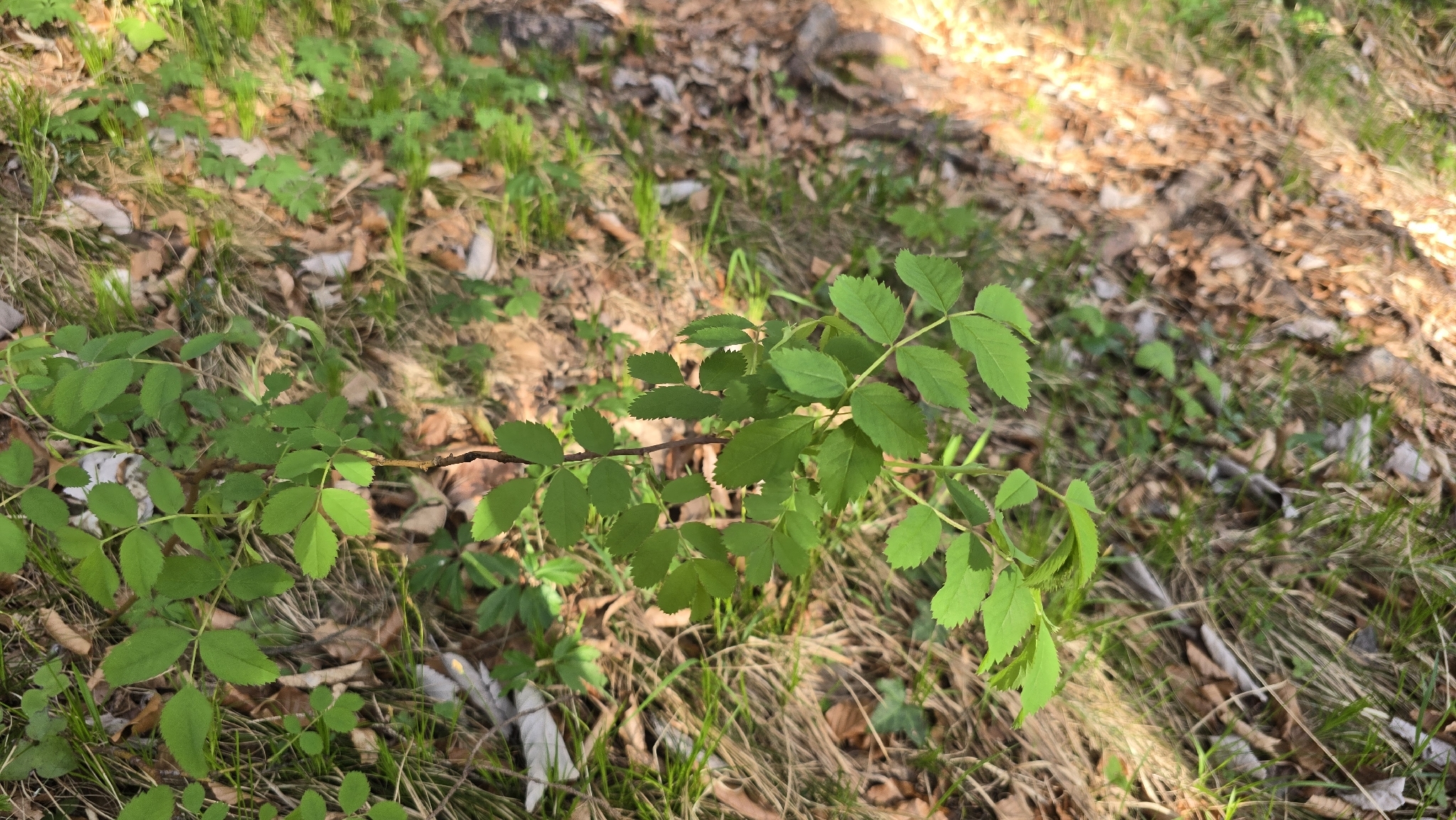
Alpine Rose is a deciduous wild rose native to the high-altitude mountains of central and southern Europe, including the Alps and Carpathians. Scientifically known as Rosa pendulina, it is distinguished from most other wild roses by its almost entirely thornless, purplish-brown stems.
This species is better suited to cooler, temperate gardens than many modern hybrids, as it naturally survives at elevations up to 2,500 m (8,200 ft). It produces single, deep pink flowers in early summer followed by distinctive, elongated red hips that hang downwards from the branches.
Key Facts
- Water: Keep soil consistently moist but never waterlogged
- Pruning: Minimal; prune only after flowering to preserve fruit
- Light: Prefers full sun but tolerates partial shade
- Height: Reaches 1-2 m (3.3-6.6 ft) at maturity
- Hardiness: Fully hardy down to USDA Zone 4
Fitting Alpine Rose into Your Garden
Alpine Rose fits best in informal, wildlife-focused, or woodland-edge gardens where its natural arching habit can be appreciated. Unlike modern hybrid tea roses, this species does not require a formal bed and is often used to stabilize slopes or fill gaps in native hedgerows. It is a reliable choice for gardeners in northern latitudes or high elevations where more delicate rose varieties fail to survive the winter.
Because the stems are largely thornless, it is safe to plant near pathways or seating areas where children and pets are present. It provides a more wild, rugged aesthetic compared to the structured look of floribunda roses. The plant is particularly useful for:
- Providing early summer nectar for bees and hoverflies
- Adding winter interest with its pendulous red fruit
- Creating low-maintenance borders in cooler climates
- Naturalizing in large, open landscapes
Identifying Rosa pendulina
You can identify Rosa pendulina by its smooth, purplish-brown stems that lack the dense prickles found on the common dog rose (Rosa canina). The shrub typically grows to a height of 1.5 m (5 ft), though it can reach 2 m (6.6 ft) in ideal conditions. Its leaves are composed of 7 to 11 serrated, oblong leaflets that are a dull green color, often turning shades of yellow or bronze in the autumn.
The flowers appear in June and July, measuring roughly 4-5 cm (1.5-2 in) across with five deep pink to magenta petals and a central cluster of yellow stamens. The most defining feature is the fruit, or hip, which is elongated and flask-shaped, reaching up to 2.5 cm (1 in) in length. These hips hang downwards (pendulous) as they ripen to a bright scarlet red, which is the source of the species name.
Choosing the Best Site
Alpine Rose requires a cool, well-drained site with consistent moisture to mimic its native mountain habitat. While it can tolerate full sun in northern regions, it often performs better in partial shade in warmer climates where the intense afternoon sun can scorch its foliage. High humidity is generally tolerated, but good air circulation is necessary to prevent fungal issues.
The soil should be rich in organic matter and slightly acidic to neutral, with a pH between 5.5 and 7.0. Avoid planting in heavy clay that remains waterlogged during the winter, as this can lead to root rot. If your garden soil is sandy, incorporate leaf mold or compost to help retain the moisture this species craves during the summer months.
How to Plant Alpine Rose
The best time to plant is in late autumn or early spring while the shrub is still dormant. If you are planting a bare-root specimen, soak the roots in a bucket of water for two hours before placing it in the ground. Dig a hole twice as wide as the root ball and deep enough so that the graft union (if present) or the base of the stems sits just below the soil surface.
Backfill the hole with a mix of native soil and garden compost, tamping down firmly to remove air pockets. Water the plant immediately after planting with at least 10 liters (2.6 gallons) of water to settle the soil. Space multiple plants at least 1.2 m (4 ft) apart to allow for their spreading, arching habit and to ensure adequate light reaches the lower branches.
Watering and Feeding
Water Alpine Rose once a week during the first growing season to ensure the root system establishes deeply. Once established, the plant is moderately drought-tolerant but will produce fewer flowers and hips if the soil dries out completely. During hot summer spells, increase watering frequency to twice a week, focusing the water at the base of the plant rather than on the leaves.
Apply a balanced organic fertilizer or a specific rose feed in early spring just as the new buds begin to swell. A second light feeding can be applied in mid-summer after the flowers have faded to support fruit development. Avoid high-nitrogen fertilizers in late autumn, as this can encourage soft new growth that will be damaged by the first frosts.
Pruning Rosa pendulina
Prune Alpine Rose only after the flowering period has finished in mid-summer to avoid removing the flower buds. Because this species flowers on the previous year’s wood, pruning in late winter or early spring will significantly reduce the number of blooms. For young plants, minimal pruning is required other than removing dead or broken stems.
For older, established shrubs, follow these maintenance steps:
- Remove one or two of the oldest, woodiest canes at ground level every three years to encourage rejuvenation.
- Cut back any stems that are crossing or rubbing against each other.
- Trim the tips of over-long branches to maintain a balanced shape.
- Always use sharp, sterilized bypass pruners to prevent the spread of disease.
Common Pests and Diseases
Alpine Rose is generally more resistant to common rose diseases than modern cultivars, but it can still be affected by black spot and rust. Black spot (Diplocarpon rosae) appears as dark circular lesions on the leaves, usually during wet summers. If you notice these symptoms, remove and destroy the affected foliage and avoid overhead watering to keep the leaves dry.
Aphids may congregate on the soft new growth in spring, but they rarely cause significant damage to an established Rosa pendulina. You can usually manage these by:
- Encouraging natural predators like ladybugs and lacewings.
- Blasting the insects off with a strong stream of water.
- Applying insecticidal soap if the infestation is severe.
- Monitoring for rose rust, which appears as orange pustules on the leaf undersides.
Flowers and Fruit
The flowering period for Alpine Rose is relatively short, typically lasting three to four weeks in early summer. The blooms are single-form, meaning they have only one row of petals, which makes the nectar and pollen easily accessible to pollinators. Unlike many garden roses, this species does not repeat-bloom; it puts all its energy into a single, heavy flush of flowers followed by fruit production.
The hips are the primary attraction in late summer and autumn, turning from green to a deep, glossy red. These fruits are exceptionally high in Vitamin C and have been traditionally used to make syrups, jellies, and teas. If you intend to harvest the hips, do so after the first frost, which helps to soften the flesh and sweeten the flavor, but remember to remove the irritating internal seeds before consumption.
Year-Round Care for Alpine Rose
| Spring | Apply a 5 cm (2 in) layer of organic mulch around the base. Feed with a balanced rose fertilizer as new leaves emerge. |
|---|---|
| Summer | Monitor soil moisture during heatwaves. Prune out old or crossing canes immediately after the flowers have dropped in July. |
| Autumn | Harvest ripe red hips for culinary use or leave them for birds. Clear away fallen leaves to prevent fungal spores from overwintering. |
| Winter | Check for wind rock after storms and firm the soil around the base. Do not prune during this time to protect dormant flower buds. |
Common Alpine Rose Problems Explained
| What you see | Likely cause | What to do |
|---|---|---|
| Yellow leaves with black spots | Black spot fungus | Remove infected leaves and improve air circulation around the shrub. |
| Few or no flowers in summer | Pruning at the wrong time | Only prune after flowering; spring pruning removes the buds for that year. |
| Wilting despite moist soil | Poor drainage/root rot | Relocate the plant to a site with better drainage or amend soil with grit. |
| Orange spots on leaf undersides | Rose rust | Prune out heavily affected branches and apply a copper-based fungicide. |
Popular Rosa pendulina Cultivars
- ‘Bourgogne’ – deep magenta flowers and particularly dark stems
- ‘Pilar’ – a more upright variety with large, showy hips
- ‘Maly’ – a compact form suitable for smaller garden spaces
- ‘Inermis’ – a selection with absolutely no thorns on any part of the plant
Companion Plants
Choose companion plants that thrive in the same cool, moist conditions as the Alpine Rose. Since this rose has a somewhat open, arching habit, it looks best when underplanted with perennials that can fill the space around its base. Avoid plants that require very dry soil or intense heat, as they will compete poorly with the rose’s needs.
Effective companions include:
- Wood cranesbill (Geranium sylvaticum), which shares its native European mountain range.
- Giant bellflower (Campanula latifolia) for contrasting blue or white spikes.
- Lady’s mantle (Alchemilla mollis), whose lime-green flowers complement the deep pink rose blooms.
- Ferns such as the male fern (Dryopteris filix-mas) for a woodland-edge aesthetic.
Frequently Asked Questions
Is Rosa pendulina completely thornless?
It is nearly thornless, with smooth purplish stems that usually lack prickles on the upper branches, though a few small thorns may appear near the base. This makes it much easier to handle than most other wild rose species.
Can you eat the fruit of the Alpine Rose?
Yes, the red hips are edible and traditionally used for jams and tea, but you must remove the irritating hairs and seeds from the center first. They are best harvested after the first frost when they have softened slightly.
How big does an Alpine Rose get?
It typically reaches a height of 1-2 m (3.3-6.6 ft) and a similar spread. Its arching branches give it a wide, bushy appearance that works well in naturalized hedges.
Does Alpine Rose need full sun?
While it flowers best in full sun, it is one of the few rose species that performs well in partial shade. In its native mountain habitat, it often grows on the edges of forests in dappled light.
Where can I buy Rosa pendulina?
You can typically find it at specialist native plant nurseries or rose growers that focus on wild and species roses. It is rarely sold in general big-box garden centers.
Information about traditional or historical uses is provided for educational interest only and is not medical advice. Do not use any plant to treat a condition without speaking to a qualified professional.
Sources & Verification
Taxonomy and distribution are checked against the databases below. Care guidance is written for cultivated species only and reviewed by our editor. How We Build Plant Profiles →


