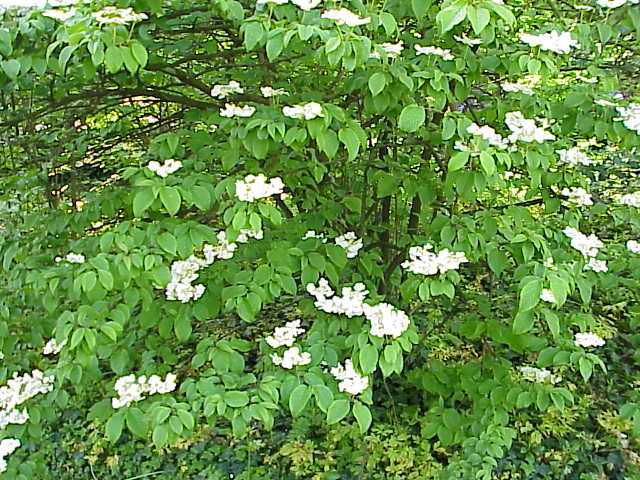
High-bush Cranberry is a deciduous shrub native to the boreal forests and wetlands of northern North America, known scientifically as Viburnum edule. It is distinguished by its tart, single-seeded red drupes and leaves that vary from unlobed to three-lobed on the same plant.
This species thrives in the subarctic conditions of Alaska and Canada, where it provides a critical food source for wildlife. Unlike many garden viburnums, it remains relatively compact and produces flowers in small, inconspicuous clusters rather than large showy heads.
Key Facts
- Height: reaches 0.5 to 2.5 m (1.6 to 8.2 ft)
- Berries: edible red drupes with high pectin content
- Hardiness: survives temperatures down to -45 °C (-50 °F)
- Leaves: opposite arrangement with 0-3 shallow lobes
- Habitat: moist forests, stream banks, and muskeg
How High-Bush Cranberry Fits in the Landscape
High-bush Cranberry is a dominant understory shrub in the boreal forests of North America, where it forms dense thickets in moist areas. It is slower growing than many other Viburnum species, often taking over a decade to reach its maximum height of 2.5 m (8 ft).
In a native garden or restoration project, it functions well as a moisture-loving transition plant between wooded areas and open water. It requires consistent ground moisture and does not tolerate the high heat of southern climates, making it strictly a choice for northern latitudes. Because it is highly shade-tolerant, it can be planted beneath larger canopy trees like the black spruce (Picea mariana).
Identifying Viburnum edule: Leaves, Bark, and Habit
You can identify High-bush Cranberry by its smooth, greyish-brown bark and its unique leaf morphology that features both lobed and unlobed shapes. The leaves are opposite, 5-10 cm (2-4 in) long, and typically have three shallow lobes at the tips of the branches, while lower leaves may be simple ovals.
The flowers appear in small, flat-topped clusters called cymes that measure only 1-3 cm (0.4-1.2 in) across. Unlike some related species, these clusters lack the ring of large, sterile outer flowers. In autumn, the foliage turns a deep shade of crimson or reddish-purple, providing a visual contrast against the bright red, translucent berries that persist into the winter months.
Viburnum edule Native Range and Habitat
The native range of Viburnum edule extends from Alaska and the Yukon all the way to Newfoundland, reaching south into the northern United States. It is particularly prevalent in the Pacific Northwest, the Great Lakes region, and New England, where it occupies cool, damp niches.
This shrub is most frequently found in nitrogen-rich soils near stream banks, lake margins, and the edges of swamps. It is a characteristic species of the muskeg—a North American peatland ecosystem—where it grows alongside Labrador tea (Rhododendron groenlandicum). It rarely occurs in dry or sandy upland soils, as its root system requires a high water table or frequent precipitation to survive the summer.
Ecological Role and Wildlife Value
High-bush Cranberry serves as a vital winter food source for various bird species, including the ruffed grouse (Bonasa umbellus) and pine grosbeak (Pinicola enucleator). The berries are high in energy but low in palatability during the summer, ensuring they remain available as an emergency food source throughout the coldest months.
Large mammals also rely on this shrub; moose (Alces alces) and white-tailed deer (Odocoileus virginianus) browse the young twigs and foliage during the spring. The small white flowers provide nectar for native bees and butterflies during their short northern blooming window. Because it forms thickets, it also provides essential nesting cover for small songbirds in riparian zones.
Conservation Status and Regional Threats
While Viburnum edule is globally ranked as Secure (G5), it is considered rare or endangered at the southern limits of its range. In states like Pennsylvania and Vermont, habitat loss and climate warming pose significant threats to the localized populations that depend on cold, boggy microclimates.
In its primary northern range, the species is abundant, though it can be impacted by the viburnum leaf beetle (Pyrrhalta viburni), an invasive pest. This beetle can defoliate entire stands, weakening the plants and reducing berry production. Monitoring for the characteristic skeletonized leaf damage in early summer is the primary way to track the spread of this pest in wild populations.
Traditional Uses and Edibility of Squashberry
The fruit of the High-bush Cranberry, often called a squashberry, contains a single large, flat stone and is traditionally harvested for food and medicine. The berries are extremely tart when they first turn red in August, but they become sweeter and more palatable after the first few hard frosts of autumn.
Indigenous peoples across North America have historically used the berries to make jams and jellies, often mixing them with oils or other sweeter fruits. The bark was traditionally prepared as a decoction to treat coughs and digestive discomfort. Because the berries are exceptionally high in pectin, they were a valued ingredient for thickening traditional preserves before the availability of commercial gelling agents.
Growing High-Bush Cranberry from Seeds
Propagating Viburnum edule from seed requires a lengthy double-dormancy period that can last up to two years. The seeds must first undergo a period of warm stratification to allow the embryo to mature, followed by a cold period to break physiological dormancy.
If you are collecting wild seeds, they should be cleaned of all pulp immediately, as the fruit contains germination inhibitors. Sowing them directly into a prepared outdoor seedbed in the autumn is the most reliable method, as it allows natural temperature fluctuations to manage the stratification process. Seedlings are slow to establish and should be protected from herbivores for the first three years of growth.
Distinguishing High-Bush Cranberry from Look-Alikes
High-bush Cranberry is most often confused with the American highbush cranberry (Viburnum trilobum), which is a much larger shrub reaching up to 4 m (13 ft). You can tell them apart by looking at the flower clusters; Viburnum trilobum has large, showy sterile flowers around the edge, whereas Viburnum edule does not.
Another common look-alike is the European cranberry bush (Viburnum opulus), which is an invasive species in many parts of North America. The European variety can be identified by the small, round glands on the leaf petioles, whereas the native squashberry has smaller, more inconspicuous glands or none at all. Other similar species include:
- Nannyberry (Viburnum lentago) – has finely serrated, unlobed leaves and blue-black fruit.
- Maple-leaf Viburnum (Viburnum acerifolium) – has deeply lobed leaves resembling maple trees and darker berries.
- Hobblebush (Viburnum lantanoides) – features much larger, heart-shaped leaves and reclining branches.
Frequently Asked Questions
Is Viburnum edule the same as the cranberry found in grocery stores?
No, true cranberries belong to the genus Vaccinium and grow on low-growing vines in bogs. High-bush Cranberry is a shrub in the Viburnum genus, and while its berries look and taste similar, it is not closely related to commercial cranberries.
Can you eat the berries of High-bush Cranberry raw?
Yes, the berries are edible raw, but they are intensely tart and contain a large, hard seed. Most people prefer to eat them after they have been sweetened by frost or cooked into jellies and syrups.
Where does Viburnum edule grow in Alaska?
In Alaska, it is found throughout the interior, southcentral, and southeast regions, typically in moist woods and along river floodplains. It is one of the most common wild berries gathered by Alaskans for home preserves.
What family does High-bush Cranberry belong to?
It belongs to the Viburnaceae family, which was formerly part of the Caprifoliaceae (Honeysuckle) family. This family includes other well-known shrubs like elderberry and various ornamental viburnums.
When do High-bush Cranberry flowers bloom?
The flowers typically bloom in late spring or early summer, usually between May and July depending on the latitude. The white or pinkish-white blossoms are small and form clusters at the ends of short lateral twigs.
Information about traditional or historical uses is provided for educational interest only and is not medical advice. Do not use any plant to treat a condition without speaking to a qualified professional.
Sources & Verification
Taxonomy and distribution are checked against the databases below. Care guidance is written for cultivated species only and reviewed by our editor. How We Build Plant Profiles →