
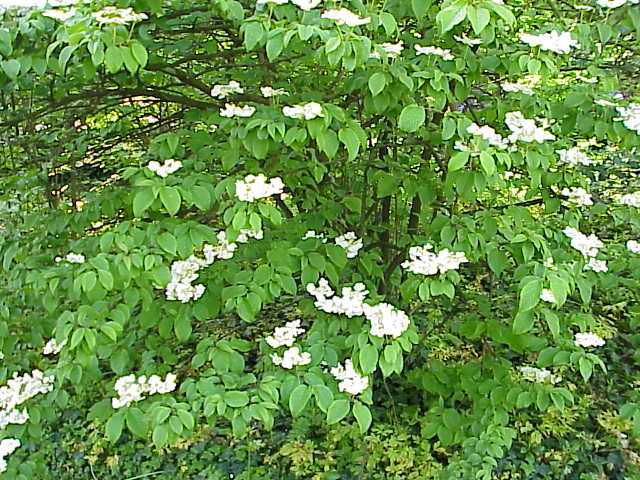
Japanese snowball (Viburnum plicatum) is a deciduous flowering shrub native to Japan, China, Korea, and Taiwan, known for its pleated foliage and white spring flower clusters.
Its horizontal branch structure requires 3–4 m (10–13 ft) of growing space, and pruning must occur immediately after blooming to avoid removing next year’s flower buds.
Key Facts
- Height: 2.5–4 m (8–13 ft)
- Hardiness: USDA zones 5 to 8
- Light: Full sun to partial shade
- Water: Moderate, 2.5 cm (1 in) weekly
- Soil: Moist, acidic to neutral, well-drained
- Pruning: Early summer after flowering
Growing Japanese Snowball in Your Garden
Japanese snowball is a multi-stemmed deciduous shrub that performs best as a focal lawn specimen, a mixed border accent, or an informal flowering screening hedge. Its distinct horizontal branching produces a layered, architectural habit in formal and cottage landscape layouts.
You should position this plant where its broad canopy has room to expand horizontally without crowding adjacent structures. It works effectively along garden paths or wood margins where morning light highlights the spring flower display.
What Does Japanese Snowball Look Like?
Japanese snowball reaches 2.5–4 m (8–13 ft) in height and spread with a broad, horizontally tiered branching habit. Leaves are arranged in opposite pairs along brownish stems, measuring 5–10 cm (2–4 in) long and 3–6 cm (1.2–2.4 in) wide.
The leaf blades feature prominent parallel veins that create a distinct pleated surface texture, turning reddish-purple in autumn. Flowers appear in two main forms:
- Sterile snowball form (f. plicatum): Dense, spherical white flower heads 5–10 cm (2–4 in) across containing only sterile florets.
- Lacecap form (f. tomentosum): Flat-topped cymes 7–12 cm (3–5 in) wide with large white sterile florets surrounding tiny fertile center flowers.
- Fruit: Small egg-shaped drupes measuring 8 mm (0.3 in) long that ripen from red to black on fertile forms.
Ideal Planting Site and Soil Conditions
Select a planting site in USDA hardiness zones 5 through 8 that receives 4 to 6 hours of direct sun daily. Full sun produces the dense flower displays, while partial shade protects foliage in regions where summer temperatures exceed 32 °C (90 °F).
Soil must be moist, organically rich, and well-drained with a pH between 5.5 and 7.0. Avoid wet clay sites that retain standing water during rainy periods, which triggers root decay.
Japanese Snowball Planting Instructions
Plant Japanese snowball in early spring or autumn by digging a hole twice as wide as the root ball and equal to its depth. Keep root crowns flush with the surrounding soil surface when backfilling.
Follow these planting steps for best establishment:
- Space individual plants 3–4 m (10–13 ft) apart to accommodate mature branch spread.
- Incorporate 5–10 liters (1.3–2.6 gal) of leaf mold or well-rotted compost into heavy soils.
- Water deeply with 15–20 liters (4–5 gal) immediately after planting.
- Apply a 5–7.5 cm (2–3 in) layer of shredded bark mulch around the base, keeping it 5 cm (2 in) away from the main stems.
How Often to Water and Fertilize Japanese Snowball
Provide 2.5 cm (1 in) of water per week during the first two growing seasons whenever rainfall drops below that amount. Established bushes require supplemental watering only during extended dry spells longer than two weeks.
Apply a balanced slow-release fertilizer with an N-P-K ratio of 10-10-10 in early spring just as new leaf buds open. Avoid high-nitrogen feeds, which encourage leaf growth at the expense of next season’s flower bud development.
How and When to Prune Japanese Snowball
Prune Japanese snowball immediately after flowering ends in June, as flower buds for the following year form during late summer. Winter or early spring pruning removes dormant flower buds and reduces blooming.
Maintain healthy structure using these steps:
- Cut back dead, damaged, or diseased branches to their point of origin.
- Remove 20% of the oldest stems down to ground level every 3 years to stimulate new basal growth.
- Trim back stray stems that disrupt the natural horizontal branch layering.
- Never shear into a rigid geometric shape, which ruins the natural tiering.
How to Propagate Japanese Snowball
Propagate Japanese snowball by taking 10–15 cm (4–6 in) softwood cuttings in early summer when new growth is firm but flexible. Rooting typically occurs within 4 to 6 weeks under warm, humid conditions.
Follow these propagation steps:
- Cut fresh stems early in the morning using sharp, sanitized pruners.
- Remove the lower leaves, leaving 2–4 top leaves intact.
- Dip the base in 0.1% IBA hormone powder.
- Insert into a moist mix of equal parts perlite and peat moss.
- Cover with a plastic dome and keep at 18–22 °C (65–72 °F) in indirect light.
Japanese Snowball Diseases and Pests
Viburnum leaf beetle (Pyrrhalta viburni) and powdery mildew are the primary health threats to this species. Larvae hatch in May and defoliate leaves down to the main veins if untreated.
Identify and treat issues with this checklist:
- Skeletal leaves: Viburnum leaf beetle larvae present; spray organic spinosad or horticultural oil on undersides of leaves.
- White film on leaves: Powdery mildew from high humidity; space plants to improve airflow and avoid overhead irrigation.
- Leaf spot: Fungal leaf spots in rainy springs; clear away fallen autumn foliage to reduce spore buildup.
Preparing Japanese Snowball Shrub for Winter
Japanese snowball requires minimal cold protection in USDA zones 5 through 8, enduring temperatures down to -29 °C (-20 °F). Mulching before ground freeze protects roots from winter upheaval.
Lay down a fresh 7.5 cm (3 in) layer of wood chips around the drip line in late October. Brush heavy, wet snow off lower horizontal branches during winter storms to prevent stem breakage.
Japanese Snowball Flower Characteristics
Japanese snowball flowers open in May and remain attractive for 2 to 3 weeks across early summer. Wild and lacecap forms produce dense outer rings of 5-petaled sterile florets measuring 2–3 cm (0.8–1.2 in) across.
Fertile central flowers attract native bees, hoverflies, and butterflies. Cultivars such as ‘Pink Beauty’ develop soft rose shades as the sterile florets age over several weeks.
Japanese Snowball Through the Seasons
| Spring | Apply a 2.5 cm (1 in) layer of organic compost around the drip line in April. Inspect stem tips for emerging viburnum leaf beetle larvae and treat with horticultural soap if found. |
|---|---|
| Summer | Prune immediately after May-June blooms finish to shape branches. Supply 2.5 cm (1 in) of water per week during high summer dry spells. |
| Autumn | Rake up and dispose of fallen leaves to eliminate fungal leaf spot spores. Apply a fresh 7.5 cm (3 in) layer of shredded wood mulch around the base in late October. |
| Winter | Gently sweep heavy snow off horizontal branches using a broom to avoid wood fracture. Avoid dormant structural pruning so spring flower buds are preserved. |
Japanese Snowball Health and Pest Troubleshooting
| What you see | Likely cause | What to do |
|---|---|---|
| Leaves eaten down to main veins | Viburnum leaf beetle larvae | Apply organic spinosad spray to foliage undersides in spring. |
| White powdery coating on foliage | Powdery mildew fungal infection | Improve air circulation and restrict watering to soil level. |
| Yellow leaves with dark green veins | Iron chlorosis from alkaline soil | Incorporate iron chelates or elemental sulfur to lower soil pH below 7.0. |
| Sparse flowers or no spring bloom | Pruning late in season or excessive shade | Prune only in early summer immediately after flowering and ensure at least 4 hours of sun. |
Popular Japanese Snowball Cultivars
- 'Mariesii' – lacecap flowerheads on distinct horizontal tiered branches
- 'Popcorn' – compact form with abundant small spherical bloom clusters
- 'Pink Beauty' – lacecap florets that turn soft pink as they mature
- 'Summer Snowflake' – narrow upright habit with repeat flowers through late summer
Companion Plants for Japanese Snowball
Pair Japanese snowball with acid-loving perennials and shrubs that thrive in partial shade and moist, well-drained soil. Underplanting with shade-tolerant perennials accentuates the shrub’s high horizontal canopy.
Effective companion choices include:
- Japanese maple (Acer palmatum) for contrasting foliage texture and autumn color.
- Oakleaf hydrangea (Hydrangea quercifolia) to extend summer blooming into autumn.
- Mountain laurel (Kalmia latifolia) for broadleaf evergreen structure.
- Plantain lily (Hosta plantaginea) to cover soil around the root zone.
Frequently Asked Questions
How do you prune a Japanese snowball?
Prune Japanese snowball immediately after flowers fade in early summer. Cut old stems back to strong side shoots and remove dead or rubbing wood to preserve its natural horizontal layering.
What is the difference between Japanese snowball and Japanese snowbell?
Japanese snowball (Viburnum plicatum) is a multi-stemmed shrub with pleated leaves and flat or rounded white flower clusters, while Japanese snowbell (Styrax japonicus) is a small tree with smooth leaves and individual hanging bell-shaped flowers.
How big does a Japanese snowball viburnum get?
A mature Japanese snowball reaches 2.5–4 m (8–13 ft) in height and spreads 2.5–4 m (8–13 ft) wide.
Why are birds attracted to Japanese snowball?
Songbirds eat the small dark red-to-black drupes produced in late summer by fertile lacecap forms (Viburnum plicatum f. tomentosum).
How do you propagate a Japanese snowball bush?
Propagate Japanese snowball by taking 10–15 cm (4–6 in) softwood cuttings in early summer, dipping the ends in rooting hormone, and keeping them in moist potting mix under high humidity.
Sources & Verification
Taxonomy and distribution are checked against the databases below. Care guidance is written for cultivated species only and reviewed by our editor. How We Build Plant Profiles →
- Royal Horticultural Society (RHS)rhs.org.uk
- Missouri Botanical Gardenmissouribotanicalgarden.org
- NC State University Extensionplants.ces.ncsu.edu
- USDA PLANTS Databaseplants.usda.gov
- GBIF — Global Biodiversity Information Facilitytaxonomy, synonyms, occurrence records
- Plants of the World Online (Kew)accepted name, native range
- Wikipediageneral reference


