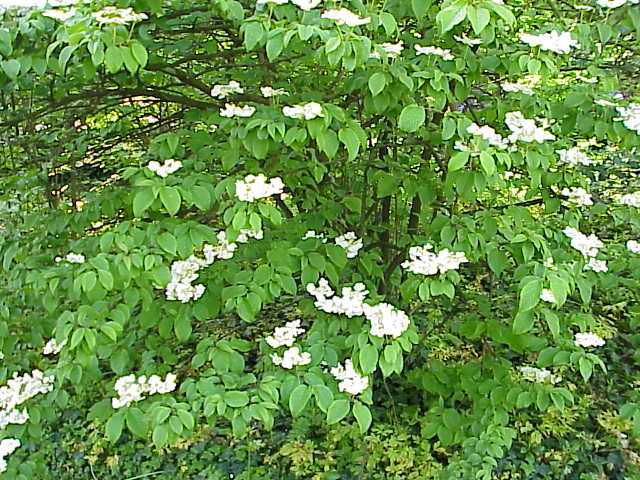
Wayfaring tree (Viburnum lantana) is a thicket-forming deciduous shrub native to Europe, northwest Africa, and southwest Asia, distinguished by downy gray-green leaves and flattened heads of creamy white flowers. In late summer, its berry clusters show a mix of coral red and glossy black drupes simultaneously.
This shrub establishes reliably on dry, chalky limestone slopes where other ornamental viburnums struggle with drought. Its raw berries can cause mild stomach upset if eaten in quantity, but birds strip them clean by mid-autumn.
Key Facts
- Hardiness: USDA zones 4 to 8
- Height: 3–5 m (10–16 ft)
- Soil: dry to moist, highly tolerant of chalk and limestone
- Light: full sun to partial shade
- Pruning: immediate post-flowering trim in early summer
- Toxicity: raw berries cause mild nausea if ingested
Growing Wayfaring Tree: Pros and Cons
The wayfaring tree suits exposed garden boundaries and alkaline hedgerows that demand wind resistance and drought tolerance. It tolerates thin, chalk-rich topsoil where moisture-loving shrubs wither during midsummer heatwaves.
You should weigh its practical benefits against a few maintenance realities before planting:
- Drought and lime tolerance: roots penetrate hard chalk and thrive in soils up to pH 8.5.
- Wildlife value: flowers feed solitary bees and hoverflies, while songbirds eat late summer fruit.
- Suckering habit: older specimens spread outward by basal shoots, which can crowd tight borders.
- Mild berry toxicity: unripened and raw berries cause nausea in young children and pets if ingested.
- Coarse foliage: large, hairy leaves gather dust in urban settings and lack bright summer gloss.
For rural windbreaks or unwatered boundary banks, its tough constitution makes it an easy long-term investment.
How to Identify Viburnum lantana
You can identify the wayfaring tree by its thick, wrinkly, oval leaves covered underneath in star-shaped gray hairs. The entire young branch structure and winter buds lack protective bud scales, giving them a dusty, powdery feel that earned the shrub its folk name “mealytree”.
Key botanical markers appear across the seasons:
- Foliage: opposite, ovate leaves measuring 6–13 cm (2.4–5.1 in) long with finely serrated margins and heart-shaped bases.
- Flowers: dense, flattened cymes 5–10 cm (2–4 in) across containing dozens of small, creamy-white five-petaled florets in May and June.
- Fruit: flattened oblong drupes 8 mm (0.3 in) long that turn from yellow-green to coral red before ripening into ink black.
- Winter twigs: pale brown, flexible stems with naked, velvety flower buds held openly at branch tips throughout winter.
These naked buds separate it from wild guelder rose (Viburnum opulus), which bears smooth red twigs, lobed maple-like leaves, and distinct scales enclosing its winter buds.
Mature Size and Growth Rate
A settled wayfaring tree reaches 3 to 5 m (10 to 16 ft) in height with a spreading crown spanning 2.5 to 4 m (8 to 13 ft). In garden settings, annual upward growth averages 30 to 45 cm (12 to 18 in) during its first five seasons.
The plant naturally assumes a multi-stemmed, vase-shaped habit before arching outwards with age. In exposed chalk scrub, wind pruning frequently pins specimens to roughly 2.5 m (8 ft), turning them into dense windbreaks. Left unpruned on deep soils, it matches hazel (Corylus avellana) in overall canopy bulk.
Sun and Soil Requirements
Plant this shrub in full sun to partial shade in free-draining soil. While it tolerates light woodland shade, flowering diminishes and berry production drops sharply if it receives fewer than four hours of direct daily sunlight.
Soil selection requires attention to drainage rather than fertility:
- pH range: thrives between 6.1 and 8.5, showing superior vigor on calcicolous, chalky substrates.
- Drainage: demands good percolation; standing winter water will cause root suffocation.
- Texture: handles stiff clays provided slopes allow runoff, as well as dry, stony gravels.
Avoid planting in waterlogged hollows alongside willows (Salix species) or red osier dogwood (Cornus sericea), which enjoy swampy ground that kills wayfaring viburnum roots.
How to Plant a Wayfaring Tree
The best planting window runs from November through March for bare-root stock, while container-grown plants can go into the ground at any point from autumn to mid-spring. Dig a planting hole twice the width of the root system but matching its exact depth so the root flare sits level with the surrounding turf.
Follow these steps to establish bare-root or potted shrubs:
- Step 1: soak bare roots in water for two hours prior to positioning.
- Step 2: loosen the sides of the hole with a garden fork to let lateral roots break through compacted soil.
- Step 3: backfill with the excavated native soil without rich compost amendments to encourage deep outward root exploration.
- Step 4: firm the ground with your heel to eliminate air pockets around the root network.
- Step 5: apply a 7 cm (3 in) layer of wood chips or crushed bark, keeping the mulch 10 cm (4 in) clear of the stems.
Space shrubs 1.2 to 1.5 m (4 to 5 ft) apart if installing a dense hedgerow, or 3 m (10 ft) apart for standalone specimen plantings.
Watering and Feeding Care
Provide 15 to 20 liters of water weekly during the first growing season whenever natural rainfall drops below 2.5 cm (1 in). Once the root system penetrates the subsoil after two years, established shrubs survive extended droughts without supplementary garden irrigation.
Fertilizer is rarely necessary for this calciphile shrub:
- First-year watering: water thoroughly every 7–10 days from April to August during dry spells.
- Feeding: an annual top-dressing of garden compost in March supplies adequate nitrogen; avoid high-nitrogen chemical granules.
- Excess fertilizer risk: heavy feeding stimulates soft, sappy shoots that attract viburnum beetle larvae and weaken wind resistance.
On shallow limestone or poor chalk soils, an annual spring mulch preserves essential moisture without forcing unnatural growth surges.
How to Prune Wayfaring Tree
Prune wayfaring tree immediately after flowering in June so you avoid removing next year’s embryonic flower buds. Because the plant forms flower buds on wood produced during the current summer, late winter shearing eliminates the spring bloom display.
Apply these targeted cuts based on the shrub’s age:
- Annual maintenance: remove dead, crossing, or chafing branches down to clean wood.
- Hedgerow trimming: clip current-season shoots back by half using shears in midsummer to tighten the screen.
- Coppicing and renewal: cut one-third of the oldest thick stems down to 15 cm (6 in) from the base in late winter.
- Sucker management: remove stray basal shoots at soil level if a tidy, compact footprint is preferred.
Hard renewal pruning triggers vigorous basal sprouting that restores dense cover within two growing seasons.
Wayfaring Tree Pests and Diseases
The most damaging pest is the viburnum leaf beetle (Pyrrhalta viburni), whose larvae chew foliage down to lace-like skeletons between May and July. Adult beetles emerge in late summer to feed again and deposit winter eggs into deep pits along young stems.
Watch for these typical symptoms and their direct treatments:
- Skeletonized leaves: inspect undersides in May for creamy-green larvae; remove heavily infested shoots or wash with insecticidal soap.
- Powdery mildew: grayish-white fungal dust coats foliage in humid, stagnant late summers; prune interior branches to boost airflow.
- Aphid colonies: black bean aphids distort growing shoot tips in spring; blast stems with a sharp hose jet.
- Stem dieback: fungal cankers cause sudden browning of solitary branches; cut affected wood back to healthy, green-ringed tissue.
Birds, ground beetles, and parasitic wasps keep most infestations under control in biodiverse hedgerow environments.
Winter Hardiness and Cold Care
Wayfaring tree withstands winter temperatures down to -30 °C (-22 °F) without branch damage, making it fully cold-hardy across USDA zones 4 through 8. The shrub produces no scale leaves over its embryonic flower clusters; instead, dense starry hairs protect dormant buds against drying winter gales and frost.
No wraps or protective fleece are needed even in sub-zero continental winters. Heavy snow can splay open multi-stemmed mature crowns, so shake heavy slush off low branches after major blizzards. In rodent-heavy countryside, fit spiral tree guards around young stems from November to March to stop winter-starved rabbits from gnawing the bark.
Wildlife Value and Landscape Uses
Wayfaring tree anchors native field hedgerows, highway banks, and soil-stabilization projects across calcareous landscapes. Its fibrous, widespread root network grips rocky slopes, reducing erosion along cuttings and chalk cliffs.
Its ecological interactions benefit a broad spectrum of native fauna:
- Pollinators: wide flower umbels provide nectar for hoverflies, bumblebees, and beetles like the spotted longhorn beetle (Rutpela maculata).
- Caterpillar host: leaves feed larvae of the olive pug moth (Pasiphila chloerata).
- Bird forage: bullfinches, thrushes, and blackcaps harvest ripening drupes throughout September and October.
- Shelter: stiff, dense twig clusters supply nesting sites for yellowhammers and common whitethroats.
Garden designers frequently combine it with field maple (Acer campestre), hawthorn (Crataegus monogyna), and blackthorn (Prunus spinosa) to build boundary hedges that deter livestock and shelter wildlife.
Frequently Asked Questions
Are wayfaring tree berries edible?
No, raw wayfaring tree berries are mildly toxic and should not be eaten. Ingesting raw fruit can cause nausea, vomiting, stomach cramps, and severe diarrhea due to irritating glycosides.
What is the difference between wayfaring tree and guelder rose?
Wayfaring tree (Viburnum lantana) has unlobed, oval, wrinkly leaves covered in gray down and berries that turn red before ripening black. Guelder rose (Viburnum opulus) features three-lobed, maple-like leaves with smooth surfaces and stays glossy translucent red when fully ripe.
Is the wayfaring tree native to the UK?
Yes, wayfaring tree is native to southern and central England, where it is a classic feature of chalk scrub, hedgerows, and downland borders. It is absent or rare as a native plant in Scotland and Ireland, where plantings represent naturalized garden introductions.
Is wayfaring tree invasive in North America?
Yes, wayfaring tree has escaped cultivation and is considered invasive or a plant of concern in several northern US states, including Wisconsin, Minnesota, and parts of New England. Its seeds spread into oak savannas and forest edges via bird droppings, crowding out native understory shrubs like arrowwood (Viburnum dentatum).
What is the folklore behind the name wayfaring tree?
Sixteenth-century herbalist John Gerard coined the name "wayfaring tree" because he observed it growing along roadsides and tracks connecting towns, suggesting it kept travelers company on their journeys. Historically, its straight, pliant shoots were used to bind bundles of wood and weave baskets.
Information about traditional or historical uses is provided for educational interest only and is not medical advice. Do not use any plant to treat a condition without speaking to a qualified professional.
Sources & Verification
Taxonomy and distribution are checked against the databases below. Care guidance is written for cultivated species only and reviewed by our editor. How We Build Plant Profiles →
- Kew Plants of the World OnlineTaxonomy, distribution, and native status.
- Royal Horticultural SocietyCultivation profile and hardiness ratings.
- Missouri Botanical GardenMorphology and landscape culture.
- Wisconsin Department of Natural ResourcesInvasive status and identification notes in North America.
- GBIF — Global Biodiversity Information Facilitytaxonomy, synonyms, occurrence records
- Wikipediageneral reference