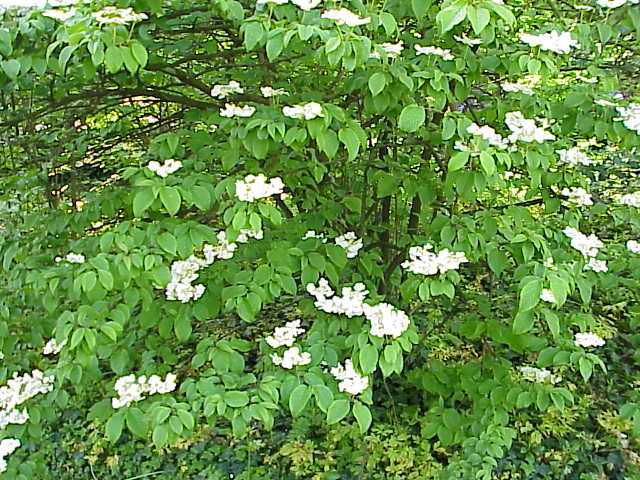
Laurustinus (Viburnum tinus) is a dense, broadleaf evergreen shrub native to the Mediterranean basin and North Africa, marked by pink buds that open into white flower clusters throughout winter.
It establishes reliably in heavy clay, withstands maritime wind, and forms dense boundary screens where cold winds strip the foliage from tender evergreens.
Key Facts
- Growth habit: Dense evergreen shrub, 2-4 m (6.5-13 ft) tall
- Bloom window: October through April during mild spells
- Light needs: Full sun to deep partial shade
- Hardiness: USDA Zones 7-10 (down to -12 °C / 10 °F)
- Soil tolerance: Chalk, loam, sand, and heavy clay
Living with Laurustinus: Hedging and Garden Fit
Laurustinus suits boundary screens, urban gardens, and coastal plots where you need year-round screening of 2 to 3 m (6.5 to 10 ft) without relentless pruning. It fills out naturally with a dense network of branches from ground level, which dampens street noise and provides shelter for nesting songbirds.
Its annual growth rate hovers around 30-40 cm (12-16 in), meaning it does not get out of hand like cherry laurel (Prunus laurocerasus). The root system stays fibrous and well-mannered, making it safe to plant alongside footpaths, brick walls, and patio foundations.
- Urban tolerance: Handles car exhaust and particulate pollution without leaf drop.
- Coastal durability: Endures salty sea breezes without scorching.
- Garden roles: Clipped formal hedges, informal boundary lines, or large container topiary.
Laurustinus Identification: Foliage, Flowers, and Berries
You can identify Viburnum tinus by its dark green, leathery leaves with tiny hair tufts in the vein angles underneath, paired with pink buds and metallic blue fruit. The branching is opposite, creating a tight, structured outline even when left unclipped.
The leaves measure 5-10 cm (2-4 in) in length and 2-4 cm (0.8-1.6 in) across, featuring smooth, untoothed margins and a shiny upper face. If you turn a mature leaf over with a hand lens, you will find tiny brown domatia (hairy pockets) where secondary veins join the midrib.
- Buds and blooms: Clustered terminal corymbs 5-10 cm (2-4 in) wide; deep carmine-pink buds opening into star-shaped white flowers.
- Flower size: Individual florets measure 6-9 mm (0.2-0.35 in) across with five rounded petals.
- Fruit: Ovoid drupes 6-8 mm (0.25-0.3 in) long that turn from light turquoise to metallic cobalt-blue, ripening black by late summer.
- Bark: Reddish-brown and smooth on younger stems, turning dark grey and lightly fissured with age.
Where to Plant Laurustinus for Best Growth
Laurustinus thrives in full sun to partial shade in moist, well-drained soil, though it also tolerates dry shade beneath mature deciduous trees once its roots establish. Full sun yields the thickest foliage and the highest number of flower heads, while deep shade produces a more open, airy branch structure.
It handles a wide soil pH range between 6.0 and 8.0, performing well in alkaline chalk as well as sticky neutral clays. Avoid low-lying frost pockets where freezing air pools for weeks, as sustained temperatures below -12 °C (10 °F) can kill unhardened terminal shoots.
How to Plant a Laurustinus Hedge or Specimen
For an informal or formal hedge, space individual plants 60 to 90 cm (2 to 3 ft) apart along your planting trench. Single specimen shrubs need at least 2 m (6.5 ft) of clearance from adjacent borders to develop their natural domed silhouette without crowding.
Autumn is the best planting window because warm soil encourages root expansion before winter flowering begins. Spring planting also works well if you provide supplemental water through the following summer.
- Dig the planting hole twice as wide as the nursery container and exactly the same depth.
- Loosen the sides of the hole with a garden fork to let roots penetrate native soil.
- Firm the soil gently around the root ball to remove air pockets without compacting it.
- Apply a 5-8 cm (2-3 in) layer of wood chip mulch, keeping it 10 cm (4 in) clear of the main trunk.
Watering Schedule and Fertilizer Needs
Give new shrubs 15 to 20 litres (4 to 5 gallons) of water weekly during their first dry season to anchor their roots into surrounding subsoil. Once established after two full growing seasons, Laurustinus handles dry summer spells without routine irrigation.
Fertilizer requirements are modest. Over-feeding causes rapid, soft sap growth that attracts sap-sucking pests like thrips and leaves the plant susceptible to winter frost bite.
- First two years: Water thoroughly whenever the top 5 cm (2 in) of soil feels dry.
- Established plants: Irrigate only during prolonged heatwaves exceeding three rainless weeks.
- Feeding: Scatter a handful of balanced organic fertilizer (such as 7-7-7) around the root perimeter each April.
- Soil conditioning: Top-dress annually with garden compost to retain moisture in sandy soils.
How to Prune Laurustinus
Prune Laurustinus in mid-to-late spring immediately after blooming finishes, which preserves the flower buds developing for the following winter. Cutting back late in summer or autumn strips away the upcoming winter floral display.
For hedge maintenance, use hand shears or bypass secateurs rather than high-speed electric trimmers. Powered blades slice through the broad evergreen leaves, leaving ragged brown edges that spoil the appearance of the hedge for several months.
- Light shaping: Trim wayward stems back to a healthy leaf node or lateral bud in May.
- Hedge trimming: Cut back new growth by half to maintain a dense outer perimeter.
- Hard renovation: Cut overgrown, leggy shrubs back to 40-50 cm (16-20 in) from the base in late April; they regenerate vigorously from dormant wood.
Laurustinus Flowering Habits and Pollinators
Flower buds develop as early as late July and stay unopened on the branch tips for up to three months before unfurling in November. In regions with mild winters, the shrub blooms in continuous waves from November through April.
Because it blooms when few other garden shrubs are active, Laurustinus is a valuable nectar station for winter-active bumblebees (Bombus terrestris) and late hoverflies during sunny winter spells. The flat-topped flower clusters allow easy landing for small beneficial predatory insects.
How to Propagate Laurustinus
Propagate Laurustinus by taking semi-ripe stem cuttings of 8 to 12 cm (3 to 5 in) during late summer from non-flowering current-season wood. Softwood cuttings taken in late spring also root well but rot faster if humidity levels spike.
Select firm stems that are green at the tip but brownish and firm at the base. Make your cut directly below a leaf node with a clean, sharp razor or knife.
- Strip off the lower pairs of leaves, leaving two to three mature leaves at the top.
- Dip the cut base into a rooting hormone powder containing IBA (indole-3-butyric acid).
- Insert cuttings into a pot filled with equal parts coarse perlite and peat-free seed compost.
- Place under indirect light with a bottom-heat mat set to 18-20 °C (64-68 °F).
- Rooting takes 6 to 8 weeks; pot up individually into 9 cm (3.5 in) pots the following spring.
Winter Hardiness and Cold Protection
Laurustinus easily endures winter low temperatures down to -12 °C (10 °F), corresponding to USDA Zone 8, while sheltered sites survive brief dips to Zone 7. Freezing easterly winds combined with frozen ground cause winter leaf desiccation, turning upper leaf margins bronze or black.
If severe sub-zero weather threatens for more than four or five days, wrap free-standing or exposed shrubs in horticultural fleece. Shrubs grown in large outdoor planters need the root ball insulated with bubble wrap or hessian, as container compost freezes through much faster than open garden soil.
Companion Plants for Viburnum tinus
Combine Laurustinus with plants that offer contrasting seasonal interest and bright winter foliage to highlight its dark, leathery background. Because it stays green year-round, it acts as an anchor behind low-growing flowering perennials.
It pairs effectively with shade-tolerant groundcovers under its drip line, as well as deciduous winter-interest shrubs that display bare, colourful wood.
- Red-osier dogwood (Cornus sericea): Bright coral-red winter stems stand out against dark Laurustinus leaves.
- Lenten rose (Helleborus orientalis): Enjoys the dappled shade underneath and blooms at the exact same winter moment.
- Sweet box (Sarcococca confusa): Offers glossy evergreen foliage and winter fragrance closer to garden paths.
- Japanese maple (Acer palmatum): Provides delicate, lacy summer foliage contrast against the broad, heavy leaves of the viburnum.
Frequently Asked Questions
Is Laurustinus poisonous to dogs?
Laurustinus is mildly toxic to dogs if consumed in large quantities, but it is not considered deadly. Ingesting berries or foliage typically causes temporary stomach irritation, vomiting, and loose stools.
Is Laurustinus evergreen?
Yes, Laurustinus is a broadleaf evergreen shrub that holds its leathery dark green leaves through all four seasons without dropping them in winter.
Is Laurustinus deer resistant?
Laurustinus is moderately deer resistant due to its tough, fibrous leaves. Hungry deer may nibble soft young shoots in early spring, but they usually bypass established foliage.
Can Laurustinus grow as a small tree?
Yes, you can train Laurustinus into a multi-stemmed or single-stemmed small tree up to 3.5 m (11.5 ft) tall by pruning away the lower lateral branches to expose bare trunks.
Is Laurustinus considered invasive?
Laurustinus is not listed as invasive in most temperate regions, although it naturalises in parts of coastal California and southern Australia where birds spread the seeds into moist woodland.
Sources & Verification
Taxonomy and distribution are checked against the databases below. Care guidance is written for cultivated species only and reviewed by our editor. How We Build Plant Profiles →
- Royal Horticultural Society (RHS)Cultivar information and cultivation requirements.
- Kew Plants of the World Online (POWO)Native distribution and botanical taxonomy.
- Missouri Botanical GardenHardiness, habit, and landscape uses.
- GBIF — Global Biodiversity Information Facilitytaxonomy, synonyms, occurrence records
- Wikipediageneral reference