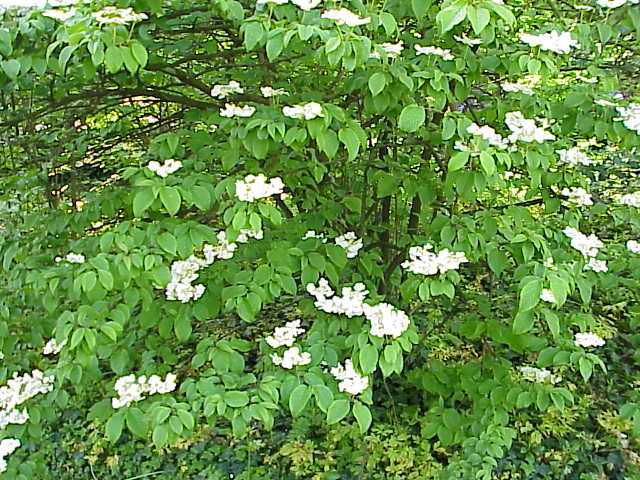
Nannyberry (Viburnum lentago) is a deciduous shrub or small tree native to northeastern and central North America. It grows naturally along stream banks, damp thickets, and forest edges from Quebec to Georgia and west to Colorado.
Planting requires full sun to partial shade and moist, well-drained soil to establish deep root systems. Mature specimens yield dark blue-black fruit clusters that turn sweet after winter frosts.
Key Facts
- Height: 4.5–6 m (15–20 ft) at maturity
- Hardiness: USDA zones 3 to 7
- Light: Full sun to partial shade
- Fruit: Edible blue-black drupes ripe in autumn
- Soil pH: 6.0 to 7.5 moist clay or loam
Fitting Nannyberry into Your Landscape
Nannyberry grows best as a multi-stemmed screening shrub or native garden specimen in cold-temperate climates. It forms dense hedges that block wind and provide privacy across USDA hardiness zones 3 through 7.
It suits naturalized borders, woodland edges, and rain garden margins where soil moisture remains consistent throughout spring and summer. High heat in USDA zones 8 and higher causes leaf scorching and stunted twig growth.
Identifying Nannyberry Viburnum
Nannyberry features ovate, finely serrated leaves measuring 5–10 cm (2–4 in) long with winged petioles attached opposite each other along gray-brown twigs. Spring blooms open in flat-topped cymes spanning 8–12 cm (3–5 in) across with small, creamy-white five-petaled flowers.
In September, hanging fruit clusters change from green to pinkish-red, then mature into dark blue-black drupes measuring 1–1.5 cm (0.4–0.6 in) long covered in a waxy bloom. The bark on older stems breaks into small, rectangular scaly plates similar to black haw (Viburnum prunifolium). Fall foliage shifts from deep green to reddish-purple.
Nannyberry Size and Growth Habit
A mature nannyberry reaches a height of 4.5–6 m (15–20 ft) and a spread of 1.8–3 m (6–10 ft). It develops an upright, vase-shaped habit that can be trained into a single-trunk small tree or left as a multi-stemmed thicket.
Annual branch growth averages 30–45 cm (12–18 in) under consistent soil moisture. Root suckers sprout regularly around the base, expanding the crown diameter if not removed annually.
Best Soil and Light Conditions for Nannyberry
Nannyberry thrives in full sun to partial shade with 4 to 8 hours of direct light daily. Plants in full sun produce higher flower density and thicker fruit yields than specimens grown under heavy forest canopy shade.
Soil requirements focus on moisture retention and drainage across a pH range of 6.0 to 7.5:
- Loam, clay loam, or silt soil rich in organic matter
- Soil depth of at least 45 cm (18 in) for taproot anchorage
- Tolerance for brief spring flooding near stream banks
How to Plant Nannyberry
Plant nannyberry shrubs in early spring before leaf break or in autumn six weeks before the ground freezes. Proper spacing depends on the intended landscape layout:
- Space plants 1.5–2 m (5–6.5 ft) apart for a continuous hedge
- Space plants 3.5–4.5 m (11.5–15 ft) apart for standalone specimen trees
- Dig a planting hole twice as wide as the root ball and equal in depth
- Backfill with native soil mixed with 25 percent compost
- Water with 20 liters (5 gallons) of water immediately after planting
Nannyberry Viburnum Care and Maintenance
Young plants require 2.5 cm (1 in) of water per week during the first two growing seasons. Established root systems withstand short summer dry spells but drop lower leaves if dry conditions persist longer than three weeks.
Apply a 5–7 cm (2–3 in) layer of wood chip mulch around the base to retain moisture and suppress weeds. Spread a single application of balanced 10-10-10 granular fertilizer in early April at a rate of 50 grams per square meter (1.5 oz per sq yd).
How to Prune Nannyberry Viburnum
Prune nannyberry in late spring immediately after flowers fade because flower buds form on previous year’s wood during late summer. Pruning in late winter or early spring removes the upcoming bloom crop.
Follow these steps to prune and control growth:
- Cut out dead, diseased, or rubbing branches at their base
- Remove up to one-third of the oldest stems every three years to stimulate young shoots
- Prune suckers arising from the roots annually if a single-trunk tree form is preferred
- Trim back overgrown branch tips by 15–20 cm (6–8 in) just above an outward-facing bud
Nannyberry Problems and Pests
Viburnum leaf beetle (Pyrrhalta viburni) poses the primary threat to nannyberry foliage by defoliating branches in late spring and mid-summer. Mildew fungi affect leaves during warm, humid weather when air circulation is limited.
- Viburnum leaf beetle: Larvae eat leaf tissue between veins in May; prune infested twig tips containing overwintering eggs in March.
- Powdery mildew: White powdery coating on upper leaf surfaces in August; thin interior branches to increase airflow.
- Leaf spot fungi: Brown dots appear after rainy spring periods; sweep and burn fallen leaves in autumn.
Winter Care and Cold Hardiness
Nannyberry survives winter temperatures down to -40 °C (-40 °F) without supplemental stem protection in USDA zone 3. Heavy snowpacks rarely break its flexible gray branches.
Protect young trunks from winter rodent gnawing by wrapping the bottom 45 cm (18 in) of the stem with hardware cloth in October. Clear fallen foliage from the drip line before snow falls to eliminate overwintering fungal spores.
Nannyberry Fruit and Wildlife Uses
Nannyberry fruit becomes sweet and soft after the first light autumn frost in October. Native Americans traditionally harvested the ripe drupes fresh or dried them into fruit leather for winter storage.
The dark berries contain a single flat seed and possess a flavor resembling dates or raisins. Birds such as cedar waxwings, ruffed grouse, and robins eat the persistent berries through winter until March.
Frequently Asked Questions
Can you eat nannyberry fruit?
Yes, nannyberry fruit is non-toxic and edible fresh from the bush or cooked into jams, sauces, and fruit leathers. The dark drupes taste sweeter after experiencing a light frost in autumn.
Is nannyberry a tree or a shrub?
Nannyberry (Viburnum lentago) grows naturally as a multi-stemmed large shrub, but can be pruned into a single-trunk small tree reaching 4.5–6 m (15–20 ft) in height.
How do you propagate nannyberry?
Propagate nannyberry by taking 10–15 cm (4–6 in) softwood cuttings in early summer, dipping them in rooting hormone, and placing them in moist sand under humidity. Seed propagation requires 3 months of warm stratification followed by 3 months of cold stratification before germinating in spring.
How fast does nannyberry grow?
Nannyberry grows at a moderate rate of 30–45 cm (12–18 in) per year when supplied with moist soil and full sun.
What is the difference between nannyberry and black haw?
Nannyberry (Viburnum lentago) leaves have distinctly winged petioles and longer pointed tips, whereas black haw (Viburnum prunifolium) leaves have unwinged petioles with shorter, rounded tips.
How do you eat nannyberry fruit?
Eat nannyberry fruit raw directly off the stem once blue-black and soft, or cook the berries into butter, pies, and jams after straining out the single central flat seed.
Sources & Verification
Taxonomy and distribution are checked against the databases below. Care guidance is written for cultivated species only and reviewed by our editor. How We Build Plant Profiles →
- Kew Plants of the World Onlinepowo.science.kew.org
- Missouri Botanical Garden Plant Findermissouribotanicalgarden.org
- NC State Extension Gardener Plant Toolboxplants.ces.ncsu.edu
- USDA PLANTS Databaseplants.usda.gov
- GBIF — Global Biodiversity Information Facilitytaxonomy, synonyms, occurrence records
- Wikipediageneral reference