
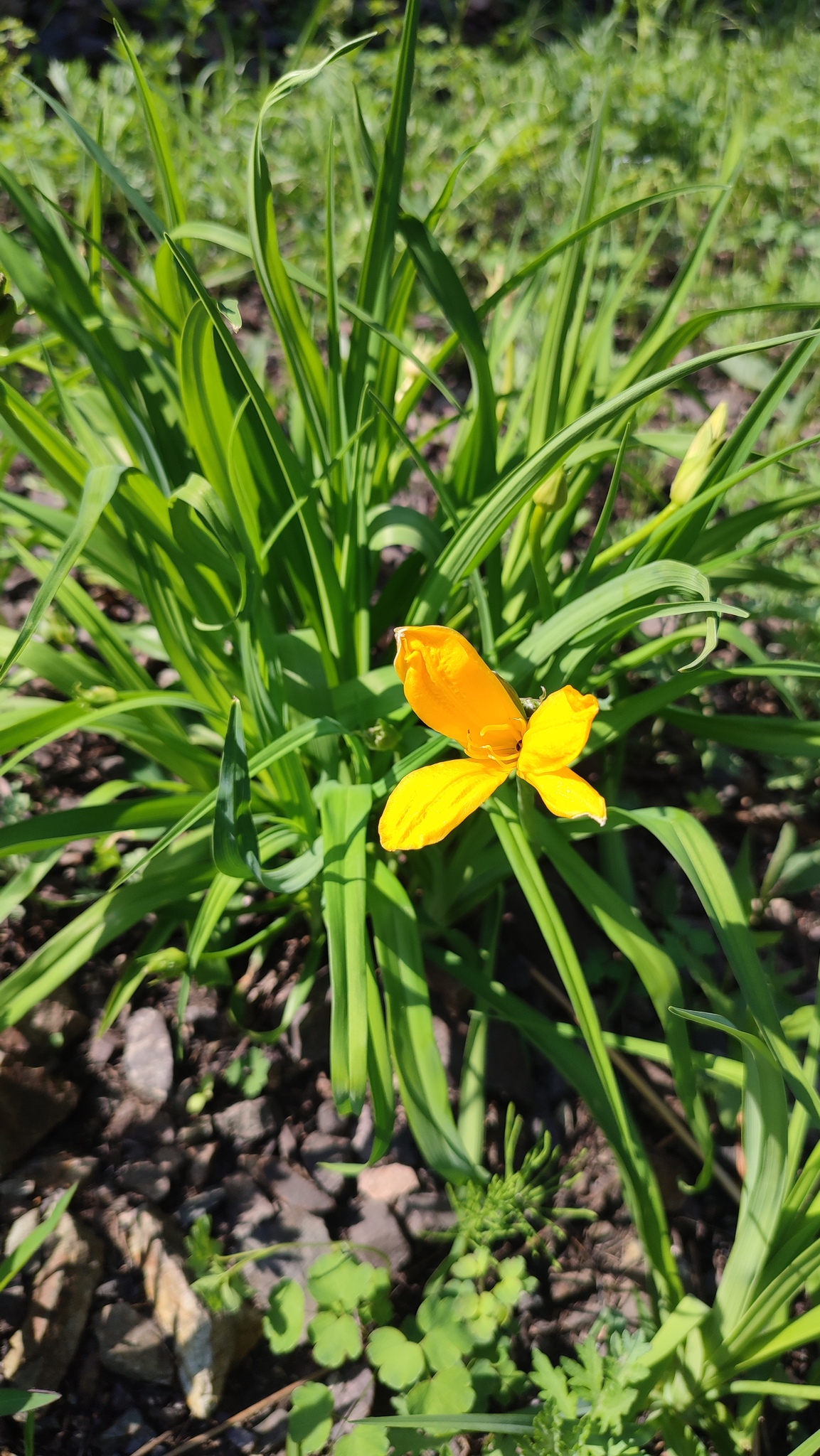
Amur daylily (Hemerocallis middendorffii) is a herbaceous perennial native to meadows, mountain slopes, and light scrub across the Russian Far East, northern China, Korea, and Japan. It features compact clumps of arching grass-like foliage and unbranched stems topped with golden-orange flowers.
This species blooms 2 to 4 weeks earlier than most standard garden daylilies, opening its first flowers in late spring. In Asian culinary traditions, growers harvest its young spring shoots and unopened flower buds for soups and stir-fries.
Key Facts
- Hardiness: USDA Zones 3 to 8
- Height: 40-80 cm (16-31 in)
- Bloom Time: Late spring to early summer
- Light: Full sun to partial shade
- Toxicity: Non-toxic to humans; toxic to cats
Where Amur Daylily Fits in the Garden
Amur daylily grows best in perennial borders, cottage gardens, and edible landscapes across USDA Hardiness Zones 3 through 8. Its compact crown forms dense mounds of foliage that prevent weed emergence along garden pathways.
Because it tolerates heavy winter frosts down to -35 °C (-31 °F), this species reliably survives severe northern winters without extra protection. It suits low-maintenance borders where long-term persistence without frequent dividing is preferred.
Identifying Amur Daylily
Amur daylily is identified by its broad, papery bracts directly below dense clusters of 3 to 6 rich orange-yellow flowers. Each funnel-shaped bloom spans 6-8 cm (2.4-3.1 in) wide and lasts only 24 hours.
The narrow, linear leaves grow 35-60 cm (14-24 in) long and 1-1.5 cm (0.4-0.6 in) wide, arching outward from the base of the plant. Unlike many garden hybrids, the flower scapes (stems) are largely unbranched and hold the blooms just above the leaf tips.
- Foliage length: 35-60 cm (14-24 in)
- Flower diameter: 6-8 cm (2.4-3.1 in)
- Flower color: Deep orange to golden yellow
- Bract features: Ovate, inflated, papery brown-tinged at maturity
Sunlight and Site Selection
Plant Amur daylily in a spot receiving at least 6 hours of direct sunlight each day for maximum flower production. In warmer southern climates, light afternoon shade prevents leaf tip scorch during July and August heat.
It adapts to diverse garden soils but prefers moist, rich loams with good drainage. Avoid waterlogged basins where standing water remains for more than 24 hours, as persistent flooding rots the fleshy root systems.
How to Plant Amur Daylily
Set crown divisions 2.5-5 cm (1-2 in) deep beneath the soil surface to ensure healthy shoot emergence. Spacing plants 45-60 cm (18-24 in) apart leaves sufficient room for crowns to expand over 3 to 5 years.
Follow these steps when planting bare-root or potted crowns:
- Dig a hole twice as wide as the root mass and 20 cm (8 in) deep.
- Build a small cone of soil in the center of the hole.
- Fan the thick, fleshy roots outward over the mound.
- Fill with topsoil, ensuring the root crown sits no deeper than 5 cm (2 in) underground.
- Water thoroughly with 10 liters (2.5 gal) of water to settle the soil.
Watering and Fertilizer Needs
Provide 2.5 cm (1 in) of water per week during the active growth period from April to July. Once established, plants tolerate brief drought periods of 2 to 3 weeks without permanent damage.
Apply a 5-10-10 balanced organic fertilizer in early spring as new shoots reach 10 cm (4 in) tall. Avoid excessive nitrogen applications, which produce soft foliage at the expense of floral buds.
Pruning and Maintenance
Cut flower scapes down to the ground level immediately after all flower buds on the stalk finish opening. Removing spent scapes prevents seed formation and directs energy back into root stores for the following season.
Trim away dead foliage in late autumn after the first hard freeze turns the leaves yellow. Clear fallen leaves around the base to eliminate overwintering sites for garden slugs and snails.
How to Propagate Amur Daylily
Propagate Amur daylily by dividing mature root clumps every 4 to 5 years in early spring or early autumn. Division keeps the plants vigorous and yields identical new plants for expansion.
Follow these steps to divide crowns successfully:
- Lift the entire clump using a garden fork inserted 20 cm (8 in) away from the base.
- Wash excess soil from the roots with a hose to expose the individual fan crowns.
- Pry the roots apart into smaller sections containing 2 to 3 leaf fans and healthy roots.
- Trim leaf tops back to 15 cm (6 in) to reduce water loss during root establishment.
- Replant immediately into prepared soil and keep moist for 3 weeks.
Winter Care and Cold Hardiness
Amur daylily requires no winter wrapping or specialized protection in USDA Zones 3 to 8. Roots survive winter temperatures down to -35 °C (-31 °F) without dieback.
In Zone 3, apply a 5-7 cm (2-3 in) layer of shredded leaf mulch over newly planted crowns during their first autumn. Remove the mulch layer in early April as green leaf tips push through the soil surface.
Common Amur Daylily Pests and Problems
Amur daylily is pest-resistant but can suffer damage from slugs eating tender spring shoots and thrips damaging open flower petals. Inspect young foliage weekly during damp spring weather.
Monitor for these common growing issues:
- Chewed leaf edges: Slugs or snails feeding at night; apply iron phosphate bait around the plant base.
- Streaked or distorted petals: Daylily thrips feeding inside flower buds; spray affected buds with insecticidal soap.
- Yellowing leaf tips in summer: Extended drought or scorching sun; increase supplemental watering to 5 cm (2 in) per week.
- Soft, foul-smelling foliage bases: Crown rot caused by waterlogged soil; dig up the plant, remove mushy roots, and relocate to a well-draining site.
Year-Round Care for Amur Daylily
| Spring | Apply 5 cm (2 in) of compost around the crown as shoots reach 10 cm (4 in). Divide dense clumps before active foliage growth accelerates. |
|---|---|
| Summer | Provide 2.5 cm (1 in) of water weekly during dry spells. Cut down spent bloom stalks at ground level after flowering completes. |
| Autumn | Cut back dead foliage to 5 cm (2 in) above the soil after the first killing frost. Apply a light layer of leaf mulch in colder zones. |
| Winter | Leave crowns dormant; inspect garden beds during thaws to ensure frost-heaved roots remain covered by soil or mulch. |
Troubleshooting Amur Daylily Problems
| What you see | Likely cause | What to do |
|---|---|---|
| Yellow, wilting outer foliage in summer | Under-watering or severe soil dryness | Water deeply with 5 cm (2 in) of water and apply a 5 cm (2 in) bark mulch layer. |
| Soft, mushy stems at soil line | Fungal crown rot from poorly drained soil | Lift the plant, trim away rotted tissue, and replant in well-drained, amended soil. |
| Flowers fail to open or appear distorted | Thrips feeding on developing buds | Remove damaged buds and spray remaining foliage with insecticidal soap in early morning. |
| Ragged holes in young spring leaves | Slug or snail activity | Distribute iron phosphate slug bait around the root zone in early spring. |
Amur Daylily Varieties and Botanical Forms
- Hemerocallis middendorffii var. middendorffii – nominal variety with compact habit and deep orange blooms
- Hemerocallis middendorffii var. esculenta – broad-bracted form traditionally harvested for edible flower buds
- Hemerocallis middendorffii ‘Maisonne’ – horticulturally selected nursery strain with early, bright yellow-orange flowers
Companion Plants for Amur Daylily
Pair Amur daylily with perennials that bloom in late summer to maintain border color after its June flower display ends. Its golden blooms contrast with purple and blue flowers that open in early summer.
Suitable companions with matching moisture and light requirements include:
- Siberian iris (Iris sibirica) – provides tall, slender leaves and blue flowers.
- Plantain lily (Hosta plantaginea) – fills partial shade gaps with broad leaves.
- Oriental poppy (Papaver orientale) – blooms concurrently in late spring.
- Ostrich fern (Matteuccia struthiopteris) – offers delicate green fronds in damp soils.
Frequently Asked Questions
Are Amur daylily flowers edible?
Yes, unopened flower buds and young spring shoots of Amur daylily are edible cooked or raw. They are traditionally harvested in East Asia and added to soups, stir-fries, and salads.
Is Amur daylily toxic to cats?
Yes, all parts of Amur daylily are highly toxic to cats and cause severe, acute kidney failure if ingested. Keep cats away from garden beds containing Hemerocallis species.
When does Hemerocallis middendorffii bloom?
Hemerocallis middendorffii blooms in late spring to early summer, typically starting 2 to 4 weeks earlier than standard midseason daylily hybrids.
What is the difference between Hemerocallis middendorffii var. esculenta and standard daylilies?
Hemerocallis middendorffii var. esculenta features wider, papery bracts directly below the flower cluster and blooms earlier in spring than most cultivars. It is specifically selected in East Asia for its edible flower buds.
How do you tell Amur daylily apart from true lilies?
Amur daylily grows from a fibrous, fleshy root crown with leaves emerging directly from the ground, whereas true lilies (Lilium species) grow from leafy vertical stems arising from underground bulbs.
Information about traditional or historical uses is provided for educational interest only and is not medical advice. Do not use any plant to treat a condition without speaking to a qualified professional.
Sources & Verification
Taxonomy and distribution are checked against the databases below. Care guidance is written for cultivated species only and reviewed by our editor. How We Build Plant Profiles →
- Kew Plants of the World OnlineTaxonomic details and distribution map
- Global Biodiversity Information Facility (GBIF)Occurrence data and common names
- Royal Horticultural SocietyCultivation advice for garden Hemerocallis
- ASPCA Animal Poison ControlToxicity warning for feline ingestion
- Wikipediageneral reference


