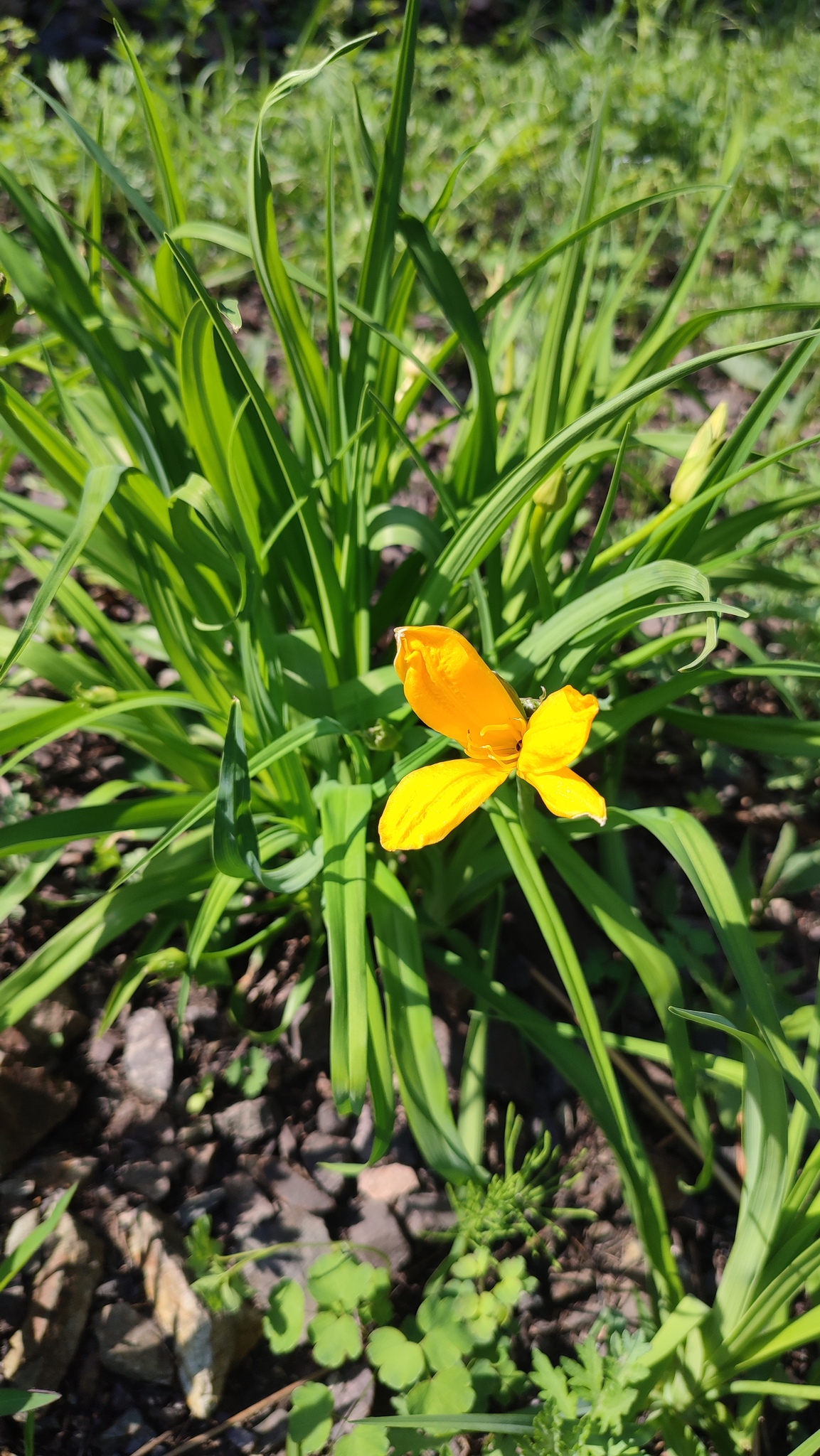
Lemon daylily (Hemerocallis lilioasphodelus) is a clump-forming herbaceous perennial native to temperate regions across eastern Asia and parts of southern Europe, known for its clear yellow, scented blossoms. It was one of the earliest daylily species introduced to western horticulture and served as a foundational parent for modern hybrids.
Unlike modern reblooming hybrids that open continuously for months, each scented flower lasts just one single day between late spring and early summer. Its vigorous rhizomes form dense weed-suppressing mats that remain fully hardy down to -35 °C (-31 °F).
Key Facts
- Light: Full sun to light afternoon shade
- Flowering time: May to June
- Height: 70-90 cm (28-35 in)
- Spread: 60-90 cm (24-35 in)
- Hardiness: USDA zones 3-9
- Pet toxicity: Severely toxic to domestic cats
Growing Lemon Daylily in the Garden
Lemon daylily suits borders, open cottage gardens, and bank plantings where a low-effort groundcover is needed to suppress weeds. It forms arching mounds of clean foliage that remain neat until the first hard autumn frosts.
This plant performs reliably in mixed herbaceous borders, meadow-style borders, and rain gardens. Because it expands via short subterranean stolons, it forms tidy colonial clumps without spreading aggressively like the related tawny daylily (Hemerocallis fulva). It tolerates heavy clay, summer humidity, and urban air pollution without foliage scorch.
How to Identify Lemon Daylily
Lemon daylily produces narrow, arching, strap-like leaves measuring 50-75 cm (20-30 in) long and 1-2 cm (0.4-0.8 in) wide, arranged in two distinct ranks.
Erect, leafless flower scapes rise above the foliage mound, reaching up to 90 cm (35 in) in height. Each scape branches at the top to support 3 to 9 flower buds that open sequentially.
- Flower shape: Open funnel-shaped trumpet measuring 7-10 cm (2.8-4 in) across
- Flower colour: Pure, uniform lemon yellow with no central eye or contrasting throat
- Fragrance: Strong, sweet citrus scent most noticeable in late afternoon and evening
- Roots: Fleshy, fibrous root system featuring slender spindle-shaped storage tubers
Where to Plant Lemon Daylily
Plant in a position that receives at least 6 hours of direct sunlight daily to produce the highest bud counts and upright flower scapes.
In hot southern regions, light afternoon shade prevents floral fading and reduces moisture stress during flowering. In deep shade, foliage becomes floppy and flowering ceases almost entirely.
Select an open site with decent air circulation. Although lemon daylily survives drought once settled, steady soil moisture during April and May ensures taller stems and larger petals.
Planting and Spacing Guidelines
Set root crowns at a depth of 2.5 cm (1 in) beneath the soil surface, spacing plants 60 cm (24 in) apart.
Planting too deeply is a common cause of poor flowering in subsequent seasons. Prepare the hole by loosening the native soil to a depth of 30 cm (12 in) and incorporating organic matter if working in pure sand or heavily compacted subsoil.
- Spread the fleshy roots outward and downward over a central mound of firm soil
- Backfill the hole and tamp the soil gently to remove large air pockets
- Saturate the root zone with 5-10 L (1.3-2.6 gal) of water immediately after backfilling
- Apply a 5 cm (2 in) layer of shredded leaf mould or compost mulch, keeping it clear of the crown
Watering and Fertiliser Needs
Provide 2.5 cm (1 in) of water weekly during the spring growing and blooming window whenever rainfall falls short.
Established clumps tolerate short summer dry spells due to their thick, water-storing root tubers. However, extended drought after blooming causes early foliage dieback and reduces next year’s bud initiation.
Apply a single top-dressing of balanced organic fertiliser, such as a 5-5-5 granular feed at 50 g/m² (1.5 oz/sq yd), in early spring as new shoots emerge. Avoid high-nitrogen feeds, which encourage excessive leaf growth at the expense of floral stems.
Pruning and Maintenance
Snap spent blooms off individual stalks daily and cut entire flowering scapes down to the ground once all buds have finished opening.
Removing faded scapes keeps the foliage mound looking tidy and prevents the plant from wasting metabolic energy on seed production. Leave green foliage untouched throughout summer and autumn because the leaves actively replenish root tubers.
Cut dead, frosted foliage back to 5 cm (2 in) above the ground in late autumn or early spring before new green spikes push through.
Propagating Lemon Daylily
The most reliable propagation method is clump division in early spring or directly after flowering concludes in midsummer.
Lift mature clumps every 4 to 6 years when flowering density drops in the centre of the mound. Lemon daylily can also be grown from true seeds, which requires 4-6 weeks of cold stratification at 4 °C (39 °F) to break dormancy.
- Dig 15 cm (6 in) beyond the foliage drip line with a garden fork to lift the root mass intact
- Shake away loose soil to reveal the individual fans of foliage and root connection points
- Cut or pry the crown into sections containing at least 2 to 3 healthy leaf fans and robust roots
- Trim leaves to 15 cm (6 in) to reduce water loss, then replant divisions immediately
Pests and Disease Problems
The primary insect pest is the daylily gall midge (Contarinia lilioasphodeli), which causes swollen, deformed flower buds that rot before opening.
Fungal issues occasionally surface during wet weather, though this species shows greater resistance to daylily rust (Puccinia hemerocallidis) than many modern hybrid cultivars.
- Gall midge: Pick off and burn swollen, spherical flower buds immediately in May; do not compost them
- Slugs and snails: Protect emerging spring shoot tips with wool pellets or beer traps
- Aphids: Wash clusters of black or green aphids from young scapes with a firm jet of water
- Crown rot: Avoid planting in permanently saturated winter soils that lack drainage
Overwintering Lemon Daylily
Lemon daylily is a dormant perennial that naturally dies down to subterranean resting buds in autumn and requires no winter heating or lifting.
The plant withstands sustained winter temperatures down to -35 °C (-31 °F) in USDA zone 3 without injury. In regions that lack consistent snow cover, applying a light covering of straw or shredded pine needles protects the crown against winter frost-heaving.
Remove any protective winter mulch in early spring as soon as green shoots reach 3 cm (1.2 in) in length to allow the soil to warm up naturally.
Lemon Daylily Bloom Season and Fragrance
Flowering commences in mid-to-late May and lasts for 3 to 5 weeks depending on spring temperatures.
Unlike the unscented midsummer cultivars, lemon daylily is prized for its rich, sweet, lemon-and-honey aroma. The fragrance intensifies in early evening as blooms open fully, attracting nocturnal hawkmoths as well as daytime pollinators.
Individual blooms open shortly after dawn and wither within 24 hours. Because healthy mature clumps produce multiple multi-budded stems, the plant displays a continuous succession of fresh flowers across the blooming window.
Year-Round Lemon Daylily Maintenance
| Spring | Top-dress the crown with 5 cm (2 in) of compost and a light 5-5-5 organic feed. Inspect May flower buds for gall midge swelling and pick off infected buds. |
|---|---|
| Summer | Deadhead spent blossoms daily. Cut completed flower stems down to ground level in July and water deeply during dry spells exceeding two weeks. |
| Autumn | Divide overcrowded clumps in early autumn if not split in spring. Cut yellowed foliage back to 5 cm (2 in) above the soil after the first killing frost. |
| Winter | Ensure drainage remains clear around the crown to prevent winter rot. In zone 3 and 4 gardens without snow cover, add 5 cm (2 in) of loose straw mulch. |
Common Lemon Daylily Problems and Solutions
| What you see | Likely cause | What to do |
|---|---|---|
| Swollen, bulbous, unopened flower buds | Daylily gall midge infestation inside the developing bud | Pick off and bin all distorted buds immediately before midges emerge to break the lifecycle. |
| Pale green leaves with yellow streaks | Fungal leaf streak or early daylily rust infection | Remove affected leaves at the soil line and avoid overhead evening irrigation. |
| Sparse flowers or weak, floppy flower stems | Insufficient sunlight or deep shade | Move clumps to a location receiving at least 6 hours of direct daily sun. |
| Mushy crown and failing spring shoots | Bacterial crown rot from waterlogged, poorly drained soil | Lift the crown, trim rotted tissue away, and replant into well-drained, gritty soil. |
Lemon Daylily Forms and Related Cultivars
- ‘Major’ – larger flowers, taller stems to 100 cm (39 in)
- ‘Flava’ – historic botanical synonym for the wild species type
- ‘Lemon Bells’ – heavy bud count, compact flowering scapes
- ‘Lemon Madeline’ – pale sulfur-yellow blooms, ruffled petals
Companion Plants for Lemon Daylily
Pair lemon daylily with perennials that flower simultaneously in contrasting blue and violet tones or share identical moisture requirements.
Good companions include Siberian iris (Iris sibirica), which shares a similar bloom window and produces clean vertical lines that complement the daylily’s arching foliage. Meadow cranesbill (Geranium pratense) weaves through the base of the stems, while catmint (Nepeta racemosa) provides a long-lasting cool lavender backdrop. For structural contrast, use the broad silver-green foliage of plantain lily (Hosta sieboldiana) in partially shaded borders.
Frequently Asked Questions
Are lemon daylily flowers edible?
Yes, the fresh petals and unopened flower buds of Hemerocallis lilioasphodelus are traditionally cooked in Asian cuisine, known as gum jum or golden needles. However, verify the plant's identity carefully, as look-alike true lilies (Lilium species) are strictly toxic.
Is lemon daylily poisonous to cats?
Yes, all parts of Hemerocallis lilioasphodelus are severely toxic to domestic cats and can trigger acute, fatal kidney failure within 24 to 72 hours of ingestion. Keep feline pets completely away from the foliage, flowers, and even the pollen.
How does lemon daylily differ from Stella de Oro?
Lemon daylily is a tall, single-flush late spring species with clear yellow, highly fragrant trumpet flowers on 80 cm (31 in) scapes. 'Stella de Oro' is a dwarf 30 cm (12 in) hybrid with unscented golden-amber blooms that reblooms throughout summer.
Why is my lemon daylily not blooming?
The two most frequent causes are excessive shade and crowns planted deeper than 2.5 cm (1 in) below the soil surface. Over-fertilising with synthetic high-nitrogen products also causes lush leaf growth at the cost of flower scapes.
How long do lemon daylily flowers last?
An individual lemon daylily flower opens in the morning and lasts for only 24 hours before collapsing. A mature clump maintains a continuous floral show for 3 to 5 weeks because each scape carries multiple buds opening in succession.
Information about traditional or historical uses is provided for educational interest only and is not medical advice. Do not use any plant to treat a condition without speaking to a qualified professional.
Sources & Verification
Taxonomy and distribution are checked against the databases below. Care guidance is written for cultivated species only and reviewed by our editor. How We Build Plant Profiles →
- Kew Plants of the World OnlineTaxonomic status and native distribution record
- Royal Horticultural SocietyCultivation profile, hardiness, and Award of Garden Merit notes
- Missouri Botanical GardenPlant characteristics, growth dimensions, and soil preferences
- ASPCA Animal Poison ControlFeline toxicity and nephrotoxicity documentation
- GBIF — Global Biodiversity Information Facilitytaxonomy, synonyms, occurrence records
- Wikipediageneral reference