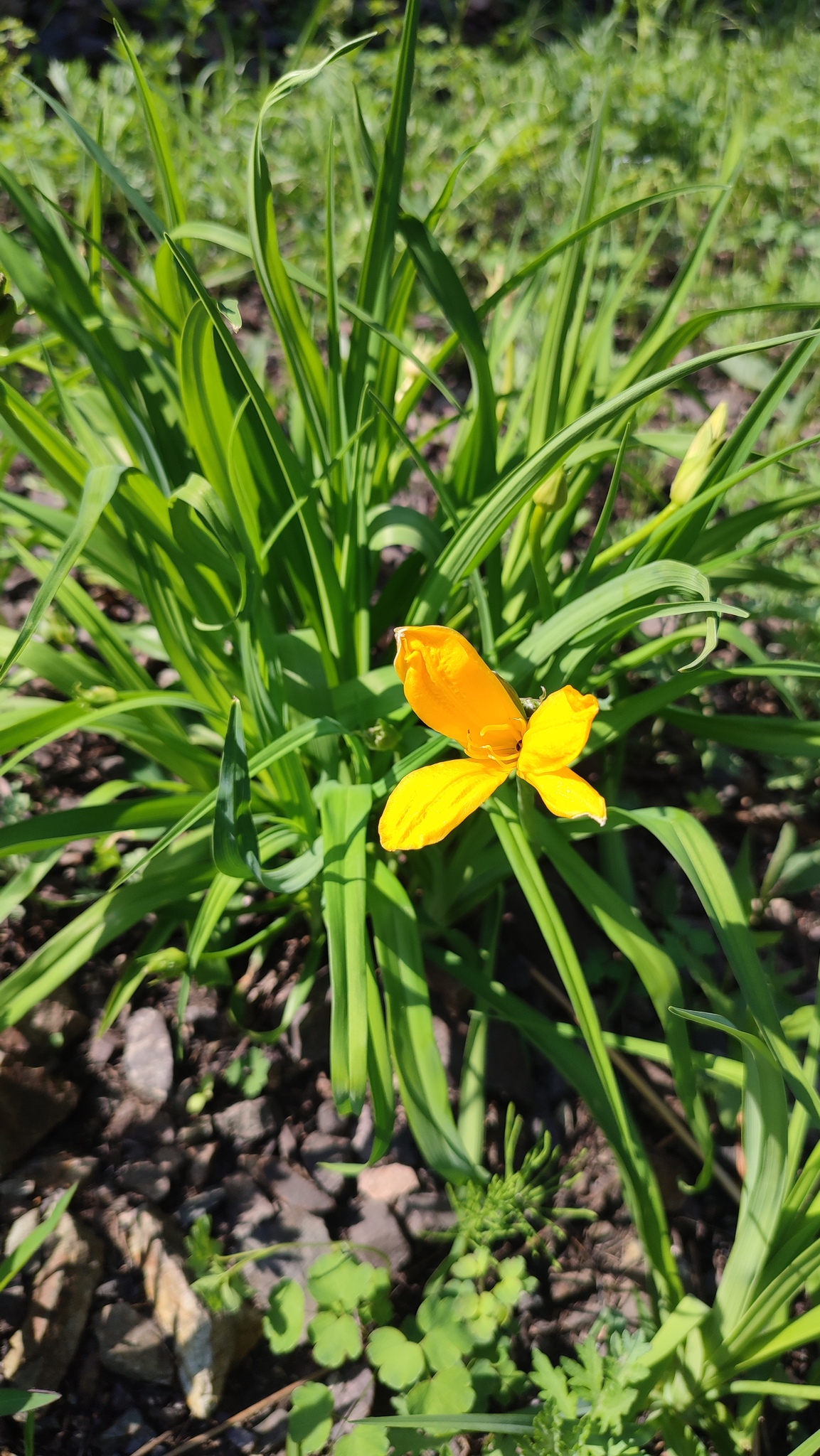
Hemerocallis fulva is a herbaceous perennial that grows from thickened tuberous roots and produces unscented, tawny-orange flowers on tall stems. It originated in Asia but has naturalized across much of Europe and North America, frequently appearing in meadows and along rural roadsides.
You will often see it thriving in neglected areas where other plants fail due to poor soil or drought. It spreads through underground runners, making it more suitable for erosion control on steep banks than for a small, tidy flower border.
Key Facts
- Water: 2.5 cm (1 in) weekly during the flowering season
- Light: Full sun for at least 6 hours daily
- Soil: Adaptable to clay, loam, or sandy soils
- Bloom: Each individual flower lasts exactly 24 hours
Fitting Orange Daylily into Your Garden
The Orange Daylily is best suited for large, informal landscapes where its aggressive spreading habit is an asset rather than a chore. Because it forms dense mats of roots and foliage, it excels at suppressing weeds and stabilizing soil on slopes or along property lines. You should avoid planting it near delicate perennials, as its rhizomes will quickly outcompete smaller species for space and nutrients.
In a garden setting, it provides a reliable source of height and color during the mid-summer gap when spring bulbs have faded and autumn flowers have yet to bloom. The foliage remains green and tidy for most of the season, though it can look ragged after the flowering period ends. It is an excellent choice for low-maintenance areas where you want maximum coverage with minimum intervention.
Identifying the Ditch Lily
You can identify this plant by its basal fan of sword-shaped leaves that arch gracefully toward the ground. These leaves measure 60-90 cm (24-36 in) in length and emerge directly from the soil, unlike true lilies which have leaves along a central stem. The flower stalks, known as scapes, are leafless and rise to a height of 1.2 m (4 ft), branching at the top to hold multiple buds.
The flowers are 10-12 cm (4-5 in) wide and feature six petals with a distinct tawny-orange hue and a yellow throat. They lack the fragrance found in many hybrid daylilies or true lilies like the Easter lily (Lilium longiflorum). Below ground, the plant possesses a network of orange-brown tuberous roots and white rhizomes that allow it to colonize new territory rapidly.
Choosing the Right Site
Select a location that receives at least six hours of direct sunlight to ensure the plant has enough energy to produce flowers. While it can survive in partial shade, the flower production will be significantly reduced, and the tall scapes may lean or flop over while reaching for the light. It is remarkably tolerant of urban pollution and salt, making it a frequent sight near paved roads.
The soil type is rarely a limiting factor for this species, as it grows in everything from heavy clay to sandy banks. It prefers a pH between 6.0 and 8.0 but is not overly sensitive to slight acidity or alkalinity. Ensure the site has enough room for the clump to expand, as a single plant can grow to a width of 90 cm (3 ft) within a few seasons.
How to Plant and Transplant Orange Daylilies
Plant the tuberous roots 2.5 to 5 cm (1 to 2 inches) deep during the early spring or autumn when the plant is not actively flowering. If you are transplanting an established clump, use a sharp spade to lift the entire root mass, ensuring you capture as many of the thick tubers as possible. These roots store water and energy, helping the plant recover quickly from the move.
- Dig a hole twice the width of the root system.
- Spread the roots over a small mound of soil in the center of the hole.
- Ensure the crown sits just below the soil surface.
- Water deeply immediately after planting to settle the soil.
- Space multiple plants 60 cm (2 ft) apart to allow for spread.
Watering and Feeding Requirements
Provide your plants with 2.5 cm (1 in) of water per week during the heat of summer to maintain lush foliage and consistent blooming. While the Orange Daylily is famous for its drought tolerance, the leaves may turn yellow and the buds may drop prematurely if the soil remains bone-dry for extended periods. Water at the base of the plant to keep the foliage dry and prevent fungal issues.
Fertilizer is generally unnecessary for this vigorous species in average garden soil. If your soil is particularly sandy or poor, a single application of a balanced 10-10-10 fertilizer in early spring is sufficient. Avoid high-nitrogen fertilizers, which encourage excessive leaf growth at the expense of the orange flowers. Mulching with organic matter will help retain moisture and provide slow-release nutrients.
Pruning and Deadheading for More Blooms
Cut the flower stalks down to the base once all the buds on that scape have finished blooming. This keeps the plant looking tidy and prevents it from wasting energy on seed production, although the common orange variety rarely produces viable seeds. Since each flower only lasts one day, you may want to remove the withered blooms daily to maintain a clean appearance, a process known as deadheading.
In late autumn or early spring, remove all the dead foliage to make room for new growth. You can cut the entire clump back to 15 cm (6 in) above the ground after the first hard frost. This helps eliminate hiding spots for pests like slugs and snails. If the foliage becomes unsightly in late summer, a mid-season trim can stimulate a fresh flush of green leaves.
Propagating by Division
Divide the clumps every 3 to 5 years to prevent overcrowding and maintain the size of the flowers. When the center of the clump begins to die out or flowering decreases, it is time to split the plant. This is best done in early spring as the new shoots emerge or in late summer after the blooming period has concluded.
- Lift the entire clump with a garden fork or spade.
- Shake off excess soil to expose the tuberous roots.
- Use a sharp knife or spade to cut the clump into sections.
- Each section should have at least 2-3 leaf fans and a healthy root mass.
- Replant the divisions immediately and water thoroughly.
Managing Invasiveness and Common Problems
Be aware that Hemerocallis fulva is considered invasive in several regions of North America due to its ability to displace native vegetation. Because it spreads via rhizomes, even a small fragment of root left in the ground can grow into a new plant. If you wish to remove it, you must dig deep to extract the entire root system or use a targeted herbicide during the growing season.
Pests are rarely a major issue, but the daylily gall midge (Contarinia quinquenotata) can cause buds to become swollen and fail to open. If you see distorted buds, pick them off and destroy them immediately to break the life cycle. Spider mites may also affect the foliage during hot, dry spells, resulting in a stippled or bronzed appearance on the leaves.
Seasonal Blooms and Edibility
The main flowering window occurs for three to four weeks in mid-summer, typically peaking in July. While the flowers are the primary draw, this species has a long history of use as a food crop in Asia. The flower buds, known as “golden needles,” were traditionally dried and used in soups and stir-fries for their delicate flavor and thickening properties.
- Young shoots can be harvested in early spring when they are under 15 cm (6 in) tall.
- The tuberous roots have a nutty flavor when boiled or roasted.
- Fresh petals can be used as a garnish or added to salads.
- Always ensure the plant has not been treated with pesticides before consuming.
- Confirm identification carefully, as true lilies (Lilium) are highly toxic if eaten.
Year-Round Care for Orange Daylily
| Spring | Divide overcrowded clumps as soon as green shoots appear. Apply a thin layer of compost around the base of the plants. |
|---|---|
| Summer | Water 2.5 cm (1 in) weekly. Deadhead spent flowers daily and remove entire scapes once they finish blooming. |
| Autumn | Cut foliage back to 15 cm (6 in) after the first frost. This is also a good time for transplanting or moving clumps. |
| Winter | Apply a 5 cm (2 in) layer of mulch in colder zones to protect the crowns from extreme temperature fluctuations. |
Orange Daylily Problems and Solutions
| What you see | Likely cause | What to do |
|---|---|---|
| Few or no flowers | Too much shade | Move the plant to a location with at least 6 hours of direct sun. |
| Yellowing leaves in summer | Extreme drought stress | Increase watering to 2.5 cm (1 in) per week during heatwaves. |
| Swollen, distorted flower buds | Daylily gall midge | Remove and destroy affected buds immediately to prevent larvae from reaching the soil. |
| Plant spreading into lawn | Aggressive rhizomes | Install a physical root barrier 30 cm (12 in) deep or dig out the spreading edges annually. |
Popular Orange Daylily Cultivars
- ‘Kwanso’ – double-flowered variety with extra petals
- ‘Flore Pleno’ – another double form, very vigorous
- ‘Europa’ – the most common sterile triploid form
- ‘Variegata’ – leaves feature white longitudinal stripes
Companion Plants for Tawny Daylily
Choose companions that can match the vigor of the Orange Daylily without being smothered by its dense foliage. Robust perennials and ornamental grasses are the best choices for creating a cohesive, low-maintenance landscape. Avoid planting delicate or slow-growing species nearby, as the daylily’s root system will quickly encroach on their territory.
- Purple Coneflower (Echinacea purpurea) provides a color contrast and thrives in similar sun.
- Black-eyed Susan (Rudbeckia hirta) offers golden tones that complement the orange petals.
- Common Yarrow (Achillea millefolium) handles the same dry, poor soils.
- Switchgrass (Panicum virgatum) adds vertical texture and movement to the planting.
- Russian Sage (Salvia yangii) provides a misty blue backdrop for the bold orange blooms.
Frequently Asked Questions
Are orange daylilies invasive?
Yes, they are considered invasive in many parts of the United States and Canada because they spread rapidly via underground rhizomes and can displace native plants. They are often found in wild areas where garden waste was dumped or where they escaped cultivation.
Do orange daylilies rebloom?
No, this specific species typically has one major bloom cycle in mid-summer. While hybrid daylilies are often bred for reblooming, the common orange daylily produces all its flowers over a three-to-four-week period in July.
What is the difference between an orange daylily and a tiger lily?
The orange daylily (Hemerocallis fulva) has upward-facing flowers and grass-like leaves growing from the ground, while the tiger lily (Lilium lancifolium) has downward-facing flowers with black spots, leaves along a tall stem, and black bulbils in the leaf axils.
Are orange daylilies toxic to cats?
Yes, all parts of the daylily are highly toxic to cats and can cause acute kidney failure if even a small amount is ingested. They are generally considered non-toxic to dogs and humans, though some individuals may experience gastrointestinal upset.
What does the orange daylily symbolize?
In Chinese culture, the daylily is traditionally associated with maternal love and was often planted when a son left home; it is also sometimes called the 'forget-sorrow' herb, symbolizing the relief of grief.
Information about traditional or historical uses is provided for educational interest only and is not medical advice. Do not use any plant to treat a condition without speaking to a qualified professional.
Sources & Verification
Taxonomy and distribution are checked against the databases below. Care guidance is written for cultivated species only and reviewed by our editor. How We Build Plant Profiles →