
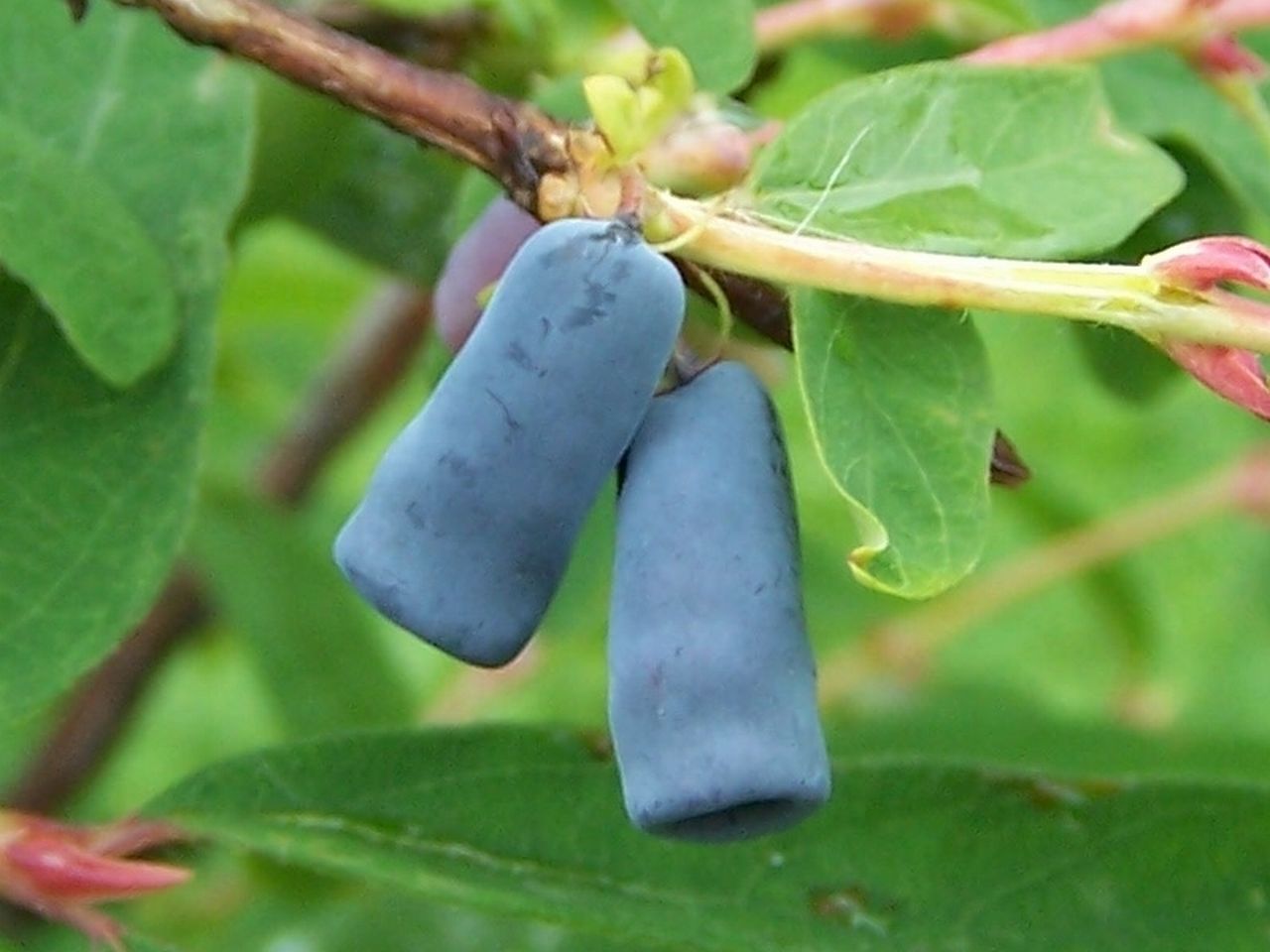
Honeyberry is a cold-hardy deciduous shrub native to boreal forests across northern North America, Europe, and Asia, known scientifically as Lonicera caerulea. It produces elongated, dusky blue berries that ripen two to three weeks before strawberries.
You must plant at least two genetically distinct, bloom-compatible cultivars within 15 m (50 ft) of each other, or the bush will not set fruit.
Key Facts
- Hardiness: USDA zones 2-7, surviving winter chills down to -45 °C (-50 °F)
- Pollination: Requires two different compatible cultivars
- Fruiting age: Yields light crops in year two, full crops by year five
- Soil pH: Thrives in a range of 5.5 to 7.0
- Water: 2.5 cm (1 in) of water per week during fruit development
- Mature size: 1.2-2.1 m (4-7 ft) tall and wide
Is Honeyberry Right for Your Garden?
Honeyberry suits cool-climate growers in USDA zones 2 through 7 who want homegrown berries weeks ahead of summer crops. It thrives where late spring frosts regularly destroy tender fruit blossoms, as its flowers withstand temperatures as low as -7 °C (19 °F).
You should consider your local summer heat before planting. The shrub struggles in warm regions with long, humid summers above zone 8, where high soil temperatures cause premature dormancy and foliage drop by July.
Because the bushes require cross-pollination to produce a harvest, budget space for a minimum pairing:
- Space requirement: Allow 1.2 to 1.5 m (4 to 5 ft) between bushes in a row
- Pollinator pair: Select two distinct varieties with synchronized bloom windows
- Time to harvest: Expect mature yields of 2 to 4 kg (4.4 to 8.8 lb) per bush after year five
What Does a Honeyberry Bush Look Like?
A mature honeyberry forms a dense, rounded shrub reaching 1.2 to 2.1 m (4 to 7 ft) in height and spread. Stems develop shredding, papery brown bark as they mature, while young shoots show a reddish-green hue.
Leaves emerge opposite along the branches, oval to elliptic in shape, measuring 3 to 8 cm (1.2 to 3.1 in) long. The foliage displays a clean matte green upper surface with a lighter, slightly pubescent underside, turning yellow or developing mild browning along edges in late summer.
Key botanical traits help separate honeyberry from related shrubs:
- Flowers: Paired, pale yellow to cream tubular blooms measuring 1.5 cm (0.6 in) long in early spring
- Fruit: Cylindrical to oval berries, 1.5 to 3 cm (0.6 to 1.2 in) long, with a waxy purple-blue bloom
- Berry interior: Deep crimson-purple flesh containing tiny, soft, unnoticeable seeds
- Branching: Upright, multi-stemmed habit with fine inner twigging that thickens with age
Sun and Soil Conditions for Honeyberry Plants
Honeyberries fruit best in full sun receiving at least 6 to 8 hours of direct light daily. In warmer southern limits of their range, provide afternoon shade to reduce leaf scorch and drought stress during July and August.
Unlike highbush blueberry (Vaccinium corymbosum), honeyberry does not demand strongly acidic soil. It adapts across a wide pH range of 5.5 to 7.5, performing best in fertile loam amended with composted organic matter.
Provide these foundational soil elements for steady root development:
- Drainage: High porosity that prevents stagnant standing water
- Moisture retention: Loam or clay-loam packed with organic material
- Mulch layer: A 7 to 10 cm (3 to 4 in) wood chip layer to keep root zones cool
How to Plant Honeyberry Bush and Start from Seed
Dig your planting hole twice as wide as the nursery container and set the crown 2 to 5 cm (1 to 2 in) deeper than it stood in the nursery pot. Deep planting encourages vigorous basal shoot development, which renews the fruiting wood over time.
Propagating from seed requires a cold stratification period of 60 to 90 days at 2 to 4 °C (35 to 40 °F). Seedlings show wide genetic variation in fruit quality and yield, so taking semi-hardwood cuttings in early summer remains the preferred propagation method.
Follow this checklist when establishing container-grown plants:
- Timing: Plant dormant stock in early spring or six weeks before the first hard autumn frost
- Spacing: Space plants 1.2 to 1.5 m (4 to 5 ft) apart in rows spaced 2.5 m (8 ft) apart
- Initial water: Soak the root zone with 15 L (4 gal) of water immediately after backfilling
- Mulching: Apply organic bark chips, keeping mulch 5 cm (2 in) away from main stems
How to Grow Honeyberry: Watering, Feeding, and Pruning
Apply 2.5 cm (1 in) of water weekly throughout fruit expansion and summer branch growth. Drip irrigation keeps foliage dry, which reduces the incidence of foliar fungal disorders in crowded gardens.
Top-dress each plant in early spring with 5 cm (2 in) of well-rotted manure or balanced 10-10-10 organic granular fertilizer. Avoid heavy synthetic nitrogen applications in midsummer, which force tender late flushes vulnerable to early winter dieback.
Pruning rules change as the bush matures:
- Years 1 to 3: Prune only broken, crossing, or dead stems to let the bush build root mass
- Years 4 and beyond: Prune in late winter while dormant, thinning out 20% of the oldest, thickest canes to ground level
- Airflow maintenance: Remove weak interior twigs smaller than pencil diameter to allow light into the canopy
When and How to Harvest Honeyberry Fruit
Harvest honeyberries two to three weeks after the skin turns uniform dusky blue. Berries turn blue on the outside long before sugar levels peak; cutting one open reveals green flesh if immature or deep crimson-purple when fully ripe.
Underripe fruit tastes astringent and sour, whereas fully tree-ripened berries carry a flavor profile between black currant (Ribes nigrum) and wild blueberry. Gently roll ripe berries off the pedicel between your thumb and forefinger.
Harvest efficiently using these grower techniques:
- Drop test: Place a clean tarp beneath the canopy and lightly shake the main canes
- Bird netting: Drape protective 1.5 cm (0.6 in) mesh nets the moment skins begin changing color
- Frequency: Check bushes every two to three days over a two-week picking window
Culinary Uses and What Makes the Sweetest Honeyberry
The sweetness of a honeyberry depends on the Brix sugar reading of the cultivar, with varieties like ‘Aurora’ reaching up to 15° Brix. Sweet varieties can be eaten fresh off the bush without adding extra sugar.
The high natural pectin content and tart undertone make honeyberries suited for processing into jams, syrups, and baked pies. In baking, they hold their structural integrity better than cultivated blueberries and stain batters deep violet.
Popular food and drink applications include:
- Fresh eating: Table fruit paired with dairy, oatmeal, or summer salads
- Preserves: Quick-setting jellies and jams that require minimal added pectin
- Fermentation: Tart country wines, ciders, and craft fruit ales
- Sauces: Reductions cooked down with honey and poured over roasted meats
Common Honeyberry Problems and Pests
The most devastating pests for honeyberry are waxwings and robins, which can strip an entire bush in less than two days. Install exclusion netting before fruit begins turning from green to violet.
Honeyberry foliage frequently suffers from powdery mildew (Podosphaera species) in humid midsummer weather. While the grey-white powdery film looks alarming, it appears after the fruit has already been picked and causes minimal systemic harm.
Watch for these common issues in your patch:
- Early leaf drop: High heat triggers natural midsummer dormancy; maintain consistent root watering
- No fruit set: Caused by poor pollination; plant a synchronized partner cultivar
- Spotted wing drosophila: Harvest promptly to prevent vinegar flies from infesting soft fruit
- Sunscald: Prolonged 35 °C (95 °F) days scorch outer foliage; install 30% shade cloth
How to Store and Freeze Honeyberries
Freshly picked honeyberries remain firm for five to seven days when kept in shallow, ventilated containers at 1 to 3 °C (34 to 37 °F). Do not wash berries before placing them into the refrigerator, as surface moisture accelerates mold decay.
For long-term storage, honeyberries freeze exceptionally well without turning mushy. Arrange clean, dry berries in a single layer on a parchment-lined baking sheet and place them in the freezer for three hours.
Store frozen harvests using these simple steps:
- Packing: Transfer pre-frozen solid berries into airtight freezer bags or vacuum pouches
- Shelf life: Keep frozen at -18 °C (0 °F) for up to 12 months with negligible flavor loss
- Dehydration: Dry in an electric dehydrator at 57 °C (135 °F) for 14 to 18 hours until leathery
Seasonal Tasks for Honeyberry Bushes
| Spring | Apply 5 cm (2 in) of compost around the base in early spring. Cover plants with bird netting as soon as green berries begin turning dark purple. |
|---|---|
| Summer | Harvest berries when interior flesh turns solid purple. Maintain 2.5 cm (1 in) of water per week and renew mulch to buffer root systems against hot weather. |
| Autumn | Rake away fallen leaves infected with powdery mildew to reduce overwintering spores. Plant new bare-root or container bushes before the ground freezes solid. |
| Winter | Prune out broken wood and remove up to 20% of the oldest canes on bushes older than four years while dormant. Protect young bark from browsing rabbits. |
Troubleshooting Honeyberry Fruit and Leaf Problems
| What you see | Likely cause | What to do |
|---|---|---|
| Berries are sour and astringent despite blue skin | Fruit was picked before interior flesh ripened | Wait an extra two weeks after skin turns blue, picking only when inside flesh is purple. |
| Bush blooms heavily but sets very few berries | Lack of a compatible, cross-pollinating variety | Plant a genetically distinct cultivar that blooms within the exact same window within 15 m (50 ft). |
| White powdery coating covers leaves in July | Powdery mildew fungal infection | Thin interior branches during winter pruning to maximize airflow and avoid overhead watering. |
| Leaves turn brown and drop in late summer | Natural summer dormancy triggered by high temperatures | Mulch root zones heavily and provide deep irrigation during hot spells to moderate soil heat. |
Popular Honeyberry Cultivars Compared
- ‘Aurora’ – high sweetness, vigorous upright grower, mid-season
- ‘Borealis’ – large boxy fruit, tart-sweet, compact habit
- ‘Tundra’ – firm skin, excellent for commercial freezing
- ‘Honey Bee’ – prolific pollinator partner, tart tangy flavor
- ‘Boreal Blizzard’ – heavy berries, late bloomer, sweet flavor
- ‘Boreal Beast’ – pollinator match for Blizzard, dense branching
Frequently Asked Questions
What is a honeyberry?
A honeyberry is the edible fruit of Lonicera caerulea, an upright, non-climbing honeysuckle shrub native to cool-temperate regions of the Northern Hemisphere. It produces elongated blue berries resembling rectangular blueberries that ripen in late spring.
What is the sweetest honeyberry variety?
'Aurora' is widely considered the sweetest honeyberry cultivar, frequently registering between 14° and 16° Brix on the sugar scale. 'Boreal Blizzard' also produces exceptionally sweet, large berries suitable for fresh snacking.
Do you need two honeyberry bushes to get fruit?
Yes, honeyberry shrubs are self-incompatible and require cross-pollination from a genetically distinct variety that flowers at the same time. Plant at least two different compatible cultivars within 15 m (50 ft) of each other.
How does honeyberry taste compared to blueberry?
Honeyberries taste like a cross between a wild blueberry, a raspberry (Rubus idaeus), and a black currant. They possess a tart, zesty undertone with tender skins and seeds so small they cannot be felt when chewed.
Can you grow honeyberries in warm southern climates?
Honeyberries struggle in areas warmer than USDA hardiness zone 7 because they require 800 to 1,200 winter chilling hours below 7 °C (45 °F) to break dormancy. Intense summer heat can also force the bushes into early defoliation.
Sources & Verification
Taxonomy and distribution are checked against the databases below. Care guidance is written for cultivated species only and reviewed by our editor. How We Build Plant Profiles →
- Kew Plants of the World OnlineTaxonomic status and native distribution for Lonicera caerulea
- NC State Extension Gardener Plant ToolboxPlant characteristics, hardiness zones, and cultivation details
- GBIF — Global Biodiversity Information Facilitytaxonomy, synonyms, occurrence records
- Wikipediageneral reference
More in Lonicera

Japanese Honeysuckle
Lonicera japonica
☀️ Full Sun 💧 Moderate

Winter Honeysuckle
Lonicera fragrantissima
☀️ Partial Sun 💧 Moderate

Common Honeysuckle
Lonicera periclymenum
☀️ Partial Sun 💧 Moderate

Box Honeysuckle
Lonicera pileata
☀️ Partial Sun 💧 Moderate

Morrow’s Honeysuckle
Lonicera morrowii
☀️ Partial Sun 💧 Moderate