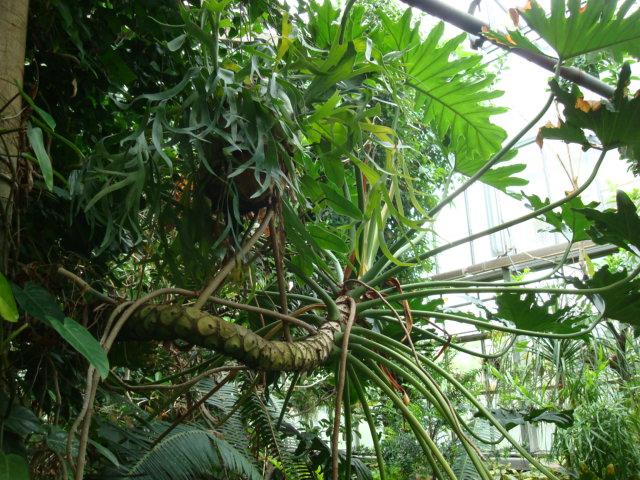
Tree philodendron (Philodendron bipinnatifidum, also classified as Thaumatophyllum bipinnatifidum) is a semi-woody evergreen native to the tropical rainforests of Brazil, Bolivia, Argentina, and Paraguay. It produces massive, deeply dissected leaves that emerge from a thickened central trunk marked by circular leaf scars.
Living indoors with this species demands substantial floor space, as a mature specimen easily spreads 1.5 to 2.5 m (5 to 8 ft) wide. Without adequate light and room to expand, the heavy petioles stretch horizontally and dominate walkways.
Key Facts
- Light: Bright indirect light or filtered morning sun
- Water: Soak thoroughly when top 5 cm (2 in) dries
- Soil: Coarse aroid mix with bark and perlite
- Temperature: 18–29 °C (65–85 °F)
- Toxicity: Toxic to humans and domestic pets
- Growth rate: Moderate, adding 3–5 leaves annually
Living with Tree Philodendron
Tree philodendron demands at least 2 square metres (21 sq ft) of dedicated open floor space to accommodate its wide canopy indoors. It suits growers with high ceilings and wide living areas, rather than compact apartment shelving. The architectural foliage casts dense shade underneath, so position it where it will not shade smaller house companions.
The single habit that keeps this plant structurally sound indoors is quarterly rotation. The heavy leaf blades lean aggressively toward the primary window, which pulls the upright trunk off-centre over time. Give the container a quarter-turn every month to prevent structural toppling.
Identifying Features and Botanical Form
You can identify this plant by its thick, trunk-like stem covered in distinctive eye-shaped leaf scars left by fallen petioles. Leaf blades measure 60–120 cm (24–48 in) long and carry deep, sinuous margins that cut almost to the central midrib. The fleshy petioles reach up to 1.5 m (5 ft) in length and support sprawling, ruffly foliage.
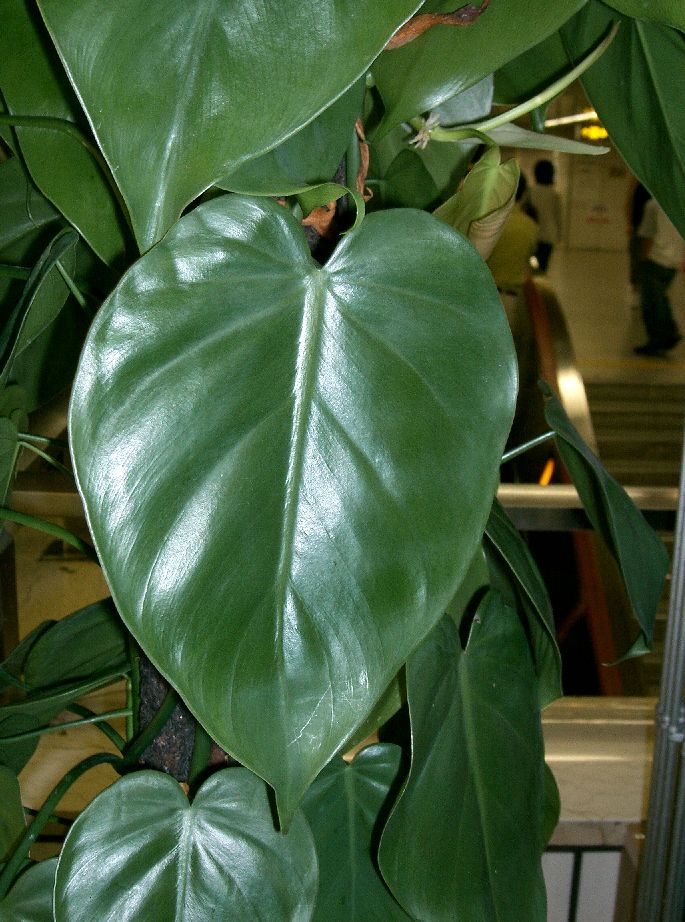
Stout, brown aerial roots emerge along the trunk and anchor into topsoil or wrap around containers. Mature trunks become semi-woody and upright, distinguishing this species from creeping vines such as heartleaf philodendron (Philodendron hederaceum). While juvenile foliage is entire and arrow-shaped, adult leaves show intricate bipinnatifid margins.
Light Requirements for Tree Philodendron
Position tree philodendron in bright, indirect sunlight for 6 to 8 hours daily. An unobstructed east-facing window or a position 2 m (6.5 ft) back from an exposed south- or west-facing window provides optimal photon levels without scorching delicate leaf margins.
Inadequate illumination causes noticeable physical deterioration:
- Petioles become weak and stretch horizontally toward light sources
- New leaves emerge small without the characteristic deep lobes
- Trunk growth stalls and aerial root production ceases
- Direct midday summer sun bleaches patches into yellow or white dry scars
How Often to Water Tree Philodendron
Water tree philodendron thoroughly once the top 5 cm (2 in) of potting soil feels completely dry. Saturate the root ball until excess liquid flows freely from the drainage holes, then discard all runoff after 15 minutes. In average home conditions, this equates to watering every 7–10 days during warm months and every 14–21 days in midwinter.
Turgid petioles hold substantial moisture, making the plant far more tolerant of brief drought than sustained waterlogging. Submerged root zones suffocate fine feeder roots, causing rapid lower foliage yellowing. Always insert a clean wooden skewer or moisture probe into the bottom third of the pot before adding water.
Best Potting Soil and Drainage Mix
Tree philodendron requires a coarse, chunky potting mix with a pH between 5.5 and 6.8 that allows rapid oxygenation. Standard potting compost packs down too tightly under regular watering, which chokes the thick root system.
Combine the following components for an ideal root environment:
- 40% premium peat-free potting compost or coconut coir
- 30% medium-grade orchid bark chips
- 20% perlite or coarse pumice
- 10% horticultural charcoal or aged worm castings
Temperature and Humidity Needs
Keep indoor temperatures between 18 °C and 29 °C (65–85 °F) with ambient humidity above 40%. Temperatures below 13 °C (55 °F) cause leaf drop and tissue damage, while heating drafts cause crisp brown margins on developing leaves.
While it tolerates average indoor humidity better than thin-leaved tropicals, higher levels encourage faster leaf unfurling. Position an ultrasonic room humidifier nearby or cluster it with large-leaved specimens like fiddle-leaf fig (Ficus lyrata) to raise local moisture.
Fertilizing Tree Philodendron Plants
Apply a balanced liquid houseplant fertilizer diluted to half-strength every four weeks from April through September. Use a standard 20-20-20 or 10-10-10 formulation with essential micronutrients including magnesium and iron.
Cease all feeding during late autumn and winter when natural daylight hours decline and metabolic activity slows. Excessive salts from chemical feeds build up rapidly in coarse substrate; flush the pot with pure water through the sink or shower twice per year to clear residual deposits.
How to Propagate Tree Philodendron
The most reliable method to propagate mature specimens is air layering or rooting basal trunk offshoots in warm conditions. Stem cuttings from old trunks rarely take without a piece of viable node and multiple intact aerial root initials.
To establish a new plant from a side shoot or basal pup:
- Sever a rooted basal offset from the parent trunk using a clean, sharp knife in late spring
- Dust the cut surface with powdered sulfur or ground cinnamon to inhibit pathogens
- Pot the offset into moist, loose potting substrate amended with 50% perlite
- Enclose the pot loosely in clear plastic at 22–26 °C (72–79 °F) until new shoot buds emerge
Common Tree Philodendron Problems and Pests
Check the underside of leaf lobes for spider mites, mealybugs, and brown scale insects every two weeks. Pests cluster along the major vascular veins, causing mottled chlorosis and sticky honeydew excretions.
Treat outbreaks by spraying all surfaces with insecticidal soap or a 0.5% horticultural neem solution twice weekly. Physical leaf tears, yellow halos from overwatering, and lower leaf drop from low light represent common non-pest culture issues.
Is Tree Philodendron Toxic to Cats and Dogs?
Tree philodendron is toxic to cats, dogs, and humans if any part of the leaf or stem is ingested. All tissues contain sharp, microscopic needle-like bundles called raphides composed of insoluble calcium oxalate crystals.
Chewing foliage releases these crystals into the mouth and pharynx, leading to severe clinical signs:
- Immediate burning sensation of the mouth, tongue, and throat
- Excessive drooling and pawing at the mouth in cats and dogs
- Swelling of the lips and upper airway
- Vomiting and transient loss of appetite
Tree Philodendron Flower and Fruit Indoors
Flowers rarely appear on indoor specimens, but mature outdoor plants produce a thick spadix enclosed by a green-and-cream spathe up to 30 cm (12 in) long. The inflorescence demonstrates thermogenesis, generating internal heat up to 38 °C (100 °F) during evening anthesis to volatilize scents and attract pollinating dynastine scarab beetles.
Fertilized inflorescences develop into a clustered, compound green fruit that ripens to a pale ivory syncarp. The pulp emits an aromatic, pineapple-like scent when completely ripe in tropical settings, though unfertilized indoor blooms simply turn brown and drop.
Tree Philodendron Care Through the Seasons
| Spring | Inspect root system and repot if roots circle the container base. Resume monthly half-strength feeding and wash dust off broad leaf blades using a damp sponge. |
|---|---|
| Summer | Water thoroughly once the top 5 cm (2 in) of soil dries. Provide active ventilation and monitor weekly for spider mites during dry, hot weather spells. |
| Autumn | Move plants away from cold draughts and drafty exterior doors. Reduce fertilizer frequency to zero by late October as day length drops. |
| Winter | Allow soil to dry deeper between waterings, roughly every 14–21 days. Position closer to bright window glass to capture lower winter sun angles. |
Diagnosing Common Tree Philodendron Problems
| What you see | Likely cause | What to do |
|---|---|---|
| Lower leaves turn entirely yellow and drop | Overwatering or waterlogged soil around the root crown | Allow the top 7 cm (3 in) of soil to dry out and ensure drainage holes flow freely. |
| Brown, crispy margins on leaf lobes | Low ambient humidity combined with warm dry radiator air | Run an ultrasonic humidifier to keep relative humidity above 45% and move away from heat vents. |
| Long, weak petioles leaning toward the window | Insufficient light exposure causing etiolation | Relocate to an east-facing window or install an overhead full-spectrum LED grow light. |
| Pale, bleached patches on upper leaf surfaces | Direct scorching from unshaded midday sun | Filter window light with a sheer curtain or move the plant 1 m (3 ft) backward. |
| Fine webbing beneath deep leaf clefts | Spider mite infestation in dry air | Rinse leaves under a tepid shower and spray surfaces with insecticidal soap every 5 days. |
Tree Philodendron Cultivars and Related Selections
- ‘Super Atom’ – compact dwarf form reaching 40 cm height
- ‘Hope’ – intermediate selection with denser branching and upright petioles
- ‘Little Hope’ – miniature cultivar suited to medium tabletop pots
- ‘Xanadu’ – related species often sold alongside, showing narrower leaves
Frequently Asked Questions
What is the difference between tree philodendron and monstera?
Tree philodendron develops a thick, self-supporting trunk with eye-shaped leaf scars and has ruffly, wavy leaf lobes, whereas Swiss cheese plant (Monstera deliciosa) is a climbing vine that produces oval leaves with internal holes (fenestrations) and flat edges.
What is the correct scientific name for tree philodendron?
The accepted botanical name was long classified as Philodendron bipinnatifidum, but molecular phylogenetics reassigned it to Thaumatophyllum bipinnatifidum; both names remain widespread in the nursery trade.
Can tree philodendron grow outdoors?
Yes, tree philodendron thrives outdoors year-round in frost-free regions across USDA hardiness zones 9b through 11, where it forms an expansive landscape shrub under partial shade.
Can you propagate tree philodendron from a single leaf cut?
No, a leaf cut at the petiole cannot generate new growth points. Propagation requires a segment of the central trunk with active nodes or a rooted basal offset.
Why is my tree philodendron weeping water droplets from the leaf tips?
This droplet weeping is called guttation, a natural process where uninjured leaves exude excess water through specialized pores called hydathodes after the plant takes up moisture from saturated soil overnight.
Sources & Verification
Taxonomy and distribution are checked against the databases below. Care guidance is written for cultivated species only and reviewed by our editor. How We Build Plant Profiles →
- Kew Plants of the World OnlineTaxonomy and distribution for Philodendron bipinnatifidum Schott
- NC State Extension Gardener Plant ToolboxMorphology, landscape cultural data, and toxicity profile
- ASPCA Animal Poison ControlClinical toxicity signs and toxic chemical compounds
- GBIF — Global Biodiversity Information Facilitytaxonomy, synonyms, occurrence records
- Wikipediageneral reference