
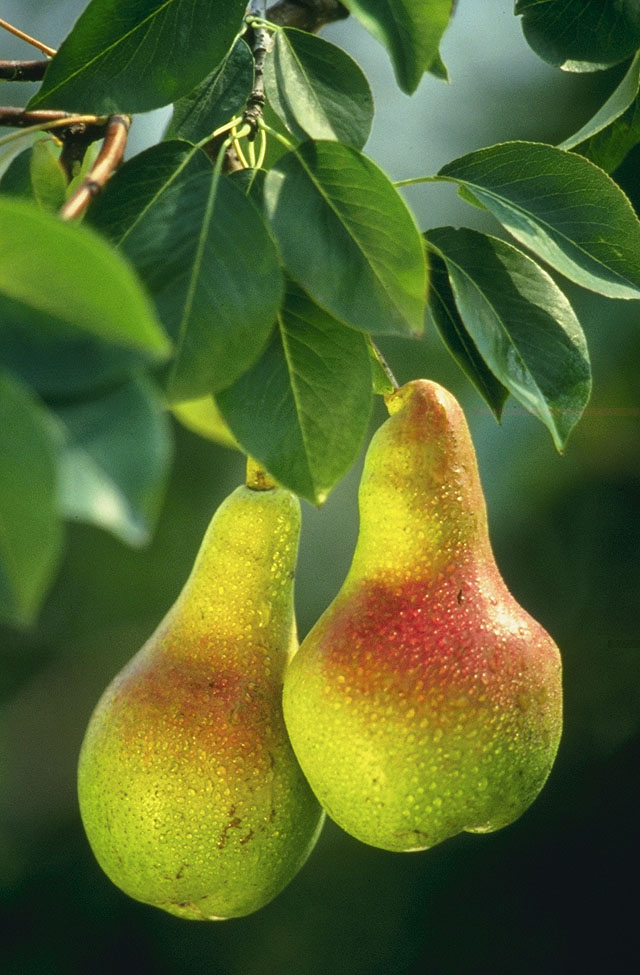
European pear (Pyrus communis) is a deciduous fruit tree native to central and eastern Europe and western Asia, recognised by its glossy foliage and teardrop-shaped fruit. Its clusters of snow-white blossoms appear in mid-spring alongside early spring pollinators.
Unlike apples, the fruit matures on the wood but must finish ripening off the tree in cold storage to prevent a gritty, mealy core. Most cultivars require a cross-pollination partner flowering in the same bloom group to set an edible crop.
Key Facts
- Light: Full sun, minimum 6 hours daily
- Height: 3 to 12 m (10 to 40 ft)
- Chill hours: 600 to 1,000 hours below 7 °C (45 °F)
- Soil pH: 6.0 to 7.0
- Ripening rule: Harvest firm; ripen off the tree
Is European Pear Tree Right for Your Garden?
Growing European pear requires a compatible pollination partner and at least 600 chilling hours below 7 °C (45 °F) to break winter dormancy. While partially self-fertile cultivars exist, cross-pollination from a partner in an overlapping flowering group increases fruit set and yields well-formed crops.
You should consider your spatial boundaries before selecting a rootstock. Trees grafted onto dwarfing rootstocks such as Quince C (Cydonia oblonga) fit smaller plots and bear fruit within 3 to 4 years, whereas standard seedling roots require ample perimeter clearance and take 6 to 8 years to crop.
- Requires 600 to 1,000 chilling hours each winter
- Needs an overlapping pollination partner for heavy crops
- Dwarf rootstocks bear in 3 to 4 years; standards take up to 8 years
- Poorly suited to subtropical areas with mild, frost-free winters
European Pear Botanical Features and Flowers
European pear trees produce white, five-petaled flowers with distinctive purple-red anthers in corymbs of 5 to 7 blooms before foliage fully unfurls. The blossom petals measure 2.5 to 3 cm (1 to 1.2 in) across and emit a light, slightly musky scent that attracts bumblebees and solitary bees.
The deciduous leaves are alternate, simple, and ovate to elliptic, measuring 4 to 10 cm (1.6 to 4 in) long with finely serrated margins. Foliage turns orange or bronze in autumn before leaf drop.
The fruit is a classic pyriform pome, tapering noticeably toward the stem end with rounded bases. The skin varies from green and yellow to russet or red-blushed, holding firm flesh embedded with grit cells known botanically as brachysclereids.
European Pear Tree Size and Lifespan
Standard European pear trees reach heights of 9 to 12 m (30 to 40 ft) with a 6 to 8 m (20 to 26 ft) spread, but rootstock selection dictates true garden dimensions. Dwarfing rootstocks cap mature growth at manageable, accessible heights for backyard harvesting.
Rootstock categories determine mature dimensions:
- Dwarfing (Quince C): 2.5 to 3 m (8 to 10 ft) height; ideal for small gardens and cordons
- Semi-dwarfing (Quince A, OHxF 87): 3.5 to 4.5 m (12 to 15 ft) height; suited for freestanding bush forms
- Semi-vigorous (OHxF 333): 4.5 to 6 m (15 to 20 ft) height; handles poorer soils well
- Standard (Pyrus communis seedling): 9 to 12 m (30 to 40 ft) height; massive orchard canopy
European pear trees have an exceptional lifespan, frequently producing crops for 50 to 100 years. Certain heirloom specimens on standard roots survive for more than 250 years under attentive orchard management.
Where to Plant European Pear
Site European pear trees in full sun with deep, moisture-retentive, well-draining soil sheltered from harsh prevailing winds. Trees require a minimum of 6 to 8 hours of unfiltered sunlight daily to ripen wood and develop sweet fruit.
Pears tolerate heavier, clay-rich substrates better than stone fruits or apples, but standing winter water causes root rot. Avoid low-lying frost pockets where cold air pools on early spring nights, as open blossoms suffer damage at -2 °C (28 °F).
Space trees according to their rootstock: dwarf trees need 2.5 to 3 m (8 to 10 ft) between trunks, while standard trees demand 6 to 8 m (20 to 26 ft) of separation from structures and neighboring canopies.
How to Plant European Pear Trees
Plant bare-root pear trees during late autumn through early spring while the tree is dormant, provided the ground is neither frozen nor waterlogged. Container-grown specimens can enter the ground at any point outside heatwaves if given attentive irrigation.
Prepare a circular planting area cleared of lawn grass and perennial weeds in a 1 m (3.3 ft) radius. Follow these planting steps:
- Soak bare roots in non-chlorinated water for 2 hours before planting.
- Spread the root system naturally across firm native soil without coiling.
- Ensure the graft union sits 7.5 to 10 cm (3 to 4 in) above the finished soil level.
- Backfill using native topsoil, firming gently with your heel to eliminate air pockets.
- Install a low stake angled at 45 degrees, securing it to the lower third of the trunk.
- Apply 20 litres (5 gal) of water and cover with 7.5 cm (3 in) of wood chip mulch.
European Pear Tree Care and Watering
Young pear trees need 25 to 40 litres (6.5 to 10.5 gal) of water per week throughout their first two growing seasons whenever weekly rainfall drops below 2.5 cm (1 in). Mature trees require irrigation only during extended summer droughts while fruit expands.
Over-fertilizing with nitrogen causes rapid, succulent shoot growth that invites fireblight infections. Top-dress mature trees in early spring with a balanced organic fruit fertilizer supplying 50 g of nitrogen per year of tree age, capped at 500 g total.
Maintain an organic mulch ring 7.5 cm (3 in) deep extending to the canopy dripline. Keep the wood chips 10 cm (4 in) clear of the trunk bark to deter vole gnawing and fungal collar rot.
Pruning and Training European Pear Trees
Prune European pear trees in late winter between January and early March while the wood remains fully dormant. Winter pruning controls height, admits sunlight into the canopy interior, and stimulates new fruiting spurs.
Pears display strong apical dominance and naturally grow upright, producing narrow branch angles prone to splitting. Follow this pruning checklist:
- Remove all dead, diseased, crossing, and vertically crowded branches at the collar.
- Thin out vigorous upright water sprouts from the interior framework.
- Spread main scaffold branches to a 45-to-60-degree angle using limb spreaders.
- Shorten leading branch shoots by one-third to an outward-facing bud to encourage spurs.
- Perform light summer thinning in July to remove unbranched current-season water shoots.
European Pear Rust, Fireblight, and Pests
The two most destructive afflictions on European pear are European pear rust and fireblight, both causing widespread leaf blemish and branch dieback. Regular canopy inspection allows early mechanical removal before pathogens colonize woody framework.
European pear rust (Gymnosporangium sabinae) requires both pear and evergreen junipers, such as Eastern redcedar (Juniperus virginiana), to complete its life cycle. It creates bright orange spots on upper leaf surfaces in early summer, followed by gall-like fruiting pustules underneath.
Fireblight (caused by the bacterium Erwinia amylovora) enters through open spring blossoms, causing shoots to blacken, wilt, and hook over into a shepherd’s crook. Prune infected stems immediately 30 cm (12 in) below visible damage, sterilizing pruning shears between every single cut with 70% isopropyl alcohol.
Winter Hardiness and Spring Frost Protection
European pear trees tolerate dormant winter lows of -25 to -30 °C (-13 to -22 °F) across USDA zones 4 through 8 without structural injury. The greater seasonal hazard occurs during spring bud swell, when freezing temperatures kill developing floral pistils.
Dormant flower buds withstand cold snaps, but green cluster and white bud stages tolerate only -3.8 °C (25 °F). Open blossoms suffer complete loss at -2.2 °C (28 °F).
Protect small or espaliered trees from forecasted late spring frosts by draping horticultural fleece over the canopy before dusk, securing it at the ground line. Remove protective coverings early the next morning so bees can access open flowers for cross-pollination.
Harvesting, Ripening, and Culinary Uses
European pears are edible pomes that must be picked mature green and ripened off the tree to achieve a melting, buttery texture. If left to ripen on the branch, enzymes break down internal cell walls, causing the flesh around the core to turn brown and mealy.
Harvest occurs between late August and October depending on the cultivar. To test readiness, cup the pear in your palm, lift horizontally to a 90-degree angle, and give a gentle twist; a mature pear detaches cleanly at the abscission notch without breaking the woody spur.
Chill harvested pears at 0 to 4 °C (32 to 40 °F) for a chilling period: 1 to 2 weeks for early varieties, and up to 4 weeks for late-winter storage types. Bring them into room temperature (18 to 21 °C / 65 to 70 °F) for 4 to 7 days before eating raw, poaching, canning, or baking.
Frequently Asked Questions
What is the difference between European pear and Asian pear?
European pear (Pyrus communis) has a pyriform teardrop shape, soft melting flesh, and must be ripened off the tree after a cold period. Asian pear (Pyrus pyrifolia) is round, crisp like an apple, and ripens to full eating quality directly on the branch.
Are European pears edible directly from the tree?
No, European pears should not be eaten soft directly from the tree because they ripen from the inside out, becoming brown, mushy, and gritty at the core. Pick them while firm and allow them to finish ripening at room temperature.
How do you ripen European pears at home?
Place firm, chilled pears in a paper bag at room temperature (18 to 21 °C / 65 to 70 °F) for 3 to 7 days. Adding a banana or apple to the bag releases ethylene gas, accelerating the softening process.
What are the nutritional benefits of European pears?
European pears provide dietary fiber (roughly 6 g per medium fruit), vitamin C, potassium, and copper, with traditional uses including soothing digestive discomfort. Most of the polyphenol antioxidants reside within the outer skin.
When should you pick European pears?
Pick pears when their background skin color shifts from dark green to yellowish-green and the fruit detaches cleanly when lifted horizontally. Firmness testers typically register 6.5 to 7.5 kg (14 to 16 lbs) of pressure at harvest maturity.
Information about traditional or historical uses is provided for educational interest only and is not medical advice. Do not use any plant to treat a condition without speaking to a qualified professional.
Sources & Verification
Taxonomy and distribution are checked against the databases below. Care guidance is written for cultivated species only and reviewed by our editor. How We Build Plant Profiles →
- Kew Plants of the World OnlineTaxonomic status and native distribution of Pyrus communis.
- Royal Horticultural SocietyCultivation, pruning groups, and rootstock standards.
- Missouri Botanical GardenHardiness, cultural requirements, and botanical characteristics.
- NC State ExtensionPest vulnerability and landscape management profile.
- GBIF — Global Biodiversity Information Facilitytaxonomy, synonyms, occurrence records
- Wikipediageneral reference


