

Jolcham oak (Quercus serrata) is a deciduous broadleaf tree native to China, Japan, Korea, Taiwan, Myanmar, Bangladesh, and the eastern Himalayas. It features glandular serrations along its leaf margins and rounded greyish-brown acorns.
This tree grows in well-drained woodland soils and serves as a major source of wood logs for shiitake mushroom cultivation in East Asia. It requires space for a broad canopy and flowers in early spring during leaf expansion.
Key Facts
- Light requirement: full sun to partial shade
- Mature height: 15 to 25 m (50 to 80 ft)
- Soil pH: 5.5 to 6.8 (acidic to neutral)
- USDA hardiness: zones 5 through 9
- Water need: moderate during initial root establishment
Is Jolcham Oak Right for Your Landscape?
Plant Jolcham oak when you need a long-lived shade tree with strong winter hardiness across USDA zones 5 through 9. It requires a planting site that accommodates a wide canopy spread over several decades.
This species works well in large gardens, parks, and forestry plots. It tolerates wind and moderate cold once established. It is less suited to small residential yards due to its mature root footprint.
Identifying Quercus serrata Leaf and Bark Features
A typical Quercus serrata leaf measures 7 to 17 cm (2.8 to 6.7 in) long and 3 to 9 cm (1.2 to 3.5 in) wide with small glandular teeth along the edge. The leaf surface is bright green above and paler beneath, turning warm yellow or brownish-orange in autumn.
Key botanical identification points include:
- Leaf shape: obovate to oblong-elliptic with 7 to 12 pairs of vein veins
- Teeth: distinctive glandular tips on every leaf serration
- Acorns: egg-shaped, 1.5 to 2 cm (0.6 to 0.8 in) long, sitting in small cupules
- Bark: dark greyish-brown with vertical furrows on older trunks
Mature Size and Canopy Spread of Konara Oak
A healthy Jolcham oak reaches a height of 15 to 25 m (50 to 80 ft) with a broad canopy spanning 10 to 18 m (33 to 60 ft). In open sun, it develops a rounded crown anchored by a sturdy main trunk up to 1 m (3.3 ft) in diameter.
Annual growth averages 30 to 50 cm (12 to 20 in) under optimal soil and moisture conditions. Forest specimens grow taller with narrower crowns, while specimen trees in open sites develop wide branch spreads.
Best Sun and Soil Conditions for Jolcham Oak Tree
Position this species in a spot receiving at least 6 hours of direct sunlight every day. Soil should be well-drained with a pH range between 5.5 and 6.8.
It adapts to acidic loam, sandy clay, and rocky mountain slopes. Waterlogged soils lead to root decay, so ensure water drains freely after heavy rains.
How to Plant Quercus serrata Seeds and Saplings
Sow fresh Quercus serrata seeds 2 to 3 cm (1 in) deep outdoors in autumn immediately after collection. Seeds require cold stratification at 2 to 5 °C (35 to 41 °F) for 60 to 90 days to break dormancy if stored until spring.
When planting nursery-grown saplings, follow these steps:
- Dig a hole twice as wide as the root ball and equal in depth
- Keep the root collar strictly level with the surrounding soil line
- Backfill with native soil without adding heavy fresh fertilizers
- Water deeply with 20 L (5 gal) of water to settle air pockets
- Apply a 5 to 7 cm (2 to 3 in) layer of wood chip mulch around the base
Watering and Soil Care for Quercus serrata
Water young saplings with 15 to 20 L (4 to 5 gal) of water per week during their first two growing seasons whenever rainfall falls below 2.5 cm (1 in). Established trees require no supplemental watering except during extended droughts.
Apply topdressing mulch annually in spring to suppress weeds and retain ground moisture. Deep watering during summer dry spells maintains leaf color into autumn.
Pruning and Structural Maintenance for Konara Oak
Prune branches only during late winter while the tree is dormant to limit sap loss and prevent pathogen entry. Remove dead, diseased, or crossing limbs to maintain a clear central leader.
Avoid heavy topping or summer pruning. Clean cuts near the branch collar heal efficiently without requiring artificial pruning sealants.
Common Pests and Diseases of Jolcham Oak
Watch for leaf-galls, aphids, and oak wilt fungus (Bretziella fagacearum) which can affect susceptible specimens. Inspect foliage in early summer for signs of feeding or spotting.
- Powdery mildew: causes white dusty patches on late-season leaves; clear fallen leaves in autumn
- Oak lace bugs: cause yellow stippling on leaf upper surfaces; spray with strong water streams
- Acorn weevils: bore holes into developing acorns; dispose of fallen infested nuts
Winter Hardiness and Cold Protection
Mature Jolcham oak trees withstand winter temperatures down to -23 °C (-10 °F) without stem damage. Young saplings benefit from trunk wraps in zones 5 and 6 during their first two winters to prevent frost cracks.
Ensure soil has adequate moisture before the ground freezes in late autumn. Mulching protects surface feeder roots from winter heave in freezing weather.
Timber, Shiitake Cultivation, and Quercus serrata Uses
In East Asian forestry, logs cut from Quercus serrata serve as the primary traditional medium for growing shiitake mushrooms (Lentinula edodes). The wood density and bark adhesion make it optimal for fungal spawn inoculation.
The durable heartwood is harvested for furniture, building timber, charcoal production, and high-grade firewood. Acorns provide an autumn food source for wild birds, small mammals, and deer.
Konara Oak Care Through the Seasons
| Spring | Inspect emerging leaves for aphids and caterpillars. Apply a 5 cm (2 in) layer of organic mulch around the base, keeping it 10 cm (4 in) away from the trunk bark. |
|---|---|
| Summer | Water young saplings with 20 L (5 gal) of water every 7 to 10 days during dry spells. Check leaves for signs of lace bug feeding or leaf spots. |
| Autumn | Collect fallen acorns for propagation or disposal. Deeply water the root zone once before the ground freezes solid in cold climates. |
| Winter | Prune structural branches, deadwood, and suckers while the tree is fully dormant. Check trunk wraps on young trees for rodent or winter damage. |
Jolcham Oak Health and Disease Diagnosis
| What you see | Likely cause | What to do |
|---|---|---|
| White powdery coating on foliage | Powdery mildew fungal infection in late summer | Improve air circulation through light winter pruning and rake up fallen autumn leaves. |
| Yellow speckling on leaf upper surfaces | Oak lace bugs feeding on undersides | Spray undersides of leaves with direct jets of water or insecticidal soap. |
| Small holes in harvested acorns | Acorn weevil larval emergence | Destroy infected acorns immediately after drop to interrupt the insect life cycle. |
| Cracking along lower trunk bark | Rapid freeze-thaw temperature changes in winter | Wrap trunks of young trees with commercial tree guard paper during autumn. |
Recognized Quercus serrata Varieties
- Quercus serrata var. brevipetiolata – short-petioled natural variety native to eastern China
- Quercus serrata ‘Variegata’ – rare nursery cultivar with cream-variegated spring leaves
Frequently Asked Questions
What is the common name for Quercus serrata?
The primary English common names are Jolcham oak and Konara oak, often referred to as bao li in China and ko-nara in Japan.
Which botanical family does Quercus serrata belong to?
It belongs to the Fagaceae family, which encompasses oaks, beeches, and chestnuts.
How do you germinate Quercus serrata seeds?
Sow fresh acorns in autumn 2 cm (0.8 in) deep in well-draining soil, or stratify them moist at 4 °C (39 °F) for 60 days before spring planting.
What is Quercus serrata var. brevipetiolata?
It is a recognized botanical variety of Jolcham oak distinguished by distinctly shorter leaf petioles, common in parts of China.
What are the primary uses of Quercus serrata?
It is used for high-quality timber, charcoal, firewood, landscape shade, and as wood logs for shiitake mushroom farming.
How does Jolcham oak differ from saw tooth oak?
Jolcham oak has smaller leaves with short glandular serrations and smaller acorns, whereas saw tooth oak (Quercus acutissima) has long hair-tipped leaf teeth and larger acorns with spiny cupules.
Sources & Verification
Taxonomy and distribution are checked against the databases below. Care guidance is written for cultivated species only and reviewed by our editor. How We Build Plant Profiles →
More in Quercus
California Black Oak
Quercus kelloggii
☀️ Full Sun 💧 Low

Algerian Oak
Quercus canariensis
☀️ Full Sun 💧 Moderate

English Oak
Quercus robur
☀️ Full Sun 💧 Moderate
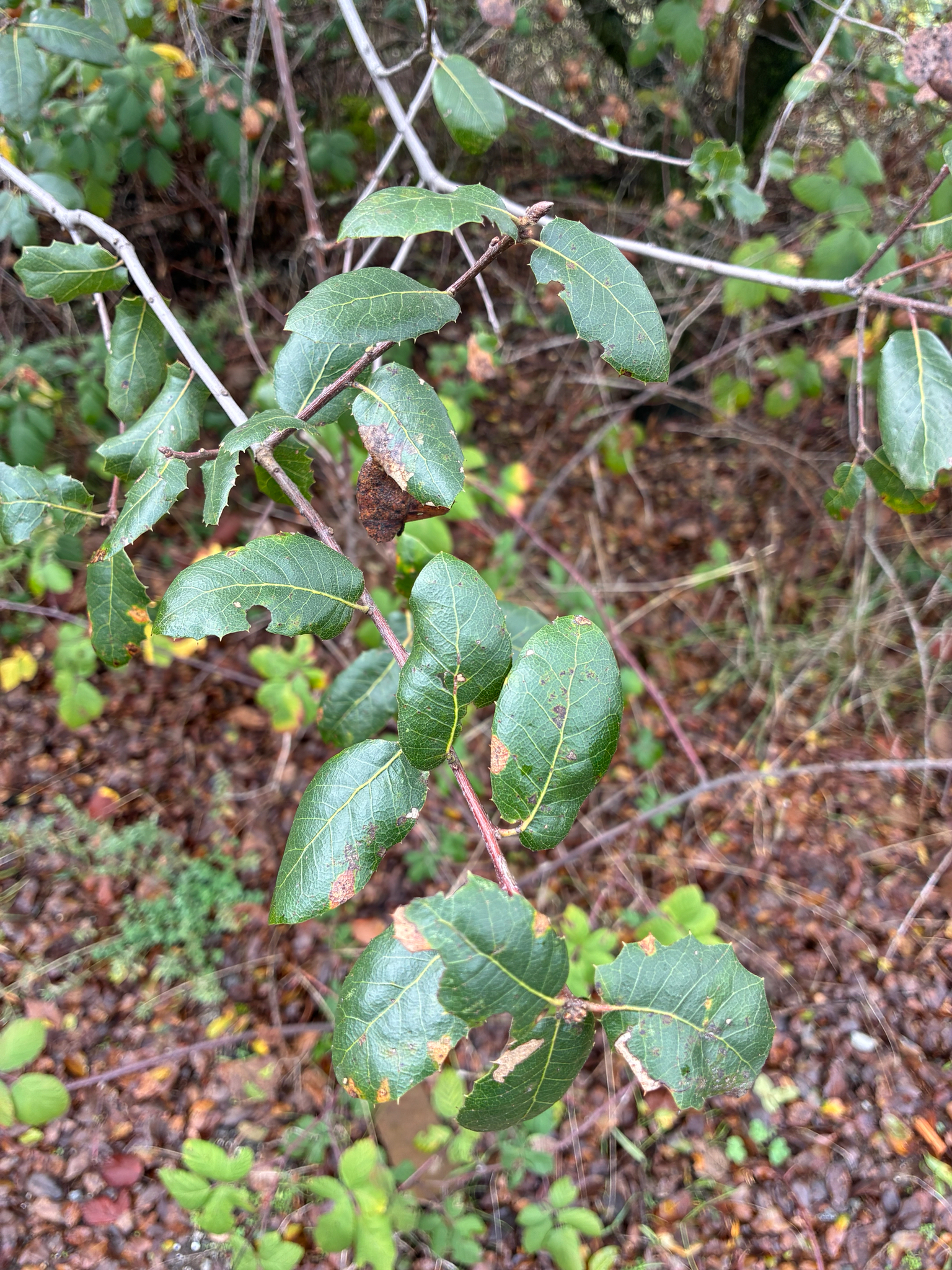
Interior Live Oak
Quercus wislizeni
☀️ Full Sun 💧 Low
Chinese Cork Oak
Quercus variabilis
☀️ Full Sun 💧 Moderate

Holm Oak
Quercus ilex
☀️ Full Sun 💧 Low