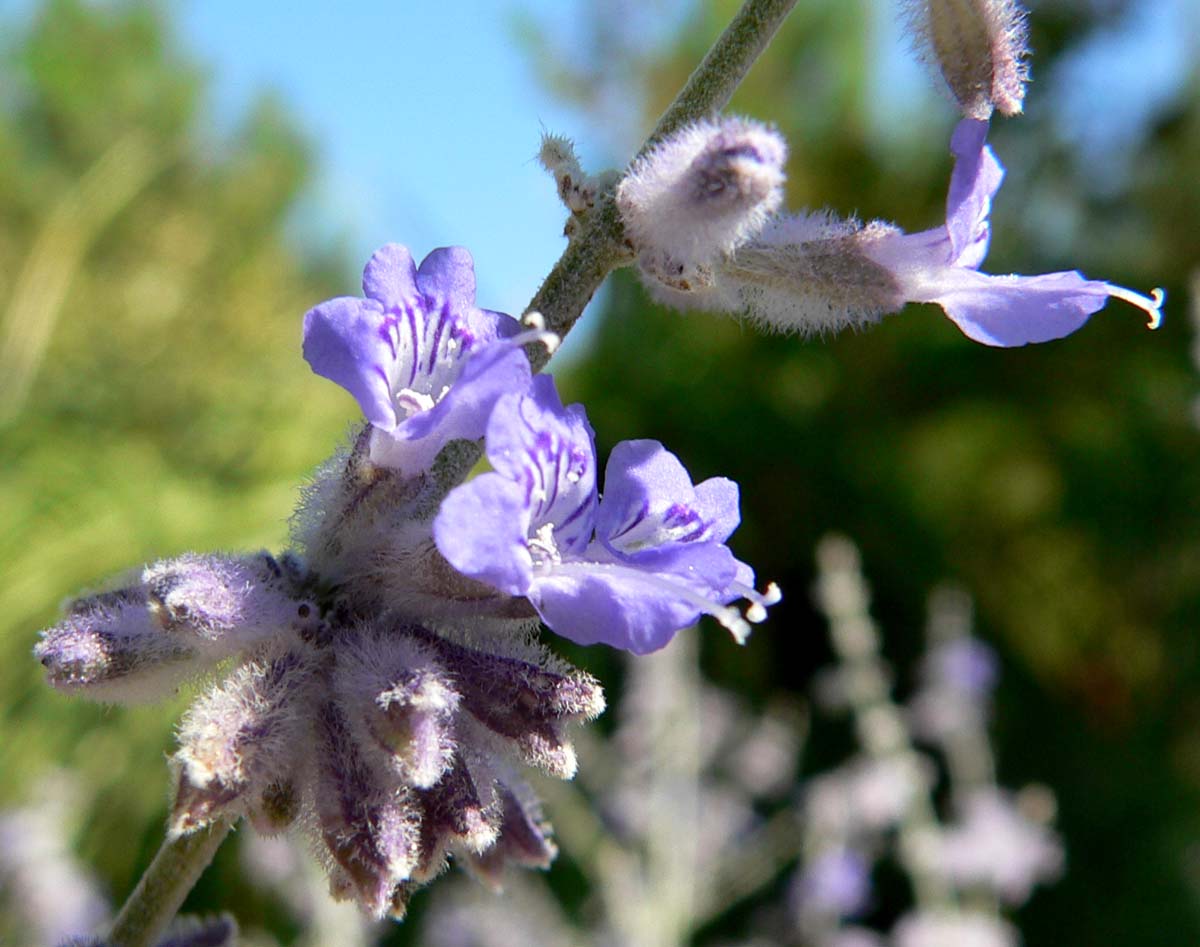
Anise-scented sage (Salvia guaranitica) is a tuberous, tender perennial subshrub native to Brazil, Paraguay, Uruguay, and Argentina, recognised by its intense cobalt-blue floral spikes held in contrasting purple-black calyces. When crushed, its textured leaves release a light liquorice fragrance.
Grown as a returning perennial in USDA hardiness zones 7b through 10, it doubles as a fast-growing annual in colder regions. Its rapid late-summer growth requires loose, free-draining soil to prevent the winter rotting of its fleshy root tubers.
Key Facts
- Light: Full sun to light afternoon shade
- Water: 2.5 cm (1 in) weekly during dry spells
- Hardiness: USDA Zones 7b to 10; tuber hardy
- Mature Size: 0.9–1.8 m (3–6 ft) high, 0.9–1.2 m (3–4 ft) wide
- Soil: Well-drained sandy loam or gravel; avoid wet clay
- Bloom Time: Mid-summer through the first hard autumn frost
Is Anise-Scented Sage Right for Your Garden?
Anise-scented sage fits sunny borders, cottage schemes, and wildlife plantings that receive at least 6 hours of direct sunlight daily. It grows at a fast rate, reaching its mature height of up to 1.8 m (6 ft) in a single season.
Because it produces nectar-rich tubular blossoms continuously from midsummer until frost, it functions as a magnet for hummingbirds, bees, and hawk moths. Gardeners with heavy, cold clay soil should grow it in large containers, as standing moisture during winter dormant periods destroys the underground tubers.
How to Identify Salvia guaranitica
You can identify Salvia guaranitica by its two-lipped, curved tubular flowers measuring 4–5 cm (1.5–2 in) long that emerge from dark purple or charcoal-black calyces. The flowers are arranged in upright terminal racemes measuring up to 25 cm (10 in) in length.
Its foliage and stem structure display distinct characteristics:
- Leaves: Ovate, wrinkled (rugose), 4–13 cm (1.5–5 in) long, with serrated margins and a pale underside.
- Aroma: Crushed leaves release an herbal anise or liquorice scent.
- Stems: Four-angled, square green stems that turn woody near the crown as the season advances.
- Roots: Thickened, fleshy underground tuberous rootstocks that spread slowly outward.
Sunlight and Soil Conditions for Blue Black Sage
Plant anise-scented sage in a site that receives full sun to partial afternoon shade. In regions with hot summers exceeding 32 °C (90 °F), dappled afternoon shade helps prevent leaf scorch and keeps the dark calyces from fading prematurely.
Soil drainage is vital for long-term survival. The plant tolerates neutral to slightly acidic soils with a pH between 6.0 and 7.5, provided water drains away rapidly.
- Incorporate coarse grit or compost into dense ground before planting.
- Avoid poorly drained sites where winter rainfall collects.
- Container plants require a potting mix cut with 25% perlite or pumice.
Planting and Spacing Anise-Scented Sage
Space young plants 90 to 120 cm (36 to 48 in) apart to allow for their bushy, spreading habit. Plant in late spring after all danger of frost has passed and soil temperatures reach at least 15 °C (60 °F).
Dig a hole twice as wide as the root ball and match the planting depth so the crown sits level with the surrounding soil surface. Water the planting hole thoroughly, apply a 5 cm (2 in) layer of shredded bark mulch to retain moisture, and keep the mulch 5 cm (2 in) away from the main stems to avoid rot.
How Often to Water and Fertilise
Give established plants approximately 2.5 cm (1 in) of water per week during the active growing season. While established specimens tolerate brief dry spells, regular irrigation keeps the flower spikes emerging without interruption.
This species requires minimal feeding; excessive nitrogen results in weak, brittle stems and reduced bloom count. Apply a balanced, slow-release granular fertiliser (such as 10-10-10) in early summer, or top-dress the root zone with 2–3 cm (1 in) of well-rotted compost each spring.
Pruning and Deadheading for Continuous Bloom
Pinch back shoot tips by 5–7 cm (2–3 in) in late spring to promote dense branching and prevent the mature plant from flopping over. Once flowering begins in July, snip spent flower spikes down to the nearest set of leaves to encourage secondary racemes.
Do not cut the woody stems down to ground level in autumn in regions where winter temperatures drop below 0 °C (32 °F). Leaving the old stems intact protects the crown and tuberous roots from winter moisture penetration. Wait until green basal shoots emerge in mid-spring before cutting back old woody growth to 10 cm (4 in) above the soil.
Propagating Salvia guaranitica from Cuttings and Seeds
Softwood stem cuttings root in 14 to 21 days, making them the most dependable propagation method. Many cultivated selections are sterile or do not come true from seed, meaning vegetative propagation preserves the exact cultivar traits.
- Softwood cuttings: Take 10 cm (4 in) non-flowering shoot tips in late summer, strip lower leaves, and insert into moist perlite or sandy potting compost.
- Tuber division: In spring, dig up mature clumps in zone 8 or warmer, slice tuberous root sections containing at least one viable eye, and replant immediately.
- Seeds: Sow true species seed indoors 8–10 weeks before the last spring frost at 20–22 °C (68–72 °F); press lightly into soil as seeds need light to germinate.
Overwintering Blue Black Sage in Cold Climates
In USDA zones 6 and colder, treat anise-scented sage as an annual or lift the tuberous roots before the first autumn freeze. Store dormant tubers in barely moist peat moss or wood shavings in a dark, frost-free location held at 4–8 °C (40–46 °F).
In marginal zones (USDA zones 7a and 7b), leave the plant in the ground and insulate the root zone. Mound 15–20 cm (6–8 in) of dry straw, shredded leaves, or bark mulch over the crown in late autumn after the first frost blackens the foliage, then pull back the mulch in mid-spring once soil warms.
Year-Round Care for Anise-Scented Sage
| Spring | Cut dead wood back to 10 cm (4 in) above ground when green basal shoots appear. Pull winter mulch away from the crown and apply a 3 cm (1 in) layer of compost. Pinch growing shoot tips when stems reach 30 cm (12 in) high. |
|---|---|
| Summer | Provide 2.5 cm (1 in) of water weekly during drought. Deadhead faded floral spikes back to lateral branch junctions. Take 10 cm (4 in) softwood cuttings in late summer for overwintering indoors. |
| Autumn | Allow late flowers to finish feeding migrating pollinators. In zones 7 and below, lift tubers for storage or apply a 15 cm (6 in) dry mulch layer over crowns after frost blackens foliage. Leave stems standing. |
| Winter | Inspect stored indoor tubers monthly, lightly misting packing media if shrivelling occurs. Keep outdoor crowns protected from excess winter rain with mulch and good drainage. Check potted overwintering cuttings for whiteflies. |
Anise-Scented Sage Troubleshooting and Solutions
| What you see | Likely cause | What to do |
|---|---|---|
| Stems splay open, lean, and flop to the ground | Excess soil nitrogen, over-watering, or insufficient direct sunlight | Move to an area with at least 6 hours of direct sun, eliminate nitrogen fertilisers, and pinch tips in late spring. |
| Crown fails to emerge in late spring | Tuber rot caused by cold, waterlogged winter soil | Replant in a raised bed or amend native soil with grit to improve winter drainage, and mulch heavily in autumn. |
| Yellow speckling on upper leaf surfaces with faint webbing beneath | Two-spotted spider mites during hot, dry weather | Rinse the undersides of the foliage with a firm spray of water or apply insecticidal soap in the early morning. |
| White, powdery film developing over leaves in late summer | Powdery mildew due to crowded spacing and poor air circulation | Thin out crowded stems and water strictly at the base of the plant to keep the leaves dry. |
Popular Salvia guaranitica Cultivars
- ‘Black and Blue’ – cobalt flowers, jet-black calyces, 1.5 m (5 ft) tall
- ‘Black & Bloom’ – thicker stems, darker calyces, earlier summer blooms
- ‘Purple & Bloom’ – rich violet-purple petals held in dark calyces
- ‘Plum Crazy’ – lavender-violet flowers with dark plum calyces
- ‘Argentine Skies’ – soft sky-blue flowers with pale green calyces
Best Companion Plants for Anise-Scented Sage
Combine anise-scented sage with companions that thrive in full sun and moderate moisture levels. The deep cobalt flowers create sharp visual contrast when positioned next to warm orange, yellow, and magenta tones.
- Purple coneflower (Echinacea purpurea): Coarse pink-purple petals and rigid upright structure.
- Licorice mint (Agastache rupestris): Warm copper-orange spikes with thread-like, aromatic leaves.
- Brazilian verbena (Verbena bonariensis): Airy lilac heads that weave through the heavier sage branches.
- Indian shot (Canna indica): Broad bronze or green foliage that supplies a bold tropical backdrop.
Frequently Asked Questions
Is Salvia guaranitica edible?
The flowers and foliage of anise-scented sage are non-toxic, and blossoms are sometimes used as a colourful salad garnish or steeped into light teas. However, it is cultivated primarily as an ornamental garden plant rather than a culinary herb like common sage (Salvia officinalis).
Does Salvia guaranitica attract hummingbirds?
Yes, its large, 5 cm (2 in) nectar-rich floral tubes and vivid blue hues are specifically adapted to attract hummingbirds throughout late summer and autumn.
Does Salvia guaranitica come back every year?
It returns reliably from its root tubers in USDA zones 7b through 10. In zones 6 and colder, it dies over winter unless the tubers are lifted and stored indoors before the ground freezes.
What is the difference between 'Black and Blue' and 'Black & Bloom'?
'Black & Bloom' blooms about two to three weeks earlier in the summer and develops thicker, sturdier stems that resist flopping compared to the older 'Black and Blue' cultivar.
Can you grow Salvia guaranitica from seeds?
Yes, true species seed germinates in 10 to 14 days when sown indoors under light at 20 °C (68 °F), but named cultivars like 'Black and Blue' are sterile or do not produce identical offspring from collected seed.
Sources & Verification
Taxonomy and distribution are checked against the databases below. Care guidance is written for cultivated species only and reviewed by our editor. How We Build Plant Profiles →
- Royal Horticultural SocietyRHS Award of Garden Merit and cultivation profiles
- Missouri Botanical GardenPlant finder characteristics, hardiness zones, and cultivation
- Kew Plants of the World OnlineNative distribution across South America and taxonomy
- NC State Extension Gardener Plant ToolboxHorticultural traits, landscape use, and wildlife value
- GBIF — Global Biodiversity Information Facilitytaxonomy, synonyms, occurrence records
- Wikipediageneral reference